️Updates from the first-round action at Royal Birkdale️Official leaderboard | R&A gets tough | And mail usBob Mac aside, it’s still a wee while until some of the more fancied stars take to the course. Time for a little scene setting, then. Ladies and gentlemen, on the tee, Ewan Murray …A fast start for Bob MacIntyre! He sends his opening tee shot into the rough down the left, and only just finds the front of the green with his second. But he rolls in a 45-footer and birdie is not a bad way to start the week! Oban’s finest already has three top-ten finishes at the Open on his resumé, including a tie for seventh at Portrush last year. Keep an eye out. Continue reading...
-
Kris Jenner's mother Mary Jo dies aged 91
Mary Jo 'MJ' Campbell was featured on multiple episodes of Keeping Up with the Kardashians over the years.
General Source
-
Root's 99 not out helps England win to level series
An improved England beat India by four wickets to set up an ODI series decider at Lord's on Sunday.
General Source
-
The Open 2026: Rory McIlroy makes slow start, Suber takes early lead at Birkdale – live
️Updates from the first-round action at Royal Birkdale️Official leaderboard | R&A gets tough | And mail usBob Mac aside, it’s still a wee while until some of the more fancied stars take to the...
General Source
-
England v India: second men’s one-day cricket international – as it happened
Joe Root denied a hundred but masterclass eases England to a four wicket victory at Sophia Gardens and levels the series3rd over: India 17-0 (Rohit 9, Gill 6) Archer continues, pitching full,...
General Source
Joe Root denied a hundred but masterclass eases England to a four wicket victory at Sophia Gardens and levels the series3rd over: India 17-0 (Rohit 9, Gill 6) Archer continues, pitching full, finding swing, troubling both these master batters. Then he goes short, rushing Rohit into a top edge, and the catch is dropped by Gus Atkinson at long leg. Archer has been so unlucky, in all formats, since he returned from the IPL.2nd over: India 11-0 (Rohit 4, Gill 6) Another lesson from Tuesday might be: don’t stray onto Shubman’s pads. Saqib Mahmood gives him a straight half-volley and pays the price as Gill’s wrists do the rest. But Saqib too finds the edge of Gill’s bat as another controlled nick squirts away for a single. Rohit comes to the party with a languid push for three, well retrieved by Harry Brook, two inches from the Toblerone. Dinesh Karthik reckons it should have been given as a four, so bear it in mind if England win off the last ball. Continue reading...
-
At least one dead as life-threatening flash floods and storms hit central Texas
Flash flood emergencies were issued on Thursday for parts of Kerr and Uvalde counties and Texas Hill CountrySign up for the Breaking News US newsletter email At least one person has died during...
General Source
Flash flood emergencies were issued on Thursday for parts of Kerr and Uvalde counties and Texas Hill CountrySign up for the Breaking News US newsletter email At least one person has died during rescue operations as “life threatening” flooding takes hold in south-central Texas, where up to 20in of rain have already fallen in some areas – just one year after the same region endured catastrophic flooding that killed more than 100 people.Flash flood emergencies were issued on Thursday for parts of Kerr and Uvalde counties, where emergency crews performed water rescues, as well as areas around the Guadalupe River and the Pedernales River, according to morning updates from the National Weather Service (NWS). Continue reading...
-
Founders Fund hires former OpenAI exec Ryan Beiermeister (and not because of her Mafia skills)
Ryan Beiermeister, who demonstrated cool analysis in the Founders Fund YouTube series "Mafia," has joined the firm as a partner.
Business Source
-
Some England players disappointed at tactics as Tuchel questions team's DNA
BBC Sport understands that Thomas Tuchel's defensive tactics in the World Cup semi-final defeat to Argentina are being hotly debated by the England squad.
General Source
-
Rebecca Perry wins Waterstones debut fiction prize for ‘delicious and dream-like’ novel
May We Feed the King, about a museum curator and a medieval monarch, was praised by judges for its ‘crisp, cool prose’ and ‘poet’s eye for detail’Author and poet Rebecca Perry has won the 2026...
General Source
May We Feed the King, about a museum curator and a medieval monarch, was praised by judges for its ‘crisp, cool prose’ and ‘poet’s eye for detail’Author and poet Rebecca Perry has won the 2026 Waterstones debut fiction prize for May We Feed the King, praised as a “delicious and dream-like tale”.Chosen from a shortlist of six novels, May We Feed the King follows a present-day curator whose job is to dress rooms in historic houses. (“When you see a replica feast scene in the great hall of an old building, I am the person who placed the pomegranates beside the pie.”) They become increasingly obsessed by the subject of their latest commission, a medieval king whose own story about his reluctance to rule unfolds in parallel. Continue reading...
-
Energy drinks to be banned for under-16s in England from April
It will be illegal to sell high-caffeine beverages to under-16s from April next year, but soft drinks with lower caffeine levels will not be affected.
General Source
-
Energy drinks to be banned from sale to under-16s in England
About 100,000 children across the country drink the high-caffeine beverages dailyHigh-caffeine energy drinks “have no place in children’s hands” and will be banned from sale to under-16s in...
General Source
About 100,000 children across the country drink the high-caffeine beverages dailyHigh-caffeine energy drinks “have no place in children’s hands” and will be banned from sale to under-16s in England from April next year under new laws designed to improve health outcomes in young people.About 100,000 children across the country currently drink high-caffeine energy drinks daily, with those in more deprived areas and households more likely to consume them, according to the government. Continue reading...
-
White House teleprompter operator accused of making $100k off Trump speech bets
A White House staffer has been accused of using inside knowledge of speeches to make nearly $100,000 on Kalshi.
General Source
-
Fifa 'assessing match reports' over Falklands banner
Fifa is "assessing the match reports" before deciding whether to punish Argentina after players held a banner in support of their country's claims to the Falkland Islands.
General Source
-
Four passes in 19 minutes: damning numbers behind England’s collapse
No successful tackles after the 63rd minute and failure to break up play through fouls also played their part in World Cup semi-final defeatThere will be coaching courses of the future that use...
General Source
No successful tackles after the 63rd minute and failure to break up play through fouls also played their part in World Cup semi-final defeatThere will be coaching courses of the future that use footage of England’s performance against Argentina to illustrate how not to defend a one-goal lead. If that sounds harsh, the data from the match justifies that stance.Many ugly statistics emerged once the postmortem began. The most damning came from OptaJoe, who noted England had 12% possession in the 30 minutes between Anthony Gordon’s goal and Argentina’s equaliser. “That is the lowest by a team to be winning for at least 10 minutes in a World Cup match in the last 60 years,” they added. Continue reading...
-
Google Vids now lets you star in your own AI videos
Google is adding personalized AI avatars to Vids that let users create videos starring a digital version of themselves, alongside Gemini Omni-powered tools for generating and editing videos from...
General Source
-
Political crisis and protests in Ukraine as Zelenskyy defends sacking defence minister
President says he had to choose ‘one side or the other’ after breakdown of relations between ministry and military leadersUkraine’s president, Volodymyr Zelenskyy, has defended his decision to...
General Source
President says he had to choose ‘one side or the other’ after breakdown of relations between ministry and military leadersUkraine’s president, Volodymyr Zelenskyy, has defended his decision to dismiss the country’s popular defence minister, Mykhailo Fedorov, and confirmed reports that relations had broken down between the ministry and the country’s top army leadership.Speaking at a press conference in Kyiv with the British prime minister, Keir Starmer, Zelenskyy said there had been a “challenging dialogue” between Fedorov – widely seen as a reformist and moderniser – and the military’s commander in chief, Col Gen Oleksandr Syrskyi. Continue reading...
-
Forest set to make £45m offer for Spurs' Bergvall
Nottingham Forest are set to make an offer of £45m for Tottenham midfielder Lucas Bergvall.
General Source
-
Arsenal close in on £34m deal for Club Brugge forward Christos Tzolis
Greece international replacement for Leandro TrossardArsenal seek defensive cover after William Saliba injuryArsenal have agreed a deal worth up to €40m (£34m) with Club Brugge to sign Christos...
General Source
Greece international replacement for Leandro TrossardArsenal seek defensive cover after William Saliba injuryArsenal have agreed a deal worth up to €40m (£34m) with Club Brugge to sign Christos Tzolis as a replacement for Leandro Trossard and will step up their attempts to sign defensive cover due to concerns that William Saliba could miss the start of the new season due to his ongoing back issues.An official bid for Tzolis, a Greece international who scored 22 goals last season and was previously targeted by Crystal Palace, has yet to be submitted but it is understood that Arsenal have verbally agreed to pay the Belgian club’s asking price. The 24-year-old is expected to have his medical in the coming days and sign a long-term contract. The former Norwich forward, who usually plays on the left flank, will be a direct replacement for Trossard after his departure for Besiktas was confirmed this week for €18m (£15.3m). Continue reading...
-
Roblox launches an AI-powered game-creation feature in its mobile app
Roblox's new "Build" feature lets users generate basic games using a single text prompt.
Technology Source
-
Vodafone settles legal claim brought by 62 former franchisees
Agreement, without admission of liability, ends 19-month high court dispute that small-business owners said left them with large debtsVodafone has settled a long-running legal claim filed by 62 of...
General Source
Agreement, without admission of liability, ends 19-month high court dispute that small-business owners said left them with large debtsVodafone has settled a long-running legal claim filed by 62 of its former franchisees who alleged the mobile phone group “unjustly enriched” itself at their expense by up to £85m.The small-business owners – some of whom said they had suffered suicidal thoughts because of the pressure exerted by the telecoms group – launched the high court claim in 2024 after running up large personal debts they said had been caused by their deals with the company. Continue reading...
-
Dog walker killer also guilty of attempted murder
A man who stabbed a dog-walker to death is guilty of attempting to kill his landlord.
General Source
-
Uber driver who killed dog walker is also found guilty of trying to murder his landlord
Dawood Safi, 28, mounted a ‘frenzied’ and deadly rampage while in the grip of a psychotic episodeAn Uber driver who stabbed a dog walker to death in a “frenzy of violence” while in the grip of a...
General Source
Dawood Safi, 28, mounted a ‘frenzied’ and deadly rampage while in the grip of a psychotic episodeAn Uber driver who stabbed a dog walker to death in a “frenzy of violence” while in the grip of a psychotic episode has also been found guilty of trying to murder his landlord.Dawood Safi, 28, killed 49-year-old Wayne Broadhurst in the random knife attack last October, just minutes after attacking his landlord, Shahzad Farrukh, and a boy of 14. Continue reading...
-
White House says Donald Trump will attend World Cup final
Infantino has said US president will hand over trophySpain v Argentina final is set for Sunday in New JerseyDonald Trump will attend Sunday’s World Cup final between Spain and Argentina, White...
General Source
Infantino has said US president will hand over trophySpain v Argentina final is set for Sunday in New JerseyDonald Trump will attend Sunday’s World Cup final between Spain and Argentina, White House press secretary Karoline Leavitt said Thursday.“We look forward to the final match on Sunday, and I know the president looks forward to attending,” Leavitt said. “This is a fitting conclusion to a tournament that showcased America’s ability to host the world on the grandest stage.” Continue reading...
-
Wheatstone to Feature Virtual Mixing Platform at IBC 2026
General Source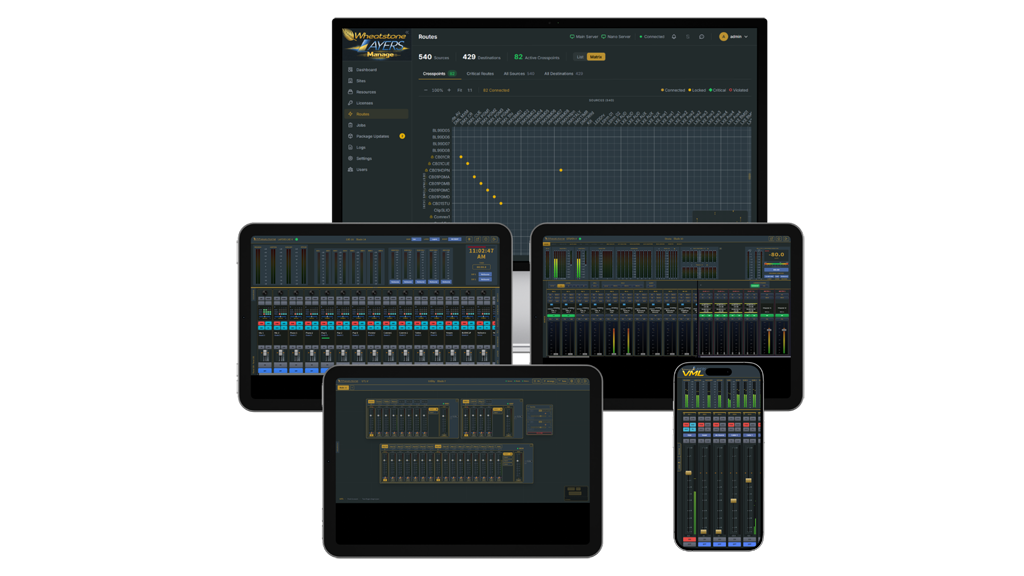
-
‘Disorderly’ intruder removed from NBC’s Today show after security breach
Unauthorized interloper was arrested after reportedly hurling racial slur at host Craig MelvinA man was arrested after breaking on to the set of NBC’s Today show on Thursday morning and allegedly...
General Source
Unauthorized interloper was arrested after reportedly hurling racial slur at host Craig MelvinA man was arrested after breaking on to the set of NBC’s Today show on Thursday morning and allegedly hurling a racial slur at a host.NYPD officers at New York’s midtown north precinct responded to a report of a disorderly person at the show’s 30 Rockefeller Center studios shortly after 9am. Continue reading...
-
From Southgate to Tuchel - has anything changed?
Thomas Tuchel was meant to be the man whose fresh approach would win England major honours, but defeat by Argentina felt like a familiar story - has anything really changed from the Gareth Southgate era?
General Source
-
Earth-like exoplanet could have life-supporting water on its surface
Scientists discover the first confirmed atmosphere around rocky planet outside our solar system that is within the habitable zoneThe search for life outside our solar system has taken another...
General Source
Scientists discover the first confirmed atmosphere around rocky planet outside our solar system that is within the habitable zoneThe search for life outside our solar system has taken another twist as researchers revealed they have discovered an atmosphere around an Earth-like planet 49 light years away that could have liquid water on its surface.Atmospheres have previously been found around gas giant exoplanets as well as “sub-Neptunes”. There have also been signs of such envelopes around rocky exoplanets that sit outside their star’s habitable zone – a region in which liquid water could exist on the planet’s surface, and hence potentially support life. Continue reading...
-
Tuchel ‘100%’ invested in leading England at Euro 2028 despite semi-final failure
Manager under fire for manner of 2-1 defeat by Argentina‘There is enough to improve and I am happy to do that’Thomas Tuchel says he is “100%” committed to leading England at Euro 2028 and finding...
General Source
Manager under fire for manner of 2-1 defeat by Argentina‘There is enough to improve and I am happy to do that’Thomas Tuchel says he is “100%” committed to leading England at Euro 2028 and finding the “extra level” for glory that eluded his team at the World Cup.The manager is under fire for the manner of Wednesday’s 2-1 semi-final defeat in Atlanta. His switch to a back five for the final quarter at 1-0 up did not work, Argentina scoring two late goals to advance into Sunday’s final against Spain. Continue reading...
-
‘Bizarre choice’: business and Labour puzzle over Shabana Mahmood as future chancellor
The home secretary, favourite to take over at No 11, has minimal economic credentials and many MPs would prefer Ed MilibandAndy Burnham last month promised the UK he would bring “good growth in...
Business Source
The home secretary, favourite to take over at No 11, has minimal economic credentials and many MPs would prefer Ed MilibandAndy Burnham last month promised the UK he would bring “good growth in every postcode and hope in every heart” when he is installed as prime minister. Britain’s industry leaders also have a hope in their hearts: that Burnham will install a pro-business chancellor.The energy secretary, Ed Miliband, was for several weeks seen as the most likely candidate to succeed Rachel Reeves but, after a brutal briefing battle and a backlash from big business, the home secretary, Shabana Mahmood, appears to have emerged as the frontrunner. Now businesses are scrambling to try to work out how she might run the economy if confirmed in the Treasury on Monday. Continue reading...
-
Lando Norris vows to overcome 10-place grid penalty at Belgian Grand Prix
McLaren’s fourth change of power unit exceeds regulationsReigning champion eyes overtaking opportunitiesLando Norris believes he can still be competitive at this weekend’s Belgian Grand Prix,...
General Source
McLaren’s fourth change of power unit exceeds regulationsReigning champion eyes overtaking opportunitiesLando Norris believes he can still be competitive at this weekend’s Belgian Grand Prix, despite a 10-place grid penalty. The defending world champion will nonetheless have his work cut out at Spa after his McLaren team took a new battery for his car, the fourth, one more than is allowed.Norris is fifth in the world championship, 82 points behind the leader, Mercedes’ Kimi Antonelli. He and McLaren have endured a series of failures from their Mercedes power unit this season, including “terminal” issues with the power electronics unit, a part of the battery. One failed in China, one was withdrawn in Japan, repaired but failed at Monaco. Continue reading...
-
Trump-backed Senate candidate is linked to white nationalist influencer – his son-in-law
Mike Collins’ son-in-law, David Alan Scheer II, has shared antisemitic conspiracies and Nazi imagery onlineUS politics live – latest updatesThe Republican Senate nominee in Georgia, Mike Collins,...
General Source
Mike Collins’ son-in-law, David Alan Scheer II, has shared antisemitic conspiracies and Nazi imagery onlineUS politics live – latest updatesThe Republican Senate nominee in Georgia, Mike Collins, who has been plagued by a string of controversies in his time in public office, has close ties with a white nationalist influencer – his son-in-law, David Alan Scheer II – it has transpired.A trucking executive and one-time “Freedom caucus” conservative endorsed by Donald Trump, Collins has been the GOP representative for Georgia’s 10th congressional district since 2023. In that time, the anti-abortion hardliner has drawn scrutiny over his associations with far-right and extremist figures, incendiary social media activity and accusations of antisemitism, which he has denied. He has also denied the legitimacy of the 2020 election and defended January 6 rioters, who he has said deserved pardons. Continue reading...
-
Amnesty UK self-reports to watchdog after calling JK Rowling women’s centre ‘anti-rights’
Beira’s Place in Edinburgh, founded by the author, says claim was ‘deeply offensive’ as it considers legal actionAmnesty International UK has referred itself to the charity regulator over a report...
General Source
Beira’s Place in Edinburgh, founded by the author, says claim was ‘deeply offensive’ as it considers legal actionAmnesty International UK has referred itself to the charity regulator over a report it published that described a sexual violence support centre founded by JK Rowling as “anti-rights”.The UK branch of the global human rights charity listed Beira’s Place in Edinburgh among more than 100 organisations it said were part of an anti-rights movement. Continue reading...
-
Oil giant BP shutters its corporate venture arm after 20 years
BP Ventures is shutting down, ending a nearly 20-year run that was marked by reportedly lackluster returns.
Business Source
-
Burnham planning summer tour of UK in early weeks as PM
Described as a "listening tour of the UK", Burnham will travel across the country in August while MPs break for the summer.
General Source
-
Tim Merlier surges to Tour de France 2026 hat-trick on stage 12 but crash hits sprinters
Soudal Quick-Step rider pips Kooij and PhilipsenTadej Pogacar safely retains yellow jerseyThe likely final sprint stage of this year’s Tour de France was won by Tim Merlier, of the Soudal...
General Source
Soudal Quick-Step rider pips Kooij and PhilipsenTadej Pogacar safely retains yellow jerseyThe likely final sprint stage of this year’s Tour de France was won by Tim Merlier, of the Soudal Quick-Step team, who added victory on the banks of the Saône to his wins in Bordeaux and Bergerac.In what has been a Tour of rare opportunity for both sprinters and breakaways, the final hour of racing was manic in its intensity and peppered with constant but futile attacks, until the riverside finish came into view. Continue reading...
-
House Republicans Urge FCC to Require Create LGBTQ+ Content Labels on Children's Programming
General Source
-
The Guardian view on the Criminal Cases Review Commission: after Malkinson errors, trust must be earned back | Editorial
A review ordered by Vera Baird should help the body tasked with identifying miscarriages of justice to rebuild itselfIn the next few months, the Criminal Cases Review Commission (CCRC) will make...
General Source
A review ordered by Vera Baird should help the body tasked with identifying miscarriages of justice to rebuild itselfIn the next few months, the Criminal Cases Review Commission (CCRC) will make one of the highest-profile decisions in its 29-year history: whether to send the conviction of Lucy Letby for the murder of seven babies, and attempted murder of seven others, back to the court of appeal. Given the level of interest in this case, the volume of medical expert criticism of the prosecution’s case, and the forthcoming report from a public inquiry, the CCRC’s role in weighing new evidence from Letby’s lawyers is arguably the biggest challenge that it has faced.A year ago, when the application was made, it did not look as though the organisation was up to it. Its reputation was badly damaged by failings in the cases of Andrew Malkinson, who spent 17 years in prison for a rape that he did not commit, and Peter Sullivan, who was wrongly imprisoned for 38 years for murder. Both men had made previous applications to the CCRC before the ones that led to their convictions being overturned (another man, Paul Quinn, was convicted last month of the rape for which Mr Malkinson was wrongly found guilty). Continue reading...
-
The Guardian view on England’s World Cup disappointment: a tale of the not wholly unexpected | Editorial
There was a sense of deja vu as Argentina came from behind to win an intense semi-final. But the players also gave the nation some memorable highsHistorically, English football-supporting culture...
General Source
There was a sense of deja vu as Argentina came from behind to win an intense semi-final. But the players also gave the nation some memorable highsHistorically, English football-supporting culture has had a well-known darker side. But in recent decades, as the England men’s team’s trophy drought has continued, some of its unofficial anthems have acquired an endearingly melancholy quality. “It was nearly complete, it was nearly so sweet”, as the Three Lions song had it in the 1990s, when England exited a World Cup and a European Championship at the semi-final stage.This summer, Oasis’s Wonderwall has been the soundtrack as Harry Kane and co progressed to Wednesday’s climactic semi-final showdown with Argentina. This is a song which, very wisely in an England context, puts a heavy emphasis on the idea of “maybe”. In the end it turned out to be maybe not. Continue reading...
-
Ben Jennings on Andy Burnham’s imminent arrival at No 10 – cartoon
General Source
-
Mother guilty over baby's hairdryer burns death
Courtney Gartshore, 28, denied the culpable homicide of her three-month-old daughter Dahlia-Rose.
General Source
-
Italian officials handed jail terms for Genoa bridge disaster that killed 43
The ex-head of Italy's motorway operator Giovanni Castellucci was handed a 12-year term over the 2018 bridge collapse.
General Source
-
Sadiq Khan among 26 new peers to enter the Lords
The London mayor is to be joined by broadcaster June Sarpong and former union chief Christina McAnea in the Lords.
General Source
-
Investigation into parking tickets for drivers queuing at petrol stations
It's part of a wider crackdown from the consumer regulator into potentially unfair practices by private parking operators.
General Source
-
‘A masterpiece in every way’: The Odyssey earns near universal acclaim as full reviews published
Christopher Nolan’s epic was given five stars by the Guardian, Independent and Telegraph, while the New York Times called it a ‘monumental adaptation’Christopher Nolan’s $250m Imax blockbuster...
General Source
Christopher Nolan’s epic was given five stars by the Guardian, Independent and Telegraph, while the New York Times called it a ‘monumental adaptation’Christopher Nolan’s $250m Imax blockbuster version of Homer’s epic poem the Odyssey looks set to be among the director’s best-received of his career, and could be a frontrunner for next year’s best picture Oscar.The Guardian’s Peter Bradshaw was among the vast majority of critics who awarded it five stars, calling it a film “with thrilling ambition, boldness, seriousness, generosity and flair. There are some broad-brush moments in the dialogue, yes, but even these are applied with a muscular flourish.” Continue reading...
-
A priority for the next chancellor: boost the London stock market
Politicians need to see there’s something worth boosting. The current hollowing-out is not healthyAnother day, another takeover bid for a UK-listed company. In fact, Thursday saw three in one...
Business Source
Politicians need to see there’s something worth boosting. The current hollowing-out is not healthyAnother day, another takeover bid for a UK-listed company. In fact, Thursday saw three in one gulp. Bath-based Rotork, which makes safety valves for pipelines, is falling to Swiss group ABB for £4.1bn. Gooch & Housego, a specialist in precision optics for aerospace and defence, is being bought by a US investment firm for £346m. And Ramsdens, a financial services and pawnbroker firm, is also being taken over from the US for £230m.Individually, the deals represent splendid one-day news for the firms’ shareholders since the premiums on the pre-action share prices are 73%, 41% and 49%. Collectively, however, they are yet another depressing chapter in the tale of London’s incredible shrinking stock market. Continue reading...
-
Uber’s $14.8B Delivery Hero deal would nearly double its global footprint
Uber has agreed to acquire Delivery Hero in a $14.8 billion all-stock deal that would nearly double the company’s global footprint and create one of the world’s largest food-delivery platforms...
General Source
-
Long-term solutions to the Prison Service crisis | Letters
Prof Ian Pickup on prison education, Henry Rossi on resentencing IPP prisoners, Andrew RC McLellan on earlier release and Dr Rod Earle on a lesson from 1930s Red ViennaThe independent review of...
General Source
Prof Ian Pickup on prison education, Henry Rossi on resentencing IPP prisoners, Andrew RC McLellan on earlier release and Dr Rod Earle on a lesson from 1930s Red ViennaThe independent review of prisons led by Amber Rudd is right to confront the drugs, violence, overcrowding and deteriorating conditions affecting our prisons (Drugs, drones and heat: Amber Rudd and David Lammy begin search for answers to prisons crisis. 12 July). It is critical that the review does not lose sight of its remit to strengthen rehabilitation and reduce the likelihood of people returning to prison after release.Education is one of the most effective tools available. A recent Ministry of Justice analysis of more than 4,500 prison learners found that those who studied with The Open University were 22% less likely to reoffend within a year of release than comparable prisoners who did not study. They also committed 37% fewer offences. Continue reading...
-
As a frontline worker, my anger over the Tories’ handling of Covid has not abated | Letter
Responding to the Covid inquiry’s findings on PPE, midwife Laura Matthews recalls the fear she felt working without adequate protectionI am a midwife who still feels extreme anger about the way...
General Source
Responding to the Covid inquiry’s findings on PPE, midwife Laura Matthews recalls the fear she felt working without adequate protectionI am a midwife who still feels extreme anger about the way the pandemic was handled (Johnson government wasted £10bn on PPE, Covid inquiry finds, 14 July).I remember being fitted for a FFP3 mask and then being told there weren’t enough to go around and given a basic paper mask instead. I remember being told that the hospital where I worked couldn’t keep providing clean scrubs, so I had to take my potentially infected scrubs home to wash instead. I remember management shutting computers down to enforce social distancing, then reopening them when they realised we needed those computers to do our jobs. Continue reading...
-
Liz Truss wheels out a series of C-list ghouls for drab London CPAC event | John Crace
Former 49-day PM helms a Conservative Political Action Conference that’s a far cry from the glitzy US versionLiz Truss has given us all so much in recent years. A mini-budget. A laugh a minute 49...
General Source
Former 49-day PM helms a Conservative Political Action Conference that’s a far cry from the glitzy US versionLiz Truss has given us all so much in recent years. A mini-budget. A laugh a minute 49 days in office. A new monarch, after the queen decided enough was enough and died two days after Liz began her Airbnb stay in Downing Street. And now she has given us one thing more. She has imported the US Conservative Political Action Conference to the UK.And like all things Liz, it’s predictably a bit shit. In the US, CPAC is a full glitz Trump fest where all the champions of the far right go to strut their stuff and sell their merch. In Liz’s hands, it’s an altogether more drab affair with little interest from the audience. A going through the motions by C-list speakers who are well past their sell-by dates and have been saying the same things for years. Everyone would have had more fun and more surprises if the conference had been AI generated. There again, with Liz you can never be too sure. Continue reading...
-
Recalling the joys of learning languages | Letters
Readers respond to an article by Rhiannon Lucy Cosslett and note that a willingness to ‘act the goat’ is the greatest predictor of successHow refreshing to read Rhiannon Lucy Cosslett’s piece on...
General Source
Readers respond to an article by Rhiannon Lucy Cosslett and note that a willingness to ‘act the goat’ is the greatest predictor of successHow refreshing to read Rhiannon Lucy Cosslett’s piece on the advantages and fun of learning languages (At last, a proper excuse for monoglots to learn another language: it helps keep your brain young, 12 July).I first heard something similar to the expression she mentions from my future French father-in-law when he opened a very good bordeaux with the comment “C’est le bon dieu en culotte de velours”. Continue reading...
-
Ava DuVernay to make Netflix documentary 14th on birthright citizenship
The film-maker behind Selma and 13th will focus on the 14th amendment for a new film out later this year as Donald Trump targets those protected by itAva DuVernay announced on Thursday that she...
General Source
The film-maker behind Selma and 13th will focus on the 14th amendment for a new film out later this year as Donald Trump targets those protected by itAva DuVernay announced on Thursday that she has made a documentary for Netflix on the 14th amendment, which gave liberty and rights to formerly enslaved people following the civil war, and has come under legal attack from Donald Trump.Netflix said on Thursday that it will release 14th later this year. The film will mark a return to nonfiction for DuVernay, the film-maker of Selma and Origin, and a follow-up to DuVernay’s 2016 film 13th, her examination of the legacy of the 13th amendment, which abolished slavery. Continue reading...
-
Marinakis, seafood and ‘sweet honey’ of Europe led Glasner to join Nottingham Forest
Owner ‘even more ambitious than I am’Club pushing to sign Lucas Bergvall from TottenhamOliver Glasner said he wants to bring back the “sweet honey” of European football to Nottingham Forest and...
General Source
Owner ‘even more ambitious than I am’Club pushing to sign Lucas Bergvall from TottenhamOliver Glasner said he wants to bring back the “sweet honey” of European football to Nottingham Forest and suggested the club’s owner, Evangelos Marinakis, may be one of few people more ambitious than him.Glasner revealed talks with Marinakis over a seafood platter in Athens convinced him to become Forest’s fifth head coach in less than 12 months, the Austrian signing a three-year contract after a fruitful two years at Crystal Palace. Continue reading...
-
Newsletter platform Beehiiv now lets subscribers chat with each other, adds AI
Beehiiv is launching an AI Copilot to help publishers with user growth and analytics.
General Source
-
Thinktanks should rethink their funding models | Letters
Hylton Guthrie says the UK has a problem with opaque political funding, while Andy McWilliam wonders if the closure of the High Pay Centre presents Andy Burnham with an opportunityPolly Toynbee...
Business Source
Hylton Guthrie says the UK has a problem with opaque political funding, while Andy McWilliam wonders if the closure of the High Pay Centre presents Andy Burnham with an opportunityPolly Toynbee laments the decline in funding of various (mostly centre-left) thinktanks because the Aberdeen Group terminated its Financial Fairness Trust (This thinktank exposed fat cats and obscenely high pay. Guess what has happened to it?, 10 July). I suggest that the financial vulnerability of thinktanks being dependent on the largesse of profit-driven financial businesses like the Aberdeen Group is a weakness of their funding model. A point which is obvious without even considering the morals of Alistair Darling founding such a trust based on a demutualisation, which just underlines the tokenism at the heart of such a model of funding.In contrast, in Germany, the state funding of political parties is accompanied by state funding for party political foundations – each party has its own foundation funded on the basis of the size of its vote share. Continue reading...
-
Mother guilty of killing baby daughter with heat from hairdryer
Courtney Gartshore. Pic: Police Scotland
General Source
-
NCTC and Minerva Announce New Middleware Partnership for Independent Operators
General Source
-
Claudia Winkleman quits her chatshow after seven episodes
Host of The Claudia Winkleman Show was ‘just too nervous to enjoy it’When the BBC revealed Claudia Winkleman was to be given her own chatshow, she deployed her trademark self-deprecation to note...
General Source
Host of The Claudia Winkleman Show was ‘just too nervous to enjoy it’When the BBC revealed Claudia Winkleman was to be given her own chatshow, she deployed her trademark self-deprecation to note that it “might be excruciating”. Yet after just one series, it is the presenter – rather than the audience or guests – that has found the show to be too much of an ordeal.The all-conquering host of The Traitors and former Strictly Come Dancing presenter has quit The Claudia Winkleman Show after just one series, saying she was “too nervous to enjoy” the conversations with the great and the good who visited her sofa. Continue reading...
-
X cracks down on creators who steal content
X will use Grok AI to better detect stolen content, redirect payouts to original creators, and crack down on engagement bait.
Technology Source
-
Protests in Ukrainian cities against Zelensky's removal of popular defence minister
A rift between Fedorov and Commander-in-Chief Oleksandr Syrskyi was apparently at the heart of Zelensky's decision.
General Source
-
Teenagers from 15 should be given MenB vaccine, say UK experts after Kent outbreak
Advisers are asking the government to consider introducing the jabs following concerns over a meningitis B outbreak earlier this year, in which two people died.
General Source
-
Liberty Puerto Rico Deploys Aurora Networks’ Remote MACPHY Solution
General Source
-
US intensifies attacks on Iran as Tehran hits back at Gulf states
Sixth day of fighting threatens to turn into all-out war and casts serious doubt on peace deal struck last monthChaos and confusion bring US no closer to resolution on strait of HormuzMiddle East...
General Source
Sixth day of fighting threatens to turn into all-out war and casts serious doubt on peace deal struck last monthChaos and confusion bring US no closer to resolution on strait of HormuzMiddle East crisis live – latest updatesThe US has intensified its attacks on Iran, hitting targets near Tehran and striking a ship it accused of trying to break its blockade, while Iran retaliated by firing missiles and drones at US allies in the region.Six consecutive days of back-and-forth attacks threaten to pull the region back into a total war and cast serious doubt about an interim deal reached last month meant to achieve a permanent peace. Continue reading...
-
Burnham’s ‘black box’ plans for cabinet send Westminster into hysteria
Few know who will get top jobs when new PM enters No 10 and the vacuum of information has its downsidesAs Labour MPs filed out of Portcullis House on the last day before parliament rose – and Andy...
General Source
Few know who will get top jobs when new PM enters No 10 and the vacuum of information has its downsidesAs Labour MPs filed out of Portcullis House on the last day before parliament rose – and Andy Burnham ascends – one said they were struggling with a metaphor for how concentrated Burnham’s power had become. Flailing for something that did not sound insulting, he gave up and likened Burnham’s absolute control to North Korea’s Kim dynasty.It is a very congenial and receptive kind of dictatorship. But never in British politics has such power been concentrated in the hands of such a tiny number of individuals. Never in British politics have so many of Labour’s biggest beasts had so little influence or leverage. Continue reading...
-
Former boss of Italian motorways sentenced to 12 years over Genoa bridge tragedy
Giovanni Castellucci among 32 people convicted over the 2018 Morandi Bridge collapse, which killed 43Thirty-two people, including the former chief executive of Italy’s motorway operator, have been...
General Source
Giovanni Castellucci among 32 people convicted over the 2018 Morandi Bridge collapse, which killed 43Thirty-two people, including the former chief executive of Italy’s motorway operator, have been convicted over the 2018 collapse of a Genoa bridge in which 43 people died.In a hushed courtroom on Thursday in the north-western Italian city, Giovanni Castellucci, a former boss of Autostrade per l’Italia, was sentenced to 12 years in prison, the highest in the case. Continue reading...
-
England had Lionel Messi under control … until one decisive and subtle shift
It was a statistically weird game for Argentina’s talisman against England, full of outliers. It didn’t matterThomas Tuchel will have prepared for every eventuality before England’s match with...
General Source
It was a statistically weird game for Argentina’s talisman against England, full of outliers. It didn’t matterThomas Tuchel will have prepared for every eventuality before England’s match with Argentina. He will have considered how his team could prosper in attack while remaining solid in defence. What to change if they scored first or if the opening goal went against them and, like so many managers before him, he will have put plenty of thought into how best to deal with Lionel Messi.For the first hour he was largely peripheral, with the data showing how England were limiting his involvement in dangerous areas. Messi’s only possession in the centre of the penalty area was snuffed out by an Elliot Anderson tackle shortly after Anthony Gordon had scored. The proportion of the distance he covered that was defined by Fifa as sprinting speed (at least 20km/h) was 4.3%, lower than against Switzerland (4.6%) or Egypt (5.4%) in the previous two rounds. Continue reading...
-
Trump made $1.4bn from crypto in one year. Is Justin Sun the man who helped him do it?
The entrepreneur is known in Washington as the financial power behind the president’s crypto fortune. How did Sun’s business love-in with the Trump family spiral into dueling lawsuits?The most...
General Source
The entrepreneur is known in Washington as the financial power behind the president’s crypto fortune. How did Sun’s business love-in with the Trump family spiral into dueling lawsuits?The most infamous financial scandal in US presidential history – the 1920s Teapot Dome affair – involved then president Warren G Harding’s interior secretary, Albert Fall, taking roughly $400,000 in bribes. Adjusted for inflation, that’s about $6m today. Last year, Donald Trump made at least $2.2bn; his single year of income is on the order of 200 to 300 times larger than the bribe that defined “presidential corruption” in the American imagination for a century.It’s taken for granted that Trump flogs items like Bibles and gold sneakers as a way to wring more money from his loyal base. But of the president’s $2.2bn, at least $1.4bn came from his crypto businesses. That’s an extraordinary achievement, even for an unscrupulous sitting president. How exactly did he do it without any prior background in crypto? Continue reading...
-
Inquest reopened into death of 14-year-old boy after ‘TikTok blackout challenge’
Landmark high court ruling calls for fresh inquiry into Jools Sweeney’s death to allow for previously omitted social media evidenceThe inquest into the death of a 14-year-old boy, whose mother...
General Source
Landmark high court ruling calls for fresh inquiry into Jools Sweeney’s death to allow for previously omitted social media evidenceThe inquest into the death of a 14-year-old boy, whose mother believes he died after a TikTok challenge gone wrong, is to be reopened in a landmark ruling by the high court.Jools Sweeney, a schoolboy from Gloucestershire, died in April 2022. His parents, Ellen Roome and Matt Sweeney, believed social media played a role in his death, pointing to the popularity of the “blackout challenge” online at the time. Continue reading...
-
Manhunt after prisoner escapes during hospital visit
Greater Manchester Police Marwan Jumaa
General Source
-
AI-powered travel agency Fora hits unicorn status, raises $60M
Travel agency Fora announced a $60 million Series D round led by Forerunner and Tactile Ventures, valuing the company at $1 billion.
General Source
-
La Liberazione di Ruggiero dall’Isola di Alcina review – 17th-century rarity is fun when it forgets to be earnest
Buxton festivalFrancesca Caccini’s 1625 work – the earliest surviving opera by a woman – is wildly imaginative, even without the original horse balletThere is magic in the air at this year’s...
General Source
Buxton festivalFrancesca Caccini’s 1625 work – the earliest surviving opera by a woman – is wildly imaginative, even without the original horse balletThere is magic in the air at this year’s Buxton festival – and it’s not just the hops from the local brewery. Wizards, sorceresses and fairies curse and charm their way through a trio of operas from three different centuries. Handel and Pauline Viardot take care of the 18th and 19th respectively, but setting the cauldron bubbling is Francesca Caccini’s 1625 La Liberazione di Ruggiero – the earliest surviving opera by a woman.Premiered at the Medici court – then under the rule of regent Maria Maddalena of Austria – it is no coincidence that the work’s take on Ariosto’s Orlando Furioso is more girl-power than most. Warrior Ruggiero has been reduced to a lovesick captive, while sorceresses Alcina (wicked) and Melissa (good) do battle over him. Add in a chorus of Alcina’s former lovers (now transformed into plants and shrubs) and you have a deliciously semi-serious, mythical romp whose premiere apparently ended with a horse ballet. Continue reading...
-
Google continues its renaming streak by turning NotebookLM to Gemini Notebook
Google said users can soon access their notebooks through AI Mode in Search.
General Source
-
Google’s AI Mode now lets you link and interact with select apps
With this new update, Google is expanding AI Mode beyond answering questions and into completing tasks across the apps they use regularly.
Technology Source
-
Couples free to marry at the beach or the pub in England and Wales under new plans
The government says it wants to update "outdated" marriage laws to give couples in England and Wales more choice.
General Source
-
What next for England? How does Tuchel fix key problems for Euro 2028?
The manner of England's World Cup exit was meek, and Thomas Tuchel must now find a way to fix those problems as focus will soon turn to qualifying for Euro 2028.
General Source
-
Uncle of Ann Widdecombe suspect says he 'nearly fell to floor' over arrest
The uncle of a man being held on suspicion of murder tells the BBC his legs "went like jelly" when he heard his nephew had been arrested.
General Source
-
Yes, you can now order DoorDash from the command line
DoorDash is opening a limited beta of dd-cli, a command-line tool that lets developers and AI agents search stores, build carts, and place orders from the terminal, marking another step toward...
General Source
-
UK cops say arrest of two young hackers disrupted the operations of an infamous hacking group
Owen Flowers and Thalha Jubair, two members of the prolific Scattered Spider hacking group, pleaded guilty and were sentenced to five years and six months in jail for hacking London’s metropolitan...
General Source
-
Man killed woman asleep with her baby, court told
Daniel Sean James, 46, is accused of killing Kirandeep Kaur in her home and stabbing another man.
General Source
-
Period tracker Stardust shares users’ health data with analytics firm, says Mozilla research
One period tracker app tested by Mozilla was 'squeaky clean,' while another app was seen sharing users' health data with an analytics company, underscoring vast differences in user privacy among...
General Source
-
Why is OpenAI selling a ChatGPT basketball?
You may have heard that OpenAI released its first piece of hardware this week. You may not have heard about the ChatGPT basketball.
General Source
-
‘Las Malvinas son Argentinas’? Not quite – but the Falklands cannot remain British for ever | Simon Jenkins
The enmity between London and Buenos Aires has gone on for far too long – sooner or later, wise heads will prevailThis week Britain and Spain agreed to demolish the border dividing Gibraltar from...
General Source
The enmity between London and Buenos Aires has gone on for far too long – sooner or later, wise heads will prevailThis week Britain and Spain agreed to demolish the border dividing Gibraltar from the Spanish mainland. It was good news. Decades of negotiation came to a happy compromise. Unfortunately the deal will not be celebrated on Sunday in a World Cup final between Spain and England. But is it too much to hope that a similar negotiation might arise from last night’s semi-final, a crushing defeat for England at the hands of Argentina, after which the Falklands-Malvinas issue raised its tired head in the form of a banner on the pitch? Can nothing good follow the generous embrace of Lionel Messi and Harry Kane?None of Britain’s imperial-era territories have an eternal right to stay as they are, let alone one that costs British taxpayers upwards of £60m a year in defence costs. In the case of the Falklands, its status as an overseas territory has been staunchly defended by successive governments largely as the price of victory in the 1982 Falklands war. In truth, I suspect this has much to do with the fact that the islanders, unlike the abandoned Hongkongers or Diego Garcians, were white British. The war also rescued Margaret Thatcher’s government from unpopularity and covered the then prime minister in glory, unlike later military adventures.Simon Jenkins is a Guardian columnist Continue reading...
-
UK aid cuts ‘reduce bilateral support to some African countries by 90%’
Critics say Foreign Office figures send ‘global message about the role the country wants to play on international stage’Labour’s foreign aid cuts mean reductions of as much as 90% in the bilateral...
General Source
Critics say Foreign Office figures send ‘global message about the role the country wants to play on international stage’Labour’s foreign aid cuts mean reductions of as much as 90% in the bilateral support the UK will give to some African countries, Foreign Office figures show.The department’s annual report includes a long-awaited breakdown of how the reduction in the aid budget will affect individual countries for the next three years. Continue reading...
-
Andrew Marr on Burnham's Plan For Number 10
What will Andy Burnham do when he becomes Prime Minister?
General Source
-
Why the UK has a food security problem – video
At one point Britain was able to produce more than 80% of the food it consumed. Today it is 57%, meaning the country cannot produce enough to feed its population, a situation described by the...
General Source
At one point Britain was able to produce more than 80% of the food it consumed. Today it is 57%, meaning the country cannot produce enough to feed its population, a situation described by the government as a national security risk. So, what happened? Josh Toussaint-Strauss looks back at how we got here, and explores the reasons why the UK is at a high risk of food shortages and how it compares with other countries Continue reading...
-
‘From the father of the guy who made Obsession’: is the nepo dad the new nepo baby?
With Dane Cook set to star in his new film, Curry Barker’s dad joins Lana Del Rey’s dad and Tom Holland’s dad in a new wave of nepo daddiesA generational shift is happening in Hollywood. The two...
General Source
With Dane Cook set to star in his new film, Curry Barker’s dad joins Lana Del Rey’s dad and Tom Holland’s dad in a new wave of nepo daddiesA generational shift is happening in Hollywood. The two big breakout films of the spring – Backrooms and Obsession – were made by a pair of plucky young YouTubers who found themselves granted the keys to the kingdom. Both of these films took more money than the most recent Star Wars, the most recent superhero movie (Supergirl) and the most recent Spielberg. It is arguably the biggest shake-up of the film industry since the rise of New Hollywood in the 1970s.But perhaps the biggest change is tangential to all of this. This week it was announced that Jeff Barker – the father of Obsession direction Curry Barker – is making a film of his own. Medium Rare is a horror short that will shoot this summer and star Dane Cook and the Oscar-nominated actor Lesley Ann Warren. This will come hot on the heels of Good Tape, another horror short of Barker’s that is currently in post-production. Continue reading...
-
Under-16s to be banned from buying energy drinks
Cans of Prime energy drink. Pic: Reuters/Kailyn Rhone
General Source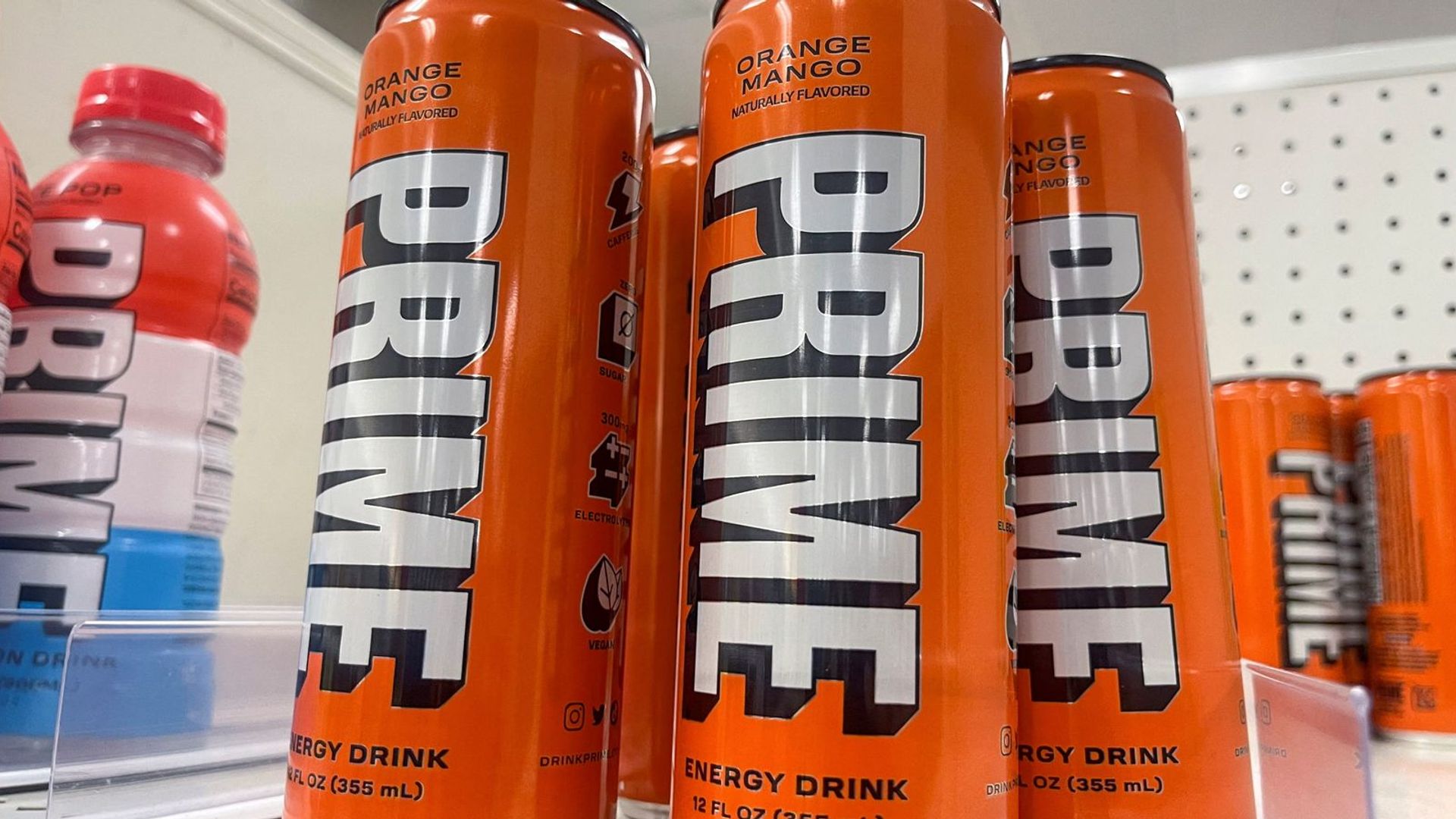
-
How a former DeepMind researcher raised at a $300M pre-seed valuation before launching a product
Drawing on more than a decade spent helping build some of the world's most influential AI systems, including research that later informed the development of ChatGPT, Andrew Dai explains why he...
Technology Source
-
Nearly one in five World Cup matches reached heat levels players’ union warns against
Guardian analysis finds 19% of games reached heat levels warranting delays, as Fifa defends its player safeguardsThe climate crisis has come for football.During this year’s World Cup, nearly one...
General Source
Guardian analysis finds 19% of games reached heat levels warranting delays, as Fifa defends its player safeguardsThe climate crisis has come for football.During this year’s World Cup, nearly one in five of the tournament’s 100-plus matches took place in levels of heat and humidity that a football players’ union has previously said should trigger delays or postponements, a Guardian analysis has found. An additional 23 matches were played in cities as they reached those heat levels, but in stadiums where conditions were mitigated by air conditioning. Continue reading...
-
Our sensitive teen daughter’s self-worth is tested by social media and peers. What should we do? | Leading questions
The more unusual you are, the more unusual it is to find people like you, writes advice columnist Eleanor Gordon-Smith. But as she grows older, her social world will shiftRead more Leading...
General Source
The more unusual you are, the more unusual it is to find people like you, writes advice columnist Eleanor Gordon-Smith. But as she grows older, her social world will shiftRead more Leading questionsOur teen daughter is a deeply sensitive, perceptive kid who longs for close friendship but often feels sidelined; she reads slights quickly, ruminates and compares herself harshly. Her 16th birthday was heartbreaking: the in-person warmth and social-media love she expected didn’t materialise, and she’s crushed. We try to parent with both empathy and backbone, validating her feelings while nudging her towards agency: widening her circles, getting busier and repairing frayed ties without begging for approval.But how do we wisely accompany a teenager whose self-worth is repeatedly tested by imperfect peers (in her mind at least) and the distortions of online recognition? What practices, language and boundaries help a highly sensitive adolescent convert disappointment into dignity and build friendships rooted in mutual regard rather than constant self-surveillance? Continue reading...
-
Brain implant helps paralysed man to feed himself and drink from cup
Keith Thomas can move arms and hands, and feel sensation of touch after ‘double neural bypass’ and months of trainingA man who was paralysed from the chest down in a swimming accident six years...
General Source
Keith Thomas can move arms and hands, and feel sensation of touch after ‘double neural bypass’ and months of trainingA man who was paralysed from the chest down in a swimming accident six years ago has been able to feed himself and drink from a cup thanks to a brain implant that bypasses his spinal cord injury.Keith Thomas of Massapequa, New York, could not lift his arms off his wheelchair when he agreed to trial the technology in 2021, but after surgery to implant electrodes in his brain and many months of training, he was able to move the limbs again. Continue reading...
-
Sheryl Sandberg leads $10 million investment in AI-powered vehicle inspection service
The startup, founded in 2021, lets enterprise customers use smartphones to scan and spot vehicle damage.
General Source
-
Former Italian motorway boss sentenced over Genoa bridge tragedy
The collapsed Morandi Bridge is seen in the port city of Genoa, Italy August 16, 2018. REUTERS/Stefano Rellandini
General Source
-
Watch: What we know about newly discovered monkey species
New monkey species hailed as 'amazing discovery' by conservationist.
General Source
-
Why AMI Labs’ Alexandre LeBrun won’t call his AI ‘AGI’ or ‘superintelligence’
While everyone in AI is chasing "superintelligence," Alexandre LeBrun, CEO of Yann LeCun’s world model startup, AMI Labs, dismisses the word.
Technology Source
-
Private schools offer 41% more tree shade than state schools in England
Analysis reveals stark socioeconomic divide, with schools with highest free school meal eligibility having fewer treesPrivate school grounds in England offer 41% more tree cover than at state...
General Source
Analysis reveals stark socioeconomic divide, with schools with highest free school meal eligibility having fewer treesPrivate school grounds in England offer 41% more tree cover than at state schools for cooling and shade in extreme temperatures, research has found.As teachers and students prepare to take their summer holidays after weeks of high temperatures where some classrooms reached highs of 40C, an analysis of tree cover in schools in England reveals a stark socioeconomic divide. Continue reading...
-
Female tennis players faced 12,000 abusive posts in 2025
Female tennis players received 12,000 abusive posts in 2025, according to a new report.
General Source
-
Moonshot’s upcoming Kimi 3 is expected to close the gap with Anthropic’s Opus 4.8
The FT reports Kimi K3 will be the largest open AI model from China, with a parameter count between 2 trillion and 3 trillion.
General Source
-
Denshattack! review – time to get on board with kickflipping trains
PC, PS5, Xbox Series X/S, Nintendo Switch 2; UndercodersColourful, counter-cultural and captivating – this rail riding game set in a dystopian Japan is as weird as it is exhilaratingEvery now and...
General Source
PC, PS5, Xbox Series X/S, Nintendo Switch 2; UndercodersColourful, counter-cultural and captivating – this rail riding game set in a dystopian Japan is as weird as it is exhilaratingEvery now and again a game appears with a premise so outrageous you stop in your tracks to take it all in. Denshattack!, a game about kickflipping trains across a dystopian future Japan, is the epitome of this feeling. Set in a post climate disaster world, people have retreated to corporate-owned domed cities to live out their days in air-conditioned, ignorant comfort. Save for a handful of outcasts, the rest of the country is a mess of broken infrastructure, where rival gangs battle it out on the ruins of Japan’s famously extensive rail network. Naive upstart Emi has one goal: become the best Denshattacker there is, one sick nosegrind at a time.Taking the idea of an on-rails platforming game to its extreme conclusion, developers Undercoders have combined the best bits of the Tony Hawk’s Pro Skater series – grinding, flipping and spinning through an entire dictionary of tricks – with the anti-establishment message behind Jet Set Radio. The rivals Emi encounters showcase the history of Japanese misfits, pitting you against ageing rockabillies and violent girl gangs without a shred of judgment. Continue reading...
-
University worker charged over Ann Widdecombe death comments
Ann Widdecombe pictured in 2024. Pic: PA
General Source
-
Fan may get 'only joking' added to England World Cup winners tattoo after defeat
Sean Carrington says he has "no regrets" about his tattoo despite the Three Lions' frustrating exit.
General Source
-
Grief Is the Thing With Feathers by Max Porter review – a bravura rendering of bereavement
Actor Russell Tovey’s narration crackles with compassion and menace in this magical story of a widower and his young sons in mourningLess than a week after the sudden death of his wife, a grieving...
General Source
Actor Russell Tovey’s narration crackles with compassion and menace in this magical story of a widower and his young sons in mourningLess than a week after the sudden death of his wife, a grieving man opens his front door to a giant crow who scoops him up into his wing and tells him: “I won’t leave until you don’t need me anymore.” Still in shock, the man is facing the prospect of raising his two young sons alone. The bird, which has previously been roaming around the family’s flat at night, has observed a household of “heavy mourning, every surface dead Mum, every crayon, tractor, coat, welly covered in a film of grief”. In that first visit, the man “woke up and didn’t see me against the blackness of his trauma”.First published in 2015 and since adapted as a play and film, Grief Is the Thing With Feathers is an inventive and sharply observed novella by Max Porter which uses verse, dialogue and the supernatural to examine a family grappling with the loss of a wife and mother who had been “busy living, and then she was gone”. In a story that shifts between the perspectives of “Dad”, “Boys” and “Crow”, we learn the man is a writer who is working on a book about the poet Ted Hughes called Crow on the Couch. Continue reading...
-
The best eye masks to help you sleep all summer – tested in a UK heatwave
From blackout masks that block 5am sunshine to silk Bluetooth masks that feel cool on your skin, these eye masks could genuinely improve your sleep• The most-hyped sleep remedies, tried and...
General Source
From blackout masks that block 5am sunshine to silk Bluetooth masks that feel cool on your skin, these eye masks could genuinely improve your sleep• The most-hyped sleep remedies, tried and testedThe best product I’ve ever reviewed for the Filter cost less than £10 and sent me to sleep. When I tested sleep aids last year in an effort to tackle insomnia, an eye mask helped me nod off faster and stay asleep for longer than numerous purported zzz-enhancers, including magnesium and lavender spray. Between you and me, it also worked better than the melatonin tablets I’d brought back from a trip to the US.Even so, when I was asked to test a range of eye masks for this article, I didn’t expect the cheap MyHalos blackout mask to retain its pole position. Masks from leading sleep brands Tempur and Manta Sleep, and therapeutic tech specialists such as Therabody, use innovative designs to calm your mind and even sync with your heartbeat. The Lumenate Nova, which deploys soothing LED light therapy, reportedly has Jennifer Aniston among its many fans.Best budget eye mask and best overall:MyHalos blackout 3D sleep maskBest Bluetooth eye mask:SnoozeBand Pro Continue reading...
-
How green is Andy Burnham? Britain’s next PM faces tough climate decisions
Heatwaves, high energy prices, calls for reindustrialisation and North Sea drilling are all high on the to-do listWildfires cast a pall of smoke this week over Greater Manchester, whose former...
General Source
Heatwaves, high energy prices, calls for reindustrialisation and North Sea drilling are all high on the to-do listWildfires cast a pall of smoke this week over Greater Manchester, whose former mayor Andy Burnham stands on the threshold of No 10. Amid three UK heatwaves so far this year, which have killed thousands of people in England and Wales, damaged harvests and left children crying in classrooms, the new prime minister’s plans for the climate crisis remain as shrouded as his city.“Burnham has been very quiet about the climate [crisis] so far,” says Chris Venables, an environmental campaigner and fellow at the Green Alliance thinktank. “I don’t think [it] is at the forefront of his mind, but that does not mean he will water down this agenda.” Continue reading...
-
Pergolesi: L’Olimpiade album review
Monaco/Raftis/Colombo/Frigato/Orchestra Ghislieri/Prandi(Arcana)Recorded from a live performance in an 18th-century theatre in Jesi – Pergolesi’s hometown – this is a brain-addling tale of love...
General Source
Monaco/Raftis/Colombo/Frigato/Orchestra Ghislieri/Prandi(Arcana)Recorded from a live performance in an 18th-century theatre in Jesi – Pergolesi’s hometown – this is a brain-addling tale of love triangles and long-lost twins set in the ancient Olympics Pietro Metastasio’s tale of dirty doings at the ancient Olympic Games proved so popular that more than 60 composers set it to music, including Caldara (for whom it was written), Vivaldi and Cherubini. Pergolesi’s version, premiered in 1735, resurrected in 1937, is among the finest, presaging what should have been a glorious operatic career if only the composer hadn’t died at the age of 26.The story begins as the formidable Megacle is persuaded to compete in disguise as his hot-headed and not entirely honourable friend Licida. What Megacle doesn’t know is that the prize is the hand of Aristea, the woman he has fallen in love with himself. Throw in Licida’s cast-off mistress Argene masquerading as a shepherdess and the discovery that Licida is actually Aristea’s long-lost twin and you have all the ingredients for a plot of brain-addling complexity. Continue reading...
-
'Good day to drown a few sorrows,' says King as he pours pint
King Charles III hinted at England's World Cup semi-final loss as he poured a pint in a pub.
General Source
-
Trump’s Board of Peace drops full Gaza recovery plan in favour of tiny pilot scheme
Revised plan aims to ‘keep something going’ amid fears Netanyahu may gamble on new all-out offensive before Israeli electionsMiddle East crisis live – latest updatesThe Gaza recovery plan being...
General Source
Revised plan aims to ‘keep something going’ amid fears Netanyahu may gamble on new all-out offensive before Israeli electionsMiddle East crisis live – latest updatesThe Gaza recovery plan being pursued by Donald Trump’s Board of Peace (BoP) has shrunk dramatically from an ambitious blueprint for the reconstruction of the whole territory to a small pilot project in the south of the strip.Even the envisaged pilot scheme – involving a temporary camp for a tiny fraction of Gaza’s 2 million displaced people, with a Palestinian administration, police and a small international security force – is not expected to take shape before the end of the year. Continue reading...
-
Mother's plea for greater online child safety as court orders new inquest into son's death
Ellen Roome with her14-year-old son Jools Sweeney. Pic: PA
General Source
-
Hal Williams, actor best known for Sanford and Son and 227, dies aged 91
The actor, who also appeared in The Waltons and Private Benjamin, died at his home in CaliforniaHal Williams, the actor best known for TV roles in Sanford & Son and 227, has died at the age of...
General Source
The actor, who also appeared in The Waltons and Private Benjamin, died at his home in CaliforniaHal Williams, the actor best known for TV roles in Sanford & Son and 227, has died at the age of 91.His representative confirmed that Williams died on 15 July at his home in California.This article was amended on 16 July 2026. It was originally stated that Sanford and Son ran from an incorrect number of years Continue reading...
-
Offer teenagers a meningitis B vaccine on NHS, advisers tell UK government
JCVI says children should have one or two doses of menB vaccine at age 15, depending on if they had vaccine as a babyAll teenagers across the UK should be offered a meningitis vaccine on the NHS...
General Source
JCVI says children should have one or two doses of menB vaccine at age 15, depending on if they had vaccine as a babyAll teenagers across the UK should be offered a meningitis vaccine on the NHS following a series of fatal outbreaks, a government commitee has said.The recommendation, made by the Joint Committee on Vaccination and Immunisation (JCVI), would mean that young people would be eligible for the menB vaccine at the age of 15, alongside catch-up programmes for those who otherwise would have missed out. Continue reading...
-
Football Daily | It’s the end of the World Cup as England know it
Sign up now! Sign up now! Sign up now? Sign up now!They say never go that far back. In the last half an hour of their end-of-days Geopolitics World Cup semi-final with Argentina, England committed...
General Source
Sign up now! Sign up now! Sign up now? Sign up now!They say never go that far back. In the last half an hour of their end-of-days Geopolitics World Cup semi-final with Argentina, England committed to the bit in the Deep South. No wonder there were gaps. Thomas Tuchel stood and watched national trauma unfold in front of his eyes as towering aerial threats such as Alexis Mac Allister and Lautaro Martínez beat his four centre-backs to cross after cross. Forget the ghosts of ‘66, the spectre of Southgate loomed over his successor as realism reared its ugly head at the business end of an England men’s major-tournament run once again. Continue reading...
-
Henry Nowak's killer confessed to brother days after murder, transcript reveals
Undated handout photo issued by Hampshire Police of Vickrum Digwa who has been found guilty at Southampton Crown Court of the murder of univ
General Source
-
MI5 reprimanded for lying about ties with neo-Nazi informant who attacked girlfriend with machete
Watchdog’s review of case criticises handling of agent X, who exploited role with agency to threaten his girlfriendMI5 has been reprimanded by a watchdog for lying about its relationship with a...
General Source
Watchdog’s review of case criticises handling of agent X, who exploited role with agency to threaten his girlfriendMI5 has been reprimanded by a watchdog for lying about its relationship with a neo-Nazi informant, who had exploited his role with the spy agency to violently threaten his girlfriend.The Investigatory Powers Commissioner’s Office (Ipco) criticised MI5’s handling of a man known only as agent X, and said some of its officers had initially misled the public about his true status. Continue reading...
-
Apple Intelligence approved for launch in China with Alibaba and Baidu
The deal, which was rumored to be in the works last year, marks an important step for Apple's AI ambitions in a key market.
General Source
-
Forget the lions: five fun things to do or see to take your mind off the football
From cheetah cubs to uplifting sport to come, put England’s World Cup exit behind you with these suggestionsIt can be a bleak feeling when the whole nation has been gearing up to celebrate England...
General Source
From cheetah cubs to uplifting sport to come, put England’s World Cup exit behind you with these suggestionsIt can be a bleak feeling when the whole nation has been gearing up to celebrate England reaching a World Cup final, only to see the dream dashed at the last minute. But there are still plenty of things to be cheerful about. Here are five suggestions of things you can do, see or enjoy to take your mind off Lautaro Martínez’s 92nd minute winner for Argentina.And football? Well, it is coming home(-ish) again soon. The next men’s European Championship is being held across England, Scotland, Wales and the Republic of Ireland in the summer of 2028, when 23 of the best teams in Europe will compete for the right to knock England out at the semi-final stage. Is that joke too soon? Continue reading...
-
Food scraps and mushrooms: the closed-loop garden behind the world’s first community-powered sauna
R-Urban Poplar in London is a ‘living lab’ where locals can experiment with ways of taking charge of their food supplyOn a stiflingly hot and dusty morning at the height of the summer’s third...
General Source
R-Urban Poplar in London is a ‘living lab’ where locals can experiment with ways of taking charge of their food supplyOn a stiflingly hot and dusty morning at the height of the summer’s third heatwave, traffic thunders down the A12 arterial route through east London. A high, red-brick wall rises by the road. What few passersby will realise is that this ivy-topped wall shelters an urban oasis, within which sits an unprecedented sustainable project.The world’s first “community powered” sauna – heated by food waste from residents of the neighbouring housing estate – is set to open here. Continue reading...
-
‘We weren’t at fault’: British yacht couple bristle at ‘armchair sailors’ and Russian denials
Exclusive: Jane and Alan Kelvey reflect on close encounter with Russian warship a few hours into two-month sailing tripThey found themselves at the centre of an international incident, the close...
General Source
Exclusive: Jane and Alan Kelvey reflect on close encounter with Russian warship a few hours into two-month sailing tripThey found themselves at the centre of an international incident, the close encounter between their small sailing boat and a Russian warship making headlines around the world.A month later, Jane and Alan Kelvey are to be found berthed in a rainy harbour in north-west France, still taken aback by their brush with Vladimir Putin’s forces – but trying to get on with their fun sailing trip. Continue reading...
-
My Fair Lady review – lovable musical transforms exuberantly beyond expectation
Chichester Festival theatreThe well-worn rags to riches story blossoms beyond its generic setup when Eliza Doolittle and Henry Higgins’ relationship develops an emotional truthFor the first hour,...
General Source
Chichester Festival theatreThe well-worn rags to riches story blossoms beyond its generic setup when Eliza Doolittle and Henry Higgins’ relationship develops an emotional truthFor the first hour, this production of Lerner and Loewe’s musical glides along smoothly enough; the cockney flower girl sings of rain in Spain, the elocution professor rails at her for murdering the English language with her guttersnipe vowels, and the whirligig of Eliza Doolittle’s transformation from “squashed cabbage leaf” into lady carries you along.Set against Dickensian lanterns and Henry Higgins’ hardwood bachelor study, its lovable songs (Wouldn’t It Be Loverly?, With a Little Bit o’ Luck, I Could Have Danced All Night and so on …) seem to emanate from a generic Musical Theatre Land – an anodyne setting entirely dissociated from the world of today. The intention, it seems, is safe, nostalgic entertainment. Continue reading...
-
'A true miracle of destiny' - Messi and Lamine Yamal's incredible first meeting
BBC Sport explores a bond between two world-class footballers from different generations who appear bound by destiny
Sports Source
-
A voyage of discovery: an idiot’s guide to reading The Odyssey
Christopher Nolan’s film adaptation of the ancient Greek epic has sparked a new appetite for an old classic. Here are the translations, podcasts and audiobooks that make the Homeric world more...
General Source
Christopher Nolan’s film adaptation of the ancient Greek epic has sparked a new appetite for an old classic. Here are the translations, podcasts and audiobooks that make the Homeric world more approachableThe Odyssey was once all Greek to me. I struggled to keep up with the characters, the mass of heroes and villains, the swarms of sons and daughters. I found the Homeric formula – repeated stock phrases passed down from the oral tradition – confusing and tiring. The prose in my 1946 EV Rieu translation, revised by his son DCH Rieu, felt laboured and laborious. I have put the Odyssey down, several times, in the course of my life. But, like Sirens, difficult books tend to have a hold on us. The recent film adaptation pushed me to once again try reading the Odyssey, so I decided on a new approach. I spoke to classicists and conducted research, aiming to render the inaccessible accessible.To read the Odyssey, start by avoiding the Odyssey. “Begin with contextualisation” – get to grips with themes and content – Antony Makrinos, associate professor in classics at UCL and director of the Summer School in Homer 2026, told me. He sent me an exhaustive list of recommendations, and I found myself in the British Museum, mid-heatwave, learning about Mycenaean civilisation and ancient Greece. I cooled down that evening with a Simon Armitage documentary, Gods and Monsters: an intriguing assessment of our flawed hero. Continue reading...
-
Hits don’t lie! Shakira’s 20 best songs, from World Cup anthems to megastar duets – ranked!
As the Colombian pop supremo prepares to perform at Sunday’s final, we rate her greatest work, including gossipy takedowns and lycanthropic lyricsOf Shakira’s World Cup anthems, it’s the joyfully...
General Source
As the Colombian pop supremo prepares to perform at Sunday’s final, we rate her greatest work, including gossipy takedowns and lycanthropic lyricsOf Shakira’s World Cup anthems, it’s the joyfully ludicrous Waka Waka from the 2010 tournament in South Africa that bangs hardest. Featuring Afro-fusion band Freshlyground, the Colombian superstar redraws preened football superstars such as Ronaldo et al as soldiers on a frontline. Continue reading...
-
Claudia Winkleman quits chat show after one series
Winkleman said she was "incredibly grateful" for the opportunity, but had been "too nervous" to enjoy it.
General Source
-
Wildfire pollution and clowns on a pilgrimage: photos of the day – Thursday
The Guardian’s picture editors select photographs from around the world Continue reading...
General Source
-
Teenager's inquest to reopen after mum's campaign
Ellen Roome believes her son's death in 2022 was as the result of an online challenge gone wrong.
General Source
-
Zixi, Comcast Technology Solutions Partner on C-band Replacement Solution
General Source
-
US strikes oil tanker with missiles as it enforces new Iran blockade
The US military targeted an unladen oil tanker which it said was heading for the key Iranian oil terminal on Kharg island.
General Source
-
Telenor lowers outlook after weaker quarter
Telenor has moderated its full-year guidance after a softer second quarter, citing weaker conditions in Norway and continued macroeconomic pressure in Bangladesh. The Norwegian telco reported...
Business Source
Telenor has moderated its full-year guidance after a softer second quarter, citing weaker conditions in Norway and continued macroeconomic pressure in Bangladesh. The Norwegian telco reported service revenues of NOK 14.68 billion and adjusted EBITDA of NOK 7.99 billion. On an organic basis, service revenues fell 0.7%, while adjusted EBITDA declined 4.8%. Free cash flow before M&A was NOK 1.82 billion. “2026 is a transition year for Telenor on several fronts as we deliver on our strategy,” said CEO Benedicte Schilbred Fasmer. “While the quarter was affected by several short-term factors, we are executing initiatives that will improve efficiency, strengthen customer value and increase returns over time.” The quarter was also hit by a Norwegian VAT provision relating to TV news channels for the 2020-2022 period, which reduced service revenues by NOK 135 million and adjusted EBITDA by NOK 162 million. Telenor said the prior-period charge was excluded from its updated 2026 outlook. The group now expects flat to low-single-digit organic growth in Nordic service revenues and adjusted EBITDA, down from previous guidance of low-single-digit revenue growth and low-to-mid-single-digit EBITDA growth. Group adjusted EBITDA is now expected to be flat to slightly negative, compared with the previous forecast of flat to low-single-digit growth. Free cash flow guidance has been lowered to around NOK 10 billion, from NOK 10-11 billion. The company said its new organisational structure would take effect in August as part of efforts to create a leaner operating model. It is also carrying dual IT cost structures as part of its transformation programme, with costs expected to begin easing towards the end of the year and into 2027. Telenor highlighted strategic progress in the Nordics, including the approval of its GlobalConnect consumer broadband transaction in Norway, the acquisition of Enivest, and the purchase of Swedish broadband provider Bahnhof. It said the three broadband transactions should generate sizeable cash flow synergies from 2030. Security and defence also remain a focus. Telenor-owned KNL has secured a EUR 6.5 million contract with the Finnish Defence Forces, while Telenor Norway has signed framework agreements with the Norwegian Armed Forces and the Norwegian National Security Authority. “In a more uncertain environment, secure and resilient communications remain a key strategic focus area for Telenor,” said Schilbred Fasmer. Sources: Telenor Q2 statement; Wall Street Journal, E24.
-
Tins ain’t what they used to be: canned wine is no longer the preserve of Gen Z
Aluminium is practical, recyclable and, for wines drunk young, the ideal container. Better still – high-quality options are increasingly availableCans are the answer to many of the problems posed...
General Source
Aluminium is practical, recyclable and, for wines drunk young, the ideal container. Better still – high-quality options are increasingly availableCans are the answer to many of the problems posed by wine. On picnics, at festivals and generally on the trot, what are more practical than bottles? Cans! For the carbon-conscious, what have a significantly lower environmental impact than glass? Aluminium cans! And what if, for whatever reason, you don’t want to commit to a full 750ml bottle of wine? Try a can! This small, light and sustainable format is a secret weapon to keep, quite literally, in your back pocket; with cans – wherever you are and whatever you’re doing – drinking wine is always possible. Not to get too Barack Obama about it, but “yes, we can”.Gen Z are largely behind the recent boom in canned wines, which stands to reason: fewer of them are drinkers and those who are do so only moderately, so a smaller format suits. According to a 2025 survey by Ocado, 53% of them “have been directly influenced by social media to try boxed or canned wine”. This shows in the way those formats are marketed: the peachy-pink can of Nice’s Pale Rosé, for instance, reads, “Won’t shatter on the dancefloor”, while Vinca’s catarratto “pairs well with great company”. A and almost all of them make a point of their recyclable packaging, appealing to the most environmentally-conscious generation to date. (Glass bottles are, after all, consistently found to be one of the largest contributors to wine’s carbon footprint.) Continue reading...
-
The Secret Garden review – thoughtful adaptation takes root in the imagination
The Egg, BathThe beloved children’s perennial is the basis for a celebration of craft, creativity and the beauty of the natural world in this charming puppetry productionThe Egg theatre celebrates...
General Source
The Egg, BathThe beloved children’s perennial is the basis for a celebration of craft, creativity and the beauty of the natural world in this charming puppetry productionThe Egg theatre celebrates its 20th anniversary with Tom Wentworth’s thoughtful but fitful adaptation of Frances Hodgson Burnett’s beloved book. As Mary and her friends nurture their secret garden, animal puppets play amid the audience and flowers pop up across a green-washed stage. It’s all very charming – particularly when Cat Rock’s beautiful puppets skip, soar and dart around the theatre. There’s a plucky robin, a majestic owl and a ridiculously lovable fluffy lamb. All the puppets are frayed around the edges with the original fabric exposed; a celebration of craft and creation just as much as the beauty of the natural world.The puppets are complemented by a striking design from Kat Heath and evocative music from composer Ben Osborn. The Yorkshire Moors around Misselthwaite Manor, where Mary is sent after being orphaned, are brought to life using curtains of fabric and giant gloves with long spindly fingers, worn by actors and swaying wildly in the wind. It’s quite unusual work, which sometimes makes the young audience giggle but gradually takes a hold of the imagination. Continue reading...
-
Chop, chop! My favourite fridge-raid dinner, no-cook meals and super salads
From taco in a bowl to cantaloupe and courgette, assemblies of raw ingredients are a terrific choice for lo-fi, hot-weather meals that require minimal cookingSign up here for our weekly food...
General Source
From taco in a bowl to cantaloupe and courgette, assemblies of raw ingredients are a terrific choice for lo-fi, hot-weather meals that require minimal cookingSign up here for our weekly food newsletter, FeastWhen Shakespeare coined the phrase “salad days”, he was referring to a state of youthful inexperience. But at 41, and midway through the hottest summer on record, I can safely say my own salad days – these weeks of endless salad-eating – are the result of experience. As my organs segue into their fifth decade, I need more than rosé and a bag of Tyrrells for dinner. (Although if you’re interested, I’m a salt-and-vinegar Furrows person and my favourite rosé – Catalan producer Can Sumoi’s La Rosa – is on offer.)I’m not only eating salad, of course, but assemblies of raw ingredients are an obvious choice if you’re looking for lo-fi meals that involve more interaction with the fridge than the oven. I like Tom Hunt’s rubric for a fridge-raid dinner salad, which – rather than sending you out for ingredients and sweat patches – uses whatever you have on hand. And Meera Sodha’s no-cook salad of tomatoes, chickpeas and rose harissa delivers fibre and flavour without so much as a struck match. And then there is Feast’s archive of recipes by Yotam Ottolenghi, which boasts doozies such as his tomatoes with mango-miso dressing and this courgette and cantaloupe salad. Ottolenghi’s lime and poppyseed slaw with curry leaf oil, meanwhile, has accompanied almost every barbecue or “family-style” spread – the citrus juice softens and “cooks” shredded cabbage, carrot and onions into submission, and don’t even get me started on its maple-turmeric cashews. The whole lot cries out for a beer – preferably Table Beer by the Bermondsey brewery the Kernel, a pale ale that is big on hops and low on booze (variable, but about 3%). Continue reading...
-
Ultrahuman’s former hardware VP raises $5.5M for devices that control AI agents, not just record you
Aina is going to pilot a new device in the coming weeks.
Technology Source
-
Airties adds Bell Canada and Cisco executives
Stephen Howe (left) and Michael Rezek Airties has appointed Stephen Howe, the former chief technology and information officer of Bell Canada, to its board of directors. The Paris-based broadband...
General Source
Stephen Howe (left) and Michael Rezek Airties has appointed Stephen Howe, the former chief technology and information officer of Bell Canada, to its board of directors. The Paris-based broadband software company has also named Michael Rezek as chief business development officer. Rezek joins from Cisco, where he was director of business development, and previously held senior business development and partnership roles at Accedian before its acquisition by Cisco in 2023. Howe spent more than 25 years in Canadian telecoms, including senior roles at Bell Canada and TELUS Mobility. At Bell, he led network and technology services, covering fibre, wireless, satellite and media networks, as well as application development, infrastructure and cloud management. Airties CEO and co-founder Metin Taskin said Howe brought experience from “large-scale deployments and innovations” at major telecoms operators, while Rezek’s background in partnerships would help the company extend the value it delivers to customers. Airties provides AI-driven software used by ISPs to manage and improve home connectivity. Its platform is designed to help operators diagnose and resolve Wi-Fi and connected-home issues, improve customer experience and reduce churn. Howe said: “Airties has an impeccable reputation for helping ISPs improve connectivity experiences through their AI-driven software and actionable insights for Tier-1 operators across the globe.” Rezek said the company had “some of the richest connected-home intelligence anywhere in the industry” and added that he would focus on partnerships around more personalised, reliable and secure connectivity for homes, MDUs and small businesses.
-
Cheltenham festival crackdown aimed at stalling significant rise in false starts
Nearly 40% of 2026 races at showpiece meeting affectedTrack layout and listening devices for stewards on menuThe British Horseracing Authority said on Thursday that it aims to introduce a series...
General Source
Nearly 40% of 2026 races at showpiece meeting affectedTrack layout and listening devices for stewards on menuThe British Horseracing Authority said on Thursday that it aims to introduce a series of measures before next year’s Cheltenham festival to tackle a significant rise in the number of false starts at National Hunt’s showpiece meeting. The percentage of false starts has climbed steadily over the past five years, from 18% in 2022 to nearly 40% at the 2026 meeting. The rate of false starts in jump racing is around 4% over the same period.A review of this year’s meeting identified particular problems at the starts for races over two and two-and-a-half miles, which begin near a bend. Continue reading...
-
‘Cool, suave and weirdly shy’: Miranda Richardson remembers Sam Neill
Sam had such ease about him and I just loved the way he seemed to cruise through life. But he confronted his mortality with real courageSam Neill’s final interview and his life in pictures‘A true...
General Source
Sam had such ease about him and I just loved the way he seemed to cruise through life. But he confronted his mortality with real courageSam Neill’s final interview and his life in pictures‘A true gentleman’: actors, directors and leaders pay tribute to Sam NeillJane Campion remembers Sam NeillWhen I first met Sam, I thought he was handsome, cool and weirdly shy. He was always a rare combination of suave and down-to-earth: this great, democratic guy with no bullshit. I just loved the way he seemed to cruise through life. He had such ease about him.Acting was just one chunk of his life: there was always a lot of other stuff going on. He couldn’t wait to get back to his farm and his wine and his animals. I remember when we were making Merlin in 1998, he kindly took me out for lunch. We had a really delicious bottle of pinot noir, and he said that was what he was aiming for with his winery Two Paddocks. Continue reading...
-
Revealed: how Europe’s most powerful farming lobby killed EU’s pesticide law
Exclusive: High-level documents show how Copa Cogeca worked to weaken legislation to protect climate and wildlifeEurope live – latest updatesNewly revealed documents from inside the most powerful...
General Source
Exclusive: High-level documents show how Copa Cogeca worked to weaken legislation to protect climate and wildlifeEurope live – latest updatesNewly revealed documents from inside the most powerful farming lobby in Europe show how it delayed, gutted and overturned some of the most sweeping farming reforms in EU history, including a plan to cut pesticide use in half.Copa Cogeca describes itself as the voice of 22 million farmers across the continent, and enjoys unrivalled access to EU lawmakers. It has even been described as a “partner in policymaking”. Continue reading...
-
Nia Archives: Emotional Junglist review | Aimee Cliff's album of the week
(Island)On the Bradford-born producer’s self-assured second album, drum’n’bass rhythms power up angsty odes with shades of Arctic Monkeys, Kate Nash and myriad genresLike another of the year’s...
General Source
(Island)On the Bradford-born producer’s self-assured second album, drum’n’bass rhythms power up angsty odes with shades of Arctic Monkeys, Kate Nash and myriad genresLike another of the year’s biggest pop records, Olivia Rodrigo’s You Seem Pretty Sad for a Girl So in Love, the second full-length from the self-proclaimed “emotional junglist” Nia Archives is an album of two halves. The first documents its protagonist falling in love at breakneck speed; the second, the whiplash of sudden heartbreak. Unlike Rodrigo, Archives didn’t grow up starring on Disney Channel, a predestined route to success, but in Bradford, cutting her teeth on early 00s pirate radio, dancehall and landfill indie.More than most major artists, Archives has carved out her own path. After leaving home at just 16 to move into a youth hostel in Manchester, she started teaching herself to make beats; eventually, she uprooted to Hackney and studied music production, and used her student loan to fund the promotion of her self-released debut single. Since then, she’s made history as the first electronic/dance act to win a Mobo in decades (after publicly campaigning for the inclusion of dance music at the awards in 2022). With her 2024 debut album Silence Is Loud, she became the first junglist to be nominated for three Brit awards, and the first to be nominated for the Mercury prize since 1997 – before she was born. Continue reading...
-
If you have been listening to Suella Braverman and think Britain has gone bonkers, let me explain | Nels Abbey
The idea that former colonies should pay reparations makes perfect sense through the lens of the new right. But have they got the telescope the right way round?Dearest World,Britain, that small...
General Source
The idea that former colonies should pay reparations makes perfect sense through the lens of the new right. But have they got the telescope the right way round?Dearest World,Britain, that small yet once highly influential nation that once proudly ruled over much of you, that “gifted” you the English language as well as William Shakespeare and Mark Morrison, that kindly bestowed upon you industrialisation as well as industrialised slavery, the proud nation that won two world wars and created football … I’m afraid to reveal, is not what it used to be. Continue reading...
-
Pete Hegseth wants testosterone for his soldiers. Finally, some gender-affirming care | Arwa Mahdawi
The defense secretary has announced a screening program for troops. Get ready for a high-T Department of WarOne day perhaps Pete Hegseth will make the news for doing something worthwhile,...
General Source
The defense secretary has announced a screening program for troops. Get ready for a high-T Department of WarOne day perhaps Pete Hegseth will make the news for doing something worthwhile, something that makes his mother proud. One day perhaps we’ll see a headline about the defense secretary that doesn’t involve allegations of sexual misconduct or bigotry, claims about past drinking on the job, possible war crimes, Christian nationalism, or his weird fixation on male facial hair.Alas, today is not that day. Rather, we are gathered here today because Hegseth is very het up about testosterone. On Wednesday, the defense secretary proudly announced a new screening program for “war fighters” 30 and older that would ensure they had the “right testosterone levels”. In a video posted on X, captioned “the High-T Department of War”, Hegseth explains: “By addressing these health markers early, we’re keeping you on the leading edge of lethality.”Arwa Mahdawi is a Guardian columnist Continue reading...
-
D&D players raise millions in real-life campaign against ‘corporate elite’
Brennan Lee Mulligan’s Dungeons and Dragons push is part of a wider trend using tabletop games for political actionJust before their election day, six Los Angeles city council candidates stood on...
Politics Source
Brennan Lee Mulligan’s Dungeons and Dragons push is part of a wider trend using tabletop games for political actionJust before their election day, six Los Angeles city council candidates stood on stage at Hollywood’s Fonda Theatre. But they weren’t there for a debate or a black-tie gala. They were there to play Dungeons and Dragons.Comedian Brennan Lee Mulligan guided the politicians through a short D&D campaign to defeat corporate villains and an evil dragon. Hundreds of enthusiastic fans in the crowd pledged additional donations up to $150 each to give the candidates what is called an “auto crit” for maximum damage to the dragon. Continue reading...
-
Glance adds NMO Total Video data
Glance has added NMO Total Video to its international audience analysis services, extending its coverage of the Dutch TV and video market. The Médiamétrie-owned TV and video intelligence company...
General Source
Glance has added NMO Total Video to its international audience analysis services, extending its coverage of the Dutch TV and video market. The Médiamétrie-owned TV and video intelligence company will represent the Dutch measurement dataset internationally. NMO Total Video covers linear, time-shifted, streaming and on-demand viewing across TV sets, smartphones, tablets, broadcaster apps and streaming services. NMO, the Dutch cross-media audience measurement organisation, launched Total Video earlier this year. The system combines panel data with census data from participating broadcasters and platforms, and is backed by commercial and public media organisations, media agencies and advertisers. Patricia Sonius, managing director of NMO, said the dataset was designed to provide a reliable view of viewing behaviour across screens and devices, adding that the first operators, video companies and platforms were already participating. The addition strengthens Glance’s international data offer at a time when broadcasters, platforms and advertisers are seeking comparable measurement across linear TV and digital video. The Netherlands has been among the European markets moving towards total video measurement as viewing fragments across broadcaster streaming services, connected TV and mobile devices.
-
Redge launches FAST channels for KAN
Redge Technologies has launched three FAST channels for KAN, Israel’s public broadcaster, extending the companies’ existing OTT technology partnership. The channels are being introduced under the...
General Source
Redge Technologies has launched three FAST channels for KAN, Israel’s public broadcaster, extending the companies’ existing OTT technology partnership. The channels are being introduced under the KAN BOX brand and will be distributed on connected TV platforms including Apple TV, Android TV and smart TVs. They will run initially for one year. The line-up includes a World Cup channel combining live match coverage with related on-demand content. It is scheduled to run for one month before being replaced by a music channel featuring songs and live performances. An Archive channel will turn KAN’s VOD library into a scheduled linear service, while a Comedy channel will be built around Kupa Rashit, giving viewers a continuous themed feed of the series and related content. The channels are powered by Redge’s MediaTool, which manages content workflows for the launch. Metadata is drawn from KAN’s back-office system, while source files are taken from its digital asset management platform. KAN operators can select series or individual VOD titles for delivery to MediaTool, allowing the broadcaster to create FAST channels without rebuilding playlists or metadata manually. The project follows Redge’s earlier delivery of a service delivery platform for KAN’s apps and supports the broadcaster’s expansion of live and event-driven streaming across connected devices.
-
Media Tasting 2026 brings media industry leaders together in Stuttgart
German conference Media Tasting brought together around 250 executives from the media, creative industries, politics, business and academia at Stuttgart’s MHP Arena on 15 July 2026. For the first...
General Source
German conference Media Tasting brought together around 250 executives from the media, creative industries, politics, business and academia at Stuttgart’s MHP Arena on 15 July 2026. For the first time at the new venue, the annual industry summit explored the future of journalism, television, content production, streaming, artificial intelligence (AI) and media resilience. Organised by Apfel Programm Marketing GmbH and supported by Landesanstalt für Kommunikation Baden-Württemberg (LFK) and MFG Medien- und Filmgesellschaft Baden-Württemberg, the event brought together industry leaders to discuss how technological change and new challenges are reshaping the media landscape. Key themes included the impact of AI on content creation, the transformation of the streaming market, the future of trusted journalism and the role of federal state Baden-Württemberg as an innovative media and creative hub. Speakers included Wiebke Wiesner (MFG), Dr Rainer Esser (Holtzbrinck/DIE ZEIT), Professor Dr Kai Gniffke (SWR), Dr Wolfgang Kreißig (LFK) and State Secretary Rudi Hoogvliet. The programme was moderated by SWR presenter Stephanie Haiber. Wiesner highlighted the importance of strong content production and collaboration between media, creative industries, science, politics and funding organisations to maintain diversity, innovation and competitiveness in times of AI-driven transformation. A special focus was placed on media resilience, with discussions on cybersecurity, disinformation and the role of media as critical infrastructure. Colonel Joachim Fallert from the Baden-Württemberg State Command and Sascha Schwoll, Head of Technology at SWR, examined how media organisations can prepare for crises and strengthen their ability to operate under challenging conditions. “Moving to the MHP Arena has given Media Tasting a new stage. But what remains at the heart of the event is bringing together people who shape the future of media. The open exchange on key industry issues is what makes this conference unique,” said Frank Apfel, Managing Director of Apfel Programm Marketing. Wiesner said the event demonstrated the importance of dialogue between media, politics, science and the creative industries. “Innovation emerges where people engage with each other. Our goal is to connect the creative, film and media sectors in Baden-Württemberg and strengthen their ability to face the future,” she said. Kreißig added that media diversity, journalistic quality and media literacy were essential for a functioning democratic public sphere. “At the same time, platforms and new technologies such as artificial intelligence are changing the conditions under which media are created and consumed. This makes exchange between media companies, politics, science and regulators more important than ever,” he said. The conference concluded with a networking reception and wine tasting on the rooftop terrace of the MHP Arena, providing participants with an opportunity to continue discussions and build new connections.
-
Why you should care about the third-place play-off between England and France
It might feel like the last thing anyone wants right now - but here is why, actually, you do want to watch the World Cup's third-place play-off.
General Source
-
New monkey species discovered in African forest
Likweli: A remarkable new species of Colobus monkey from the Lomami National Park, Democratic Republic of Congo Pic: Daniel Rosengren
General Source
-
Disney+ expands language support
Disney+ has expanded its language support as the streamer continues to localise its service for international markets. The platform is adding support for 17 further audio languages, taking the...
General Source
Disney+ has expanded its language support as the streamer continues to localise its service for international markets. The platform is adding support for 17 further audio languages, taking the total number available on Disney+ to 58. The Disney+ user interface is now available in more than 30 languages, while subtitles and closed captions are offered in up to 42. The latest expansion includes Arabic, Croatian, Hebrew, Thai, Indonesian, Malay, Hindi, Tamil and Telugu, with availability across user interface, audio and timed text depending on the language. Disney+ has also introduced a right-to-left interface for languages including Arabic and Hebrew, intended to make navigation more natural for viewers using those languages. The update reflects the increasing importance of localisation to global streaming platforms, particularly as international originals travel beyond their domestic markets and services seek growth outside North America and Western Europe. Disney cited titles including Perfect Crown, Dear Killer Nannies, Battle of Fates and The Boss as examples of local originals reaching global audiences.
-
Lionsgate Studios draws European takeover interest
Lionsgate Studios has attracted acquisition interest from Banijay and Mediawan, as consolidation continues across the international production and studio sectors. First reported by Reuters,...
Lionsgate Studios has attracted acquisition interest from Banijay and Mediawan, as consolidation continues across the international production and studio sectors. First reported by Reuters, Lionsgate has appointed an investment bank to assess inbound approaches, according to people familiar with the process. The company, whose franchises include Hunger Games and John Wick, has a market value of around $3.8 billion. There is no certainty that a transaction will follow. France’s Bolloré, which controls Canal+ parent Vivendi, is not believed to be among the bidders. The interest comes after Lionsgate completed the separation of its studio business from Starz, leaving Lionsgate Studios as a standalone, publicly traded content company with film and television production, distribution, talent management and a library of more than 20,000 titles. Banijay is already working through the integration of All3Media, following the creation of an $8 billion production group backed by Banijay and RedBird IMI. The combined company includes formats and scripted titles ranging from Big Brother and Survivor to The Traitors, Fleabag and Call the Midwife. Mediawan has also been expanding outside France, including in English-language production. Earlier this year it acquired Peter Chernin’s North Road Company, adding further US scale through assets including Chernin Entertainment. A deal for Lionsgate would give either group a much larger US studio and library business, but would also mark a significant step beyond European-led production consolidation into Hollywood studio ownership.
-
Madelon Vriesendorp review – sex-crazed visions of skyscrapers copulating
Sir John Soane’s Museum, LondonThe Empire State building is caught in bed with the Chrysler Building and a milk bottle turns into a dragon in the raunchy and cheekily provocative work of the Dutch...
General Source
Sir John Soane’s Museum, LondonThe Empire State building is caught in bed with the Chrysler Building and a milk bottle turns into a dragon in the raunchy and cheekily provocative work of the Dutch artist and architectIn a high-rise New York apartment with a wide window that surveys the Manhattan grid below, the Empire State and Chrysler Buildings are in bed together. The Chrysler melts in a silvery swoon, shagged out, while the beacon atop the Empire State Building still glows fiery red and on the bedside table the Statue of Liberty’s arm holds up a torch suggesting more passion to come. But oh no! The lovers have been caught at it. At the door is the forbidding RCA Building, which has left its usual station at 30 Rockefeller Plaza to see this!Madelon Vriesendorp’s 1975 skyscraper sex romp drawing Flagrant Délit – “caught in the act” – can be seen twice in her exhibition Mind Games: as a standalone print and as the cover of Delirious New York, the 1978 book by her ex-husband Rem Koolhaas that is both a surreal history of the city and a subversive manifesto for a new kind of modern architecture. Vriesendorp is what exactly? An architectural cartoonist? A cartoonist architect? She is certainly more than just a graphic prankster, and won the 2025 Soane Medal given to visionaries who have “furthered and enriched the public understanding of architecture”. Hence this show. And it all started with skyscrapers copulating. Continue reading...
-
Who is the frontrunner to be the UK's next chancellor?
Andy Burnham will be moving into Downing Street next week, and a question remains over who will be his neighbour in Number 11.
General Source
-
I started filling out a survey - and was plunged into serious soul-searching | Adrian Chiles
I was full of positivity when I began reading the National Survey for Wales, but the questions quickly grew deeper and deeperHave I done any hang-gliding in the last four weeks? Hang on (no pun...
General Source
I was full of positivity when I began reading the National Survey for Wales, but the questions quickly grew deeper and deeperHave I done any hang-gliding in the last four weeks? Hang on (no pun intended), let me think. No, not as far as I can recall. No hang-gliding. Will leave that box unticked.Filling in the National Survey for Wales is a dizzying experience. One minute you’re exasperated with how long this trivial pursuit is taking, the next you’re into some serious soul-searching. Guilt-inducing, thought-provoking, sometimes moving. There’s a lot going on. Continue reading...
-
‘He came to save us’: satirical play elevates Timmy the whale to Jesus-like figure
Timmy: Hope Dies Last portrays stranded humpback as saviour for a divided country, igniting both optimism and griefWhen people in Germany organised a daring rescue mission for a humpback whale...
General Source
Timmy: Hope Dies Last portrays stranded humpback as saviour for a divided country, igniting both optimism and griefWhen people in Germany organised a daring rescue mission for a humpback whale stranded on the Baltic coast in April, it briefly looked like a country stricken with political division and economic anxiety was rallying around a common cause.A new satirical play inspired by the episode, however, suggests the spectators, social media influencers, politicians and millionaires who flocked to the seaside in support never just wanted to rescue the cetacean that came to be nicknamed Timmy, but for Timmy to rescue them. Continue reading...
-
How I Shop with Angela Hartnett: ‘The purchase I regret the most? Any fitness machine!’
Always wondered what everyday stuff celebrities buy, where they shop for food, and the basic they scrimp on? The chef and restaurateur talks vintage plates, proper photo albums and cycling with...
General Source
Always wondered what everyday stuff celebrities buy, where they shop for food, and the basic they scrimp on? The chef and restaurateur talks vintage plates, proper photo albums and cycling with the Filter• Don’t get the Filter delivered to your inbox? Sign up hereAngela Hartnett is a chef and restaurateur known for her sophisticated yet simple Italian cooking. Her passion for food was instilled in her by her Italian mother and grandmother. After starting out in Gordon Ramsay’s kitchens at Aubergine and Pétrus, Angela became head chef at Pétrus, helping the restaurant achieve a Michelin star. In 2008, she co-opened the now Michelin-starred Murano in London’s Mayfair with Gordon Ramsay before taking full ownership two years later. Several Café Muranos have followed, as have Hartnett Holder & Co at Lime Wood in Hampshire and Cicoria at the Royal Opera House.She co-hosts the podcast, Dish from Waitrose, with Nick Grimshaw. She has an MBE and an OBE for services to the hospitality industry and to the NHS during the Covid-19 pandemic. Continue reading...
-
Jess Cartner-Morley on fashion: forget delicate chains – this summer, make your jewellery big and bold
Fashion is getting braver with accessories again, so lean into it by embracing loud earrings and chunky pendantsThis summer, I want jewellery that makes some noise. Real noise – earrings that...
General Source
Fashion is getting braver with accessories again, so lean into it by embracing loud earrings and chunky pendantsThis summer, I want jewellery that makes some noise. Real noise – earrings that swish, bangles that clatter – and visual noise as well. Stuff to wear when you want to be seen and heard. The total opposite, in other words, of the jewellery most of us have been wearing lately. Charming, delicate jewellery has become the default. Two necklaces of different lengths on fine chains. One has a heart pendant, the other an initial or a birth stone, am I right? Maybe a curated earlobe of tastefully small mismatched diamond hoops.There is absolutely nothing wrong with this look. It is really nice. In fact, this is exactly the problem. Continue reading...
-
British mother on the run after abducting sons from American father
Nishika Samaratunga holding their son Blaine. Pic: Ben Baier/PA
General Source
-
The best books to read in July: new paperbacks from Andrew O’Hagan, Miriam Toews and Oyinkan Braithwaite
Looking for a new reading recommendation? Here are some fantastic new paperbacks, from the gripping story of an international murder case to a state-of-the-nation yarn*** Continue reading...
General Source
-
The secret lives of flight attendants: ‘British passengers always drink like they’ve never drunk before’
Lewd propositions, drunken tirades, groping, grumbling and grubby behaviour – cabin crew have to experience it all, at altitude. They open up about the horrors they’ve seen from passengers and...
General Source
Lewd propositions, drunken tirades, groping, grumbling and grubby behaviour – cabin crew have to experience it all, at altitude. They open up about the horrors they’ve seen from passengers and colleaguesLast week, right at the start of this year’s holiday season, a 30-year-old drunk British holidaymaker tried to kiss a male flight attendant on a plane, spent a week in Mallorca presumably thinking his actions were consequence-free, and was then arrested on his way back through Palma airport. In February, Jet2 banned two passengers from the airline for life after a mid-air brawl on a flight from Turkey to Manchester, and last week BA had to cancel a flight back from Barbados, because (some) members of the crew were still too drunk from the hotel bar to operate it. There’s a connection between these incidents, and it’s not just as flight attendant Thomas, 27, puts it: “Well, drunk Brits – you know how that goes”.The term “air rage” was coined in the 90s, but the behaviour it describes went through the roof post-Covid. In 2021, the number of reported incidents in the US was greater than in the previous three decades combined. A new category of misdemeanour had appeared – mask non-compliance. Continue reading...
-
‘A sublime, breezy confection’: writers on their 2026 songs of the summer
The annual rundown of Guardian writers picking their most played tracks of the season goes from club-ready pop to sunny tech houseCheck out a Spotify playlist of the choicesKim Petras’ greatest...
General Source
The annual rundown of Guardian writers picking their most played tracks of the season goes from club-ready pop to sunny tech houseCheck out a Spotify playlist of the choicesKim Petras’ greatest song to date is also the best outsider country song in recent memory: if Ethel Cain and Lana Del Rey could ever put the beef behind them and duet, the dusty gutter romance of Jeep is exactly how you’d want it to sound. The song creates a flyover state love story in a strangely effective union of hyperpop and Americana, creating a windswept fantasy of “doing some middle America shit” with your man: Four Loko-fueled hookups, gas station canoodling and screaming along to rage music beneath the stars. The truly audacious thing is the bridge, a whispered and impressionistic slur that feels like Petras is eight drinks deep, doing donuts in her car until everything blurs. It’s total make-believe, but Petras is so good at making you feel her longing that it gets me choked up. When she recently came out at a Charli xcx show to perform Jeep unannounced, it already felt like an anthem. Owen Myers Continue reading...
-
‘People think you’ve got 10,000 cats’: the support group for hoarders
Many hoarders are scared to seek help but one UK housing association is taking a more empathetic approachAt one end of the table sits Tony*, who showers at his local leisure centre in Birkenhead...
General Source
Many hoarders are scared to seek help but one UK housing association is taking a more empathetic approachAt one end of the table sits Tony*, who showers at his local leisure centre in Birkenhead every day. His landlord won’t fix his bathroom because of his hoarding. Then there’s Sarah*, who ended up homeless with her three teenagers after their landlord evicted them because of hoarding. In her new home the problem has started again, but she says she’s petrified to ask for help in case she loses her property.Sian Cowley, 35, who has struggled with hoarding for decades, says: “I’ve lived without central heating for two years. A lot of us live without the basics like hot water, heating and cooking because we are too scared to get people in to do repairs because of the threat of eviction.” Continue reading...
-
Renzo Piano’s giant glass cube towers over the rest of the Stirling prize’s samey brick-built shortlist
Coming from the same developer as the Shard, London’s latest trophy building may be 54 storeys shorter than envisaged but should rise to building of the year If Irvine Sellar, the larger-than-life...
General Source
Coming from the same developer as the Shard, London’s latest trophy building may be 54 storeys shorter than envisaged but should rise to building of the year If Irvine Sellar, the larger-than-life developer who gave London the 95-storey hypodermic pinnacle of the Shard, had had his way, the UK’s tallest building would have been joined by a sibling: a 72-storey residential tower soaring above Paddington Station, the pair of leviathans winking conspiratorially at each other across the capital. In the end the Paddington Pole, as it became known, attracted the feather-spitting ire of heritage bodies and community groups, and after 1,800 objections, was refused planning permission by Westminster Council.Undaunted, Sellar and his architect Renzo Piano – the Italian imperator of hi-tech and co-designer, with Richard Rogers, of Paris’s Pompidou Centre – went back to the drawing board and simply lopped off 54 storeys. And so, in a reverse ferret that was a gift to headline writers (“Pole-axed” trumpeted Building magazine), the Pole became the Cube: an 18-storey office block, homogenous, crystalline and curiously self-effacing, despite its cubic chonk, its glacial glass walls reflecting the grey London sky. Continue reading...
-
British Steel is taken into public ownership to save UK supply
Scunthorpe factory expropriated from China’s Jingye and ministers will ask a valuer to assess compensationBritish Steel has formally been taken into public ownership 15 months after the government...
General Source
Scunthorpe factory expropriated from China’s Jingye and ministers will ask a valuer to assess compensationBritish Steel has formally been taken into public ownership 15 months after the government stepped in to prevent the closure of its steelworks in Scunthorpe and the loss of 4,000 jobs.Keir Starmer on Thursday said it was in the national interest for the government to take over the factory from its Chinese owner, Jingye, in one of the last significant actions overseen by him as prime minister after the Steel Industry (Nationalisation) Act received royal assent on Wednesday. Continue reading...
-
The Hawk review – Will Ferrell’s dated golf comedy just isn’t that funny
Ferrell’s brash ladies man and loser golfer could have been hilarious. But comedy has sped up over the last two decades, and all the genital gags and dodgy references fall flatIn the 2000s,...
General Source
Ferrell’s brash ladies man and loser golfer could have been hilarious. But comedy has sped up over the last two decades, and all the genital gags and dodgy references fall flatIn the 2000s, American comedy had a rude awakening. While the preceding decade had been all attractive sophisticates bantering in big cities, the new millennium arrived in a miasma of crude, cartoonish buffoonery: Austin Powers, American Pie, Dude, Where’s My Car? These were, sadly, the sacred texts of a millennial adolescence.In comparison, the work of the Frat Pack – a group of comic actors that included Ben Stiller, Will Ferrell, Steve Carell, Seth Rogen and Luke and Owen Wilson, plus writer-director Judd Apatow – seemed almost highbrow. By the middle of the decade, this cohort had funnelled ribald irreverence into much better films, including Zoolander, Dodgeball and Anchorman. Eventually, though, the worm turned; as chin-stroking dramedy and nerdy Marvel wisecracking took hold of the zeitgeist, this PC-needling silliness fell out of fashion. Continue reading...
-
‘I felt Holden was talking to me alone’: The Catcher in the Rye at 75
JD Salinger’s wry, subversive classic inspired novelist Joseph O’Connor to be a writer. He reflects on why this story of a disaffected teenager remains as fresh and transgressive as everIn 1981,...
General Source
JD Salinger’s wry, subversive classic inspired novelist Joseph O’Connor to be a writer. He reflects on why this story of a disaffected teenager remains as fresh and transgressive as everIn 1981, when I was 17, my first girlfriend gave me a paperback of her dad’s favourite novel. I’d never heard of it despite living in a home full of books. My parents loved the work of Edna O’Brien, Muriel Spark, John le Carré, Dickens. So did I. But encountering the first sentence of JD Salinger’s The Catcher in the Rye made the world burst into colour.“If you really want to hear about it, the first thing you’ll probably want to know is where I was born, and what my lousy childhood was like, and how my parents were occupied and all before they had me, and all that David Copperfield kind of crap, but I don’t feel like going into it, if you want to know the truth.” Continue reading...
-
Fleabag at 10: did Phoebe Waller-Bridge usher in a wave of female-fronted series – or straitjacket them?
The confessional classic opened the floodgates for a generation of brilliant female showrunners. But as risk-averse streamers tighten their purse strings, is the industry forcing women’s stories...
General Source
The confessional classic opened the floodgates for a generation of brilliant female showrunners. But as risk-averse streamers tighten their purse strings, is the industry forcing women’s stories back into a box?Ten years ago, Phoebe Waller-Bridge locked eyes with the camera and asked her audience: “Do I have a massive arsehole?” An unexpected punchline to a monologue about a booty call that went surprisingly – and literally – south, it announced Waller-Bridge as a new star of British telly. The half-hour comedy series Fleabag broke the fourth wall, and the internet. Its second season was even bigger, spawning countless thinkpieces discussing Andrew Scott as the “hot priest” and the sold-out Topshop jumpsuit worn by Waller-Bridge, which had a keyhole cutout revealing an aspirational slice of boob.Both Fleabag and Waller-Bridge were praised for blazing a path that female showrunners and their feminist creations could later stomp down. It secured Waller-Bridge an exclusive deal with Amazon worth a reported $20m (£16m) a year. The show’s success certainly changed Waller-Bridge’s life. But, a decade on, as the British television industry has been reshaped by the rise of streamers, budget cuts and dwindling opportunities for new talent, how did it change TV? Continue reading...
-
You be the judge: should my girlfriend stop buying so many flowers?
Damien says plants last longer, but Tolu doesn’t think things have to survive for years to be worthwhile. Who should turn over a new leaf?• Find out how to get a disagreement settled or become a...
General Source
-
The social media ban sceptic: are we getting it wrong on kids, tech and mental health?
Psychologist Candice Odgers has studied adolescent mental health for 25 years. She fears the current debate around smartphones obscures some of the biggest issues facing teenagers – from the...
General Source
Psychologist Candice Odgers has studied adolescent mental health for 25 years. She fears the current debate around smartphones obscures some of the biggest issues facing teenagers – from the impact of Covid to the health of their adult caregiversThe quickest way to make being online safer for children and teens would be to kick all adult men off the internet, the Canadian psychologist Candice Odgers believes. Men are the biggest perpetrators of sextortion and most likely to spread misinformation, she says.Odgers is not recommending this as a policy for governments to adopt: “That would be crazy, right? It would be unfair.” But she is on a drive to puncture the prevailing narrative that the best way to address online harms is a social media ban for teenagers. Continue reading...
-
Celebrity influencers paid up to £1m to advertise deodorant on Instagram
The chief executive of Wild reveals what happens behind the scenes of social media posts.
General Source
-
M&A Shark Week: four mergers and the one that split us
“So I’m gonna be the party pooper for once.” Me on Fox buying RokuNo guest this week. Just Evan Shapiro and me plus four media mergers. Let’s start with the money to set the scene. Comcast paid...
General Source“So I’m gonna be the party pooper for once.” Me on Fox buying RokuNo guest this week. Just Evan Shapiro and me plus four media mergers. Let’s start with the money to set the scene. Comcast paid $39B for Sky in 2018, then took an $8.6B write down on it. Fox is buying Roku for $22B, well below what Roku was worth at its 2021 peak. Paramount is still chasing Warner Bros Discovery at $111B for a company worth a fraction of that. Comcast breaks itself up. The week before we recorded, Comcast confirmed it would spin off NBCUniversal and Sky from its connectivity business, six months after cutting Versant loose in January. Management says it’s not a prelude to more M&A. Evan doesn’t buy that for a second and he named the buyer he thinks this is really being dressed up for.Sky buys ITV. Confirmed the day we recorded: Sky is taking ITV’s broadcast and streaming arm for up to £1.6bn, leaving ITV Studios on its own with a content deal running to 2032. With Banijay and All3 now an $8bn super-indie, ITV Studios won’t stay orphaned for long. Fox buys Roku. Here Evan and I split. He thinks Lachlan Murdoch’s $22bn move is the smartest thing a traditional media CEO has done in years. I don’t. We argue it out live.Paramount and WBD hit the wall. The Justice Department cleared it. Everyone else is circling: a coalition of state attorneys general led by California’s Rob Bonta has sued to block it, the Writers Guild too and the UK Secretary's Lisa Nandy is minded to intervene. Evan has a firm call on whether this $111bn deal ever closes.Listen or watch and tell us which side you’re on these 4 M&A operations 👉🏻 APPLE PODCASTS | SPOTIFY | YOUTUBE | DEEZER with more platforms here. That’s it for today but before you go:🗳️ Poll time🎙️ Live Pod AlertOn September 10th, during Streaming Made Easy Live, we will record a live episode of The Media Odyssey Podcast. Come see us live! TMO listeners get 15% off tickets here.
-
Why did Ryanair-Air Malta plane window blow out mid-air and could it happen again?
Passenger Ljubisa Karović was nearly sucked out of his seat when Boeing 737-800’s window blew out on flight from GreeceFor nervous flyers, it sounds like the stuff of nightmares; for most, only...
General Source
Passenger Ljubisa Karović was nearly sucked out of his seat when Boeing 737-800’s window blew out on flight from GreeceFor nervous flyers, it sounds like the stuff of nightmares; for most, only contemplated in an action movie. But last week, a passenger really was nearly sucked out through a broken aircraft window mid-flight.Ljubisa Karović was on a Ryanair-Air Malta flight leaving Thessaloniki in Greece when the adjacent window blew out of the Boeing 737-800, pulling his head and shoulders out of the plane. His wife and fellow passengers helped to keep him inside. Continue reading...
-
Where tourists seldom tread, part 21: two northern powerhouses on the rise once more
Preston and St Helens were heartbeats of the industrial age, but their power faded. In the last of our series, we discover how their legacy is finally being celebratedWhere tourists seldom tread,...
General Source
Preston and St Helens were heartbeats of the industrial age, but their power faded. In the last of our series, we discover how their legacy is finally being celebratedWhere tourists seldom tread, parts 1-20This double act of “Lancashire” locations is my final celebration of Britain’s bypassed towns. My native county has dominated my life of late, and one key question asked in these columns has been: can you holiday right at home?The French author Xavier de Maistre believed you could fit a journey inside a single room. And in Instructions on How to Climb a Staircase the Argentine-French writer Julio Cortázar turned a walk upstairs into a quest. An entire county offers enough adventures to fill a life. Continue reading...
-
Up All Night by Imogen Willetts review – a seductive history of going out
From 18th-century pleasure gardens to Studio 54, the story of nightlife in all its hedonistic – and political – gloryIn this fabulous alternative history of the modern world, the academic and...
General Source
From 18th-century pleasure gardens to Studio 54, the story of nightlife in all its hedonistic – and political – gloryIn this fabulous alternative history of the modern world, the academic and “party historian” Imogen Willetts looks at the last 500 years of civilisation through the sometimes blurry lenses of its after-dark scenes, with fascinating results. She begins by trying to capture what it feels like to go on a big night out, focusing on a phenomenon that, in 1912, the sociologist Émile Durkheim labelled “collective effervescence”. In one passage, she explains this by referencing dancing as part of ancient tribal hunting rituals, listening to Charli xcx’s 365, or singing along to Sweet Caroline with tens of thousands of other people in a stadium.This is no dry academic study, then, and its mix of historical research, critical theory and conversational references to pop culture makes for a bright and compelling read. What Willetts calls the “seemingly superficial act of getting gussied up to drink, dance, have fun and meet people” is, of course, much more than that, and she scratches away at the layers with skill. Nightlife can contain, or enable, rebellion, community, innovation, art, love, sex and political revolution. From Japan to France, from Shanghai to Germany, via many detours to the United States, she examines historical movements as they might be seen from dusk till dawn. Continue reading...
-
Emergencies on planet Earth: images from the climate crisis – in pictures
From fierce flooding and escaped pigs to birds that can’t fly due to the weight of plastic in their stomachs, mankind’s biggest challenges are on stark display at Summit Photo 2026 Continue reading...
General Source
-
TV tonight: Jennifer Garner and Chloë Sevigny star in glossy summer drama
Five wealthy women set off for a weekend where everyone has something to hide. Plus: Dan Snow follows in Odysseus’s wake. Here’s what to watch this evening9pm, Sky AtlanticThis glossy drama about...
General Source
Five wealthy women set off for a weekend where everyone has something to hide. Plus: Dan Snow follows in Odysseus’s wake. Here’s what to watch this evening9pm, Sky AtlanticThis glossy drama about wealthy women who head off on a girls’ weekend is the perfect chaser for anyone who raced through Two Weeks in August. After her husband dies, celebrity cook Hollis Shaw (Jennifer Garner) organises a bougie trip with four friends: the school mom, the college bestie, the sort-of sister and the fan who reached out on social media. But everyone has a secret – and one is an absolute shocker. Gemma Chan, Chloë Sevigny, Regina Hall and D’Arcy Carden star. Hollie Richardson Continue reading...
-
How birds are coping in the heatwave
Birds are unable to sweat but they keep cool by seeking shade and bathingAs we humans sweltered in the record-breaking late June heatwave, we might not have spared much thought on how birds were...
General Source
Birds are unable to sweat but they keep cool by seeking shade and bathingAs we humans sweltered in the record-breaking late June heatwave, we might not have spared much thought on how birds were coping.Unlike us, birds are unable to sweat, so instead they have evolved other ways to avoid overheating. These include seeking shade beneath trees, bushes and hedgerows, spreading their wings to allow cooler air to circulate around their body, and opening their bills to cool down, the same as dogs do when they pant. Birds are also able to pump blood into their bare parts – bills, legs and feet – which allows their body heat to disperse. Continue reading...
-
Revealed: Bucharest tourists hiring rentals that could collapse in an earthquake
Exclusive: More than 200 illegal holiday properties found in buildings at the highest level of seismic riskTourists in the Romanian capital, Bucharest, are staying in illegal accommodation listed...
General Source
Exclusive: More than 200 illegal holiday properties found in buildings at the highest level of seismic riskTourists in the Romanian capital, Bucharest, are staying in illegal accommodation listed on Airbnb and Booking.com in buildings considered so seismically vulnerable they could collapse in the event of a major earthquake, according to exclusive data shared with the Guardian.Analysis of data collected by Re:Rise, a Romanian organisation working on seismic risk reduction, identified at least 207 illegal tourist rental properties advertised across the two platforms in Bucharest at the end of May, with a combined capacity to host more than 1,000 visitors each night. Continue reading...
-
Thursday news quiz: Meta losing face, sugar in space and a bear in the wrong place
Test yourself on topical news trivia, pop culture and general knowledge every Thursday. How will you fare?And so after nearly 70bn matches – or so it seems – the Fifa World Cup has reached the...
General Source
Test yourself on topical news trivia, pop culture and general knowledge every Thursday. How will you fare?And so after nearly 70bn matches – or so it seems – the Fifa World Cup has reached the sharp end. But regular readers will know that they face the sharp end of the challenge of the Thursday news quiz every Thursday. Fifteen questions await on topical news, general knowledge and pop culture. Plus collective nouns for some reason. There are no prizes, but let us know how you got on in the comments. Allons-y!The Thursday news quiz, No 256 Continue reading...
-
Burnham must avoid ‘summer of speculation’ on tax, warns CBI chief
Rain Newton-Smith calls for a new generation of public-private partnerships to fund major projectsAndy Burnham must avoid another “summer of speculation” on tax and spend that would spook British...
Business Source
Rain Newton-Smith calls for a new generation of public-private partnerships to fund major projectsAndy Burnham must avoid another “summer of speculation” on tax and spend that would spook British business, the chief executive of the CBI has warned.As Burnham prepares to take up the Labour leadership on Friday, with a new cabinet to be announced on Monday, Rain Newton-Smith urged him to tread carefully. Continue reading...
-
Defence is the one public budget we dare not question – will Andy Burnham break this cycle? | Andy Beckett
Any boost for the military will be paid for by cuts elsewhere. Britain’s new PM should be careful he is not being sold a pupFor many British voters, politicians and journalists, public spending...
General Source
Any boost for the military will be paid for by cuts elsewhere. Britain’s new PM should be careful he is not being sold a pupFor many British voters, politicians and journalists, public spending has had a bad name since the late 1970s, when Margaret Thatcher’s government began its long campaign to tame the supposedly bloated state. From this perspective, the public sector wastes money, commissions unnecessary or out-of-date projects and generates endless jargon and reasons for its own existence, while delivering strikingly fewer social or economic benefits.Constant public and private lobbying for more funds from every minister, this argument continues, has helped make the job of prime minister impossible, and raised taxes and government debt to intolerable levels. Therefore the state requires a fundamental rethink – which means its sense of entitlement needs to shrink. Continue reading...
-
Country diary: From the beech trees of home to the hot Surrey Hills | Virginia Spiers
St Dominic, Cornwall, to Reigate: Along the way, this nervous passenger passes rolling downlands of cereals, Stonehenge, and of course, lorries loaded up with strawAt the start of the second...
General Source
St Dominic, Cornwall, to Reigate: Along the way, this nervous passenger passes rolling downlands of cereals, Stonehenge, and of course, lorries loaded up with strawAt the start of the second heatwave, we visit Jack’s twin and her family in Surrey. From our landmark clump of beech loaded with mast, the car brushes through lanes of rampant deciduous growth woven with bedstraw, honeysuckle and incipient fruits of bramble. Our neighbour’s cut and cleared hayfield overlooks luminous flowers of sweet chestnut, with dead ash in Nanie Rowe’s wood.Across the Tamar, through a patchwork of woods and pastures, we meet the first lorry-load of straw – essential supplies from upcountry needed for winter bedding. By Exeter, the dampness eases off and the motorway cutting through red sandstone reminds me of fertile arable land, much of it encroached on by suburbs. Along slower stretches, I look sideways beyond the ubiquitous ragwort to pick out features such as the wooded eminence of Cadbury Castle. Near Ilchester, Somerset, trailers of chopped “cut-whole” straw stems and unripened grain are carted along the three-lane highway. Continue reading...
-
Moroccan intelligence insider reveals widespread use of Pegasus hacking software
Whistleblower suggests internal security services deployed spyware from 2017 against key domestic and foreign targetsA former member of Morocco’s domestic intelligence service has helped to...
General Source
Whistleblower suggests internal security services deployed spyware from 2017 against key domestic and foreign targetsA former member of Morocco’s domestic intelligence service has helped to provide an unprecedented insight into how the north African state used hacking software – including Pegasus spyware – to target journalists, human rights defenders, French politicians and Spanish cabinet ministers and police officers.Pegasus, which is manufactured by the Israel-based NSO Group, allows its operator to access everything on a target’s mobile phone, including emails, text messages and photographs. It can also activate the phone’s recorder and camera, turning it into a listening device. Continue reading...
-
‘The minute I had success, I stopped taking drugs’: John Waters on 60 years of screen carnage
As Hairspray and his ‘angriest movie’ Desperate Living are rereleased, the ‘Pope of Trash’ reflects on dead dogs, dirty rats, ‘that lunatic RFK’ and why there are no novelty dances any moreJohn...
General Source
As Hairspray and his ‘angriest movie’ Desperate Living are rereleased, the ‘Pope of Trash’ reflects on dead dogs, dirty rats, ‘that lunatic RFK’ and why there are no novelty dances any moreJohn Waters still remembers the day his 1988 comedy Hairspray was awarded a PG certificate. “It was horrible,” he says.Until then, Waters, christened the “Pope of Trash” by the novelist William S Burroughs, was notorious for filming the unfilmable. In Eat Your Makeup, he recreated JFK’s assassination only five years after the event, casting the boisterous Divine in drag as Jackie Kennedy. He invented a blasphemous sex act called the “rosary job” in Multiple Maniacs, which also featured a rape-by-giant-lobster. Most repulsively, in Pink Flamingos, he persuaded Divine to scoff a fresh dog turd on camera. Continue reading...
-
The Dacre dynasty: how Britain’s rightwing press was radicalised
At the Daily Mail, Paul Dacre broke new ground in selling readers an angry rightwing perspective. Today, most of Fleet Street is run by his disciplesIn 1986, 131 years after the Daily Telegraph...
General Source
At the Daily Mail, Paul Dacre broke new ground in selling readers an angry rightwing perspective. Today, most of Fleet Street is run by his disciplesIn 1986, 131 years after the Daily Telegraph was founded, its editor, Max Hastings, wrote a memo to senior colleagues about the newspaper’s nature and purpose. “The Daily Telegraph is … ‘nice’,” he said, “in the business of reassurance, of providing confirmation each morning for our readers that their world is looking pretty safe and stable.” He went on: “We are not a strident campaigning newspaper – our business each day is to seek to give our readers the fullest possible information about what is happening in the world, and to suggest what it might mean.”In practice, under Hastings and many other Telegraph editors, this ethos produced a journalism of pervasive but usually understated conservatism: often focused on the English countryside, the value of hierarchy and tradition, the pleasures of seasonal pursuits such as foxhunting and gardening, the interests of farmers and retired military men – and cautionary tales about more reckless lives gone wrong, often presented through enjoyably detailed reports from the divorce courts. The Torygraph, as many non-readers called it, could be inward-looking and “numbingly dull”, says Geoffrey Wheatcroft, the historian of British conservatism, but it was “thoroughly respectable”. Many of its most renowned figures, such as Hastings’s predecessor as editor, Bill Deedes, were “mildness itself”. Continue reading...
-
Fears for New Zealand’s native species as first bird flu case emerges
Minister urges public to report cases of three or more sick or dead birds in a group after brown skua seabird tests positive for H5N1 on Wellington beachThe deadly H5N1 bird flu has been confirmed...
General Source
Minister urges public to report cases of three or more sick or dead birds in a group after brown skua seabird tests positive for H5N1 on Wellington beachThe deadly H5N1 bird flu has been confirmed in New Zealand for the first time, sparking alarm that some of the country’s most beloved and vulnerable native birds could be wiped out if it spreads.A single ocean-going seabird, a brown skua, returned a confirmed positive test on Wednesday, after it was found on Petone beach in Wellington on 10 July, said Andrew Hoggard, the biosecurity minister. Continue reading...
-
'I couldn't leave the house, I worried I'd cheat': The rise of relationship OCD
Relationship OCD is gaining awareness, but limited data means little is known about how common the condition is.
General Source
-
waipu.tv adds five Warner Bros. Discovery FAST Channels
German TV streaming service waipu.tv is expanding its FAST Channel line-up through a partnership with Warner Bros. Discovery, adding five new themed channels focused on true crime, mystery,...
General Source
German TV streaming service waipu.tv is expanding its FAST Channel line-up through a partnership with Warner Bros. Discovery, adding five new themed channels focused on true crime, mystery, emergency services, motoring and adventure. The rollout begins with TLC Mystery, which launched on 15 July 2026, while DMAX Blaulicht, DMAX Motor, DMAX Schatzsucher and TLC Crime will be introduced over the following two weeks. The new channels offer curated programming drawn from Warner Bros. Discovery’s existing catalogue and are available around the clock. DMAX Blaulicht focuses on police, fire and rescue services, featuring emergency operations ranging from high-speed pursuits to complex rescue missions. DMAX Motor is dedicated to motoring content, including classic cars, custom vehicle builds, tuning projects and workshop programmes. Adventure-themed DMAX Schatzsucher follows treasure hunters on expeditions around the world in search of gold, historical artefacts and hidden relics, while TLC Crime offers a continuous line-up of true crime programming covering criminal investigations, cold cases, forensic science and offender profiling. TLC Mystery centres on unexplained phenomena, paranormal events and mysterious stories. In addition to the linear channels, all programming will also be available on demand through the platform’s waiputhek catch-up library, allowing viewers to watch content whenever they choose. The five Warner Bros. Discovery channels are included at no extra cost for all waipu.tv subscribers.
-
ProSiebenSat.1 to launch new linear TV channel Sat.2
German media company ProSiebenSat.1 is expanding its free-to-air television portfolio with the launch of a new linear entertainment channel, Sat.2, in early 2027. The channel will target viewers...
General Source
German media company ProSiebenSat.1 is expanding its free-to-air television portfolio with the launch of a new linear entertainment channel, Sat.2, in early 2027. The channel will target viewers aged 50 and above with classic German programming across broadcast and streaming platforms. Sat.2 will become the eighth brand in the broadcaster’s channel portfolio alongside Sat.1, ProSieben, Kabel Eins, sixx, ProSieben MAXX, Sat.1 Gold and Kabel Eins Doku. Although positioned as a linear television channel, Sat.2 will also be available on the company’s streaming platform Joyn and selected third-party platforms, reflecting ProSiebenSat.1’s strategy of distributing content across multiple services. Chief Content Officer Henrik Pabst said the launch builds on the strong performance of the group’s thematic channels and is designed to strengthen its offering for older audiences.” Our clearly positioned target group channels have grown significantly in recent years,” Pabst said. “With Sat.2, we aim to strategically expand our portfolio and, in particular, offer viewers aged 50 and older a new and additional alternative for their entertainment needs.” The channel’s programming will primarily consist of popular SAT.1 productions from the past two decades, with a strong emphasis on German fiction such as classic television series like Der Bulle von Tölz and Kommissar Rex. Ellen Koch, who oversees ProSiebenSat.1’s thematic channels and is responsible for developing the new service, said that with the move the company aims to make content more accessible regardless of how audiences choose to watch, noting that the target demographic increasingly consumes media across linear television, streaming services and free online platforms such as YouTube. “Under the Sat.2 brand, we’re curating content across all channels so that our audience spends more time watching and less time searching,” she said. The broadcaster also sees commercial opportunities in the launch. Lennart Harendza, Managing Director and Chief Revenue Officer at ProSiebenSat.1 advertising sales subsidiary Seven.One Media, said the combined reach of Sat.1 and Sat.2 would offer advertisers improved access to an attractive audience while reinforcing ProSiebenSat.1’s commitment to advertising-funded media.
-
XR Launches XR ONE Ad Ops Platform
General Source
-
CatchLight, Sony Launch Initiative to Help Local Newsrooms
General Source
-
Audio-Technica Unveils 20 Series USB Microphone Control Application for Elgato Stream Deck
General Source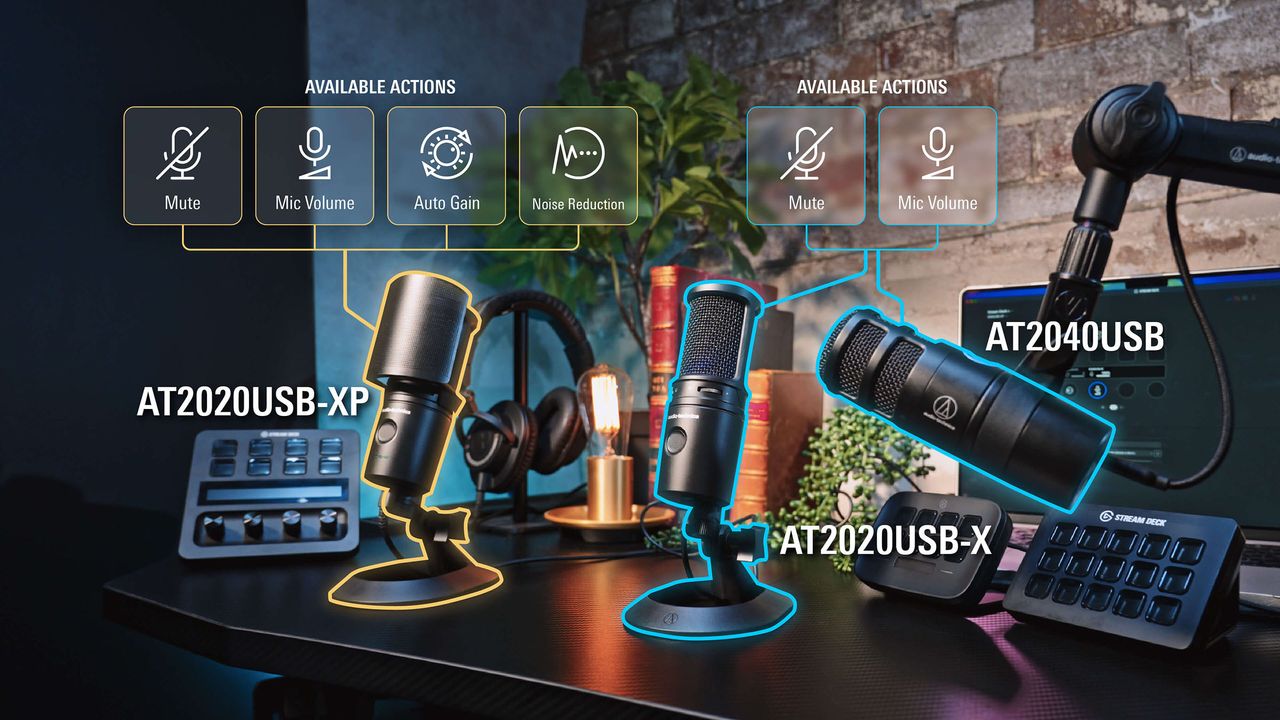
-
Parks: Cable Broadband Sub Losses Slow Down
General Source
-
ICE fatally shoot two men in Maine and Texas
Trump tells immigration officers not to pause vehicle stops after the killings
General Source
-
Cox Media Group Taps Waymark for AI Ad Creation Tools
General Source
-
The Odyssey is a 'colossal piece of cinema', critics say in rave reviews
The film, starring Matt Damon and Zendaya, is director Sir Christopher Nolan's first since Oppenheimer.
General Source
-
SMPTE Kicks Off 110th Anniversary Campaign
General Source
-
ATSC Updates Industry Audio Loudness Guidance
General Source
-
‘Zara death pants’: are these the world’s most dangerous trousers?
Wide-legged and flowing, they are causing a storm on social media, with people posting videos of the fabric getting caught in escalators and causing painful tripsName: “Zara death...
General Source
-
Backyard Biennial: East review – this morose and meaningless exhibition gave me a migraine
Whitechapel Gallery, LondonI feel bad for the artists whose work has been crowbarred into a wonky show about migration, protest, climate and identityIt’s rare that an exhibition is so bad you feel...
General Source
Whitechapel Gallery, LondonI feel bad for the artists whose work has been crowbarred into a wonky show about migration, protest, climate and identityIt’s rare that an exhibition is so bad you feel compelled to text a friend saying “you wouldn’t believe the garbage I just saw” as soon as you get out. And if you can walk around this badly explained, undercontextualised, barely linked, poorly thought through mess of a show without getting a migraine, you have a stronger constitution than me.This is an exhibition about east London. Or maybe it’s about Britishness. Or migration. Or the climate crisis. Or music. Or global trade. Whitechapel Gallery doesn’t seem to really know, so what chance do the rest of us have of figuring it out? The gallery would argue it’s about all of these things; I’d say it manages to be about none of them. Continue reading...
-
The Odyssey review – Nolan goes god-tier with breathtaking epic of men, monsters and moral metamorphosis
Doing full justice to the Homeric legend, Christopher Nolan amasses an epic cast to convey the true cost of war with film-making of thrilling ambitionA classicist’s verdict: soulful hero flatters...
General Source
Doing full justice to the Homeric legend, Christopher Nolan amasses an epic cast to convey the true cost of war with film-making of thrilling ambitionA classicist’s verdict: soulful hero flatters our times as women and nuance pushed overboardNolan’s film shot on occupied land. That feels like a betrayalChristopher Nolan reinvents the Homeric legend as a colossal origin-myth story of postwar disillusion, an epic ordeal of anguish witnessed by the dead and presided over by capricious deities who participate on almost equal terms with the humans. It speaks to the generational pain of PTSD; plenty of soldiers come home in person after any war promptly enough, but arriving back to their prewar state emotionally or spiritually can take years or decades and may never happen at all. The invisible odyssey of anguish is punctuated by flashback episodes, hallucinations, confrontations with the arbitrary gods of dysfunction. And all the time the spouses and children cannot move on with their lives.This is a film with thrilling ambition, boldness, seriousness, generosity and flair. There are some broad-brush moments in the dialogue, yes, but even these are applied with a muscular flourish. It has gasp-inducing, Imax-sized landscapes of loneliness shot by cinematographer Hoyte van Hoytema – who, incidentally, avoids the sea’s traditional cliched colour – and full-tilt battle sequences and fight scenes accompanied by the throbbing and thrumming of drums. Continue reading...
-
UPDATED: FCC to Vote on Replacing National Broadcast Ownership Cap
General Source
-
A modern odyssey: the archaeologist following Homer’s route on a bicycle
As Christopher Nolan’s star-studded adaptation is released, Australian archaeologist and cyclist Sam Wood has recreated Odysseus’ journey on two wheelsBackpacking around Europe is a rite of...
General Source
As Christopher Nolan’s star-studded adaptation is released, Australian archaeologist and cyclist Sam Wood has recreated Odysseus’ journey on two wheelsBackpacking around Europe is a rite of passage for many young Australians but when Sam Wood proposed a trip with his two brothers in 2009, he had something a little more ambitious in mind.An avid cyclist who studied classical archaeology at the University of Sydney and spent three years working at the British Museum, he suggested retracing the route that the Carthaginian general Hannibal took over the Alps with his war elephants in 218BC. Continue reading...
-
Students and recent graduates: tell us your best and worst experiences of uni societies
We would like to hear about the highs and lows of university clubs and societiesAs a new academic year approaches, we would like to hear from students and recent graduates (five years ago or less)...
General Source
We would like to hear about the highs and lows of university clubs and societiesAs a new academic year approaches, we would like to hear from students and recent graduates (five years ago or less) about their experiences of university clubs and societies that freshers might find instructive.What was your best experience of a university club or society? And what was your worst? Continue reading...
-
Zombies, gore and creepy kids – why we can’t stop playing horror games
As global anxieties multiply, video games from Resident Evil to Mouthwashing are providing rich source material to help decode society’s problems• Don’t get Pushing Buttons delivered to your...
Entertainment Source
As global anxieties multiply, video games from Resident Evil to Mouthwashing are providing rich source material to help decode society’s problems• Don’t get Pushing Buttons delivered to your inbox? Sign up hereHorror is so hot right now. There’s Obsession, Evil Dead Burn and Hokum in the cinema, Widow’s Bay, From and Something Very Bad Is Going to Happen on TV, and, of course, a rotting smorgasbord of horror games including Resident Evil Requiem (pictured top) and Reanimal, soon to be joined by Silent Hill: Townfall, Silver Pines and Dreadmoor. We’re also seeing weird cross-pollinations, with horror movie studio Blumhouse making games, while games themselves become horror films and the whole backrooms genre infects every medium it touches.So it was fascinating to attend last week’s horror and gaming conference at Falmouth University, in Cornwall: a gathering of students, researchers and lecturers, all engaged in the academic study of horror games. There were brilliant talks on zombies and posthumanism, the gothic in games, and the role of monstrous little girls in survival horror (there are a lot of them!). Subjects as diverse as masculine fragility, disability and ageing came up; Will Doyle, creative director at Supermassive Games, gave a great keynote on the art of creating horror in games using tools such as revulsion, spatial alienation and the human instinct of apophenia. I learned a lot about theorists such as Julia Kristeva and Mark Fisher, and about the technical similarities between indie horror games and film noir (for example, the use of darkness and creative camera techniques to “hide” budget restrictions). It was incredible fun. Continue reading...
-
‘This is my bucket-list spot for wild camping’ Outdoors expert Sian Lewis answered your questions
The Filter’s authority on camping and the outdoors, Sian Lewis answered your questions on the best tents for all conditions, how to keep out wildlife, and meals to make your kids happyejtp19 asks:...
General Source
The Filter’s authority on camping and the outdoors, Sian Lewis answered your questions on the best tents for all conditions, how to keep out wildlife, and meals to make your kids happyejtp19 asks: My six man Hi-Gear tent complete with zipped off sleeping area is on its last legs and I need to replace it. I’ve got the romantic urge to go for a teepee/bell tent ... but I’m worried I’m going for style over substance. How annoying is not having a zipped-off sleeping area? Is there a teepee/bell type tent with a separate bedroom and is it worth it?Sian replies:I have a bell tent and I absolutely love it for festivals, weddings and family camps, but they do have limited uses - they’re heavy, only have one room as you said, and take a while to erect and dismantle. I also paid to have mine cleaned after a few years of use as polycotton isn’t fully waterproof and can get mildewed if you don’t put it away fully dry.You could look at something in between a bell tent and a tech-y tent - I rate Robens for quality and its Fairbanks Grande and Fairbanks Venturer are gorgeous, teepee styles that are easier to transport and erect (but with no sleeping areas). The only teepee-style tent with sleeping compartments I can find is Decathlon’s Teepee 5.2.Firstly, camping alone as a woman is brilliant - once you get used to it. It can take a few camps to feel confident, and I’d recommend starting in a comfy campsite by yourself or even going for a solo glamping trip and seeing if you enjoy having some time alone under canvas. I’ve wild camped alone hundreds of times and always really enjoyed it. I’d suggest trying one night alone not far from your car - if you don’t like it you can always drive home and try another time.If you fancy trying wild camping, firstly make sure you’re aware of where you can camp legally, and let someone know your plans and location. I like to take some creature comforts such as a good book or a podcast (not a true crime one, mind).. Remember that no-one knows who you are once you’re inside a tent. Pitch late and leave early and you’ll probably have your spot all to yourself. Continue reading...
-
NAB: NextGen TV Represents 'an Essential Investment in the Future of Free, Local Television'
Entertainment Source
-
‘They want to break our will’: Gaza flotilla activist tells of rape in Israeli detention
Anna Liedtke files criminal complaint in Israel over alleged attack by female guards and says abuse was intended to silence campaignersThe third time Anna Liedtke was subjected to an illegal...
General Source
Anna Liedtke files criminal complaint in Israel over alleged attack by female guards and says abuse was intended to silence campaignersThe third time Anna Liedtke was subjected to an illegal strip-search in Israeli detention, female prison guards forced her on to her knees, covered her mouth to stop her screaming and raped her, according to interviews and a criminal complaint filed in Israel.She described hearing male guards laughing during the attack, which she believes they watched and may have filmed. It took place in an area separated from the prison hallway by a partially drawn curtain that her attackers had left open. Continue reading...
-
Hitomi Broadcast to Launch Spectra HDR Color Verification Tool at IBC2026
General Source
-
How to turn empty broad bean pods into a mouthwatering risotto – recipe | Waste not
Use the whole pod – husks, beans and all – for a rustic, nutritious version of a seasonal favouriteTom Norrington Davies is a friend, fellow chef and one of the best yoga teachers I know, so you...
General Source
Use the whole pod – husks, beans and all – for a rustic, nutritious version of a seasonal favouriteTom Norrington Davies is a friend, fellow chef and one of the best yoga teachers I know, so you can probably imagine my pleasure on recently coming across his recipe for broad bean and mint risotto, which he wrote for The Eagle Cookbook in 2009. Like many restaurants, this legendary gastropub pods their broad beans to reveal the beautiful green bean inside; this is my zero-waste interpretation. Continue reading...
-
Writers Guild sues to block Paramount-WBD deal
The Writers Guild of America has filed a federal lawsuit seeking to block Paramount Skydance’s proposed takeover of Warner Bros. Discovery, arguing the deal would reduce competition for writers...
General Source
The Writers Guild of America has filed a federal lawsuit seeking to block Paramount Skydance’s proposed takeover of Warner Bros. Discovery, arguing the deal would reduce competition for writers and lower pay. The action was filed by WGA West and WGA East in the US District Court for the Northern District of California. The guilds allege the combination would violate US antitrust law by reducing competition in markets for episodic TV and streaming writing, overall television writing deals and screenwriting for major theatrical films. The complaint says the merged company would have the ability and incentive to cut costs by suppressing writers’ wages and reducing output, leading to fewer employment opportunities. The WGA action follows a separate lawsuit by 12 Democratic state attorneys general, led by California, seeking to block the deal. The states argue the transaction would reduce competition in theatrical film distribution and basic cable programming, with possible consequences for prices, consumer choice and employment in the entertainment industry. According to the Associated Press, the states have also sought emergency relief to prevent the companies closing the transaction while the case is heard. California Attorney General Rob Bonta has said the merger would lead to higher prices, fewer films and TV shows, and lower content quality. Paramount has rejected the claims, arguing the combination would strengthen competition against larger streaming and technology platforms. AP reported that the company has said the merged group would expand opportunities for writers and maintain two distinct film studios, while committing to release at least 30 theatrical films a year. The proposed acquisition is valued at nearly $111 billion including debt. It would bring together two of Hollywood’s remaining legacy studios and combine assets including Paramount+, CBS, Warner Bros., HBO Max and CNN.
-
‘Please don’t lose another pound!’: Ozempic is upending the wedding dress industry
The ubiquity of GLP-1s is wreaking new havoc on bridal designers who must scramble to accommodate rapid weight lossIn bridal stores across the world, solicitous sales assistants are being trained...
General Source
The ubiquity of GLP-1s is wreaking new havoc on bridal designers who must scramble to accommodate rapid weight lossIn bridal stores across the world, solicitous sales assistants are being trained to ask a new, blunt question: “Are you planning on losing a drastic amount of weight?”Wedding season’s new disruptor is semaglutide, now used by 10% of engaged couples, according to a survey by the wedding planning platform Zola. In the same survey, 42% of couples said the ubiquity of GLP-1s has made them feel they should “look a certain way” for their wedding. Continue reading...
-
How changes to ‘buy now, pay later’ rights affect you
Treasury says shoppers will get a ‘fairer deal’ as new rules for BNPL credit are introduced on WednesdayMillions of shoppers will enjoy more rights and protections from Wednesday as new rules for...
General Source
Treasury says shoppers will get a ‘fairer deal’ as new rules for BNPL credit are introduced on WednesdayMillions of shoppers will enjoy more rights and protections from Wednesday as new rules for “buy now, pay later” take effect in the UK.The government said it was delivering on its commitment to end the buy now, pay later “wild west”. Continue reading...
-
Never mind the garage forecourt – carnations deserve a place in your garden
Easy to grow, hardy and charming, these once-maligned flowers are having a much-deserved comebackYou might not know the term Caryophyllaceae but I guarantee you’d be able to spot a carnation,...
General Source
Easy to grow, hardy and charming, these once-maligned flowers are having a much-deserved comebackYou might not know the term Caryophyllaceae but I guarantee you’d be able to spot a carnation, which is part of this family. Garage forecourt carnations have been having a semi-ironic fashion moment as a cut flower for a while now, but I’m yet to see them making a garden comeback.I’d always dismissed the whole family as fusty, old-fashioned bedding plants for fussy little gardens. But it turns out that whoever is in charge of the carnation comms is having a good run. I keep seeing them around. Rose campion, another Caryophyllaceae, has even turned up in my garden – or rather, it has survived there. I didn’t plant it, and a photo from last July shows a scorched wasteland (it’s now a haven for moths, grasshoppers and bees, which shows what not mowing can do). But they’re biennial (they take two seasons to get from seed to flower), so I guess it was biding its time. It’s bright pink with a soft grey leaf, and not the kind of thing I’d choose, but I’m enjoying it so much I’ll be encouraging it to self-seed in the wildflower patch. Continue reading...
-
TF1 x Netflix: both sides of the deal, live at SME Live 2026
I made the trip from Amsterdam to Paris in June on a hunch that TF1’s upfront wouldn’t be a normal one. I was right. The next morning I scrolled the entire TF1+ hub inside Netflix, shelf by shelf,...
General Source
I made the trip from Amsterdam to Paris in June on a hunch that TF1’s upfront wouldn’t be a normal one. I was right. The next morning I scrolled the entire TF1+ hub inside Netflix, shelf by shelf, from the 7:23am train home to walk you through the whole integration on day one.A month on, I still have questions. So I’m doing something about it. On September 10 at Streaming Made Easy Live in Amsterdam, the day before IBC opens, Laurence Pera (Groupe TF1) and Emma Lloyd (Netflix) will sit with me on stage and we will take those questions live. They’re the first confirmed speakers of this 2nd edition. I could not have picked a bigger story to open with.Quick refresher on why this deal matters. TF1 is now live inside Netflix in France. 5 broadcast channels running 24 hours a day, live sport, breaking news and up to 40,000 titles from TF1+’s catalogue, all sitting inside an interface built for on-demand browsing.Netflix has never embedded a broadcast partner before. Not at this scale, not anywhere. And the deal rewrites more than the home screen. TF1 PUB sells all advertising within TF1 content on Netflix, with Médiamétrie ratings counting towards TF1. Even ad-free Netflix subscribers will see ads when watching TF1 content.On stage, we’ll unpack how the partnership came together, what the integration really took to build and what it means for everyone who thought they owned the aggregation game in France. Now it’s your turn. What would you ask TF1 and Netflix if you had them in the same room? Hit reply or drop it in the comments, I read everything and the best questions are coming on stage with me.Join us in person on September 10 at Rode Hoed, Amsterdam. Get your ticket here with a 15% discount on all tickets. Early bird pricing on Buyer passes runs until July 19, so move fast.That’s it for today. See you tomorrow for another episode of The Media Odyssey Podcast.Marion
-
Sali Hughes on beauty: behold the power of the long-wearing liquid eyeshadow
This nifty addition to your makeup bag will give the impression of a person with time, skill and polish – with every little effortA liquid eyeshadow is the answer to all your eyeshadow misgivings,...
General Source
This nifty addition to your makeup bag will give the impression of a person with time, skill and polish – with every little effortA liquid eyeshadow is the answer to all your eyeshadow misgivings, and I will die on this hill. One neutral, long-lasting shadow gives the impression, however false, of a person with time, skill and polish, when in fact its effort:effect ratio is a joke.Just daub on to the middle of your lid from lash line to socket, avoiding the inner and outer corners in the first instance, then take a clean fluffy shadow-blending brush and buff in a windscreen wiper motion to spread across to the corners and soften any hard lines. Continue reading...
-
‘People are picking the dumbest fights’: the tortured history of America’s culture wars
In a new book, Isaac Butler goes back to the 1980s to trace how battles started against the arts, from Piss Christ to Mapplethorpe, and looks at what we can learn for todayIsaac Butler is...
General Source
In a new book, Isaac Butler goes back to the 1980s to trace how battles started against the arts, from Piss Christ to Mapplethorpe, and looks at what we can learn for todayIsaac Butler is limbering up for an event at Politics and Prose, an independent bookshop and venerable Washington institution, but still has time to explain his arm tattoos.They variously depict: a logo from his grandparents’ company in the 1960s; a satellite that his father worked on at Nasa; a “jaunty crab” for his wife, who finds crabs “hilarious”; an iris by Japan’s Utagawa Hiroshige for Butler’s daughter, Iris; a drawing of a scene from a production of The Seagull by the Russian theatre maker Konstantin Stanislavski; and an artwork by the American painter and photographer David Wojnarowicz that shows a house on fire. Continue reading...
-
The best fake tan in the UK for a sunkissed, streak-free glow – tested
Want to recreate the lustre of days spent in the sun with none of the damage? Try these expert-approved formulas• The best IPL and laser hair removal devices testedThe wise among us would never...
General Source
Want to recreate the lustre of days spent in the sun with none of the damage? Try these expert-approved formulas• The best IPL and laser hair removal devices testedThe wise among us would never forgo our safe-sun protocol, but there’s no denying that many of us feel happier and healthier with a tan. The irresistible lure of sunkissed skin has long been a summer staple – and from tanning waters to wipes, instant tans to gradual tanning moisturisers, there are now more ways than ever to get a faux glow.There’s also been a growing demand for multitasking beauty products, so the newest fake tan formulas often add skincare benefits alongside the bronze. Self-tans infused with hyaluronic acid, niacinamide and vitamin C hydrate, nourish and protect, much like your usual body cream or facial serum.Best fake tan overall: Bare by Vogue Williams clear tan waterBest budget fake tan:Dove Summer Revived Sunkissed Glow + Pro-Ceramides gradual tan lotion Continue reading...
-
Media over QUIC: What if quality, latency and scale were never actually in conflict?
Live streaming has long presented a structural tradeoff: protocols optimized for low latency, such as WebRTC, do not scale efficiently to large audiences, while protocols built for CDN-scale...
General Source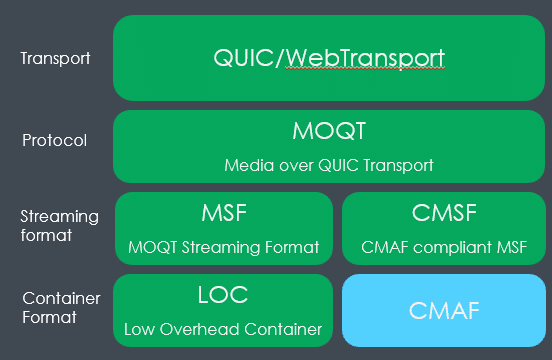
Live streaming has long presented a structural tradeoff: protocols optimized for low latency, such as WebRTC, do not scale efficiently to large audiences, while protocols built for CDN-scale reach, such as HLS and DASH, impose a latency floor that makes them unsuitable for time-sensitive use cases. Media over QUIC (MoQ) is a fruitful effort to address both constraints within a single protocol — and in 2026, it is moving from standardization work to commercial deployment. The QUIC emergence of MoQ The live streaming industry has been working around the same fundamental limitation for over a decade. HTTP-based protocols — HLS, DASH, and their low-latency variants — have proven extraordinarily scalable and operationally mature. They power the vast majority of streaming traffic on the internet today – they work reliably at any scale, integrate naturally with CDN infrastructure, and benefit from decades of tooling and operational experience. Their segment-based model does impose a latency floor that LL-HLS and LL-DASH have progressively reduced, typically reaching the 2–6 second range in real-world deployments. For the growing class of use cases where sub-second latency matters — live sports, interactive events, live betting — that gap remains a genuine constraint. WebRTC solved the latency problem but created a different one. Every viewer requires a dedicated session on a Selective Forwarding Unit (SFU). When reaching thousands of concurrent viewers, that architecture becomes expensive and complex to operate. WebRTC was designed for video calls, not for streaming at scale. Media over QUIC takes entirely a different approach. Instead of segments, MoQ treats media as a continuous stream of individually addressable objects — one per video frame, one per audio chunk. Instead of pull-based HTTP requests, it uses a publish/subscribe model where intermediate relays subscribe to content once and push the stream to millions of subscribers. This is structurally different from WebRTC, where every viewer requires a dedicated session, and from HLS/DASH, where every segment request travels independently up the CDN chain. The result is an architecture that can deliver sub-second glass-to-glass latency at CDN scale. The protocol runs on QUIC — the same transport that powers HTTP/3 — which gives it native browser support via WebTransport[1], stream multiplexing without head-of-line blocking, and intelligent handling of packet loss without the blunt instrument of TCP retransmission. From IETF draft to industry standard MoQ is being developed at the IETF by the Media over QUIC working group. The core specification for Media over QUIC Transport(MOQT), `draft-ietf-moq-transport`, has reached revision 18 as of May 2026, and the working group is targeting a Working Group Last Call at IETF 126 in Vienna in July 2026 — the last formal gate before RFC publication. The protocol is now widely stabilized. The data model (tracks, groups, objects), the pub/sub control messages (SUBSCRIBE, PUBLISH, FETCH), and the QUIC and WebTransport bindings are converged. What remains in active development are advanced features — mechanisms for dynamic track switching, filter-based content selection, and fill-fetch for catch-up playback — which are being refined through a rigorous program of interoperability testing. Alongside the transport with MOQT the working group has adopted several companion specifications: the MOQT Streaming Format (MSF), which defines how video and audio are packaged as MoQ objects using the Low Overhead Container (LOC) for efficient frame encapsulation. MSF also describes how media and event tracks are signaled in a JSON “catalog,” serving a role similar to a DASH manifest or HLS playlist. its CMAF-compatible variant (CMSF) for operators already running CMAF workflows. For operators running CMAF-based workflows today, the CMSF format provides a defined migration path: the same fMP4 chunks can be packaged as MoQ objects, reusing existing encoder infrastructure while gaining the benefits of MoQ delivery, as demonstrated by Ateme at NAB 2026. An ecosystem that moved faster than the RFC The industry did not wait for the RFC. At Mile High Video 2026 in Denver, MoQ dominated the technical program. Topics ranged from ABR adaptation strategies for MoQ to live sports watch parties, VOD synchronized playback, and AI-generated event timelines. The volume of MoQ research presentations in a single conference edition is itself a signal: MoQ is where the industry’s engineering attention has moved to. At NAB Show 2026 in Las Vegas, demonstrations from over a dozen vendors made MoQ tangible and cross-vendor for the first time. Ateme demonstrated DRM-protected low-latency live MoQ streaming in partnership with EZDRM and also demonstrated sub-second latency delivery while maintaining high video quality — a combination that has historically forced a tradeoff. Ateme engineers have also contributed directly to the open-source ecosystem, providing key contributions for MoQ support to Shaka Player -the reference open-source javascript player – which was tested against the live Ateme TITAN encoder output through both Cloudflare and self-hosted MoQ relays. Subsecond latency demonstration by Ateme at NAB 2026 There were already some hints towards commercial deployments: Cloudflare deployed MoQ relay infrastructure across its entire edge network — 330+ cities — built on its open-source `moq-rs` implementation. nanocosmos launched MoQ in production at IBC 2025, reporting early adopter deployments reaching hundreds of thousands of concurrent viewers Oracle Video @ Edge entered the market asa MOQT relay fabric for enterprise media workflows. Red5 launched a managed MoQ relay service in partnership with CacheFly. Together, these deployments mark the transition from protocol experimentation to commercial infrastructure In May 2026, Ateme teamed up Big Blue Marble in its Proof of Concept (PoC) to evaluate MoQ. This PoC aims to test MoQ in a live sports environment, utilizing live broadcast feeds to assess MoQ’s performance, scalability, and operational readiness for future live event streaming. The OpenMOQ consortium: coordinating the ecosystem With multiple organizations moving simultaneously, the risk of fragmentation is real. That is the problem OpenMOQ was created to solve. Founded in September 2025, OpenMOQ is an industry consortium – of which Ateme is a member – focuses on interoperability, shared tooling, and coordinating MoQ adoption across the vendor ecosystem. It is not a standards body – the IETF remains the home of the specification — but a coordination layer that ensures the implementations converging on the IETF drafts can are interoperable to each other in production. The practical significance of OpenMOQ is that it changes the dynamics for operators evaluating MoQ. When multiple CDNs, encoder vendors, and player SDK providers are coordinating on interoperability, the risk of betting on a single vendor’s interpretation of the spec drops considerably. What MoQ changes for operators — and what it doesn’t MoQ is not a wholesale replacement for existing infrastructure. HLS and DASH will continue to serve the vast majority of streaming traffic for years, and for non-latency-sensitive content they remain the right choice. The use cases where MoQ changes the equation are those where sub second latency matters: live sports and betting, interactive events and any scenario where viewers need to experience the same moment simultaneously. In those contexts, MoQ offers something genuinely new: the ability to achieve WebRTC-class latency with CDN-class scale, without operational overhead. While this blog post mainly mentions the B2C, secondary distribution aspects, it is worth mentioning that MoQ is a highly interesting candidate for primary distribution. MoQ would allow a broadcaster to publish once into the relay network and have affiliates, regional distributors, and platform partners subscribe directly via MOQT. Ateme participated to the Oracle Video @ Edge NAB 2026 demo, which demonstrated this use-case. MoQ for primary distribution allow scaling far more easily when affiliates multiply. MoQ’s pub/sub model means the broadcaster publishes once; the relay network handles the distribution. What the standard still needs to address Several gaps are worth naming for anyone making architectural decisions today. Monetization and ad insertion are partially specified in MSF. Ad insertion support in MoQ is partial. The MSF Event Timeline already can carry SCTE-35 cue points for client-side ad insertion. An extension is considered to allow server-guided ad insertion. Beyond that, the picture is incomplete: server-side ad stitching is not standardized, and MoQ has no equivalent yet to the interstitial mechanisms defined in HLS or the 6th edition of DASH. VOD support remains limited in the current core spec. The working group has acknowledged that full video-on-demand semantics — range-based playback, trick play, seek — require patterns not yet formally specified. The Fill Fetch mechanism being finalized improves the situation for live catch-up, but VOD over MoQ is still a work in progress. ABR switching in the relay is architecturally novel and still being defined. The Dynamic Track Selection mechanism (relay-driven quality switching based on congestion signals) and the Top Tracks Filter are both heading toward standardization, but neither is yet in the stable core draft. Player-side ABR logic for MoQ also lacks the decades of tuning that HLS/DASH ABR algorithms have accumulated. The browser ecosystem still has gaps. WebTransport — the browser API that MoQ depends on — is now supported across Chromium, Firefox, and as of April 2026, Safari iOS 26.4. But deployment of WebTransport-capable browsers is not yet universal, and operators targeting diverse device populations will need fallback paths for the foreseeable future. Finally, if MoQ is envisaged for Primary distribution as an alternative to SRT (mp2ts based), it may have to carry rich service information (DVB SI/PSI Tables or ATSC System Information) that describes service information including EPG data, conditional access information and regulatory metadata. A MoQ-based primary distribution system would need to define how this metadata is carried. Additionally, primary distribution content is typically protected via conditional access systems (CAS), while MoQ’s security model targets DRM. None of these are reasons to dismiss MoQ — they are reasons to plan carefully, and to be precise about which use cases are ready for production today versus which will mature over the next two to three years. How Ateme helps As a global leader in video delivery solutions, Ateme is approaching MoQ on several fronts. First, at the encoder level: pushing the boundaries of ultra-low latency compression with TITAN to ensure that the quality-latency tradeoff that has long constrained live streaming simply doesn’t have to exist. Second, at the standards level: actively contributing to the interoperability and viability of the MoQ ecosystem — through membership in OpenMOQ, contributions to Shaka Player, and hands-on validation of the protocol stack in real conditions as done for NAB 2026 over the cloudfare or the oracle cloud infrastructure or in the platform of the Big Blue Marble platform. With solutions spanning contribution, transcoding, packaging, and delivery across every network type Ateme is uniquely positioned to guide customers through the MoQ transition, whatever their infrastructure starting point. The bottom line MoQ is at the inflection point between promising and proven. The RFC finalization is imminent. The ecosystem is real and the market is forming. Relay infrastructure starts being deployed. The browser support gap, long a barrier to end-to-end MoQ delivery, is narrowing with WebTransport support landing across major browsers in 2026. For technical decision-makers evaluating streaming architecture, the question for those seeking sub second end to end low latency is no longer whether MoQ matters — it is how quickly your end-to-end chain from contribution to player can be upgraded. [1] WebTransport is the API co-developed by W3C and IETF that gives JavaScript controlled access to QUIC streams and datagrams, within a security model the browser can enforce, without exposing raw UDP sockets. L’article Media over QUIC: What if quality, latency and scale were never actually in conflict? est apparu en premier sur Ateme.
-
Sail away to the Côte d’Opale: a watery adventure in northern France
A catamaran service from Dover to Boulogne is the perfect start to a trip exploring the Pas-de-Calais and marshes of Saint-Omer by bike, boat and kayak“It’s all about tuning into the culture of...
General Source
A catamaran service from Dover to Boulogne is the perfect start to a trip exploring the Pas-de-Calais and marshes of Saint-Omer by bike, boat and kayak“It’s all about tuning into the culture of the sea,” helmsman Chris O’Brien tells me, scanning the rippling cobalt horizon from the wheel of a catamaran. “People find the water, and the meditative experience of sailing, healing.” Meditative isn’t a word that usually comes to mind when talking about cross-Channel ferries on a bank holiday weekend, but this is no ordinary ferry.Launched last year, SailLink operates a largely wind-powered (engines are only used when necessary) service from Dover to Boulogne up to five times a week between April and mid-September, with a new Shoreham to Fécamp route due to start trials later this year. Continue reading...
-
A moment that changed me: I started yoga – and saw my scoliosis in a surprising new light
As a teenager I declined a painful operation to straighten my spinal curvature, and it was a decision I sometimes regretted. But through daily stretching and exercise, my relationship with my body...
General Source
As a teenager I declined a painful operation to straighten my spinal curvature, and it was a decision I sometimes regretted. But through daily stretching and exercise, my relationship with my body was transformedI was 13 when a spinal surgeon gave me unsolicited career advice. “Scoliosis won’t ruin your life,” he said, peering over his spectacles, “unless you want to do bikini modelling.” As a young teenager, I hadn’t thought much about job prospects, let alone modelling, but his words stung. It also curdled my situation into a lose-lose scenario: either have a painful operation to fuse metal rods with my spine, or endure a lifetime with an abnormally twisted back.Until this point, I’d perceived my spinal curvature in terms of the inward experience: pain. Now, I became aware of an external dimension: a disfigurement. Something to be hidden. This did me no favours as a teenager in the age of Instagram. While I declined the operation due to the risks and the extended leave from school, the surgeon’s blithe remark burdened me with shame. Continue reading...
-
Marie Frank’s recipes for strawberry shortcakes and cardenales with apricot compote
Not a ‘cake person’? Loaded with fruit and whipped cream, these luxurious pastries are sure to hit your sweet spotStrawberry, or any berry, shortcakes are the perfect dessert to make for those in...
General Source
Not a ‘cake person’? Loaded with fruit and whipped cream, these luxurious pastries are sure to hit your sweet spotStrawberry, or any berry, shortcakes are the perfect dessert to make for those in your life who are not cake people. I’m married to a “not cake” person, so I would know. For me, the contrast between the salty, slightly warm shortcake (which is more like a biscuit), whipped cream and macerated fresh fruit is perfection, and hits enough of the sweet spots still to feel like a dessert without actually being cakey. But, first, the cardenal, a truly elegant, light-as-a-feather cake that’s made with alternating rings of genoise sponge and meringue all sandwiched with whipped cream. Though the building blocks are simple – meringue, sponge and cream – when combined, they turn into something really special. Continue reading...
-
The scary rise of locksmith scams: ‘I was shut out with my baby – and charged £2,200 to get back in’
In the UK, these scams have become an epidemic, rising 147% between January and March, compared with the same time last year. Why are they suddenly so common? And what can you do if you’re charged...
General Source
In the UK, these scams have become an epidemic, rising 147% between January and March, compared with the same time last year. Why are they suddenly so common? And what can you do if you’re charged thousands for a quick, easy job?Sarah was alone in her flat with her three-month-old baby when a man put a card machine in her face and demanded she pay £2,209. A few hours earlier Sarah, 30, had been for a walk with her daughter when it dawned on her that she had left her keys at home. She did what most people would do in the same situation: search Google for a nearby locksmith. “I had a screaming baby, so I needed someone to quickly let me in,” she says.Sarah came across a seemingly legitimate company, near the top of the search results, which was sponsored. The company’s website said prices started at £45 and claimed they had received “4,500-plus five-star reviews and counting”, so she called them. When the locksmith arrived, Sarah says, he “seemed pleasant and relatively quiet” at first. After examining her lock, however, he told her it was a high-security one and the only way to get inside was to drill it open. He broke his way in and changed the lock before delivering another blow: he had accidentally damaged the internal mechanism, which also needed replacing. After Sarah got inside and placed her baby on a changing mat, the locksmith told her the price: £2,209. Continue reading...
-
World Cup: Argentina vs. Egypt?The Reigning Champion?s Comeback and Added-Time gift for Advertising
Yospace is collecting streaming and advertising data from 14 OTT rights-holders worldwide throughout the tournament, showing how in-match events shape streaming audiences and advertising...
General Source
Yospace is collecting streaming and advertising data from 14 OTT rights-holders worldwide throughout the tournament, showing how in-match events shape streaming audiences and advertising opportunities. In this article, we're analyzing Argentina's 3-2 win against Egypt, with a stunning comeback perhaps only the reigning champions could secure.
-
Moving Beyond Cost-Cutting to Optimize Streaming TCO
Video services are under immense pressure to reduce costs and optimize Total Cost of Ownership (TCO). However, a tunnel vision focus on cost efficiency alone is a risky strategy for a number of...
General Source
Video services are under immense pressure to reduce costs and optimize Total Cost of Ownership (TCO). However, a tunnel vision focus on cost efficiency alone is a risky strategy for a number of reasons. If video services want to truly optimize TCO, they need to look much wider than solely focusing on cutting costs.
-
Cutting CDN Costs: A Conversation with CDN77
Recently, I sat down with Katerina “Kate” Dobnerova and Juraj Kacaba of CDN77 to discuss one of the largest recurring line items that every video publisher faces: CDN costs. By way of background,...
General SourceRecently, I sat down with Katerina “Kate” Dobnerova and Juraj Kacaba of CDN77 to discuss one of the largest recurring line items that every video publisher faces: CDN costs. By way of background, CDN77 is a video-focused global CDN that’s been in the market for 14 years, running a network with more than 300 Tbps of capacity and daily peaks around 85–90 Tbps, with roughly 90% of it video, both live and VOD. Their traffic is split across Europe, the US, APAC, and emerging markets, and they walk customers through exactly this kind of cost analysis all the time. Without question, CDN delivery is critical infrastructure; get it wrong, and you don’t have customers. But it’s also expensive, and there’s real money to be saved without touching the quality of experience. This conversation looks at the problem from two directions: cutting the bits you create and deliver, and cutting the cost of the CDN itself. It’s lightly edited for length and clarity. Here’s a link to the video, which I’ve embedded below. Cutting the Bits Jan Ozer: Let’s start our cost-cutting journey with encoding. Per-title encoding lets you cut the bits you store and deliver. How many of your customers are using per-title encoding, and how many are moving to CMAF packaging to reduce storage and delivery costs? Juraj Kacaba: We see a decent number across the whole scale. We serve customers from what we call growth plans, which are the smaller customers, up through large enterprise solutions. Especially at the higher end, we see either per-title encoding or some form of smart bitrate optimization across the board. Most customers are doing at least some type of optimization. Jan: Where’s AI showing up in that? Juraj: It comes down to the specific customer, because every use case, implementation, and device mix is different. What we currently see is a prevalence of AI-driven tools for CRF or similar approaches that are built on open-source standards and then fitted tightly into the ecosystem the client already uses. Jan: What about codecs? How much advanced-codec usage are you seeing? H.264 versus HEVC versus AV1? Juraj: It’s heavily use-case specific. On mobile you want to stick to the format that’s most widely supported across devices, and you have mobile networks in play. On standard OTT platforms, we increasingly see AV1 and other cutting-edge codecs. If I had to put rough numbers on it, I’d still say about 80% is H.264, with the rest split among the newer formats. Clients implement the new codecs but keep H.264 to support all the older devices. Jan: And CMAF? Juraj: For all new standardized applications, CMAF is now quite prevalent. Having one data source for both HLS and DASH is clearly the way forward. In practice, it’s roughly half the traffic. Most major clients have their own pipelines; even for those using our encoders, we still see them keep DASH for legacy devices. And in heavily customized pipelines you’ll see even more obscure formats. But about half the traffic is CMAF today. Making Caching More Efficient Jan: Once you’ve done what you can on the encoding side, improving caching efficiency seems like the most effective way to cut delivery costs. If I’ve got the encode side covered, is caching where you’d start? Kate Dobnerova: Let me give the bigger picture first, then narrow it down. More often than not, companies go straight for squeezing the per-gig rate, which can make sense. But it’s always worth running a full cost analysis of the entire workflow first, not just the CDN line item. Start with origin and processing. What do you actually spend to prepare and serve the content before it even hits the CDN? Very often clients spend more on storing, processing, and getting data to the CDN than on the CDN traffic itself. Egress — the traffic between the origin and the CDN — is often the single biggest source of hidden costs. So the first question we ask is: how do we eliminate egress in the first place? Could some of these operations move to the edge? Then there’s cache efficiency, which moves the needle most for VOD-heavy platforms. Every cache hit means content is served from cache; every cache miss means a trip back to origin, which — as I said — often costs more than the CDN traffic itself. In practice, getting your cache hit ratio from, say, 92% to 97% can save you more than anything you’d negotiate on the per-gig price. After that come device-specific manifests, capped CRF, and smarter ABR ladders. And only once you’ve worked through all of that do you get to the commercial levers: committed contracts, multi-CDN leverage, and renegotiation. Jan: You mentioned 92% versus 97% for cache hit ratio. Is 97% achievable? Is that a common number? Kate: It’s always client- and use-case specific — the target for live is different from VOD, because VOD comes with different challenges. With VOD, you have huge libraries, content growing exponentially, and content lifecycles that change dramatically, while the demand on the cache ratio stays high. So there’s no universal formula. But for VOD-heavy platforms, we’re usually aiming for something like 97–98%. Figure 1. Katerina Dobnerova, Head of Technical Integration, CDN77. “Getting your cache hit ratio from, say, 92% up to 97% can save you more than anything you’d negotiate on the per-gig price.” — Kate Dobnerova, CDN77 There are different strategies to get there. One is a multi-layer CDN architecture, or a hierarchical network of servers with more layers between the edge servers closest to end users and the origin. The most popular, “hot” content is cached closest to the end users, on edge servers in many locations. In CDN77’s case, that’s more than 200 locations. If content isn’t cached at the edge, you fetch it from anywhere in the infrastructure rather than from origin: mid-tier layers in fewer, bigger locations, all the way down to an origin shield, which is typically a single location in front of the origin server. So if you publish a new series, instead of 200 edge locations each fetching from origin, you ideally fetch it once from the origin shield. On top of that, there are cache-optimization strategies at the server level: admission and eviction algorithms, so only content likely to be requested repeatedly gets cached; consistent hashing, so only unique content is cached; and Bloom filters, which, in short, means the servers talk to each other and know what’s cached on each layer. There are dozens of these optimizations; those are just a few. Choosing a CDN Jan: Once a streamer has done everything they can on caching, they’re looking at either another CDN or getting the cost down on their current one. If I’m thinking about switching, what should I look for in pricing? Kate: A few boxes to check. First, transparency and simplicity — I want to understand the big picture of what I’ll actually pay, not a thirteen-page pricing script. Some providers still charge for requests, which we don’t, and clients often only realize it at the very end because it wasn’t stated transparently. Then: if I migrate, does it create cost elsewhere? What’s their caching strategy, and how cache-efficient can they be? Is my egress cost going to stay the same, go down, or go up? I’d also look hard at the provider’s financial stability. We’ve seen four CDNs exit the market, and prices going up. I want predictability. Migrating to another CDN is not a simple DNS change; it’s a major engineering effort, so I want to know the CDN will still be here in five years. And can they handle my use case entirely, or am I so locked in that I have to keep part of my services with another provider? “I want to understand the big picture of what I’ll actually pay, not a thirteen-page pricing script.” — Kate Dobnerova, CDN77 Jan: How do you even estimate cost without knowing the cache hit ratio, which varies by provider? Kate: When a client comes to us, we start by looking at the cache hit ratio they’re getting with their existing provider — that tells us a lot. But the most important thing is testing. We always ask for a sample of traffic so we can see the traffic structure and exactly how cache-efficient we can be. We can’t hand someone a price tag until we understand the traffic structure and cache efficiency, so seeing a sample is absolutely crucial. Jan: Do CDNs handle ABR with different levels of proficiency, or is it just bits you deliver? Juraj: From a pure CDN standpoint, it makes no difference to us whether a chunk is high- or low-bitrate. But we build the whole stack with video in mind, and we approach VOD and live differently — even at the hardware level. With VOD you usually have large archives and latency isn’t as critical, so you tend to have a large cache space. With live, we cache the chunks in RAM rather than on SSDs or hard drives, because live viewers are almost all watching the “live edge” — the same few chunks. You want to pull those into cache as fast as possible and push them straight out, with request coalescing and so on. So the nature of the CDN and the hardware stack differ by use case. Figure 2. Juraj Kacaba, Head of Client Implementations at CDN77, “Live viewers are almost all watching the live edge — the same few chunks. You want to pull those into cache as fast as possible and push them straight out.” — Juraj Kacaba, CDN77 Jan: What about long-term storage? If I’m a VOD publisher with an asset that’s accessed infrequently, do I store it in a different tier — and does that extend time to first frame? Juraj: On the origin side, in object-storage terms, there are many providers and offerings. Infrequent-access storage — what AWS and others call it — can save you quite a lot. We run two storage tiers: a standard one optimized for video using HDDs, and a frequent-access, small-file-optimized tier built on SSDs. The right choice depends on the file formats, the structure, and the use case, because any limiting factor in the pipeline will eventually show up in your QoE and your cost. If your archive is large enough, it makes a real difference — with a few terabytes it doesn’t matter much, but with the very large archives that streaming platforms carry today, it’s definitely worth optimizing on the origin side. Jan: What about the location of points of presence relative to your target audience — is that a QoE issue, a caching issue, or both? Juraj: Actually, both. We used to see CDNs quoting crazy numbers—700-plus locations. But the number of POPs is a tug-of-war. You want to be in every corner of the world, as close to end users as possible. But the more edge locations you have, the fewer requests hit each edge server, which means that server is more likely to have to fetch content from the origin shield or even origin. So a huge number of POPs can actually hurt your cache hit ratio if your traffic isn’t extremely global and dense. We have a substantial number of locations, but for specific regions, we sometimes disable POPs because consolidating to one location can improve the hit rate for that country or state. It really comes down to the nature and structure of the traffic. “A huge number of POPs can actually hurt your cache hit ratio.” — Juraj Kacaba, CDN77 Multi-CDN Kate: Let me bridge from there, because it connects to multi-CDN. When clients have multiple CDNs in their stack, they get coverage across all the interconnections and locations in that combined pool. With global traffic, you often find no single CDN has the ideal combination of price and performance everywhere, so multi-CDN lets you get the best of each vendor. We’ve had many clients come to us for delivery in hard-to-reach markets — Africa, the Middle East, Latin America — where we’ve deployed embedded caches directly inside ISP networks, which often lets us offer better business terms and excellent performance thanks to the local deployment. Jan: One way to get a good price is to commit to volume. When does it make sense to go multi-CDN, given I’ll still have to hit thresholds to keep my price on the CDN I’m already with? Kate: You’ve named one of the drawbacks: splitting your volume across CDNs reduces your volume-based discount leverage. But commercially, it also creates a very direct competitive situation, which is an advantage. Then there’s reliability — resilience and redundancy — which makes sense from a risk-management perspective. And coverage, as I mentioned. For large-volume clients, multi-CDN comes naturally; the question isn’t whether to do it but how many vendors to have and how to manage the stack. That said, you’re multiplying your workflows — commercially, because you negotiate with each vendor, and technically, on implementation. It gets more complicated if you’re doing edge computing, where there’s a lack of standardization. Some clients get creative here: they deploy one primary CDN that serves as both the origin shield — which reduces egress — and the edge compute platform, while the remaining CDNs act purely as delivery proxies. Jan: How do I actually control a multi-CDN setup? If I’m a small company with limited engineering, should I use a service, license software, or build it myself? Kate: Both approaches work — third-party services that manage multi-CDN based on configurable rules, or in-house allocation setups. Some clients split traffic equally with a round-robin approach, every third, fourth, or fifth request to a given CDN. But more often we see clients allocate based on a combination of performance and price, controlling volume shares and geographic distribution at the country or ISP level using actual QoE data. That’s typically a regular evaluation — monthly or quarterly. More recently, some clients move traffic close to real time: if you feed CMCD data, CDN real-time logs, and player data into your system, you get log-based visibility into what’s actually happening on the performance level, which lets you make quick decisions and manage QoE through near-real-time actions. Jan: Every CDN reports differently. How hard is it to integrate and analyze those logs together? Juraj: It comes down to the fact that no two providers standardize on anything — logging included. We have our own real-time logging, which we stream into whatever log-processing pipeline or object storage the client uses; they then match the log formats and move on. Or, in enterprise implementations, clients ask us to match their log format, and we’re happy to if it lets them focus on other parts of the integration. The same goes across features — signed URLs, for instance, use a different format at every CDN. When several CDNs exited the market around the same time, we saw a wave of new clients whose platforms were already built around a specific URL format, and changing the whole URL structure is a serious task. So we actually implemented several competitors’ formats into our platform to ease the switch. It can be an endeavor, and this is where Kate’s and my teams try to take on as much of the customization as possible to keep the client’s work smooth. Jan: You said multi-CDN is natural for most of your large customers. Redundancy, price, QoE — what’s the biggest motivation? Kate: It’s a combination of all of them, plus the current market situation. Clients tell us it’s part of their risk-management strategy — with CDNs exiting the market and raising prices, they don’t want to rely on a single provider. Jan: If I’m a small publisher on a single CDN and I come to you wanting to cut costs this way, is that a service you provide — the integration layer — or is that on me? Juraj: We help with specific parts of the implementation. Where we can make an easy change on our end — say, a tweak in the Nginx configuration — we’re happy to, because a small change for us can save days or weeks of development on the client side. The overall integration platform is usually handled by the client, but wherever we see a chance to help, we do. A lot of that happens in shared Slack channels, where we stay on top of the process and help clients in real time as challenges come up. Deciding to go multi-CDN is always a combination of factors. Price-wise, if your traffic allows it, having multiple CDNs is a good thing. But there’s also resilience — you get local network disruptions where some CDNs are affected, and others aren’t. When there isn’t a huge engineering effort behind it, it’s at least worth looking into: mixing and matching CDNs across regions based on what works best for your use case. Kate: I’d just add that you really need to check your boxes and see what works for you. For a smaller publisher, it may not make sense because you lose the volume-based discount and end up with a higher per-gig price simply from spreading traffic across more CDNs. It’s very individual. We consult each client based on their traffic volume, geographic distribution, and usage patterns. Jan: That’s all I have. You’ve both been great — I appreciate the time and a genuinely cohesive, valuable discussion. Kate: Thanks, Jan. Great questions, and hopefully useful. Juraj: Thanks a lot. The post Cutting CDN Costs: A Conversation with CDN77 first appeared on Streaming Learning Center.
-
DMC Deploys Two ‘Reverse Remote Production’ Trucks From Broadcast Solutions
General Source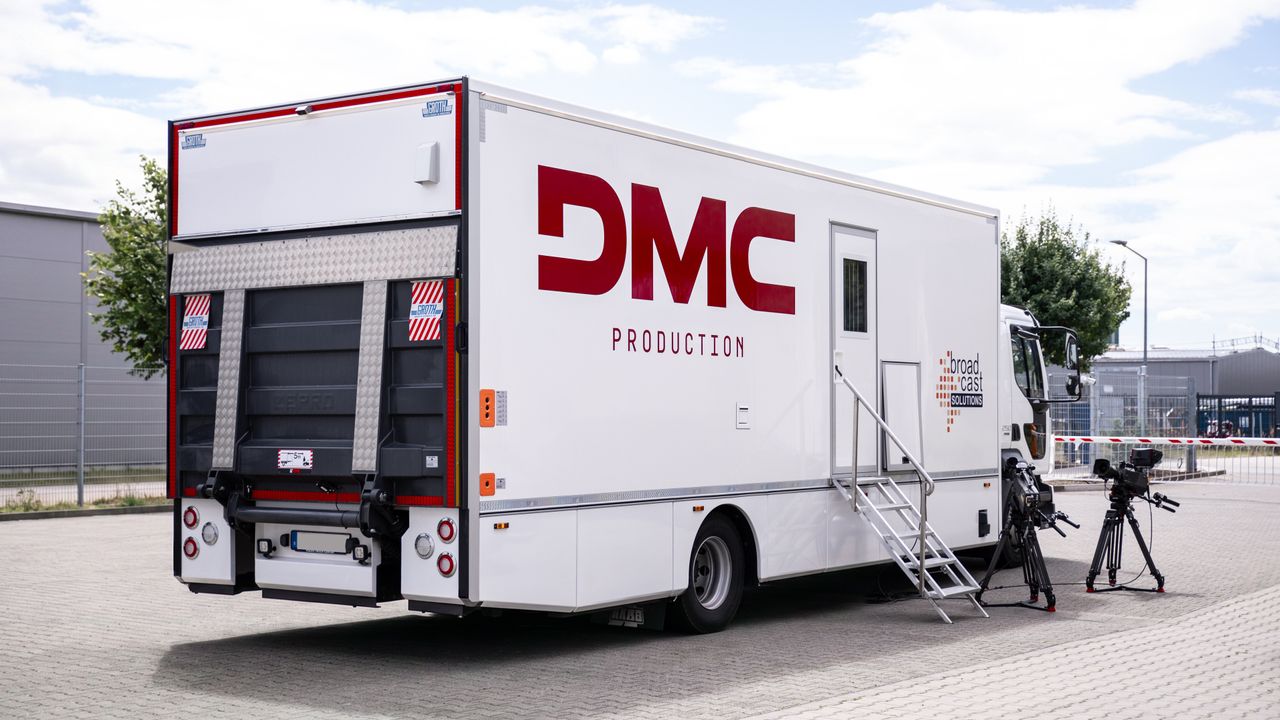
-
AIMS Announces Second IPMX Product Testing and Certification Event
General Source
-
Scripps Sports, Ion Score Women’s Volleyball Rights
General Source
-
S&P Analysis: Three Quarters of Americans Watch Live Sports
General Source
-
Colorado Wildfires Bring Close Call for Broadcasters
General Source
-
We’d like to speak to maritime, port workers, their friends and family about how the Middle East conflict is affecting them
We want to hear from those working or living at sea, including maritime workers, sailors, port staff and family about how the situation is affecting their workThe conflict in the Middle East...
General Source
We want to hear from those working or living at sea, including maritime workers, sailors, port staff and family about how the situation is affecting their workThe conflict in the Middle East continues to disrupt shipping across the region, including in the strait of Hormuz, one of the world’s busiest maritime routes.Donald Trump has once again threatened to take control of the strait of Hormuz, as he announced the reimposition of a naval blockade on Iran and demanded a 20% tariff on all cargoes shipped through the key maritime passage. Continue reading...
-
Tegna Names Scott Gill VP, Technology and Operations
Mike Demenchuk is content manager of TV Tech and content director of the NAB Show Daily, taking on those roles after serving as content manager of Broadcasting+Cable and Multichannel...
General Source
Mike Demenchuk is content manager of TV Tech and content director of the NAB Show Daily, taking on those roles after serving as content manager of Broadcasting+Cable and Multichannel News since 2017. After stints as reporter and editor at Adweek, The Bond Buyer and local papers in New Jersey, he joined the staff of Multichannel News in 1999 as assistant managing editor and had served as the cable trade publication's managing editor since 2005. He edits copy and writes headlines for both the TV Tech print magazine and website, and manages content and production of the NAB Show Daily and other special projects.
-
Tell us: what do you want from the next Labour leader and UK prime minister?
Ahead of Andy Burnham taking over from Keir Starmer, we’d like to hear what qualities, values and priorities people want to see in the next prime ministerAndy Burnham is to become the next prime...
Politics Source
Ahead of Andy Burnham taking over from Keir Starmer, we’d like to hear what qualities, values and priorities people want to see in the next prime ministerAndy Burnham is to become the next prime minister after winning the backing of 349 of the party’s MPs to replace Keir Starmer.In a recent op-ed in The Times, Burnham wrote: “Doing politics differently means levelling with the public, engaging them in decisions and ensuring more social value in return for increased government spending.” Continue reading...
-
The best air coolers to chill your home during UK heatwaves – tested
They’re cheaper and greener than air conditioning, but which evaporative cooler impressed us most?• The best fans to keep you cool, tested• Dyson HushJet Mini Cool fan reviewAir coolers should not...
General Source
They’re cheaper and greener than air conditioning, but which evaporative cooler impressed us most?• The best fans to keep you cool, tested• Dyson HushJet Mini Cool fan reviewAir coolers should not be confused with air conditioning. An air cooler can lower your room temperature by a couple of degrees, while aircon can lower it by tens of degrees. So it’s important to manage your expectations. But air coolers are much more energy efficient: they use a fraction of the electricity of aircon.Evaporative air coolers work by pulling warm air through water-soaked pads. The water evaporates, which uses energy, so the process cools the air. So while it’s not fridge-cold like aircon, the air is cooling – like a sea breeze taking the edge off summer heat.Best air cooler overall: Swan Nordic air cooler – currently out of stockBest portable air cooler:Morphy Richards Flexi Freeze Continue reading...
-
Dynamic Media Facilities Could Reshape the Future of Broadcast Workflows
General Source
-
D-topia review – cosy sci-fi mystery takes aim at AI
PC, PS5, Xbox Series X/S, Nintendo Switch, Nintendo Switch 2; Marimittu GamesA soft puzzle game makes a sharp point about the over-optimised future aheadIn the far future, on a planet that is not...
Technology Source
PC, PS5, Xbox Series X/S, Nintendo Switch, Nintendo Switch 2; Marimittu GamesA soft puzzle game makes a sharp point about the over-optimised future aheadIn the far future, on a planet that is not Earth, AI is in charge. This entity is no Skynet-esque killer robot but a machine that cares for humanity. Manifesting most visibly as cute droids, the technology is pervasive – embedded in everything from the design of the sleek architecture to the gorgeous, mostly sunny artificial weather. The so-called Optimization System has but one responsibility: ensuring the greatest happiness for the greatest number of people.In less skilled hands this game might have felt like an undergraduate seminar on the limits of utilitarianism. But Japanese studio Marumittu Games elegantly marries its philosophical concerns with smart design choices. You play as a young, unnamed Facilitator tasked with tending to both the city’s bots and its human residents. Each morning you wake up, sleepily loping off to the bathroom before sitting down for an exquisitely rendered breakfast, and then embark on your day’s work. Like everything else in this near-future scenario, labour is designed to cause as little frustration as possible, amounting to simple maths brain teasers on a grid – nothing too taxing, but enough to keep you engaged. Continue reading...
-
Why Captioning Workflows Need to Move From Compliance Checks to Content Intelligence
General Source
-
Nominations for Best of Show Awards at IBC2026 Now Open
General Source
-
Live at Scale: The World Cup Exposed Advertising's Infrastructure Gap
With 104 matches, 48 teams, and three host countries, the 2026 World Cup would challenge any campaign plan. But this tournament poses even more structural complexity than ever before: for the...
General Source
With 104 matches, 48 teams, and three host countries, the 2026 World Cup would challenge any campaign plan. But this tournament poses even more structural complexity than ever before: for the first time, a single sporting event of this magnitude is simultaneously airing across broadcast television, multiple streaming services, smart TV homescreens, and social feeds, often within the same household, sometimes on the same couch. And most advertising infrastructure was not built for that.
-
Sneak Preview: The Retention Game: Managing Subscriber Acquisition and Churn
On Thursday, Aug. 13, Roku's Nicole Fencel, Philo's Steven Chang, Women in Streaming Media's Deepali Narsiker, and Horse & Country's David Guinan will join Chris Pfaff for the?Streaming Media...
General Source
On Thursday, Aug. 13, Roku's Nicole Fencel, Philo's Steven Chang, Women in Streaming Media's Deepali Narsiker, and Horse & Country's David Guinan will join Chris Pfaff for the?Streaming Media Connect panel "The Retention Game: Managing Subscriber Acquisition and Churn." Join this closing panel for a candid discussion on which subscriber acquisition and retention strategies work in 2026 and which ones fail to move the needle. Learn how leading streaming platforms are drawing on data science insights and leveraging personalization to turn one-show drop-ins into long-term, loyal subscribers.
-
Building the Perfect Live-Event Operations Playbook
On Thursday, Aug. 13, LinkedIn's Chris Packard, LiveX's Corey Behnke, and MemeHouse's Zylo Hefferan will join the SVTA's Bhavesh Upadhyaya for a Streaming Media Connect panel that examines how top...
General Source
On Thursday, Aug. 13, LinkedIn's Chris Packard, LiveX's Corey Behnke, and MemeHouse's Zylo Hefferan will join the SVTA's Bhavesh Upadhyaya for a Streaming Media Connect panel that examines how top streaming teams prepare for, monitor, and recover from tentpole live events like sports and concerts. The discussion will range from pre-event capacity planning, load testing, and failover strategies to establishing best practices for managing traffic spikes when the stakes are highest.
-
Everyone wants to be the aggregator
That was the question behind the keynote I recently gave. Everyone in this business wants to sit between the viewer and the content. Far fewer are actually built to hold that spot. Here’s what the...
General Source
That was the question behind the keynote I recently gave. Everyone in this business wants to sit between the viewer and the content. Far fewer are actually built to hold that spot. Here’s what the word hides. Being the aggregator means controlling four layers at once. Most of the contenders have two, maybe three. So in the keynote I built a scoreboard and I ran five player types through the four layers: TV manufacturers, Big Tech, telcos, broadcasters and streamers now trying to aggregate each other and the new OS entrants. Besides Big Tech, none of them holds all four yet. Who’s closest, who’s building their missing layer and who’s about to find out they’re a tenant, that’s the talk in this video I made for you. Watch or listen to the video and grab the link to access the deck 👇🏻 Read more
-
EasyJet Holidays’ ‘spa’ resort was lacking an on-site spa or gym
We booked the £1,070-a-week retreat because of the facilities, but when we got there they were a round-trip awayLast month’s tale of a winter break spoiled because easyJet Holidays had neglected...
General Source
We booked the £1,070-a-week retreat because of the facilities, but when we got there they were a round-trip awayLast month’s tale of a winter break spoiled because easyJet Holidays had neglected to state that the hotel’s heated pool and spa incurred hefty charges was discordant music to another reader’s ears. He writes:We returned last month from an easyJet Holidays break at a “wellness retreat” with prominently advertised spa facilities, which turned out not to have any spa facilities whatsoever. We had booked a £1,070 week at the Vasia Sea Retreat in Sissi, Crete, because I wanted access to a gym at least twice a day as rehabilitation from a serious knee injury, and my wife was keen for pool and pilates classes. Continue reading...
-
Microsoft Surface Laptop 8 review: a quality PC whose trackpad taps you back
Snappy performance, long battery life, great keyboard and excellent new haptic touchpad make the best of Windows 11Microsoft’s Surface laptop for consumers is back, faster and with longer battery...
General Source
Snappy performance, long battery life, great keyboard and excellent new haptic touchpad make the best of Windows 11Microsoft’s Surface laptop for consumers is back, faster and with longer battery life and a hefty price increase because of the high cost of memory and chips.The Surface Laptop 8 is a straight replacement for the seventh edition from 2024, which was the first of Microsoft’s new generation of ARM-based, Qualcomm-powered PCs designed to better rival Apple’s MacBook Air and other thin and light machines. Continue reading...
-
A family group walking holiday in Exmoor: steam trains, tree climbing and lashings of ice-cream
Would walking buddies convince reluctant children that hiking can be fun? A group trip with an Enid Blyton vibe proved a hit with the whole family“I’m not going to wake her up,” I hiss at my...
General Source
Would walking buddies convince reluctant children that hiking can be fun? A group trip with an Enid Blyton vibe proved a hit with the whole family“I’m not going to wake her up,” I hiss at my 12-year-old son who’s standing half naked in a dark corridor of a Victorian house. “Please, Mum. She said we could come at any time! I don’t want to get Lyme disease,” he begs.This is not the kind of drama I was expecting when I signed up to a family walking holiday in Exmoor. A few meltdowns about an extra mile or a blister perhaps, but not a night mission to one of the guides to request a tick removal. Continue reading...
-
Summer etiquette: 47 essential rules – from sex to sunloungers to shopping in swimming trunks
When is it OK to go shirtless? What time can you start drinking on holiday? And can you ask a stranger to apply your sunscreen? Experts explain the behaviour that’s hot this summer – and what’s...
General Source
When is it OK to go shirtless? What time can you start drinking on holiday? And can you ask a stranger to apply your sunscreen? Experts explain the behaviour that’s hot this summer – and what’s really, really notSummer means a loosening of rules and norms. Eating with your fingers is suddenly encouraged, near-nakedness is everywhere and a 6am airport pint is unremarkable. It’s a hot, sticky recipe for social chaos and – if you share my view on showing off ungroomed feet – possibly the end times of human civilisation. Here, then, is everything you need to know about summer etiquette. Continue reading...
-
UK children will be one of unhealthiest generations in decades, doctors say
Analysis of 12 indicators including asthma, obesity and vaccination finds child health is ‘national embarrassment’Children in the UK will grow up to be one of the unhealthiest generations in...
General Source
Analysis of 12 indicators including asthma, obesity and vaccination finds child health is ‘national embarrassment’Children in the UK will grow up to be one of the unhealthiest generations in decades, with child health outcomes having declined or stalled completely across all areas, a group of leading paediatricians has said.Reduced vaccination rates alongside rising hospital admissions for asthma and mental health disorders are all contributing factors to the UK’s record on children’s health, which should be seen as a “national embarrassment”, their analysis has found. Continue reading...
-
CBS Atlanta Adds a Noon Newscast
General Source
-
NOAA to Study Potential of Broadcast Datacasting for Weather Alerts
General Source
-
Heidi Raphael to Head N.Y. State Broadcasters Association
Mike Demenchuk is content manager of TV Tech and content director of the NAB Show Daily, taking on those roles after serving as content manager of Broadcasting+Cable and Multichannel...
General Source
Mike Demenchuk is content manager of TV Tech and content director of the NAB Show Daily, taking on those roles after serving as content manager of Broadcasting+Cable and Multichannel News since 2017. After stints as reporter and editor at Adweek, The Bond Buyer and local papers in New Jersey, he joined the staff of Multichannel News in 1999 as assistant managing editor and had served as the cable trade publication's managing editor since 2005. He edits copy and writes headlines for both the TV Tech print magazine and website, and manages content and production of the NAB Show Daily and other special projects.
-
12 States Sue to Block $110 Billion Warner Bros./Paramount Merger
General Source
-
Design Agency Girraphic Uses Vizrt Graphics For Netflix MMA Event
General Source
-
Stretch, be gentle and build flexibility: expert tips on doing the splits
Doing a split may look impressive, but experts caution it should not be done without practice and it may not be for everyoneOn Love Island USA’s recent eighth season, contestant Kenzie Annis...
General Source
Doing a split may look impressive, but experts caution it should not be done without practice and it may not be for everyoneOn Love Island USA’s recent eighth season, contestant Kenzie Annis quickly distinguished herself with her ability to perform the splits, abruptly deploying the maneuver in fits of both delight and rage.Seeing the splits on TV shows such as Love Island and RuPaul’s Drag Race can make people “want to take on that challenge and to push themselves to new heights”, said Ramoni Overton, a yoga instructor and YouTuber based in Los Angeles. Continue reading...
-
SMPTE Expands Free IP for Media Training Resources
General Source
-
ARRI Divests Rental Business
General Source
-
Kat HTML test do not use
General Source
-
UPDATED: Scripps, DirecTV End Blackout, Ink New Retrans Deal
General Source
-
This is how we do it: ‘In our open relationship, I prefer “don’t ask, don’t tell”. But he wants the details’
Rick and Rachel are non-monogamous – but they both know this arrangement may not work forever• How do you do it? Share the story of your sex life, anonymouslyI’ve tried knowing and not knowing,...
General Source
-
My husband no longer desires me, but engaging an escort has complicated things | Ask Annalisa Barbieri
You and your husband need to have a frank discussion and decide whether you want to negotiate the next stage of life together or apartI’m 55 and, after being a dutiful wife for 30 years, my sex...
General Source
You and your husband need to have a frank discussion and decide whether you want to negotiate the next stage of life together or apartI’m 55 and, after being a dutiful wife for 30 years, my sex drive declined after a traumatic hysterectomy eight years ago. My husband was patient and kind throughout. I love him dearly, but sex was never really the same afterwards, which I attribute to the surgery.I’ve now been through menopause and suddenly find my libido returning. However, my husband no longer desires me due to weight gain. He can’t maintain an erection for long, and is very critical of my sexual performance. He’s seen a doctor, but nothing came of it, and he refuses couples counselling. Continue reading...
-
‘They said to me, you were the best sex toy we ever had’: the pain, pleasure and paranoia of life in a throuple
From Hollywood movies to confessional memoirs, three-person relationships are everywhere. But is it really possible to keep everyone satisfied? Happy trios, bruised couples and rejected lovers...
General Source
From Hollywood movies to confessional memoirs, three-person relationships are everywhere. But is it really possible to keep everyone satisfied? Happy trios, bruised couples and rejected lovers tell allPriscilla can pinpoint the moment she realised that her throuple was falling apart. Her fiancee, Kiara, had started kissing their shared girlfriend, Olivia, in a way that went on for just a little too long. One night, after the three of them had gone out for a romantic dinner in Savannah, Georgia, where they live, Olivia and Kiara started kissing in the front seats of the family car and it seemed as if they were never going to stop. About 10 minutes in, Priscilla tried to reach out and touch her fiancee’s shoulder, but her seat belt was buckled. Unbuckling and leaning forward felt intrusive. And, anyway, Kiara and Olivia seemed to have forgotten all about her. Watching the kiss unfold, squashed into the back with all the baby seats and toys, Priscilla thought about how by rights it was her turn to sit up front. She was always in the back seat. She felt a flicker of something competitive. “I worried, am I desired less than her?” she recalls now. “Will I be replaced?”In the early days, Priscilla felt giddy with the excitement of being in a throuple. She and Kiara had been together for eight years, and adding a third person to their relationship felt like a way of exploring non‑monogamy without losing one another, because every new romantic experience would be shared. Olivia was an old friend, so Priscilla and Kiara’s children were comfortable with her. When the kids were in bed, they would walk to the beach holding hands as a three, to watch the sunset. At night, they would curl up to sleep together, and form a kind of cuddle chain. Priscilla would cuddle Olivia, and Olivia would cuddle Kiara. Continue reading...
-
Rincon Secures Major Milwaukee Bucks Broadcast Rights Deal
General Source
-
Game Creek Video Standardizes on Grass Valley’s K-Frame Switchers
General Source
-
NEP Inks New Agreement with Wimbledon
General Source
-
Fujifilm Introduces Cinema Power Zoom for GFX System
General Source
-
NAB Launches Redesigned Spot Center
General Source
-
FreeCast Cities To Stream Local TV, Premium Channels
General Source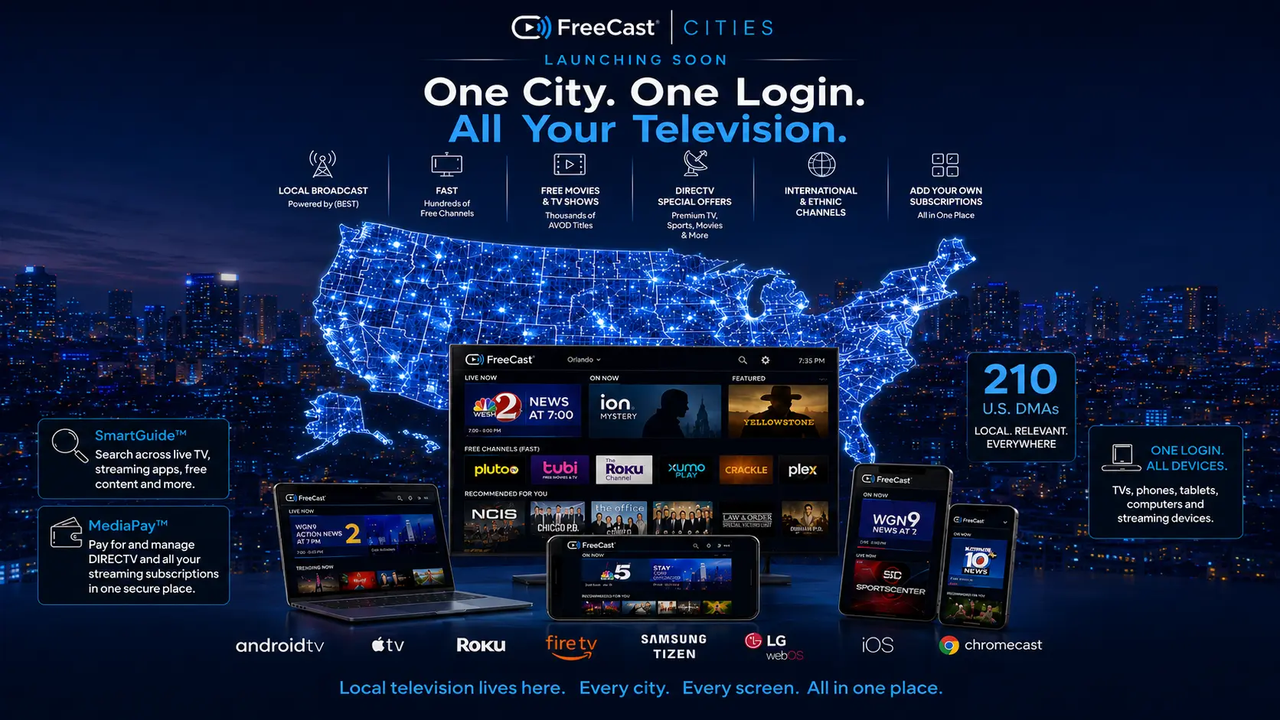
-
Court Denies Stay of Nexstar-Tegna Merger; Trial Date Set for State AG's, DirecTV Challenge
General Source
-
Vape packaging and flavouring face restrictions under UK plans to reduce appeal to children
Ministers consider bringing e-cigarette laws in line with tobacco as data shows 20% of teenagers have tried vapingVapes could be sold in plain packaging as part of a range of proposals to stop...
General Source
Ministers consider bringing e-cigarette laws in line with tobacco as data shows 20% of teenagers have tried vapingVapes could be sold in plain packaging as part of a range of proposals to stop them being marketed to children.The UK-wide plans also include limiting device colours to white, black or grey, and keeping vapes out of sight in shops, according to the Department of Health and Social Care. Continue reading...
-
Warner Bros.’ The Ranch Lot to Host LA28 Olympics International Broadcast Center
General Source
-
Half of Marketers Increased CTV Budgets, But Only 33% Fully Trust Performance Claims
General Source
-
Sage Offers Guidance on EAS Password Changes
General Source
-
Wedotv FAST Channels Launch on TiVo Platforms in Europe
General Source
-
IAB Releases ‘Redefining Media Types’ Standard for Public Comment
General Source
-
Registration Opens for 2026 NAB Show New York
General Source
-
Chyron’s PRIME 5.4 Brings Template Experience to More Newsrooms
General Source
-
ITV Taps Gravity Media for Innovative Reverse Remote Production of FIFA World Cup
General Source
-
The whole TV dial, rebuilt for vertical.
"They're getting a very high calorie, low taste experience from the vertical landscape today." Lior FriedmanNetflix, Disney+, Paramount+ and Peacock all bolted a vertical feed onto their apps this...
General Source"They're getting a very high calorie, low taste experience from the vertical landscape today." Lior FriedmanNetflix, Disney+, Paramount+ and Peacock all bolted a vertical feed onto their apps this year. Quibi got to premium mobile video first, burned through a reported $100,000 a minute and lasted six months. The phone won the attention war years ago. The premium content to fill it still isn’t there.This week on The Media Odyssey Podcast, Evan Shapiro and I bring Guy Hameiri and Lior Friedman, co-founders of RoseBerry, a vertical premium television studio. It picks up where our Lisbon episode with Bogdan Nesvit of My Drama left off, when he told us that the five telenovela arcs of micro drama can’t sustain the format on their own. Guy and Lior are the two people who took that seriously.These are TV people first. Hameiri sold Abot Hameiri, the Israeli studio behind local Survivor, X Factor and Netflix’s Shtisel, to Fremantle and ran it as chairman until the end of 2024. Friedman comes out of Amagi and started his career as a TV anchor. Their thesis is that micro drama was only the first wave and the rest of television, true crime, dating reality, soap, scripted, is heading to the phone next. How though? The engine underneath their operation is an AI tool they’ve named Red Snapper. The deals are in place: Fremantle, Banijay, A&E, All3Media and Cineflix, with a pipeline they put in the hundreds of titles by year-end.For proof, they handed us an 18-year-old episode of Neighbours, the Australian soap, recut vertical for Fremantle with a paywall dropped at a plot cliffhanger. They explain what they pulled out of the frame and what they deliberately left in.Then came the news and this was the part I’d been waiting for. Three months ago they had a real question mark over whether anyone would watch non-micro-drama on a phone. Now their own app, epis, has the first-party data to settle that discussion and the conversion and session numbers are strong. When the launch first crossed my desk, I wrote that I might finally have to change my mind on micro dramas. I’m still not all the way there. But these are TV people mixing content, tech and AI and that is a different animal from what we’ve seen so far. LISTEN and/or WATCH in full 👉🏻 APPLE PODCASTS | SPOTIFY | YOUTUBE | DEEZER with more platforms here. That’s it for today but before you go:🎙️ Live Pod AlertOn September 10th, during Streaming Made Easy Live, we will record a live episode of The Media Odyssey Podcast. Come see us live! TMO listeners get 15% off tickets here. 🗳️ Poll time
-
The Next Battle in Sport Isn't Content. It's Context
The next battle in sports won't be fought over content libraries, streaming platforms or production workflows. Most organizations already have more content than they know what to do with. The real...
General Source
The next battle in sports won't be fought over content libraries, streaming platforms or production workflows. Most organizations already have more content than they know what to do with. The real challenge is helping audiences navigate it. Helping them understand why a moment matters. Helping them discover stories worth following. Helping them connect with athletes, teams, and competitions in a meaningful way.
-
Incrementality at Scale: Closing the Loop Without Moving Data
Incrementality has become a board-level priority. It is now even more important for those signing off on marketing budgets to understand what outcomes advertising actually drives, not just where...
General Source
Incrementality has become a board-level priority. It is now even more important for those signing off on marketing budgets to understand what outcomes advertising actually drives, not just where it reaches. For CMOs, this presents a significant challenge, as most measurement methods aren't suited to this.
-
What the Satellite-to-IP Transition Means for TV Advertising
The move toward managed IP distribution gives broadcasters an opportunity to rethink how linear channels are packaged, customized and monetized. While a measured transition away from satellite is...
General Source
The move toward managed IP distribution gives broadcasters an opportunity to rethink how linear channels are packaged, customized and monetized. While a measured transition away from satellite is the first priority, many forward-looking organizations are also planning for the commercial advantages that follow.
-
Study: 43% of Younger Viewers Have Cancelled Subscriptions over Bad UX
General Source
-
N.Y. State Broadcasters Association Selects Hall of Fame Class of 2026
General Source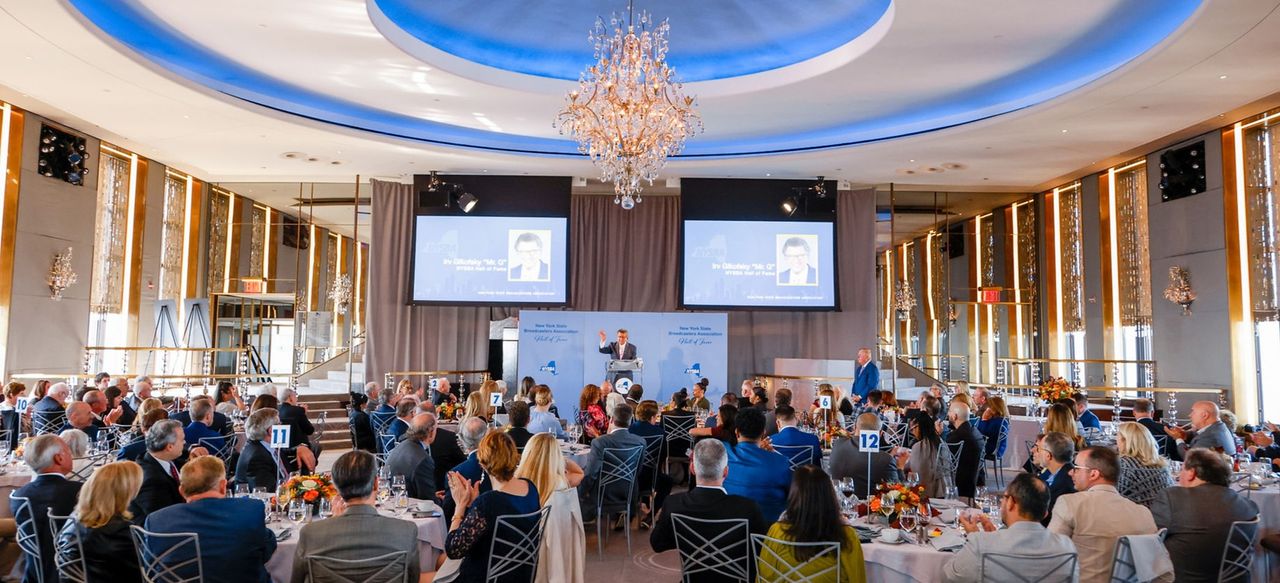
-
Beeble Introduces AI-Driven SwitchHDR Converter
General Source
-
What Industrialized Illegal Streaming Is Costing the Industry in 2026
In this clip from her keynote fireside chat at Streaming Media Connect 2026, Verimatrix's Maria Malinkowitsch offers a snapshot of live-streaming piracy in 2026, what it's costing major sports...
Entertainment Source
In this clip from her keynote fireside chat at Streaming Media Connect 2026, Verimatrix's Maria Malinkowitsch offers a snapshot of live-streaming piracy in 2026, what it's costing major sports rightsholders, why the fragmentation of sports rights and the cost burden on fans is making the industry susceptible to pirates, and how the industrialization of illegal streaming and the rise of "piracy as a service" are adding fuel to the fire and making antipiracy efforts more challenging than ever.
-
Roblox outsourced growing up
For three years, nobody advertised to children under 13 on Roblox. The platform banned it outright in 2023 under pressure from child-safety campaigners and the door stayed shut. Then this spring...
General Source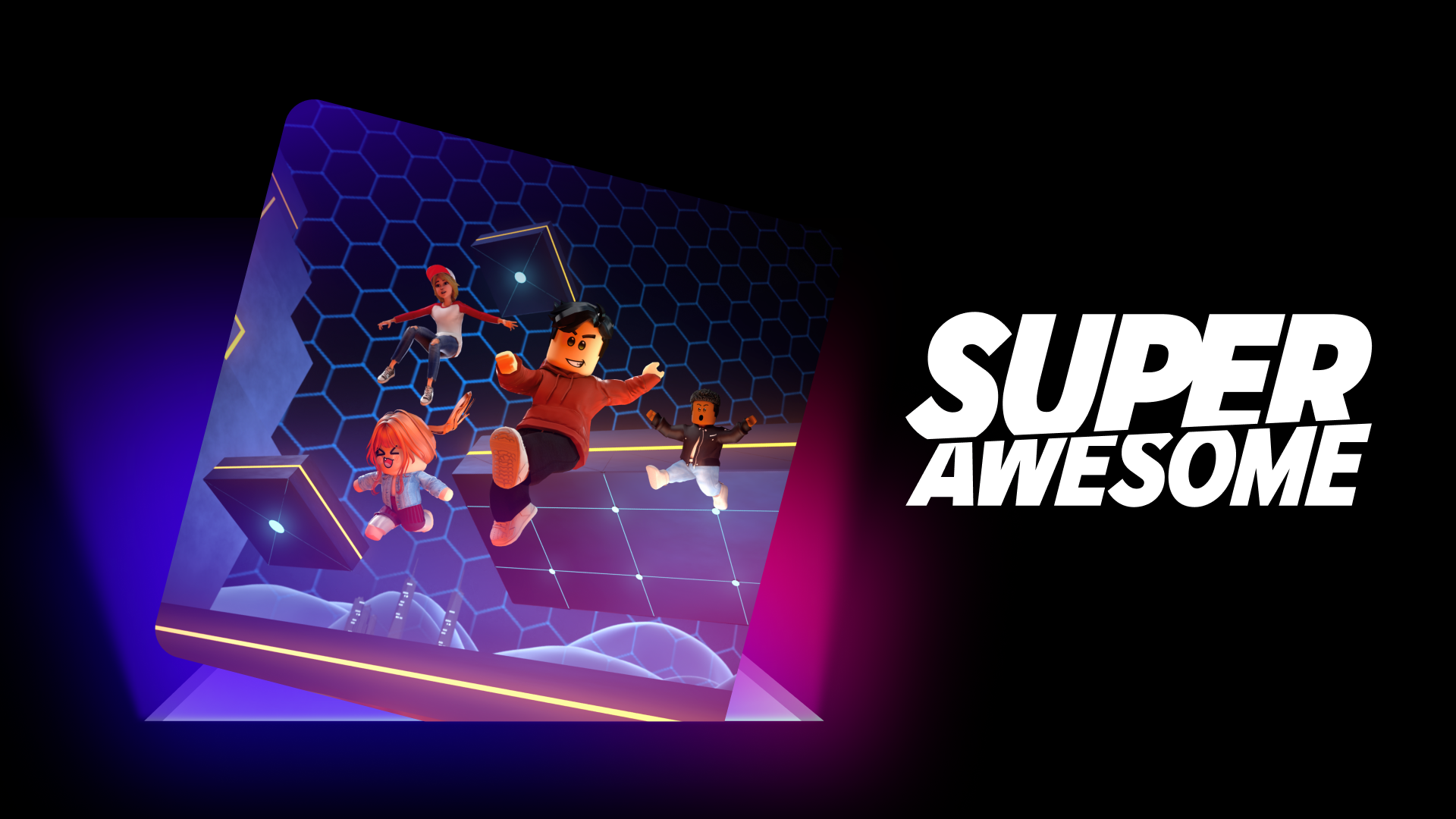
For three years, nobody advertised to children under 13 on Roblox. The platform banned it outright in 2023 under pressure from child-safety campaigners and the door stayed shut. Then this spring Roblox rebuilt its entire approach to younger users. In April, it introduced Roblox Kids for ages 5 to 8 and Roblox Select for ages 9 to 15, tightened age verification and in June it named the company allowed to bring back ads to under 13s on their platform. That company is SuperAwesome. I met Nicholas Walters years ago and we were due a catch up following the partnership announcement. I wanted to understand why a firm few people have heard of just became one of the sole gatekeepers for one of the largest audiences on the internet (over-13 users are PubMatic’s and Google Ad Manager’s purview). Roblox counts 144.5 million daily active users and among those who have verified their age on the platform: 35% are under 13, a scale that makes the segment too large to leave unmonetised and too sensitive to monetise carelessly. Walters runs the business day to day and the case he makes is simple. Kids and family content is enormous and underfunded, the money that should flow to the people making it keeps getting blocked by exactly the compliance questions SuperAwesome exists to solve. Today at a glance:Proudly commercialThe contextual betInside Awesome IntelligenceYouTube 2016, all over againProudly commercialWalters is direct about what SuperAwesome is for. The internet, he argues, was never built with anyone under 18 in mind and fixing that means solving privacy and safety at the same time as solving money.“We are proudly commercial. If you can’t get money flowing into the people who make good content, there will be no good content.”Nicholas Walters, SuperAwesomeThat is the same flywheel argument Gregory Dray made to me about YouTube kids content a few weeks back. Advertising, influencer partnerships, gaming and now Roblox all serve the same function for SuperAwesome. Give brands the confidence to spend against under-18 audiences and the money moves from brand budgets to the creators actually making the content those kids watch.The scale of the problem this is meant to solve is not small. On YouTube alone, Walters reckons there are maybe 125 million people who could call themselves a creator of some kind. Finding the right ones and proving they are safe enough to fund is the entire business.The contextual betSuperAwesome’s answer to the targeting question is to not target individuals at all.“We have no interest in targeting individual users. We don’t use cookies, we don’t collect email trackers. We are solely about building the smartest contextual data platform we can.”Nicholas Walters, SuperAwesomeContextual advertising places ads by what is on screen, not who is watching. What is contextually relevant to a 16 year old is nothing like what is relevant to a 26 year old and getting that granularity right across every age band under 18 is hard.Co-viewing complicates the picture, since a huge amount of youth-directed content gets watched by the whole household. SuperAwesome’s answer was to acquire the world’s largest youth-directed podcast network at the start of this year, betting that co-listening / co-watching families are worth reaching through kids’ content. Inside Awesome IntelligenceAwesome Intelligence is the data layer under everything SuperAwesome does, built to fix what it calls youth data scarcity. Privacy law bans tracking anyone under 18, so brands have been targeting kids based on age and gender, nothing else.SuperAwesome swaps that for values, passions, fandoms, trends thanks to 13 years of campaign data, 9 million-plus research inputs, 150-plus studies.On YouTube it runs two checks at once. One classifies 125,000 channels for brand safety and audience fit. The other watches channels daily, AI plus humans, so the list doesn’t go stale.The real test is off YouTube: Roblox, Minecraft, Fortnite, the “unstructured, UGC-driven” chaos where under-18s actually live and where age and gender explain nothing. SuperAwesome’s bet is that the same audience profile travels with a brand from YouTube into a game.Nickelodeon is one proof point. In Germany, for the launch of The Thundermans: Undercover, SuperAwesome ran an audience-based strategy against a standard age and gender control group, split across two segments: Pop-Culturists (41% core passion for entertainment) and Classics (49% define themselves through their digital identity). Both segments named The Thundermans as a fandom before the campaign even launched.The lift was real. Video completion rose 27 pts, click-through 16 pts and interstitial engagement 14 pts.The Thundermans Nickelodeon Case StudyYouTube 2016, all over again“Roblox is the breakout digital platform for this decade. I have very strong YouTube 2016 vibes on this platform. The usage is undeniable, users have made their choice, they have escape velocity in terms of engagement. This is what escape velocity looks like.”Nicholas Walters, SuperAwesomeThe numbers back the comparison. SuperAwesome puts weekly gaming activity among Roblox’s under-13 users at 98%, which makes Roblox less a platform for kids than the default environment they live in. The structural problem is identical to the one SuperAwesome already solved once on YouTube. Roblox now permits advertising to all ages across hundreds of thousands of user-built experiences, spanning fashion games, sports games, driving games, creation tools and role-play, with new experiences launching daily. A brand faces the same question it faced on YouTube in 2016: which of these environments is safe, and which one actually reaches the audience I want?SuperAwesome says its team manually plays every title and scores it against 11 brand suitability flags, catching realistic weapons or graphic violence that metadata alone would miss. That's a genuinely large ask given 15,000 new games launch on Roblox daily and it's why Awesome Intelligence layers on 80-plus contextual categories on top, so a brand can target a specific interest instead of a blunt age band.Kids content is YouTube's lowest-earning category and the plumbing to sell premium kids inventory still isn't built. SuperAwesome's classification engine has run on YouTube the whole time, which tells you the bottleneck was never safety data. It was a platform willing to build a selling machine around it. So will Roblox do what YouTube didn't?That’s it for today. See you on Thursday for another edition of Streaming Made Easy!Share
-
Comcast Secures Lock on UK Commercial TV
ITV is to sell its media and entertainment division, including its broadcast channels and ITVX streaming service, to Sky for ?1.6 billion ($2.1bn), marking one of the most consequential...
General Source
ITV is to sell its media and entertainment division, including its broadcast channels and ITVX streaming service, to Sky for ?1.6 billion ($2.1bn), marking one of the most consequential restructurings in modern British broadcasting. The deal positions Sky, owned by Comcast, as the UK's largest commercial broadcaster and creates a new domestic heavyweight designed to compete more aggressively with global streaming giants such as Netflix, Amazon, and YouTube.
-
The Best OTT Analytics SDK Is No SDK at All
Every OTT viewer-analytics program starts the same way: put an SDK in every app. One for iOS, one for Android, half a dozen smart TV families, and two generations of set-top box. Each integration...
General Source
Every OTT viewer-analytics program starts the same way: put an SDK in every app. One for iOS, one for Android, half a dozen smart TV families, and two generations of set-top box. Each integration costs engineering weeks. Each one slows an app release. For operators running their own CDN, there is a simpler answer: skip the SDK entirely. Every OTT session, live or VOD, already passes through that CDN. With CMCD, the delivery layer now sees what the player sees. PILOT Analytics turns your CDN into the measurement layer: player-level insight on every device, with nothing to install in any app. The SDK Tax Gets Paid Three Times SDK-based OTT analytics bills you in three currencies: license fees, integration engineering on every platform, and slower app releases forever after. The work never finishes. Every player update, app release, or SDK version bump reopens it. The return on that spend is partial coverage. Legacy set-top boxes and minority smart TV platforms rarely justify the integration cost, so they stay dark. Yet those devices are over-represented in support tickets. The viewers you most need to see are the ones the SDK model leaves out. There is a data-ownership cost too. SDK vendors typically process viewer telemetry in their cloud, on their retention terms. Server-side analytics runs against your own CDN logs, in your own deployment. Your viewer data stays yours. See how PILOT Analytics works CMCD Turns the CDN Into Your Analytics Agent CMCD (Common Media Client Data, the CTA-5004 specification) changed the economics. Players attach standardized playback telemetry to the requests they already send. The major open-source and commercial players now ship it as a configuration option. Enabling CMCD is a flag, not a development project. PILOT Analytics reads those signals alongside the CDN logs and reconstructs every OTT session server-side. Each session record carries rebuffering events with duration, the full bitrate history, and pause, seek, and trick-play behavior. It captures audio language switches, subtitle usage, and the device, brand, and player software behind each user agent. Sessions are classified as live, VOD, catch-up, or nPVR, so timeshifted audiences stop hiding inside linear numbers. A network dimension separates an ISP peering problem from a platform problem. No agents are installed in any app. Coverage starts the day the analytics attaches to the CDN, and it includes every device that ever requests a stream from it. One Data Set for Every Team That Argues About Quality The same session records feed seven views, each answering a different budget holder’s question. Operations watches delivery health: concurrent sessions, throughput, delivered volume, cache hit ratio, and HTTP errors. Content and commercial teams read engagement: unique viewers, viewed hours, and channel and asset rankings, with timeshift viewing counted as what it is. Product teams see which devices, brands, and player stacks carry the audience, which settles device-support prioritization with evidence. Support teams search any viewer’s session and get a per-session experience grade, its bitrate history, and its error pattern. “It buffers sometimes” becomes a diagnosable event with a timestamped cause. Security teams get fraud detection: credential sharing and session hijacking surfaced in real time, connected to enforcement in NEA CDN®, with watermarking IDs tied to sessions for piracy investigations. One pipeline, one data model, and no reconciliation meetings about whose number is right. Deployment Is No Longer a Platform Project Analytics platforms have a habit of becoming their own infrastructure project. The recent PILOT Analytics releases went after this directly. Configuration moved from deployment files into the user interface, including the collection agents themselves. The operations team that uses the system now tunes it, without a Kubernetes specialist in the loop. It deploys on premises or on AWS, runs on a single node where the footprint demands it, and upgrades through PILOT Manager like the rest of the Ateme stack. The cost scales with your CDN estate, not with the number of device platforms marketing wants to launch next year. Where an SDK Still Earns Its Keep Server-side visibility ends at the delivery layer, and the boundary deserves honesty. UI navigation, content discovery, DRM license failures, and ad-SDK errors happen entirely on the client. They never touch a CDN log. CMCD depends on players sending it; where a player predates CMCD support, sessions still reconstruct from delivery logs with less playback-state detail. And where no subscriber identifier is passed, unique-viewer counts rest on derived identifiers that shared IP addresses can blur. If you already run an instrumented app estate you trust, server-side analytics is the cross-check and the coverage extension for everything you could not instrument. If you are deciding where the next analytics dollar goes, the calculus has shifted. One Question for the Next Budget Round What did viewer measurement cost in engineering weeks last year, and what share of your audience can it still not see? Your CDN already knows the answer to the second question. The interesting decision is how much you are prepared to keep spending on a second copy of data it already holds. Explore related insights Explore PILOT Analytics Who’s Paying for Your Streaming Piracy Problem? About the Author Mark Haines CDN Product Manager & OTT Streaming Solutions Manager at Ateme Mark brings 18+ years of experience in OTT streaming & Content Delivery Networks. With a background spanning product management, solution architecture, and business development, he helps content owners, telcos & network operators navigate modern streaming infrastructure, from CDN strategy and live video delivery to cloud-native OTT platform design. At Ateme, Mark leads product direction for the NEA CDN portfolio and drives OTT & streaming solution strategy for major telcos and network operators worldwide, having previously spent 5 years as a Global Solution Architect. Prior to Ateme, he held solution architecture and business development roles at Velocix, part of Nokia/Alcatel-Lucent’s IP Video division. L’article The Best OTT Analytics SDK Is No SDK at All est apparu en premier sur Ateme.
-
Reducing TCO for Streaming Services
Financial pressures felt over the last few years has led to a new set of challenges around total cost of ownership (TCO). Video services are now tasked with finding ways to reduce spending and...
General Source
Financial pressures felt over the last few years has led to a new set of challenges around total cost of ownership (TCO). Video services are now tasked with finding ways to reduce spending and increase revenue generation, all without increasing churn, and this has caused the age-old build versus buy debate to resurface.
-
The fandom flywheel BBC built to outlast Bluey
“For us, that is about proving out the model. Anyone can be successful once. It’s about that repetition, and that shows us that the model is not only working for us, but can be repeatable and...
General Source“For us, that is about proving out the model. Anyone can be successful once. It’s about that repetition, and that shows us that the model is not only working for us, but can be repeatable and hopefully scale.”Jasmine Dawson, SVP of Digital, BBC StudiosCannes Lions makes a lot of people perform optimism they don’t feel. Not Jasmine Dawson. This week on The Media Odyssey Podcast , and I talked with the BBC Studios SVP of Digital live from Cannes, for a second year running. Last year she told us BBC Studios was betting on fandom over reach. This year the numbers backed her up. Anyone can have a good year once.Jasmine Dawson also came with news. Three stories, all breaking first on this episode of the podcast. BBC Studios is launching a new global advertising network called “Affinity” built around fandom rather than the reach metrics the industry still defaults to. 5 content verticals, each anchored in IP that already carries a proven, passionate audience. The 2nd piece of news dismantles a wall that’s sat inside the BBC for years, the one separating BBC Studios from the BBC’s own public service channels. Dan McGolpin runs iPlayer and Channels. For the first time, the pair is coordinating their YouTube strategy as a single unit. The consequence is 50-plus new channels launching this year, each built around a specific community rather than a broad content area. Then Anna Rafferty, SVP Digital Consumer Engagement at the LEGO Group, walked in. She didn’t come on to license a toy line and call it a day. She came on as a genuine co-creator, building new content with BBC Studios to delight families with LEGO brick recreations of beloved Bluey moments (Queens, Sleepytime, The Beach, etc.). The first episode premieres today on The Bluey Channel, the official LEGO channel and the LEGO Little Ones channel on YouTube and Bluey.TV.Start there, then listen to the episode for everything behind it.LISTEN and/or WATCH in full 👉🏻 APPLE PODCASTS | SPOTIFY | YOUTUBE | DEEZER with more platforms here. That’s it for today but before you go:🗳️ Poll time
-
What Broadcasters are Teaching us About Sovereign Cloud
At Ateme, we have been building cloud-native video technology for several years. Our platform runs on AWS, Google Cloud, and any Kubernetes environment by design. We made that choice early because...
General Source
At Ateme, we have been building cloud-native video technology for several years. Our platform runs on AWS, Google Cloud, and any Kubernetes environment by design. We made that choice early because we wanted our customers to have flexibility: the ability to select the infrastructure that best fits their operational, financial, and compliance requirements. Over the past two years, broadcasters have been asking new questions about infrastructure, resilience, and operational control, and in the process, they have revealed an important shift in how cloud strategy is being evaluated. For much of our cloud journey, conversations focused on familiar topics. Which platform delivers the best economics for large-scale transcoding? How can live streaming latency be reduced? How do broadcasters prepare for audience spikes during major events? Today, another question increasingly enters those discussions: sovereignty. A new set of questions Starting in late 2024 and accelerating through 2025, we began hearing a different type of question from broadcasters and media organizations. Not: “Which cloud offers the lowest cost?” But: “What are our options if sovereignty becomes a strategic requirement?” The discussion was rarely about technology alone. It often reflected wider concerns around operational continuity, regulatory alignment, and long-term control of critical infrastructure. One frequently cited example came from outside the media industry. Following a sanctions-related decision involving the International Criminal Court in The Hague, questions emerged across Europe about dependency on technology providers operating under foreign jurisdictions. The case highlighted a broader reality: infrastructure decisions increasingly involve geopolitical and regulatory considerations alongside traditional technical criteria. While many of these conversations originated in Europe, the underlying concern is not uniquely European. Governments, broadcasters, telecom operators, and critical infrastructure providers worldwide are examining how dependent they are on external technology platforms and what options exist to increase resilience and operational control. How the cloud landscape is evolving Major cloud providers have recognized these concerns and invested heavily in sovereign cloud initiatives. AWS, Microsoft, and Google have all introduced offerings designed to address requirements around data residency, governance, and compliance. These developments have expanded customer choice. At the same time, some organizations continue to evaluate whether infrastructure ownership, legal jurisdiction, and operational independence should form part of their cloud strategy. Sovereignty is now joining performance, cost, scalability, and reliability as another factor in cloud decision-making. Why broadcasters are part of the conversation Broadcasting is increasingly recognized as critical digital infrastructure. For broadcasters, losing access to transcoding, packaging, streaming, or content processing systems during a major live event can have immediate public consequences. National elections, major sporting events, breaking news coverage, and public service broadcasting all depend on reliable, resilient technology platforms. Public broadcasters in particular often balance commercial, regulatory, and public-interest obligations. As a result, infrastructure decisions may involve considerations that extend beyond pure technology metrics. For some organizations, sovereignty has therefore become part of a broader resilience strategy rather than a standalone compliance exercise. France Télévisions’ partnership with Scaleway illustrates this trend toward infrastructure models built around local governance and operational independence. As France Télévisions President and CEO Delphine Ernotte Cunci stated: “Tech sovereignty is a strategic priority for our group.” Evaluating the technology As these conversations became more common, we wanted to answer a practical question: Can sovereign cloud infrastructure support broadcast-grade video workloads at scale? Based on our testing and validation work, the answer is yes. Working with Scaleway, we validated Ateme’s cloud-native platform across a wide range of workflows, including live and file encoding, low-latency streaming, just-in-time packaging, cloud DVR, VOD delivery, dynamic ad insertion, subtitling, accessibility services, and immersive video formats. The results demonstrated that sovereign cloud environments can meet the performance, scalability, and operational requirements expected by broadcasters. Scaleway’s infrastructure also provides access to GPU resources and AI platforms that support media workflows such as automated subtitling, speech translation, content summarization, sports highlights generation, contextual advertising, and accessibility services. As AI becomes more deeply integrated into media operations, questions around data governance and operational control are becoming part of the broader technology discussion. What we observed is that broadcasters no longer need to view sovereignty and performance as mutually exclusive objectives. Scaleway’s approach is built around European jurisdiction, open technologies, and security frameworks such as SecNumCloud. Combined with competitive economics and the absence of egress fees, it offers an alternative deployment model that some broadcasters are increasingly evaluating alongside traditional hyperscaler environments. Most importantly, the decision is no longer between sovereignty and capability. The technology has matured to the point where organizations can evaluate sovereign cloud options on their operational merits as well as their governance model. The operational dimension Technology is only one part of the equation. Broadcasters also need operational expertise, monitoring, support, and accountability. Infrastructure decisions ultimately succeed or fail based on how systems are operated day to day. This is where BCE plays an important role. With more than 25 years of experience deploying, operating mission-critical media environments and supporting hundreds of customers internationally, BCE provides the system integration competence and operational layer that allows cloud infrastructure and video platforms to function as a fully managed service. Their perspective is simple: cloud infrastructure only becomes a media service when it is operated end to end. Together, Ateme, Scaleway, and BCE provide an example of how sovereign cloud infrastructure, media technology, integration expertise and operational services can be combined into a complete production-ready solution. What this means for broadcasters We did not set out to build a sovereign cloud offering. We built cloud-native video technology designed to run anywhere, because our customers have different requirements and priorities. What has changed is that sovereignty has become part of the conversation for a growing number of organizations. While the discussion may be particularly visible in Europe, the underlying questions around resilience, control, and long-term dependency are increasingly global. The encouraging finding is that the ecosystem has matured significantly. Sovereign cloud platforms have evolved from emerging alternatives into production-ready environments capable of supporting demanding media workloads. For broadcasters evaluating their next generation of cloud infrastructure, the question is no longer whether sovereign options exist. The more relevant question is which deployment model best aligns with their operational, regulatory, and strategic objectives. Our role at Ateme remains the same: providing video technology that gives customers the freedom to make that choice. Explore related insights Europe’s First End‑to‑end Sovereign Cloud Media Supply Chain Data Sovereignty for Video Delivery: What European Operators Need to Know Ateme provides broadcast-grade video encoding, packaging, and OTT streaming solutions deployable on any cloud infrastructure. Ateme is a validated technology partner with Scaleway, part of the iliad Group. BCE, part of Bertelsmann/RTL Group, provides end-to-end broadcast and media workflow integration and 24/7 managed operations. L’article What Broadcasters are Teaching us About Sovereign Cloud est apparu en premier sur Ateme.
-
Visualizing Verticalization at Scale: A Q&A with Ateliere's Flavius Goman on Ateliere Storyline
This Q&A with Ateliere president and COO Flavius Goman explores how Ateliere Storyline tackles high-volume content verticalization, including meeting the challenges of conscientious frame-cropping...
General Source
This Q&A with Ateliere president and COO Flavius Goman explores how Ateliere Storyline tackles high-volume content verticalization, including meeting the challenges of conscientious frame-cropping (especially for complex and high-action scenes), manual review, the story interpretation involved in compelling automated serialization, and how this technology might be used outside of a strictly entertainment context.
-
Your Competitors Are Serving the Same Ads for 30% Less. The Difference Is the Server.
Ad tech teams optimize the code. They rarely question the server. Here is what that costs?and what one platform changed to fix it.
General Source
-
The 6 Principles That Will Define the Future of Streaming Infrastructure
The current delivery environment is fragmented and dynamic. In this environment, the industry needs to shift its focus from trying to optimize a stable system to instead operate effectively within...
General Source
-
The 3 names that own UK's Free Streaming shelf
Free Streaming was supposed to tear down the gates. No subscription, no broadcast empire required, just content and an audience meeting on a shelf. Reach the viewers who have tired of paying for...
General Source
Free Streaming was supposed to tear down the gates. No subscription, no broadcast empire required, just content and an audience meeting on a shelf. Reach the viewers who have tired of paying for yet another subscription and do it without the decades of brand and infrastructure the old broadcasters spent generations building.For our newest edition of Above the Fold with Looper Insights, we decided to test that pitch against hard placement data. We tracked 7 UK AVOD services across 14 streaming platforms, from Fire TV and Samsung to Sky Q and PlayStation consoles. Across May 2026, those 7 generated £60.4M in Media Placement Value (£MPV) over 29,785 promotional spots and 2,433 unique titles.So who actually walked away with that £60.9M? Let’s find out. Today at a glance:The number that settles itWhy the broadcasters still winWhat this means if you are not a PSBPlus the full May rankings and placement data in our latest report. Subscribe nowThe number that settles itThree names took 84% of the market.ITVX, Channel 4 and Channel 5 generated £51.2M of the £60.9M in £MPV across May. The four international streamers, Tubi, Pluto TV, Plex and Rakuten TV, split the remaining £9.7M between them. ITVX alone, at £23.2M, outweighs all four of those services combined by nearly two and a half times. One caveat: Rakuten TV runs both a free ad-supported service and a transactional store, so its figure reflects placement visibility across both rather than AVOD alone.So the Free Streaming shelf that was meant to let new entrants reach audiences without a broadcast empire behind them spent May promoting, overwhelmingly, three broadcast empires. Why the broadcasters still winScale explains most of it. ITVX ran the highest spot count of any service in the analysis and placed it across all 14 tracked platforms. Channel 4 matched that 14-platform spread, the joint widest in the market. When a service appears on every major device in UK homes and does so thousands of times over, the placement value compounds in a way a narrower footprint cannot reach.The content behind the spots tells the rest and each broadcaster promoted to a clear identity. ITVX led on drama, headed by the Gemma Arterton espionage thriller Secret Service, which topped the entire market for the month. Samsung TV (2022) - ITVX - HomeChannel 4 promoted to a different audience entirely, with returning reality franchises like Celebs Go Dating anchoring its slate. Channel 4 - Fire TV - Appstore FeaturedChannel 5 built its month on homegrown drama, led by Number One Fan and its flagship commission The Hardacres. Channel 5 - Virgin TV 360 - HomeWhat unites the three is not so much a shared content strategy but the machinery underneath. Amazing content, decades of platform relationships, the carriage deals, the prominence agreements and the budgets a broadcaster accumulates. That machinery is what the home screen “rewards”.What this means if you are not a PSBThe international tier reached £9.7M in May, with Tubi and Pluto TV doing most of the lifting.Tubi leads and it is doing something the others are not. Its slate leans on YouTube-native franchises like Ben Azelart, Jordan & Salish Matter and The Royalty Family, creator content with no equivalent at scale on any other UK AVOD service. Ampere Analysis put Tubi UK’s catalogue growing 99% across 2025, the fastest of any AVOD service it tracked. So the May prominence sits on a base still expanding fast.Then the lesson for whoever owns the content rather than the platform it runs on. Police Interceptors ran on both Channel 5 and Pluto TV in May, promoted on two unrelated free services and counted on both. One hour of British factual telly, working twice in the same month. If you are a rights holder choosing between an exclusive and going wide, that is the argument for wide. Pluto TV - Fire TV - TV ProgrammesThe other lesson is consistency. The broadcasters win on presence. They turn up on all 24 platforms, week after week and no single slot has to carry them. A challenger can match a PSB on one placement. Holding that across the whole market, through the quiet weeks and the loud ones, is what takes years to build.None of this is a UK quirk. The home screen behaves the same way across European CTV and the question for every broadcaster and streamer is whether they are putting enough behind prominence to match their ambition.This piece shows three broadcasters owning 84% of the shelf. The report shows you the placement-by-placement detail of how, every title's £MPV and the creative that earned it. Get it here. That’s it for today. Comments, shares or likes come a long way 🙏🏻Catch up on our previous reads:🗳️ Poll Time:
-
How 5 migrated to AWS Elemental MediaPackage v2
5, part of Paramount, operates one of the UK’s largest free-to-air broadcasting networks, delivering simulcast and free ad-supported television (FAST) channels across a range of platforms...
General Source
5, part of Paramount, operates one of the UK’s largest free-to-air broadcasting networks, delivering simulcast and free ad-supported television (FAST) channels across a range of platforms including LG, iOS, web&desktop, Android TV, Fire TV, Freely, and Freeview Play. In early 2025, 5 considered a migration from their existing packaging solution that included a third-party pre-segmented packager with AWS Elemental MediaStore as an origin for DVB-DASH delivery and a just-in-time packager: AWS Elemental MediaPackage v1 for MPEG-DASH and HLS delivery. This post tells the story of that migration—what drove the decision, how 5 and Amazon Web Services (AWS) collaborated to deliver new capabilities, and the results that followed. Why migrate? To support multi-platform delivery, the existing 5 architecture included two parallel pipelines: one based on a third-party packager that produced DVB-DASH compliant output for the Freely platform and another based on AWS Elemental MediaPackage v1 that served MPEG-DASH and HLS based platforms. This required duplicated encoding resources, managing a fleet of Amazon Elastic Compute Cloud (Amazon EC2) instances with manual failover mechanisms—all adding operational overhead, increasing infrastructure costs, and introducing reduced resilience. Additionally, the end of life of AWS Elemental MediaStore in November 2025 provided a firm deadline, adding urgency to a migration that was already strategically desirable. MediaPackage v2 offered native DVB-DASH support with full accessibility signaling, enhanced HLS accessibility tagging, flexible SCTE-35 marker handling, and SPEKEv2-based digital rights management (DRM) encryption—all within a single AWS service. Critically, it also delivered capabilities their existing dual-pipeline architecture lacked, specifically, unified automated failover, stack consolidation eliminating duplicated infrastructure, and a single just-in-time packaging pipeline serving all output formats without parallel workflows. Together, these capabilities made MediaPackage v2 not only a viable migration target but the essential foundation for 5’s multi-platform delivery strategy. 5’s Senior Director of 5 Streaming Technology, Matt Le Masurier, summarized the impact of consolidating onto MediaPackage v2: “We were running eight EC2 instances and five additional MediaLive channels to handle our DVB-DASH output, alongside ISO-DASH and HLS via MediaPackage v1. Migrating to MediaPackage v2 allowed us to consolidate the stack, removing the need for the duplication. Five MediaLive, eight EC2 instances, and MediaStore were all deprecated upon completion of this project. Operationally, this has also simplified our live media pipelines as well as improving resilience. The former DVB-DASH solution had a manual failover step, not seamless failover that we benefit from in MediaPackage now.” Resulting architecture The following diagram illustrates the end-to-end streaming workflow deployed on AWS, from live source ingest through to viewer delivery. Live channels are played out from the 5 facility and transported using SRT (with embedded SCTE-35 ad markers) into the AWS Cloud. Within AWS, AWS Elemental MediaLive encodes the content, and AWS Elemental MediaPackage v2 packages it into DVB-DASH, MPEG-DASH, and HLS formats, applying DRM encryption through the SPEKE v2 protocol. Then signals are going to Google’s server-side ad insertion (SSAI) service through Amazon CloudFront, which is used as an origin shield. SSAI uses enhanced metadata from a placement opportunity information system (POIS) to get content-aware decisions for stitched ads into each viewer’s stream. The personalized adaptive bitrate (ABR) content is then delivered to end-viewer devices over the internet through a content delivery network (CDN). Figure 1: 5 end-to-end streaming workflow The migration journey: Q1 2025 – Q1 2026 The overall migration journey from consideration to execution took around 12 months with different stages. Early engagement and testing (January–April 2025) In Q1 2025, AWS reached out to 5 with a preview of new DVB-DASH functionality on MediaPackage v2. 5 expressed strong interest and by April had freed up engineering capacity for Q2 evaluation. 5 agreed to test beta code rather than wait for general availability, a decision that gave the team additional time to shape the feature set and identify production requirements. AWS provided Amazon CloudFront playback endpoints for DVB-DASH testing. Initial testing quickly confirmed successful playback, and the collaborative development cycle began. Collaborative development and feature delivery (May–September 2025) As 5 progressed through testing, the close partnership between 5 engineers and AWS specialists across the AWS Elemental MediaLive and AWS Elemental MediaPackage service teams proved instrumental. 5’s real-world production requirements drove several important enhancements to both services: DVB-DASH accessibility signaling – 5’s requirement for DVB-DASH accessibility signaling, including audio description tracks with the correct DASH roles and accessibility values, led to the development of the built-in CMAF ingest path from MediaLive to MediaPackage over introducing MediaPackage v2 support on the MediaPackage output group in MediaLive. AWS prioritized updates to keep accessibility metadata flowing correctly from MediaLive to MediaPackage v2 through the MediaPackage output group type on MediaLive. HLS manifest attribute enhancements – 5 identified that key HLS manifest attributes—NAME, DEFAULT, AUTOSELECT, rendition group ID, and stream ordering—needed to be carried through the CMAF ingest path. Because CMAF ingest format has limited capability to transport free-form metadata, AWS developed custom extensions to the MediaPackage output group on MediaLive to address this problem, delivering the enhancement in September 2025, a capability that benefits all MediaPackage v2 customers. DASH role specification alignment – 5’s conformance testing identified that the DVB-DASH specification requires at least one audio Adaptation Set (or more for the audio ABR use case) to carry a @value of main when multiple audio Adaptation Sets are present. Working together on the final design, AWS and 5 confirmed MediaLive was updated to align with the specification, and AWS deployed the fix across AWS Regions. SCTE marker flexibility – The ability of MediaPackage v2 to toggle between binary and XML-encoded SCTE markers for DASH output addressed a long-standing requirement for 5’s dynamic ad insertion (DAI) service, providing the format flexibility their downstream systems needed. SPEKEv2 DRM integration – 5 successfully integrated their keystores with MediaPackage v2, using Secure Packager and Encoder Key Exchange (SPEKE) v2 for content encryption. AWS provided real-world Content Protection Information Exchange (CPIX) sample files with Widevine and PlayReady system IDs, so 5 could complete their DRM integration and proceed to comprehensive testing. POIS integration for ad signaling – 5 implemented a POIS integration with MediaLive, enabling use cases such as episode ID insertion, ad break marker removal, and early ad break notifications for Google DAI. The POIS integration has been running successfully in production as part of overall migration, demonstrating the flexibility of AWS media services. Scalable multi-environment deployment – 5 scaled their deployment across development, staging, and production environments, each requiring dedicated endpoints with different encryption keys and DASH profiles. Meanwhile, AWS worked with the team to put the necessary MediaPackage v2 endpoint capacity in place, unblocking the full rollout in October 2025. Testing and platform deployment (October–December 2025) With the key enhancements deployed by late September 2025, 5 kicked off comprehensive quality assurance (QA) testing in October. AWS extended the MediaStore end-of-life deadline by 4 months through February 2026, providing 5 the latitude needed for thorough end-device validation. The team ran a full set of test cases across different player platforms, including iOS, web&desktop, LG, Freely, Fire TV, Android, and Freeview Play. By the end of December, 5 successfully completed testing across all target platforms and passed internal QA validation. Going live (January–February 2026) In January 2026, 5 reported progress toward full migration: Four new FAST channels launched on Fire TV using MediaPackage v2 Five simulcast channels deployed on Freely and Freeview Play using MediaPackage v2 All remaining streams targeted for migration to MediaPackage v2 by end of January By February 2026, 5 confirmed two major milestones: Complete decommissioning of the previous third-party packager Full cessation of MediaStore usage Key takeaways 5 gained several valuable takeaways from the project: Start early, even with beta features – 5 agreed to test beta DVB-DASH code rather than wait for general availability (GA). This decision gave the team additional time to identify requirements and shape the feature set collaboratively with AWS. Real-world testing drives better products – 5’s production requirements directly influenced enhancements to both MediaLive and MediaPackage v2, including HLS manifest attribute support, DASH role alignment, and accessibility signaling improvements. These enhancements benefit the entire AWS customer base. Accessibility is a platform enabler – Proper accessibility signaling like audio descriptions, captions, and role metadata isn’t only about compliance. It’s what unlocks access to platforms such as Freely, and it delivers a more inclusive experience for all viewers. Collaborate closely with AWS service teams – Close collaboration between 5 engineers and AWS solutions architects and product managers was essential. The partnership model, where customer feedback directly shapes service development, accelerated delivery for both parties. Use service transitions as a modernization catalyst – The MediaStore end of life provided a clear timeline, but 5 used it as an opportunity to modernize their entire streaming workflow, moving off MediaStore as well as their legacy third-party packager entirely, while expanding to new platforms. Conclusion 5’s migration to AWS Elemental MediaPackage v2 demonstrates what’s possible when a broadcaster takes a strategic, collaborative approach to infrastructure modernization. A comprehensive workflow upgrade has resulted in consolidating all packaging onto a single, future-proof AWS platform. For broadcasters considering a similar journey, 5’s experience shows that early engagement, a willingness to test emerging capabilities, and close collaboration with AWS can turn an infrastructure transition into a competitive advantage—reaching new platforms and audiences and delivering more inclusive streaming experiences. To learn more about AWS media services, visit the AWS Media Services page. Ready to migrate to MediaPackage v2? 5’s journey demonstrates how AWS Elemental MediaPackage v2 delivers on the promise of unified, resilient live packaging at scale. For all existing MediaPackage v1 customers, v2 is the recommended path forward—bringing just-in-time packaging across HLS, MPEG-DASH, DVB-DASH, and CMAF into a single managed service with automated failover, SPEKE v2 DRM, enhanced accessibility signaling, and flexible SCTE-35 handling as standard. Whether you’re consolidating parallel pipelines, preparing for new platform requirements, or looking to reduce operational complexity, the MediaPackage v2 migration path is well-proven. To start planning your migration, reach out to your AWS account team or visit the AWS Elemental MediaPackage page. Further reading AWS Skill Builder Lesson: Media Services Learning Plan AWS Media Services Resources Back to basics: HTTP video streaming DVB-DASH and EBU-TT-D support in AWS Elemental MediaPackage Back to basics: Accessibility signaling with AWS Elemental Media Services
-
Comcast to Split Into Two Companies, Spin Off NBCUniversal and Sky by Mid-2027
I would have thought this would have taken place sooner. Comcast Corp. announced plans to split its media and technology businesses, spinning off NBCUniversal and Sky into a separate publicly...
General Source
I would have thought this would have taken place sooner. Comcast Corp. announced plans to split its media and technology businesses, spinning off NBCUniversal and Sky into a separate publicly traded company. NBCUniversal will hold theme parks, Universal Studios, NBC, Telemundo, Peacock, Bravo, and Sky, while Comcast will hold the broadband, wireless, and cable businesses. The deal is expected to close by mid-2027, with Mike Cavanagh, Comcast’s current co-CEO, running the new NBCUniversal, and Comcast led by the returning former CFO, Michael Angelakis. The news comes just months after Comcast shed most of its cable TV business to Versant Media. Comcast’s acquisition of NBCUniversal in 2011 was seen as a major bet on the benefits of combining content and distribution pipelines, but Wall Street never saw the value, and in recent years, we have seen little proof of value in keeping the businesses combined. Comcast’s current co-CEO reinforced this point when asked why they are doing the deal now, saying, “Where we previously believed that scale and the diversification benefits warranted operating these businesses as one company, we’ve now simply changed our mind about that.” Comcast Chairman and co-CEO Brian Roberts said the split was “absolutely not” a step toward potential strategic transactions for either company and that selling NBCU is “definitely not our plan.” Comcast expects to retain a stake of up to 19.9% in NBCUniversal for up to a year after the tax-free spinoff is completed. For those who suggest this now means that Netflix, Apple, etc., can acquire NBCU and Peacock, slow down. Anyone can claim that one company should acquire another, but that doesn’t mean it makes financial sense or benefits the company. People are writing “let the bidding begin,” but the split won’t even take place for another year. No one is bidding on anything.
-
The Correct Way to Choose an x264 Preset, Part 2: Your Audience Changes the Answer
Here’s the question on the table. x264’s veryslow preset delivers better quality than the medium preset but takes roughly 4x longer to encode, boosting your encoding costs by a healthy 4x (2-3x if...
General Source
Here’s the question on the table. x264’s veryslow preset delivers better quality than the medium preset but takes roughly 4x longer to encode, boosting your encoding costs by a healthy 4x (2-3x if using a cloud encoder). Which is the right preset for you, medium or veryslow? Like everything else in streaming, it depends. By way of background, in a 2023 article titled “The Correct Way to Choose an x264 Preset,” I argued that you don’t choose an x264 preset to set quality; you choose it to control cost. In this regard, once a title reaches about 1,000 views, the higher-quality preset almost always wins. The article was correct as far as it went. But it didn’t incorporate two streaming realities. First, it only looked at a single rung, where most services stream full-encoding ladders. Second, it didn’t account for the proportion of each rung actually delivered to its users. That is, if you deliver the top rung of your video files to, say, 95% of your viewers, you get a different result than if you deliver the middle and bottom rungs to mobile viewers. The bottom line? You can only assess the true value of a slower preset (or any encoding parameter or codec that increases quality while also increasing encoding cost) by testing the ladder rungs you actually ship in the proportions your viewers actually retrieve and play them. You can’t make this call on a single file Let’s take a step back. When I first built the SLC Bitrate Explorer (SBE), it was a single-file tool. That’s fine for analyzing a single encode, but you can’t make a strategic decision like this based on a single clip. The optimal preset depends on how your entire catalog behaves across many titles. So the latest version adds a portfolio feature that lets you combine multiple files into a single analysis. It’s a free upgrade, and I describe the workflow in a separate article I’ll write later. Using the new version to analyze the medium vs very slow preset decision, I built a 19-file portfolio. I produced two full ladders for each preset, each with a top-rung target of 95 VMAF. So, both presets start at the same quality level, but at different bitrates, with the ladders stepping down normally from there. Figure 1. The new portfolio feature lets you consolidate the results from multiple files and categorize them. Click to view any figure at full resolution. What a slower preset actually buys you Let’s explore the different bitrates statement for a moment. As I mentioned above, many producers consider the preset decision quality-related. But it’s not. As you know, you can hit 95 VMAF using either the medium or veryslow presets. Veryslow just gets there at a lower bitrate, but bumps your encoding costs by 4x. If you stay with medium, you can achieve the same quality level; you’ve just got to boost the bitrate to get there. So the preset isn’t really a quality decision. It’s a bitrate decision, which makes it a cost decision: how many bits do I have to spend to hit my target quality? That’s exactly what BD-Rate answers, so that’s where most people start. What BD-Rate Actually Measures Figure 2. BD-Rate says that very slow can match Medium’s quality with a 9.32% bitrate reduction. Run a BD-Rate analysis, and the answer looks great. Across the 19 files, veryslow is 9.3% more efficient than medium, ranging from 5.96% to 15.19% depending on the title. Does this mean that changing to veryslow from medium will reduce your bandwidth costs by 9.32%? Unfortunately, no. To explain, BD-Rate is a synthetic metric that measures the bitrate difference at a matched quality across the entire rate-quality curve. So, 9.3% is what you’d save if your viewers were evenly distributed across every point on that curve. The problem is, you don’t deliver artificial rungs; you deliver real rungs with real bitrates and real quality levels to different viewers. We’ll explore this issue further below after a fuller discussion of the facts. For now, What is the most accurate predictor? Measuring the bandwidth and quality deltas using the actual distribution patterns experienced by your users. That’s why, in addition to classic BD-Rate computations, SBE allows you to enter your distribution patterns to measure the quality and bandwidth deltas your encoding alternatives deliver. Viewer Bandwidth Distribution Settings SBE ships with multiple preset audience profiles like the three shown in Figure 3, IPTV, Top Heavy, and Mobile. These were inspired by the article “Optimizing Mass-Scale Multi-Screen Video Delivery” by Yuriy Reznik and his colleagues at Brightcove. In the article, the researchers explained how to produce ladders that optimized performance for different distribution profiles. Inherent to this concept is that ladders perform differently based on their distribution profiles. SBE doesn’t create customized ladders; it measures the performance of alternative ladders based upon the distribution profile experienced by that service. If you scan through the options in Figure 3, you’ll see the ladder rungs and distributions on the right. You can use these or create your own based on your own service. Figure 3. Ladder rungs and distribution percentages for IPTV, Top Heavy, and Mobile distribution platforms. Figure 4 shows multiple results using the three distribution profiles, along with the assumptions underlying their production. The customizable assumptions include: Cost per GB for distribution ($0.02) Encoding cost per hour ($0.50). You can also directly insert the cost per minute if you’re using a cloud encoder Encode time vs baseline (in the veryslow column). Veryslow takes about 4x longer to encode than medium, resulting in a higher encoding cost that must be offset by bandwidth savings. Projected viewing hours (to estimate lifetime savings) Figure 4. Bandwidth savings and quality differences were measured using the different profiles. Click to see the image at full resolution. All results compare the veryslow encode to the baseline medium encode. The results include: Actual bandwidth savings Breakeven in hours (how many hours of viewing is needed before the lower bitrate offsets the increased encoding cost) VMAF difference – the difference in quality produced by veryslow (can also show SSIM and PSNR) How veryslow and medium compare Table 1. Comparing Veryslow to the Medium preset. Table 1 summarizes the benefits of veryslow over medium, and as you can see, it varies significantly by distribution profile. For the IPTV distribution profile, the bandwidth savings are the highest, and the breakeven is the shortest. The VMAF delta is nominal because both presets targeted a VMAF of 93. The top-heavy distribution, which is likely the most representative, is very similar. Mostly top rungs delivered means the large bandwidth savings and minimal VMAF uplifts. With mobile, you see the reverse. Bandwidth savings drop by over 60% compared to the IPTV numbers, while VMAF quality improves by 1.27 points. FYI – SBE exports Excel summaries from most tabs. In portfolio mode, there are two exports. BD-Rate – includes BD-Rate and RD-Curves for all files, genres, and overall in VMAF, SSIM, and PSNR metrics. You can download a sample BD-Rate Excel file here: Medium_VslowPortfolio_BD-Rate_Export Breakeven – includes Breakeven data for each file and overall using the selected audience distribution. You can download a sample Breakeven Excel file here: Medium_VslowPortfolio_breakeven Why BD-Rate Misrepresents Why don’t these numbers come close to those predicted by BD-Rate? Let’s start by exploring what BD-Rate actually represents. Specifically, it measures the average bitrate difference between two encodes at the same quality level over the common quality range. That’s great in theory, but look at the rate-quality curves built from the two ladders, and almost no real rung pair actually sits at the same quality. Every rung delivers some mix of a little less bitrate and a little more quality. BD-Rate counts the bitrate part and ignores the quality part. So it’s measuring something real, but only half of what veryslow buys you. Figure 5. The medium and veryslow ladders for a single title (orchestra). Second, veryslow’s advantage doesn’t deliver the same benefits everywhere on the ladder. Figure 5 shows why. Near the top, both presets reach the same quality, but veryslow gets there at a lower bitrate. That’s the ball sitting just left of the blue one, and that gap is a real bandwidth saving. Lower down, the curves separate vertically instead. As a result, for the same rung, veryslow delivers zero bitrate savings but improved quality. In general, with mobile-centric patterns dominated by middle- and lower-rung consumption, higher-quality codecs and encoding parameters deliver improved quality but minimal bandwidth savings. So the advantage of improved efficiency is bandwidth at the top and quality at the bottom. Your audience profile determines which one you get. BD-Rate doesn’t measure real savings Finally, bitrate savings and BD-Rate are two completely different numbers. When you summarize BD-Rate findings, you perform a simple average of the BD-Rates of all tested files. Actual bitrates don’t matter. When computing overall bitrate savings, you compute the actual bytes the baseline ships and the actual bytes the test ships, and add up the difference. That’s the only honest way to project what you’ll save. Using this method, a high-bitrate title carries far more weight than a small one because it consumes more bandwidth. This is what you see in Table 2. If you average the BD-Rates, you get a healthy 8.77 combined. If you compute using the actual bitrate differences, the benefit drops to 4.78. Sure, it’s only about a 4-point difference, but those four points are a 45% miss. Table 2. The difference between BD-Rate and average bitrate savings. So which number should you share with your boss? Obviously, the one that corresponds most closely to how the change will actually impact your bandwidth bill and average video quality. Actual grounded estimates, not BD-Rate. What this means So, back to the original question: which preset is right for you? Streaming publishers Run the numbers and consider the breakeven point for the higher-quality level. If most videos are consumed at far higher rates than that number, use the higher-quality preset. If some do and some don’t, consider encoding high-volume and long-tail videos at a higher quality setting, while using lower quality for videos unlikely to hit the breakeven numbers. Note that this mimics YouTube’s strategy of encoding all videos in H.264 and VP9, while reserving the higher-quality (and more expensive to encode) AV1 for more popular videos. This ensures that its investment in encoding will be recouped through bitrate savings. Internal and enterprise video If you’re not paying to distribute your video, there are no bandwidth savings to offset the increased encoding costs. If you’re using a cloud service, I would opt for the cheapest encoding level and adjust the bitrate to achieve quality targets. If encoding in-house, I would use the highest-quality setting my current system supports. If you have one machine in the corner encoding 5% of the time, use veryslow. If you’re close to needing to buy another computer, I’d switch to medium and adjust the bitrate. About SLC Bitrate Explorer (SBE) SLC Bitrate Explorer (SBE) is the tool behind every number in this article. Load any H.264, HEVC, VP9, or AV1 file and see its codec parameters, bitrate, frame structure, and quality metrics in one place. The portfolio feature analyzes your whole catalog at once, and the audience-distribution model shows the bandwidth and quality your viewers actually receive, not the BD-Rate average. Windows and Mac. Trial: Full access free for 14 days, then a free tier (File Intelligence, File Compare, Bitrate Chart, and still-image Frame Viewer). Pro is $109.99. The post The Correct Way to Choose an x264 Preset, Part 2: Your Audience Changes the Answer first appeared on Streaming Learning Center.
-
Your video library doesn't exist (to AI, anyway)
🛒 Walmart just finished its ad stackWalmart is acquiring French start up Vibe.co, a self-serve connected TV ad platform built for small and mid-sized businesses. Terms were not disclosed. WSJ and...
Business Source🛒 Walmart just finished its ad stackWalmart is acquiring French start up Vibe.co, a self-serve connected TV ad platform built for small and mid-sized businesses. Terms were not disclosed. WSJ and The Information both put the price at roughly $1.4B, with The Information breaking that down as $1.2B in cash plus about $180M in executive retention payments. This is Walmart’s second major CTV purchase in two years. VIZIO cost $2.3B in 2024. Add Vibe.co and Walmart has spent more than $3.5B building connected TV infrastructure. The logic behind both deals is the same. VIZIO gave Walmart the screen and the viewership data running through it. Vibe.co gives Walmart the software to sell ads against that screen without needing an agency or a media buyer on the other end. Layer in Walmart’s own shopper data and closed loop measurement and a small business can now buy a CTV campaign the way it buys a Meta ad, then watch the sale happen at checkout.The advertisers Vibe.co was built for, the ones too small for a national TV buy, are also the bread and butter of local broadcasters. Walmart Connect just built a faster, cheaper, more measurable way to take that business away from them.🎥 Not every bundle deserves a yesFor the final episode of Inside the Bundle, in partnership with Bango, we finish on a high note with a good friend of mine: Kerry Ball, EVP Business Development & Partnerships for BBC Studios Global Channels & Streaming and the former Chief Commercial & Strategy Officer who built BritBox’s distribution playbook. She’s super open (how refreshing!): according to her, 80 to 90% of BritBox’s syndication subscribers, picked up through Amazon Channels, Roku and other partners, were never going to find the service through direct marketing on its own.We get into the framework behind that number: streamer-to-streamer bundles with Starz, Hallmark and MGM Plus, a pop up branded corner inside HBO Max and why annual subscriptions do more for churn than any retention email ever will. For the Nordics versus North America telco comparison and what Kerry thinks about banks and MVNOs crashing the video party, you’ll have to press play.Watch the full episode here:This closes the series. Thank you to all our amazing speakers: David Bouchier, Kenechi Amobi Belusevic, Vincent Stevens, Joan Cruells, Ana Lopez, David Purdy, Chris Van der Linden, Kerry Ball. 🎙️The kids are NOT alrightTwo Shapiro on The Media Odyssey Podcast this week!Jamie Shapiro took the stage during StreamTV Denver to interview Andy Donner from Common Sense Media, Sara DeWitt from PBS Kids and Evan Shapiro. The conversation builds on a report Evan co-produced with Common Sense Media called “It’s 10pm, do you know what your kids are watching?”.Parental demand for trustworthy kids content keeps climbing. The supply side is what’s cratering. Streamers commission kids shows when the metric of the moment rewards it, then cut the budget the second a different metric takes priority. It happened to documentaries, then indie film and kids content just joined the list. From there, the episode gets into who actually has a shot at fixing this, whether AI belongs anywhere near kids production and why the best odds sit with the corner of the industry that has the least money to spend.👉🏻 APPLE PODCASTS | SPOTIFY | YOUTUBE | DEEZER with more platforms here.📺 The lowest-earning category on YouTubeKids and families make up one of the most-watched parts of YouTube and one of the worst paid. The big accounts pull billions of views a year, the engagement charts look spectacular and yet the money per view stays stubbornly low.I caught up with Gregory Dray to understand why the mismatch but more importantly what he plans to do about it. Dray co-founded the kids media company Animaj, he chairs the new Hasbro and Animaj venture Lumee, and he spent years before that running YouTube Kids globally, so he has made this argument from inside the platform and outside it. He puts kids and family at more than 15% of all viewing on YouTube. This pretty much tracks with every single report we get from Precisify which shows YouTube as the go to platform for kids aged 2-12. In their latest research, YouTube sits n°1 at 65% in the UK and Germany, 66% in Australia and 75% in the US.The timing of this interview is no coincidence. This week, the kids content business gathers in the Alps for Annecy, the animation industry’s biggest week of the year, while the brands and agency that can pay for the advertising around that same content take over the Croisette for Cannes Lions. How can we ensure that the people who make what children watch and the people who buy the ads beside it sit at the same table? Lumee is here to create that opportunity. 🎥 Your video library doesn't exist (to AI, anyway)ChatGPT can read your entire website in under a second. It cannot watch a single one of your videos. There’s a name for that blind spot now, well three names.→ AEO (Answer Engine Optimisation) is the oldest of the three. It started with Google’s featured snippets and voice search, where the goal was writing the one answer Siri or Alexa reads back.→ GEO (Generative Engine Optimisation) means getting your content cited inside the actual answer ChatGPT, Perplexity, Gemini or Claude generates.→ GEA (Generative Engine Advertising) points to ad formats sitting inside generated answers. It barely exists as a product today and nobody has decided where the ad budgets land on it.In partnership with Nvidia, the Paris ad tech Aive launched at VivaTech a platform called Video AEO/GEO/GEA, built to turn every video into a knowledge source that AI agents like ChatGPT, Gemini, Claude and Perplexity can index, understand and cite. The stack: Aive’s own MGT (Multimodal Generative Technology) running alongside Nvidia’s open source Nemotron models. Together they read more than 25 signals per video at once, automatically picking out the products, brands and spokespeople on screen, along with key messages and visual proof. Co-founder and CPTO Rudy Lellouche says the system tracks actions and exact timing frame by frame and that it works just as well on video with no sound at all. Video makes up most of internet traffic and almost none of it gets parsed by the engines now deciding what gets recommended. Every brand pouring budget into video has been building an asset the next wave of search can’t see. I called this in my 10 bets for 2026 piece. Tubi and M6+ landing on the ChatGPT store « solved » the front door. Aive is going after what’s behind it. The video itself still has to be translated before any of that discovery work means anything.That’s it for today but before you go:🗳️ Poll timeThanks for reading Streaming Made Easy! This post is public so feel free to share it.Share
-
The kids are NOT alright
“There's no FDA for the platform raising your kids”.Andy Donner, Common Sense MediaTwo Shapiro on The Media Odyssey Podcast this week! Jamie Shapiro took the stage during StreamTV Denver to...
General Source“There's no FDA for the platform raising your kids”.Andy Donner, Common Sense MediaTwo Shapiro on The Media Odyssey Podcast this week! Jamie Shapiro took the stage during StreamTV Denver to interview Andy Donner from Common Sense Media, Sara DeWitt from PBS Kids and . The conversation builds on a report Evan co-produced with Common Sense Media called "It’s 10pm, do you know what your kids are watching?”. Parental demand for trustworthy kids content keeps climbing. The supply side is what’s cratering. Streamers commission kids shows when the metric of the moment rewards it, then cut the budget the second a different metric takes priority. It happened to documentaries, then indie film and kids content just joined the list. From there, the episode gets into who actually has a shot at fixing this, whether AI belongs anywhere near kids production and why the best odds sit with the corner of the industry that has the least money to spend.Listen to this one whether you sign off on content budgets or you sign off on screen time. The episode makes a real case for the executives, then makes an even more personal one for the rest of us about what's actually shaping our kids while nobody's checking.LISTEN and/or WATCH in full 👉🏻 APPLE PODCASTS | SPOTIFY | YOUTUBE | DEEZER with more platforms here. That’s it for today but before you go:🗳️ Poll timeSubscribe now
-
The lowest-earning category on YouTube
Kids and families make up one of the most-watched parts of YouTube and one of the worst paid. The big accounts pull billions of views a year, the engagement charts look spectacular and yet the...
General Source
Kids and families make up one of the most-watched parts of YouTube and one of the worst paid. The big accounts pull billions of views a year, the engagement charts look spectacular and yet the money per view stays stubbornly low. I caught up with Gregory Dray to understand why the mismatch but more importantly what he plans to do about it. Dray co-founded the kids media company Animaj, he chairs the new Hasbro and Animaj venture Lumee, and he spent years before that running YouTube Kids globally, so he has made this argument from inside the platform and outside it. He puts kids and family at more than 15% of all viewing on YouTube. This pretty much tracks with every single report we get from Precisify which shows YouTube as the go to platform for kids aged 2-12. In their latest research, YouTube sits n°1 at 65% in the UK and Germany, 66% in Australia and 75% in the US. The timing of this interview is no coincidence. This week, the kids content business gathers in the Alps for Annecy, the animation industry’s biggest week of the year, while the brands and agency that can pay for the advertising around that same content take over the Croisette for Cannes Lions. How can we ensure that the people who make what children watch and the people who buy the ads beside it sit at the same table? Lumee is here to create that opportunity. Today at a glance: What the Disney deal gives awayPrivacy became the alibiThe reservation betWhat happens off YouTubeThe grind that has to payWhat the Disney deal gives awayDisney Advertising and Lumee stroke a deal to have the JV representing a selection of family inventory across roughly 65 Disney YouTube channels in the US, the first outside name Lumee has taken on beyond its two founding partners. Put the three portfolios together and you reach more than 100B YouTube views across 2025 alone. What a get for Lumee and what a fascinating move from Disney. Disney runs one of the biggest ad sales operations in media. It’s 2025-26 upfront closed with sports advertising alone near 4 billion dollars and streaming above 40% of total volume, on top of a direct line to every major agency on earth. It still decided that a fifty-fifty startup, chaired by the former boss of YouTube Kids, could sell part of its YouTube family inventory better than Disney could in house. Companies rarely hand out work they find easy.“Kids’ and family content is currently the most undervalued real estate in the digital world.” Gregory Dray, speaking to VarietyDisney’s own framing stays diplomatic, all about trust and reaching families wherever they watch, which is exactly what you would expect a company to say while admitting the in-house route was not working.Privacy became the alibiThe privacy constraint is real. In 2019 Google paid the FTC 170M$ to settle charges that YouTube had collected data on children and the platform then made creators label anything aimed at kids as Made for kids. That label switches off personalised advertising, comments and data collection. Disney paid 10M$ in 2025 to settle claims it had mislabelled kids videos across channels including Pixar and Disney Animation. Nobody serious argues that small children should be tracked and targeted.The cost of that switch landed fast. “After January 2020, YouTube was forced to change practices and stop doing targeted advertising for kids’ content, which caused the money for kids’ creators to fall overnight by 50%.”Gregory Dray (from our conversation, translated)So the kids business moved to contextual advertising, which places ads by what sits on screen rather than who watches. Lumee is built for exactly that, COPPA compliant and contextual by design. That part of the story holds up. Then Dray’s argument turns. Privacy explains why you cannot run behavioural targeting against a six-year old. It does nothing to explain why a seller cannot move premium contextual kids inventory cleanly, above all on connected TV, where the higher CPMs live. That is a product and engineering job and by his account YouTube keeps leaving it half built with promised fixes for selling kids inventory on the big screen that arrive every six months and never quite ship.The reason sits in plain view on Alphabet’s own balance sheet. The company plans to spend between 175 and 185B$ on capital projects in 2026, most of it pointed at AI. Anything outside that priority waits and the unglamorous plumbing of kids monetisation sits a long way down the queue. Line up the numbers and the indifference makes cold commercial sense. YouTube’s advertising business earned around 40B$ in 2025. Dray puts the entire global kids advertising market near 4B$. A platform that size has little reason to grind through hard, constrained, low-margin work for a prize a tenth of what it already banks.The reservation betSo what is the alternative Dray is selling. Lumee does no auction at all. Every placement is booked in advance, the way television advertising worked before programmatic took over and Dray is rebuilding that old model inside YouTube. The inventory goes out as premium, brand-safe and contextual, placed by what is on screen and around which shows, with visibility down to the individual video and channel. "We take the old linear model and copy and paste it into YouTube."Gregory Dray (from our conversation, translated)The bet underneath is a price bet. Dray reckons booked, verified, premium placement is worth a multiple of cheap auction inventory and he puts reservation at three to four times auction rates during base periods. The catch is that he has to talk the market into it. Agencies have spent years chasing Peppa Pig and Disney audiences as cheaply as the auction allows and Lumee turns up asking them to pay a premium for control and context instead. That is a re-education job and re-education takes time. Two hard limits shape how far the model can stretch. The first is partner sales rights. Lumee can only represent channels that already hold the right to sell their own YouTube inventory, which the Disney, Hasbro and Animaj brands do. Plenty of enormous channels do not, so even when owners come knocking, YouTube’s own rules keep them out. Dray points to El Reino Infantil, one of the largest Spanish language kids networks anywhere, as inventory he simply cannot touch. That ceiling doubles as a feature, since he is adamant Lumee should stay a curated house rather than swell into a catch-all network."We will selectively represent ad sales for premium third-party brands ... to avoid becoming a broad ad network."Gregory Dray (from our conversation, translated)The second limit is measurement and it is the one that matters most. By his account, Nielsen, Comscore and Kantar can measure a publisher’s reach against households with children on every major platform except YouTube, because YouTube will not share the data. A category that nobody measures cleanly gets sold cheaply, every time. So part of the build is a set of COPPA-compliant measurement tools.What happens off YouTubeYouTube dominates the story but Lumee also sells across CTV, FAST and AVOD and the ecosystem is not good at selling against kids content. The audience is valuable and they know it but kids and family sits awkwardly inside a general ad operation, half understood and easy to get wrong. A lot of platforms are nervous about the category, worried about the faux pas of an ad landing beside a preschool show where it has no business being. That caution leaves money on the table. A specialist who takes the whole category off their hands, with brand safety built in, solves a problem they would rather not own. I would expect platforms and channel partners are already lining up at Lumee's door.Running a single campaign across YouTube, FAST and AVOD is hard though because the systems do not talk to each other and FAST does not pass through Google Ad Manager the way YouTube inventory does. Lumee had to build its own ad serving and order management to stitch the environments into one buy. The grind that has to payThe question is whether enough of the market agrees that premium kids attention is worth booking and paying for. Dray’s early read is that the demand is real. The IP he represents is close to unavoidable, so the meetings come easily, and he says parts of the market had been waiting for exactly this, a single serious front door to premium kids inventory. Curiosity is not committed budget though and turning one into the other is the work of the next year or two. For now Lumee is a proof of concept, three blue-chip portfolios and a model it still has to validate before it scales.He is clear-eyed about how that happens. He describes two camps among the companies in the ecosystem. One wants to flip the table and force a wholesale rethink of the economics, which he is certain will never come. He sits in the other, grinding out small wins from inside the system he used to run, one product fix and one agency conversation at a time. There is nothing glamorous about it and he thinks it is the only version of this that is real.The stakes give the grind its urgency. Kids and family pulls more attention than almost anything on YouTube and converts the least of it into money and money that never arrives cannot fund the next generation of shows. Every year the gap holds, the audience drifts further onto a platform that monetises a sliver of what it could, while the companies making the content those kids actually watch keep subsidising the reach.Whether Lumee changes that will not be settled by a press release. It comes down to whether a media buyer in London or New York will pay three times the auction rate for a Peppa Pig pre-roll because they can finally see, channel by channel, what they are buying. That is the sale Dray has set himself. He spent years learning how YouTube says no. He is betting he now knows how to make it say yes.That’s it for today. See you on Thursday for another edition of Streaming Made Easy. Share
-
Computing VMAF: How Missing Color Metadata Tanked the Score
Developing a metrics tool is the easy part. Wire up FFmpeg, shell out to libvmaf, parse the JSON, draw a pretty line chart. It’s a weekend project, and the part they show you at vibe-coding camp....
General Source
Developing a metrics tool is the easy part. Wire up FFmpeg, shell out to libvmaf, parse the JSON, draw a pretty line chart. It’s a weekend project, and the part they show you at vibe-coding camp. The part they don’t show you are the edge cases: the files that are a frame short, the variable frame rates that quietly drift, the mismatched timebases. And the one we want to talk about today: the file that looks completely normal, plays perfectly, and silently throws your quality score off by forty points. That’s the vibe coding reality that no one realizes on the way in. Edge cases are the ones that take hours, days, or even weeks to resolve and make up the difference between a pretty science project and a useful tool. Job Number 1: get the numbers right My tool is Streaming Learning Center Bitrate Explorer, or SBE, and its core function is computing metrics, specifically VMAF, PSNR, and SSIM. Our ground truth is Moscow State University’s Video Quality Measurement Tool (VQMT), so when our scores diverge by more than a tenth of a point or two on scaled files, we stop and figure out why. Fortunately, there have been fewer and fewer issues until this weekend. The symptom That’s when a batch of encodes returned ultra-low VMAF scores. Numbers so bad they’d imply a broken encode. You see this in Figure 1, with the orange file substantially below the blue file. On the left, if you click the image to open it in full size, you’ll see the scores: 50.5 for jazz_no_color_info.mp4 (orange), 86.7 for Jazz_with_color_info.mp4 (in blue). But when I viewed the files in Frame Viewer, the integrated player, they looked very similar. I couldn’t spot any differences to account for the scoring discrepancy. Figure 1. One file had unexpectedly lower quality than the other. So, I ran the same files through VQMT, and the order reversed. Jazz_no_color_info (Figure 2 in green) edged jazz_with_color_info (in red), 88.81 to 86.73. Figure 2. The VQMT scores were much closer. To obtain another data point, I ran the same files through FFmetrics, and the results were identical to SBE. So, two out of three tools produced answers I knew were very likely incorrect. That’s not a “you have a bug” situation. That’s a “there’s something about these files” situation. Finding it: just look at the files side by side This is where one of SBE’s quieter features earned its keep: the File Compare screen. Drop the problem file next to a file that scored correctly, and read down the column. If you click the Show Deltas Only checkbox on the upper right, it hides all parameters except those that differ. The only major difference was in the color space and color range, which were absent on the left, but accurately provided on the right. Note that these are datapoints that should be included in the file header metadata, not information that we discern from the file itself. Figure 3. The File Compare tab made the differences easy to spot. That one difference is the whole story. Here’s why. Why a missing tag craters the score As you almost certainly know, VMAF compares the encoded picture to the source, pixel by pixel. When the encode is a lower resolution than the source, you must scale it up to match the source; otherwise, the metric won’t compute. All GUI-based tools, like FFMetrics, VQMT, and SBE, perform this scaling under the hood. Unfortunately, without the color information in the file, SBE and FFMetrics produced a faulty scaled file. We figured out it was the scaling step by using FFmpeg to scale the same input to a Y4M file at the source resolution. We ran that file through SBE, and the score matched VQMT. It was the scaling step without the color information that was hosing our comparisons. How we fixed it, and why it’s not a magic wand The fix was to stop letting FFmpeg guess when there was no color information. SBE now explicitly declares the color at the input for any untagged file. We applied the fix, re-ran the analysis, and the score matched VQMT again. Figure 4. With the fix, the scores are nearly identical to VQMT, our ground truth. While this worked in this case, here’s the thing. An untagged file genuinely doesn’t tell you whether it’s limited or full range. We make the safe, standard assumption, but it’s still an assumption. So instead of hiding that, SBE surfaces it. A warning icon sits right next to the affected score (see the top-left of Figure 4), and clicking it opens a window that explains what we assumed, why, and how to verify the result (Figure 5). Specifically, scale the file to Y4M format at its source resolution and run SBE again on the Y4M file. If the score matches SBE, you’re good; if not, you’ll have to experiment further in other tools. Figure 5. The selected approach won’t work all the time, so here’s what’s happening and how to resolve it. Two takeaways If you’re measuring quality, with any tool, SBE, FFMetrics, VQMT, or even FFmpeg: the moment you see a score much lower than you’d expect, stop and find the cause before you trust it. You always have to confirm the low score visually. That’s why features like SBE’s Frame Viewer (and VQMT’s Show Frame) are so critical. A 40-point miss usually isn’t the encode. It’s something upstream, like color tags, frame alignment, or a resolution mismatch, quietly lying to your math. And note that the tools that “agree” can all be making the same assumption and the same mistake. If you’re an encoding vendor, this is your edge-case reminder. Truth be told, the file played fine and looked completely normal. A viewer would never notice. But hand that untagged file to a QC engineer at a streaming shop on deploy day, watch their VMAF dashboard light up red, and you’ve manufactured a five-alarm fire over a single missing flag. It’s worth a line in your QC step: does every output actually declare its color? We can’t promise we’ll resolve every edge case before you hit it, but if you do run into one, we’ll do our best to track it down and fix it. That’s how this issue surfaced, and it’s how the product will keep evolving. If you want to see how SLC Bitrate Explorer behaves on your own files, you can download a 14-day fully functional trial and try this workflow in your environment. The post Computing VMAF: How Missing Color Metadata Tanked the Score first appeared on Streaming Learning Center.
-
Here’s What Some in the Media are Getting Wrong About Fox’s Announcement to Acquire Roku
Here’s a bulleted list of what the media and some in the industry are getting wrong about Fox’s announcement to acquire Roku, including some making up numbers. Stick to the facts. Those using...
General Source
Here’s a bulleted list of what the media and some in the industry are getting wrong about Fox’s announcement to acquire Roku, including some making up numbers. Stick to the facts. Those using Fox’s purchase of MySpace as evidence as to why Fox will mess up the Roku acquisition are delusional. That deal is neither comparable nor relevant. The MySpace acquisition took place 21 years ago, before social media existed, two years before Netflix started streaming, five years before Instagram launched, and even two years before the iPhone was announced. Based on its current licensing deal with the NFL, Fox can’t make NFL games “free” on Tubi or The Roku Channel. That’s not how NFL deals are structured, and the price paid is based on the type of service it will be on (free/vMVPD/SVOD) and the number of users. If Fox wanted to make games free, it would have to renegotiate its terms with the NFL, if the NFL allowed it. I see many posts calling Roku a hardware company, or that Fox is paying for a dongle. Read the balance sheet. In Q1 2026, Roku’s revenue from device sales was less than 10% of total revenue, at $118M, down 16% YoY. Roku does not have 100 million “Roku devices” in the market. Roku reported it has more than “100 million streaming households,” and many of those households are accessing Roku’s platform via third-party hardware from TV manufacturers. Roku’s definition of a household is “the number of distinct user accounts streaming on the Roku platform in a given 30-day period.” That doesn’t mean “100 million people,” as some are reporting. A report said Netflix “bid” on Roku, which is not accurate. Netflix never put in a binding bid for Roku. (Netflix has since confirmed this) Being interested in acquiring a company and having discussions with them is not the same as “losing out” to Fox. For those saying Netflix needs a FAST service, they don’t need to acquire Roku to get one. Why can’t CNBC quote the actual number? Fox “acquired Tubi in 2020 for less than $1 billion.” The price was “approximately $440 million in net cash.” It’s a public number. Many are incorrectly citing numbers from Roku’s balance sheet and even implying that Fox will “take on Roku’s debt.” Wrong! Roku has zero long-term debt and had $2.38 billion in cash and cash equivalents at the end of Q1. Fox says the deal is expected to be accretive to free cash flow per share by the second full year after closing. This means it adds more cash to the company than it costs. – Fox did not take on $12 billion in debt. FOX obtained $12 billion of fully committed bridge financing from Morgan Stanley Senior Funding. They didn’t borrow $12 billion; they are simply approved for $12 billion in financing. The debt impact on the balance sheet is expected to be approximately $8.3 billion. My post, which gives a quick overview of the deal with factual numbers, can be found here.
-
Inside TF1’s first day on Netflix
Top of the morning everyone! I promised you a proper walkthrough once I’d played with the integration myself. Here it is live from the 7:23am train back to Amsterdam.TF1 went live inside Netflix...
General Source
Top of the morning everyone! I promised you a proper walkthrough once I’d played with the integration myself. Here it is live from the 7:23am train back to Amsterdam.TF1 went live inside Netflix France yesterday. 5 channels: TF1, TMC, TFX, TF1 Séries Films, LCI. Up to 40,000 titles. I scrolled the entire TF1+ hub shelf by shelf this morning inside the Netflix mobile and CTV apps. When you open the Netflix mobile app, a full-screen pop-up greets you straight away: “Discover TF1+ on Netflix. Experience more series and variety on Netflix.” Two buttons, OK or Explore TF1+. Tap Explore and you land directly in the hub.If you dismiss the pop-up instead, TF1+ isn’t gone. It’s sitting further down the home feed as its own row, the 6th one down, labelled “TF1+ on Netflix.”Once you’re inside the hub, here are the genre rows top to bottom: TF1+ Essentials, TV Dramas, Entertainment, Soap Operas, Summer Movies, Competition Shows, Reality TV, Police Series, New episodes every day, Family Watch Together, TV Comedies, Action Movies, Comedy Movies, Documentaries, Romantic movies, Thriller Movies, TV Movies, Sports, News & Current Affairs. I don’t get Sports and News & Current Affairs sitting dead last especially with several programs with Mbappé front and center (did you see his two amazing goals on Tuesday night?!). I wasn’t able to test on a second account to see if the row order differs (here I used a brand new account as I hold a Dutch Netflix account so couldn’t see TF1 at all). This could change as the Presidential Election coverage ramps up. TF1 has also invested in new sports rights with the Rugby Nations Championship (1st game between France - New Zealand on July 4th), the Rugby World Cup, Euro & World Cup Basketball tournaments, France football friendly matches until the Euro, and the Champions League’s finales coming to TF1 for the 2028-2031 cycle. Now onto the live component which is the biggest change for a platform like Netflix. There’s no live channel tiles anywhere on mobile. Every single row is on-demand only. This is where the TV experience differs. On TV, TF1+ shows up as a genre filter pill at the start of the genre row. Tap into TF1+ on TV and the first row you hit is “En direct,” 5 live channels playing simultaneously: each tile showing the current programme, its time slot, and what’s coming up next. Right below that: “TF1+ Essentials” the curated row mixing tentpole titles, then the rest of the 18 genre rows I described above. Sure Live TV makes more sense on a television, where someone might land on the big screen wanting something to just play, the way they’d flip a remote. On a phone, nobody’s settling in for 3 hours of linear viewing. The on-demand depth on mobile and the live-first layout on TV both match how people actually use each device but could this change? TF1 does offer live channels in its mobile app. Search treats TF1+ as a real entity too. Type “TF1” into Netflix’s own search bar and the first result is a dedicated TF1+ branded banner, not a generic title card. Below it sits a results grid from the TF1+ catalogue. What about the program tiles? The TF1+ wordmark only appears in the surrounding UI text, never on the artwork itself. Open any title page and the key art runs logo-free, no TF1+ branding burned into the image the way Netflix watermarks its own Originals on some thumbnails. Could this hurt TF1 long-term with viewers attributing all its content to Netflix? Switch to a Kids profile on the same account and the TF1+ row disappears entirely, hub and all, not filtered down to age-appropriate titles, just gone. As far as I can see, there’s not even kids titles from TF1 inside Netflix. That tracks because Netflix doesn’t allow ads inside Kids profiles while TF1 does inside TF1+ (for an ad-free experience, Tfou Max is TF1’s standalone kids SVOD).Speaking of SVOD, TF1+ Premium, TF1’s paid ad-free tier, doesn’t carry over into this integration either. Netflix subscribers get TF1 content with ads (even if they are on a Netflix ad-free plan). I wonder how ad-free viewers will react to seeing ads inside Netflix (the pair must have tested this with focus groups) and whether TF1 will bring the same ad load as it does in streaming (I had crossed the Belgian border by the time I could test watching a full episode).I’m not going to debate here whether TF1 made the right call doing this deal. That argument needs real data so I’ll wait for the first Netflix weekly Top 10s and the Médiamétrie numbers before I say anything about whether this was the right move. What I will say is this. You can’t blame them for trying. Last night also reminded me that French Media can put on a show « à l’américaine » when it wants to. The evening deserved its upfront name with stars, Ambre (winner of the Star Academy) singing two songs, Dancing with the stars grooving on the Kpop Demon Hunters’s hit song. Now if I’m honest, the thing that actually got my heart racing was watching Larry Tanz take his seat in the audience, hearing Greg Peters work through a few lines of French and Japanese on stage. How crazy am I? 😆 That’s the part of this job that still gets me. Media, at its best, is genuinely fun to cover.Today’s edition is free for everyone as this launch is a big deal for our industry. But if you want to keep getting editions like this one, consider upgrading to a paid subscription to Streaming Mase Easy (even just for a month). It’s what keeps me going. Sharing, commenting, whatever you feel like doing is caring. Happy Friday,Marion
-
Five Things that Break OTT Services at Peak Load, and What to Test Before Kickoff
The failures that take down a live stream at peak concurrency are not the ones you see in normal operation. They are the ones that only appear when a few million viewers arrive in the same ninety...
General Source
The failures that take down a live stream at peak concurrency are not the ones you see in normal operation. They are the ones that only appear when a few million viewers arrive in the same ninety seconds, which is also the one moment you cannot afford them. By then the test window is closed. Here are five failure patterns we have seen repeatedly across large live events, each with a test you can run before kickoff, the fix that usually applies, and the diagnostic that tells you whether the thing is actually optimised or quietly broken. 1. Origin manifest update spikes What breaks: at low latency, manifests update constantly, and every player refreshes them on a tight cadence. When concurrency jumps, the manifest request rate to the origin can spike faster than the segment request rate, and the origin starts serving stale or slow manifests. Viewers see stalling that the CDN dashboards do not explain, because the segments are fine. The manifests are late. Test before kickoff: load-test manifest requests separately from segment requests, at the refresh interval your live config actually uses, scaled to projected peak. Most synthetic load tests hammer segments and under-test manifests, which is backwards for low latency. Fix: cache manifests at the edge with a short, correct TTL, and confirm the origin shields are absorbing manifest refreshes rather than passing them through. Diagnostic: watch origin manifest latency at the 99th percentile, not the mean. If p99 manifest latency climbs while segment latency stays flat as concurrency rises, the manifest path is your bottleneck. 2. ABR degradation under shallow low-latency buffers What breaks: low-latency streaming runs the player on a much shallower buffer, which leaves the adaptive bitrate algorithm less room to absorb network variance. Under congestion, ABR logic tuned for a deep buffer overreacts, oscillates between renditions, or collapses to the bottom of the ladder and stays there. Viewers get a stream that is technically playing and visibly bad. Test before kickoff: run your real player matrix under simulated network impairment, packet loss and jitter, at low-latency buffer settings rather than defaults. The behaviour you care about only shows up when the buffer is shallow. Fix: tune ABR parameters specifically for the low-latency profile, and validate per player implementation. The right settings for Shaka Player are not the right settings for ExoPlayer. Diagnostic: measure rendition switch frequency and time-at-lowest-rendition during impairment. A healthy low-latency ABR holds a stable mid-ladder rendition. A broken one flaps or floors. 3. Ad-marker drift and replay desync What breaks: SCTE-35 ad markers slightly misaligned with segment boundaries cause ad breaks to start a beat early or late, and on replay or start-over the drift compounds until the ad insertion desynchronises from the content. The live stream looks fine. The start-over and catch-up versions are subtly broken, which is the version a large share of the audience watches. Test before kickoff: validate ad-marker alignment against segment boundaries across live, start-over, and catch-up renditions, not live alone. The desync is a replay problem, so it has to be tested on replay. Fix: align splice points to segment boundaries at the packager, and confirm the markers survive the packaging path intact. Diagnostic: compare marker timestamps to segment-boundary timestamps. Any non-zero drift that grows across a replay window will surface as a visible ad-insertion fault for catch-up viewers. 4. Regional CDN cache exhaustion What breaks: concurrent viewers for a live event cluster geographically and temporally, so a regional cache can fill and start evicting hot content precisely when every viewer in that region wants the same few segments. The cache hit ratio collapses, requests fall through to the origin, and a region that looked fine at average load browns out at peak. Test before kickoff: model cache fill for the regions you expect to peak, using realistic concurrency clustering rather than evenly distributed synthetic load. The failure is regional, so a global average hides it. Fix: size regional cache and origin-shield capacity for clustered peak, not average throughput, and confirm hot content stays resident through the peak window. Diagnostic: track regional cache hit ratio under rising concurrency. If hit ratio falls while origin egress rises in a specific region, that region is exhausting its cache. 5. STB re-buffer storms after a network blip What breaks: a brief network interruption causes a population of set-top boxes to re-buffer and reconnect at the same instant. They all request the same segments at the same moment, producing a synchronised demand spike that can be larger than steady-state peak and that hits the origin in a thundering-herd pattern. The original blip was minor. The recovery takes the service down. Test before kickoff: simulate a synchronised reconnect across a representative device population and measure the recovery demand spike, not just steady state. The danger is in the recovery, not the outage. Fix: implement jittered reconnect and request back-off on the client where you control it, and confirm origin shields can absorb a synchronised spike. Headend input redundancy reduces how often the blip happens in the first place. Diagnostic: measure the ratio of recovery-spike request rate to steady-state peak. If a one-second simulated blip produces a recovery spike well above your provisioned peak, you have a thundering-herd risk. The redundancy that prevents several of these at the source Most of the five failures are made worse by upstream instability, so the cheapest mitigation is often to stop the instability at the headend. A 1+1 active/active statistical multiplexer keeps the encode and mux stage running through a component failure without a visible interruption. SMPTE 2022-7 input redundancy, which protects against the loss of an input feed by running two time-aligned copies, is on the NEA Live roadmap for the same reason: the fewer upstream blips reach the delivery path, the fewer reconnect storms and manifest spikes you have to absorb downstream. One honest caveat about pre-event testing No test rig reproduces a real audience exactly. Synthetic load misses the long tail of real device behaviour, real network paths, and the genuinely unpredictable ways a few million people interact with a live event. Pre-event testing has a realistic goal: find the failures that are reproducible in a lab, so the only ones left on match day are the ones that genuinely could not be found in advance. That is a much smaller and more survivable set. Landing thought Every one of these failures is invisible at normal load and obvious at peak, which is why they get shipped and then discovered live. The operators who get through a major event cleanly are the ones who tested the peak-specific failure modes on purpose, before kickoff, while there was still time to fix them. NEA Live and NEA CDN are built around these patterns because the patterns came from production events, but the discipline matters more than the product: test the failure that only happens at peak, before peak. Explore related insights Sports and Live Events Solutions From 40 Seconds Behind to Broadcast-Level Latency Who’s Paying for Your Streaming Piracy Problem? About the Author Mark Haines CDN Product Manager & OTT Streaming Solutions Manager at Ateme Mark brings 18+ years of experience in OTT streaming & Content Delivery Networks. With a background spanning product management, solution architecture, and business development, he helps content owners, telcos & network operators navigate modern streaming infrastructure, from CDN strategy and live video delivery to cloud-native OTT platform design. At Ateme, Mark leads product direction for the NEA CDN portfolio and drives OTT & streaming solution strategy for major telcos and network operators worldwide, having previously spent 5 years as a Global Solution Architect. Prior to Ateme, he held solution architecture and business development roles at Velocix, part of Nokia/Alcatel-Lucent’s IP Video division. L’article Five Things that Break OTT Services at Peak Load, and What to Test Before Kickoff est apparu en premier sur Ateme.
-
TF1 is live on Netflix. Here is what it looks like.
The deal everyone in media has been watching finally went live. TF1 is now inside Netflix in France. As I write this article (from a cab feeling a tad nauseous), 5% of French subscribers have...
General Source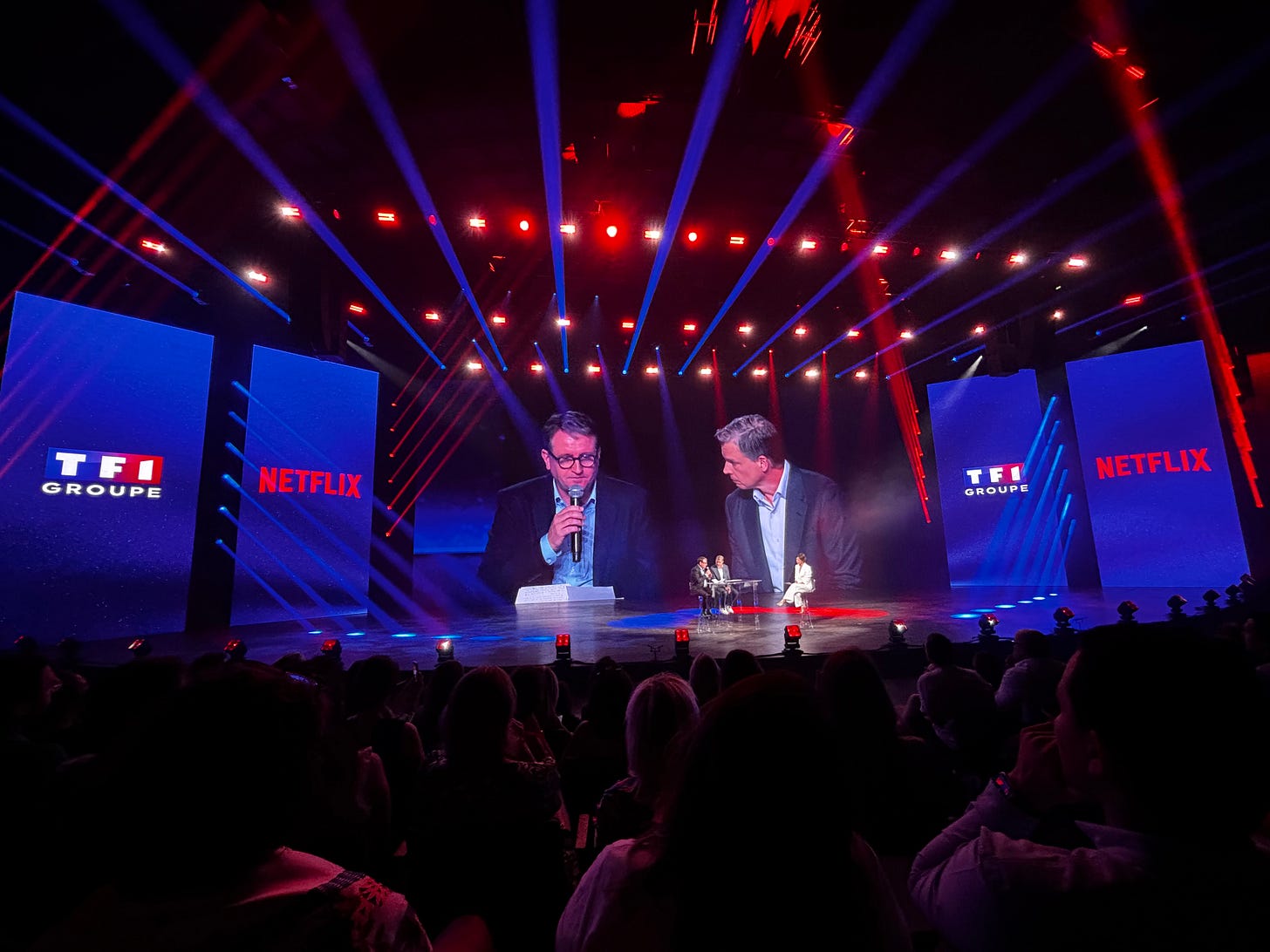
The deal everyone in media has been watching finally went live. TF1 is now inside Netflix in France. As I write this article (from a cab feeling a tad nauseous), 5% of French subscribers have access to the TF1 hub. If you are one of them, comment or reply to this email (I read everything). This is not a minor UI tweak. Netflix has never embedded a broadcast TV channel partner before and at that scale no less. We are talking live channels, restart, pause and up to 40,000 titles from TF1+‘s catalogue, all sitting inside the Netflix interface. The technical lift alone was significant: TF1 runs 5 channels, 24 hours a day, with breaking news and live sport baked into the schedule. Netflix’s usual product, a clean SVOD library you browse at your own pace, had to absorb something far more demanding.So how does it actually hold up?In the video, I give you a 1st glimpse of the integration. Once I’ve played with the interface myself, I will walk you through the full experience: where TF1 lives on the Netflix home screen, how the live channels are presented, how the catalogue is surfaced and whether TF1’s branding survived the integration or got swallowed by Netflix’s design system. Spoiler: brand visibility is one of the things worth watching closely here.There is also the ad question. TF1 PUB handles all advertising within the TF1 content on Netflix, with Médiamétrie ratings counting towards TF1, not Netflix. That means even subscribers on Netflix’s ad-free tier will now see ads when watching TF1 content. That is a significant shift in the user experience and advertisers are paying attention. The wider implications are real. Canal+ and French telecoms operators have long sold themselves as the one-stop aggregator for French TV and SVOD. Netflix doing this deal directly with TF1 moves the goalposts. France Télévisions followed with a similar hub inside Prime Video. Disney+ now distributes the live channel of L’Equipe. The distributor model is under pressure and will not look the same in 3 years.Watch the video to see how the integration actually plays out. Then tell me whether you think TF1 got the deal terms right. Sharing is caring. If you’re reading about this launch first here, tag me, reshare. I made the trip from Amsterdam to Paris as I had a hunch this wouldn’t be any upfront. I was pretty damn right. Now time for bed.Marion
-
Why 50,000 beats 5 Million
“You’re renting your audience… YouTube, their job is to get you not to watch Valerie’s content. Their job is to get you to watch what’s next after Valerie’s content.”Billy Cooper - CEO Visible...
General Source“You’re renting your audience… YouTube, their job is to get you not to watch Valerie’s content. Their job is to get you to watch what’s next after Valerie’s content.”Billy Cooper - CEO Visible thingsThis week I got to do something rare: sit back and relax to listen to The Media Odyssey Podcast. flew solo this week for a guest he’s wanted on the show for a while. Valerie Bertinelli’s career started on shows like One Day at a Time, Hot in Cleveland and then she ran her own cooking show on Food Network. Earlier this year she launched something most TV stars wouldn’t even contemplate: her own platform. She built it with Billy Cooper, whose company Visible Things turns television veterans into direct-to-fan operators.Cooper’s origin story matters here. He and his co-founders Andrew Greenberger and Willis Robertson met at a production company called 44 Blue, where Cooper ran Pit Bulls & Parolees for Animal Planet for nearly 20 seasons before Warner Discovery decided the channel didn’t need original programming anymore. The lesson he took from that collapse became the whole business. Audiences keep asking for a show long after a network kills it, so why not hand them the means to bring it back themselves.That’s exactly what happened with Valerie. The team licensed all 172 episodes of Valerie’s Home Cooking back from Food Network, then built three new shows around her, including one where her longtime recipe developer Sophie Clark walks viewers through the swaps and substitutions a real cooking show never lets you see. There’s a book club, a wellness podcast and a Hot in Cleveland revisiting series recorded inside Valerie’s actual wine cellar.Valerie’s Place chases the 1% of Bertinelli’s 5 million social followers who’d actually pay to be part of her community. Three months in, the platform’s own social accounts went from zero to 300,000 followers and the email list alone sits at 50,000.Bertinelli and Cooper make the case that the business isn’t the show, it’s her. The playbook applies well beyond television. Anyone with a name, a face and an actual fan base can run the same play.LISTEN and/or WATCH in full 👉🏻 APPLE PODCASTS | SPOTIFY | YOUTUBE | DEEZER with more platforms here. That’s it for today but before you go:🗳️ Poll timeSubscribe now
-
Sony Marketing Inc. built Cloud-based live video production for sports events with AWS Elemental MediaConnect Router
Sony Marketing Inc. and Sony Corporation built a cloud-based live video production system using AWS Elemental MediaConnect Router to complement their existing on-premises infrastructure for...
General Source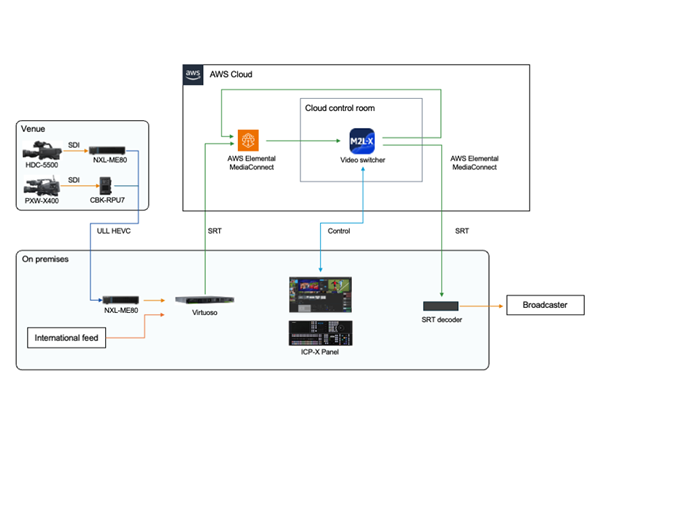
Sony Marketing Inc. and Sony Corporation built a cloud-based live video production system using AWS Elemental MediaConnect Router to complement their existing on-premises infrastructure for large-scale sports events. By adding cloud-based video routing alongside traditional on-premises routers, they created a hybrid system capable of handling more than 90 live video sources, including international broadcasts, domestic cameras, and replays, while reducing the overall cost and complexity of their physical infrastructure. In this post, we walk through how Sony extended their on-premises video production environment into the cloud, and how AWS Elemental MediaConnect Router solved a key technical constraint that made the hybrid architecture possible. When traditional infrastructure can’t meet modern scale demands Traditional video production for large sports events comes with a familiar set of pain points: High equipment costs – Cameras, routers, switchers, cabling, and racks require significant capital investment for limited-use periods. Transportation and logistics – Shipping equipment to event venues is increasingly expensive and complex. Large on-site teams – Installation, calibration, and teardown require specialized personnel and extended preparation windows. Long lead times – Setup can take days or weeks before an event begins. Sony wanted to dramatically reduce their on-premises footprint without compromising broadcast quality or production flexibility. The design constraint that shaped the architecture Sony’s production requirements called for more than 90 video source systems. They selected eight Sony M2L-X cloud switchers (plus one spare) for video switching. But a critical limitation surfaced: the M2L-X pre-selector supports a maximum of 32 inputs. That gap of nearly 60 sources became the defining design challenge. One option was to add on-premises video routers upstream of the switchers to handle source selection. But that would have reintroduced the physical infrastructure Sony was trying to eliminate, conflicting with their cloud-first design goals. Solution overview Sony deployed MediaConnect Router upstream of the M2L-X switchers, creating a cloud-based routing layer that replaced the need for physical pre-selectors entirely. Here’s how it works: All video sources ingest into AWS Elemental MediaConnect – International feeds, domestic cameras, replays, and other sources all land in the cloud. MediaConnect Router handles source selection – Operators dynamically route any combination of the 90-plus sources to the appropriate M2L-X switcher inputs. M2L-X handles production switching – The cloud switchers receive their routed inputs and handle transitions, effects, and program output as usual. This architecture, shown in the following diagram, eliminated the 32-input bottleneck without adding any on-premises hardware. Figure 1: System architecture showing MediaConnect Router as the central cloud-based routing layer between video sources and M2L-X cloud switchers Control and operation For crosspoint control, Sony used their in-house circuit control application, Live Link Control (L2C), which interfaces with AWS Elemental MediaConnect Router through its API. This gave operators: A crosspoint control screen that sends routing commands to MediaConnect Router by way of API, with the same look and feel as conventional hardware video routers Remote control panel integration for each switcher, supporting familiar production workflows The ability to manage both cloud and on-premises routing from a single interface, whether on-site or remote Because L2C abstracts the API layer behind a familiar control surface, operators worked with the same panels and workflows they already knew. The following screenshots show these panels. Figure 2: L2C control screen Figure 3: L2C remote control panel AWS support for the event To ensure operational readiness for a live broadcast of this scale, Sony worked closely with the AWS Unified Operations for Media team throughout the planning and testing phases. The engagement included architecture reviews, operational runbook development, and real-time support during the broadcast. Ahead of the event, the Unified Operations team helped validate the hybrid architecture, including AWS Direct Connect resilience, multi-AZ deployment patterns, and MediaConnect Router failover configurations, which proactively identified and mitigated risks before going live. Results The simplified infrastructure of the cloud-based system reduced Sony’s physical footprint at event venues. Fewer racks, fewer cable runs, and fewer equipment shipments translated directly into lower transportation and installation costs. Setup that previously required extended on-site preparation became faster and simpler. Using M2L-X cloud switchers with conventional operation panels provided broadcast-quality production with familiar operations, so the production teams could work in the cloud environment without changing their workflows. Video transitions, effects, and other production elements met television broadcast standards with no compromise in quality. MediaConnect Router delivered the production flexibility at scale that physical routers couldn’t match in this architecture: Full source access – All 90-plus video sources were selectable in the cloud, removing the 32-input pre-selector constraint. Multi-program production – Switcher outputs could be re-ingested as sources, enabling multiple simultaneous program productions. Improved reliability – Flexible routing configurations for multi-viewer setups improved system availability and provided better failover options during live production. Conclusion Sony’s implementation demonstrates cloud-based video production at broadcast scale. By using MediaConnect Router for video routing, they transformed a physical infrastructure constraint—more than 90 sources exceeding switcher input limits—into a software configuration challenge that scales elastically. This architecture delivers a proven path for broadcasters managing large-scale live events: reduced costs and operational complexity without compromising production quality or established workflows. To get started with cloud-based video routing, visit the AWS Elemental MediaConnect product page or explore the MediaConnect User Guide. Further reading AWS Announces Elemental MediaConnect Router Live cloud production for sports on AWS Broadcast & Live Production on AWS
-
How Fast Will AV2 Deploy?: Ask Joe Sixpack
The AV2 spec went final in late May 2026, AOMedia announced it on June 9, and VeriSilicon had a decode IP core out within about two weeks. An AOMedia member survey reports that 53% of respondents...
General Source
The AV2 spec went final in late May 2026, AOMedia announced it on June 9, and VeriSilicon had a decode IP core out within about two weeks. An AOMedia member survey reports that 53% of respondents plan to adopt AV2 within a year and 88% within two years. Over the next several months, expect a steady stream of AV2 support announcements, which will seem like momentum towards rapid adoption. Here’s the fair way to read all of it, and it’s got nothing to do with compression ratios, licensing, or silicon roadmaps. No codec ever achieved fast adoption based on merit alone. Each accelerated adoption happened because there was a “lever,” a reason strong enough to accelerate the process. HEVC had a lever. H.264 had a lever. AV1 had the cleverest lever of all: YouTube withholding 4K from any player that didn’t support its preferred codecs, first VP9 and then AV1. AV2’s problem is that a lever usually works only once, and by 2026 they’ve all been pulled. The natural schedule is slow Before exploring the accelerated adoption scenarios, let’s first look at the default path. Absent market-driven acceleration, every codec walks the same slow path shown in Figure 1 from an AOMedia launch presentation. The spec finalizes, chip vendors build decode silicon, device makers design that silicon into TVs and phones, products ship, and the installed base of capable devices slowly accumulates. Usually, these activities occur serially, one finishing, and the next starting. The chip ships, design-in starts. Only when the installed base crosses a threshold do mainstream publishers start deploying, because encoding and storing yet another format cost money and deliver no ROI until enough people can play it. One InterDigital white paper pegged that threshold as 30% of the addressable base. Good enough. Figure 1. Adoption timeline from the Alliance for Open Media. When AOMedia launched AV1 in 2018, it forecast one year for silicon and two for consumer devices. That was optimistic even before COVID wrecked the supply chain, and AV1 missed it. Add the two to three years it takes for the installed base to reach 30% after devices ship, and the honest default is something like four to six years from a finished spec to a market an independent publisher will address. That’s the schedule when nobody is in a hurry. The interesting question is what ever makes anyone hurry. HEVC: Consumers push adoption Figure 2. HEVC adoption was very accelerated. You wouldn’t know it from all the bad press, but HEVC is the fastest codec adoption on record. HEVC’s first edition was released at the end of January 2013. The 4K race was already the centerpiece of that month’s CES, two weeks before the spec even froze, with major brands showing UHD panels and HEVC demonstrated on the floor through external decoders. Those first 4K sets were panels without onboard HEVC decode, Sony’s 2012 and 2013 Bravias among them, so the earliest 4K HEVC decoding occurred in outboard boxes. Sony cared enough to ship a dedicated one, the FMP-X5, in 2014, purely so its 4K sets could play Netflix in HEVC. Built-in decode appeared on some 2014 model-year Bravia 4K TVs. You see additional Smart TV support in Figure 2. In terms of publisher support, Netflix streamed 4K HEVC with House of Cards by April 2014, barely a year after the spec closed. A hardware race running ahead of a frozen spec, onboard decode the next model year, and a major publisher live inside fifteen months is only possible if chip development, silicon availability, and TV design-in were all running in parallel rather than in sequence. Penetration of HEVC-capable devices then climbed steadily toward near-universal adoption, according to one installed-base projection, rising from 57.5% in 2019 to 90.4% in 2023 and an estimated 99.6% by 2027. In contrast, VVC went final in July 2020, and there still are few, if any, TVs with VVC decoding outside of Brazil, close to six years later. AV1 went final in March 2018, and some TVs with AV1 decoding appeared in mid-2020, though it took several more years for support to become pervasive in new models. Regarding licensing, MPEG LA announced its HEVC license terms in September 2014. HEVC Advance announced its terms in 2015, while Velos Media launched in 2017. In essence, HEVC succeeded before the pools launched and all the complaints started. Penetration climbed straight through all three rounds of licensing turmoil without a wobble (Figure 3). Figure 3. Sales of UltraHD TVs after HEVC launch. From here. The reason was 4K, and then HDR. They provided a legitimate shiny new object that consumers walked into a store and wanted, and that sold new TVs. That pull accelerated deployment because no CE manufacturer wanted to be without a 4K set when a customer was willing to pay for it. HEVC didn’t move fast because its logistics were fast. It moved fast because consumers gave the whole industry a reason to skip the waiting. And once you got on that train, you barely noticed the royalties you were paying, and certainly didn’t complain about the goose making all that gold. H.264: Publishers Push Adoption Consumers are one engine. Publishers are the other, and H.264 is the clean example of a publisher lever. In the late 2000s, web video meant Adobe Flash, and Flash reached the desktop browser and almost nowhere else. There was Flash and TV sets, which were running MPEG-2 and increasingly H.264. Then the screens multiplied. The iPhone shipped with no Flash, Android followed, smart TVs arrived with their own players, and HTML5 video appeared. A publisher who wanted those audiences had no path through Flash. H.264 was the path. Once Adobe added H.264 to Flash, it became the one codec publishers could produce that played everywhere, inside Flash, on iOS, on Android, on smart TVs, and in HTML5. Publishers jumped at that, and adoption was rapid because H.264 provided access to new markets while reducing their encoding costs. The pull came from the supply side, and it was every bit as strong as HEVC’s consumer pull. A codec that expands a publisher’s reach while reducing costs gets adopted quickly. AV1: when YouTube and Netflix push adoption AV1 is the model AV2 will be measured against in the living room, and the main lever was YouTube 4K (Figure 4). Figure 4. Apple added VP9/AV1 to claim the ability to display YouTube in “their full 4K glory.” The story starts with VP9. As reported in FlatpanelsHD in an article entitled, 2015 TVs will support YouTube in 4K by using VP9: We first heard about Google’s efforts to bring VP9 – and with it, YouTube in 4K – to Smart TVs at CES 2014. The timing was odd because in 2014 no TVs actually supported VP9. That will change in 2015, where Samsung, Sony, LG, Sharp, and Philips TVs will be capable of streaming YouTube in 4K. Google have chosen to go its own way in the pursuit of better streaming picture quality. Most industry players are betting on HEVC to replace mpeg4, but Google wants its own VP9 to succeed. So it has decided that YouTube will use VP9 for 4K streaming on TVs.” It’s clear that had YouTube chosen HEVC, VP9 would have never achieved these design wins. A few years later, YouTube started encoding its most popular videos in AV1. Here the picture gets a bit muddled. Most likely, YouTube’s pitch to SmartTV vendors changed from “to watch 4K videos, you must support VP9,” to “to watch our most popular videos at their best quality, you must support AV1.” Of course, you can’t drop VP9 support because most 4K videos are NOT encoded in AV1. In parallel, Netflix advanced its use of AV1, reinforcing the AV1 value proposition to include improved QoS and HDR; what SmartTV product manager could resist that? Together, YouTube and Netflix, two AOMedia founders, created quite the value proposition. In a recent tech blog, Netflix reported that over the past five years (2021–2025), 88% of large‑screen devices, including TVs, set‑top boxes, and streaming sticks, submitted for Netflix certification have supported AV1. The big question is, will AV2 create the same value proposition? It’s possible that YouTube could switch to AV2 for 4K/8K videos, duplicating the AV1 message, but consumers already get 4K with AV1. That’s the catch with the cleverest lever: it works by withholding something people want, and you can only withhold it once. YouTube already spent the 4K lever on VP9 and AV1. There’s nothing left to hold hostage for AV2, and “support AV2 or miss our best videos at their best” is a hostage few will pay for when they already get 4K. The thing you can’t trust: the survey Codec surveys consistently over‑promise. A recent vendor survey, for example, shows AV1 in production at 17% of organizations with 40% more planning to deploy in 2026, implying 57% combined by year‑end, which are numbers that echo AOMedia’s own AV2 survey optimism. But five years of Bitmovin Video Developer Reports show a different reality: AV1 usage crept from roughly the low teens to the mid‑teens, while “plan to deploy” numbers remained far higher (Figure 5). Figure 5. AV1 adoption predictions from the Bitmovin Video Developer Report. Don’t get me wrong; I find the data from Bitmovin reports extremely valuable (and you can complete the current survey here). But I’ve learned to consider the codec adoption data more as an indicator of sentiment than of true intent. Does AV2 give anyone a reason to accelerate the adoption curve? Put AV2 to the same test, and here’s the trouble: every lever’s already been pulled. Will consumers jump? Ask whether any AV2 announcement would make Joe Sixpack want a new TV. AV2 delivers nothing he doesn’t already get from the HEVC or AV1 set in his living room. 4K is done, HDR is done; so there is no compelling reason for him to buy, and no consumer pull to compress the schedule the way 4K did for HEVC. YouTube and Netflix may (again) attempt to create that pull, but with YouTube 4K covered, it’s clearly less powerful. Will publishers outside the AOM hyper-scalar club rush to AV2? The H.264 test was reach while reducing encoding costs, and AV2 fails it. Every viewer an AV2 stream can reach is already reachable with a codec they already produce, so adopting AV2 doesn’t consolidate their encodes. Instead, it adds an encode, a storage tier, and a fallback path in exchange for some efficiency on the sliver of devices that can decode it. Will Meta, Netflix, and YouTube rush to adopt? Without question, but if it’s anything like AV1, they won’t pull other publishers with them. All that, and the end of the royalty-free fiction And there’s the royalty situation. Figure 6. AV2’s royalty status will likely hinge on AV1, which is looking increasingly royalty-bearing. As compared to AV1, the 2026 royalty realities will hit AV2 disproportionately harder. When AV1 launched, the pitch featured “royalty‑free” language that persists to this day. The deliberate impression wasn’t “royalty‑free vis‑à‑vis AOM,” which is the narrow reality, but “royalty‑free, period.” By 2025–2026, that illusion is gone, at least among the relevant decision-makers. Sisvel says its AV1 pool now covers roughly half of the finished‑product AV1 market and has already signaled it is “prepared” for AV2 with a follow‑on pool. AV1 is also in scope for the new Avanci Video and Access Advance Video Distribution programs, which offer one‑stop streaming licenses for HEVC, VVC, AV1, and VP9. Presumably, AV2 will be included as well. And Dolby is now suing Snap over alleged AV1 and HEVC patent infringement in the U.S. and Brazil, explicitly arguing that it has made no FRAND or royalty‑free commitments for AV1 (FRAND is Fair, Reasonable, and Non-Discriminatory). Ironically, because AV1 isn’t a standard created by a standard-setting organization, and because Dolby made no FRAND statement regarding AV1, royalties may not be limited by FRAND, so AV1 could be more expensive than other codecs like HEVC or VVC. Finally, InterDigital just won an injunction against Disney for using HEVC in Europe. While not AV1-related, it strengthens the claims to content-side royalties and establishes that royalties on encoding-related patents are not FRAND-restricted. So, if Dolby decides to sue Snap in the UPC, it’s likely that these same rulings will be applied to AV1. The bottom line is that the royalty-free posture that may have accelerated AV1 adoption is now gone, which may add friction to every implementation decision, hardware or content. As with HEVC, this friction could be overcome with a strong enough demand lever, but I don’t see that here. So here is the realistic expectation, venue by venue. Browser support comes fast, call it twelve months, because the browsers are AOM-controlled and software decode ships in an update. Hyperscaler delivery to computers follows, maybe twenty-four months, serving AV2 to those software decoders where it costs almost nothing to try. And then it stalls, because the next venues need hardware. Mobile took Apple about five years to add AV1 silicon, and AV2 has substantially higher decode complexity in early software implementations, so software playback on a hundred-dollar phone looks doubtful, and mass-market hardware is a long, driverless wait. Smart TVs are further out still. Show me the pull that adds AV2 hardware decoding to mobile and the living room, and I will revise the timeline. I don’t see one. So, the slog None of this means AV2 fails. It’ll grab the cheap footholds, the browser and the hyperscaler desktop, within a couple of years. Essentially, the same places AV1 reached first, for the same reason: they cost almost nothing to try. AV1 didn’t fail, and VVC hasn’t failed. They’re slogging up the natural schedule on hardware cycles and a few committed giants, not on a wave of any strong lever. That’s the honest forecast for AV2 too, the same slog into mobile and the living room, paced by hardware generations, not survey horizons. But notice what’s missing this time. HEVC had consumers. H.264 had publishers. AV1 had YouTube holding 4K hostage. Each of those levers is good for one pull, and all three have been pulled. So when the support announcements roll in, ask yourself: would it make Joe Sixpack buy a new TV, or hand a publisher a market it can’t already reach? When the answer’s no, you already know how fast this goes. I’d love to be wrong. I’ve just watched this happen enough times to doubt that I will be. The post How Fast Will AV2 Deploy?: Ask Joe Sixpack first appeared on Streaming Learning Center.
-
First look at Rakuten TV's European platform data
Most published research on FAST and AVOD in Europe is consumer survey data. Valuable in its way but it records what viewers say they do, not what platforms actually see them doing. Real...
General Source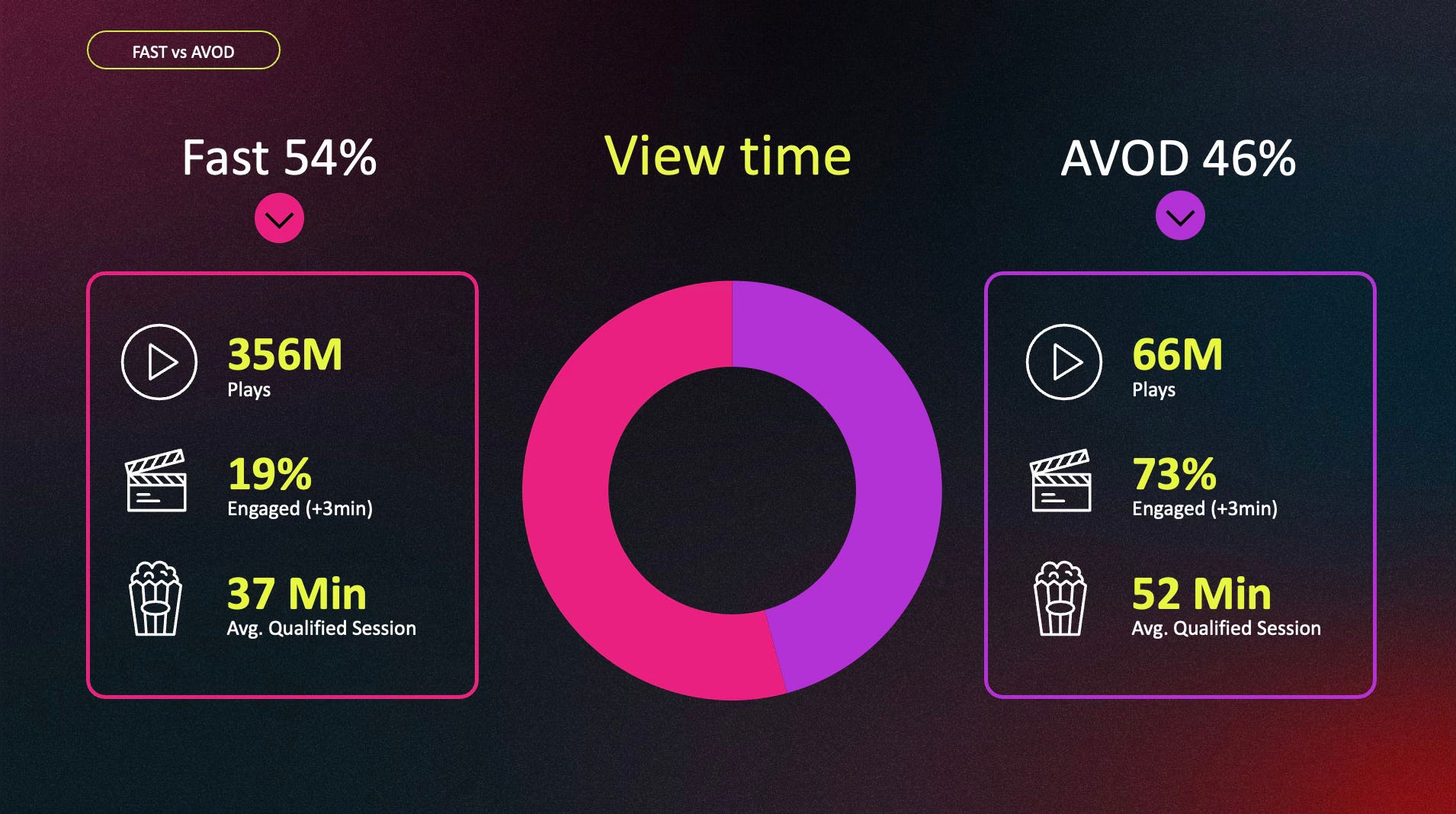
Most published research on FAST and AVOD in Europe is consumer survey data. Valuable in its way but it records what viewers say they do, not what platforms actually see them doing. Real consumption numbers, broken down by market, by title and by performance metric, almost never appear in a public forum. Rakuten TV Enterprise changed that for one session on June 9 during which Maria Chacon Brito, Head of FAST Channels Partnerships at Rakuten TV, put the company’s own platform consumption numbers on screen for the first time. What viewers actually watch across FAST and AVOD, broken down by market, by genre and by 3 distinct performance metrics. Some of it confirmed what the industry assumes, a fair amount didn’t.This edition covers that session in full as well as two research pieces Rakuten TV drop: “The FAST Advantage” on European consumer attitudes to free streaming and “Beyond the Break” on CTV advertising. I’ll draw on both where they add to the platform data. Today at a glance: Equal on time, miles apart on behaviourWhat Europe actually watchesThe 3-question framework for FAST: What drives viewers in? What makes viewers stay? What brings viewers back?BONUS: Instead of my crooked pictures from the event, the team at Rakuten TV was kind enough to share the slides with me and so with you too.Subscribe nowEqual on time, miles apart on behaviourThey look balanced on paper. FAST accounts for 54% of total viewing time on Rakuten TV while AVOD accounts for 46%. Close enough to call even but the behaviour behind that number is completely different.FAST generated 356 million plays in the period while AVOD generated 66 million. FAST is where people browse: only 19% of FAST plays run past 3 minutes. On AVOD, 73% stay beyond 3 minutes. The average qualified session is 37 minutes on FAST, 52 on AVOD. FAST is where viewers arrive without a plan while AVOD is where they go with one.Rakuten TV - June 2026AVOD is also heavily skewed toward film with 86% of viewing going to movies, 14% to series (the library is deeper with 6K+ movies live while the series library is still growing with 700% episodes). Engagement on both is almost identical, 72% for movies and 73% for series, which means once someone picks something on AVOD, they commit regardless of the format. Rakuten TV - June 2026This matters for how you programme and monetise each format. An AVOD viewer who sits through 52 minutes of a film behaves very differently from a FAST viewer who dips in and out. Treating them identically is where the revenue gap opens up.The FAST Advantage consumer survey puts a number on the broader shift. 80.1% of European viewers now treat FAST as a main or alternative way to watch television, and 93.7% watch it on the main TV screen in the living room. FAST has stopped being background noise, it’s primary viewing.What Europe actually watchesDrama, thriller and action fill the top 3 in every AVOD market: UK, Germany, France, Spain and Italy. Comedy and adventure at 4 and 5, barely any variation by country.Rakuten TV - June 2026Go one level deeper, to the actual titles, and it gets even more interesting. Read more
-
Fox Corporation to Acquire Roku: Close in the First Half of 2027, $22B in Enterprise Value
The rumors are true. Fox Corporation announced it has agreed to acquire Roku for $160 per share, in cash (60%) and Fox common stock (40%), valuing Roku at approximately $22 billion in enterprise...
Business Source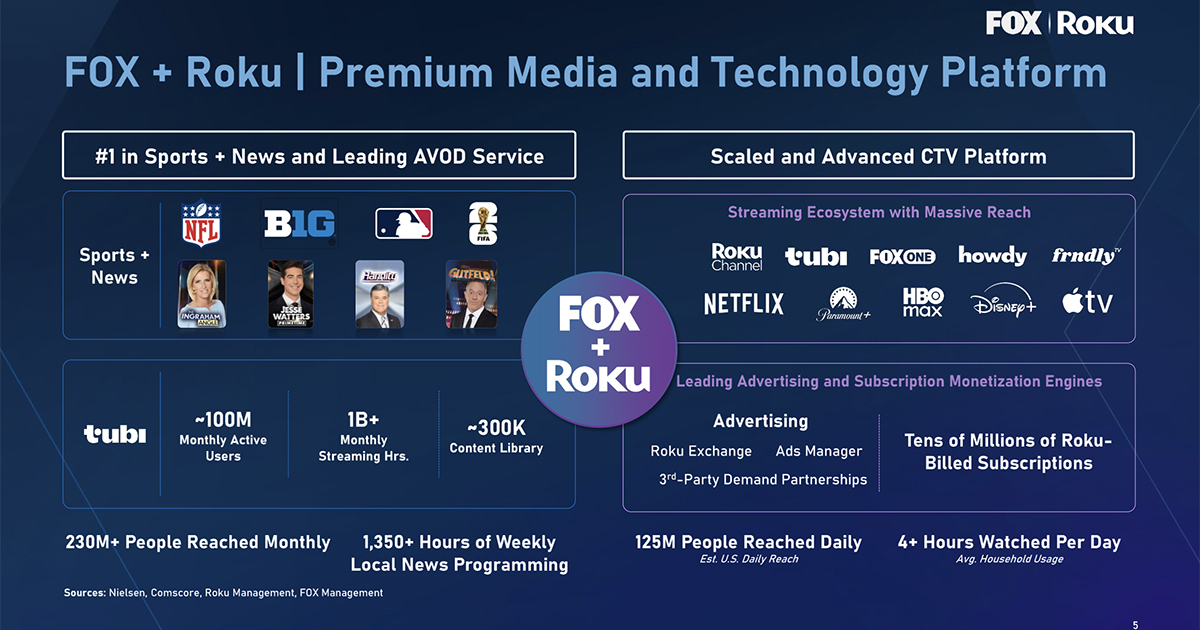
The rumors are true. Fox Corporation announced it has agreed to acquire Roku for $160 per share, in cash (60%) and Fox common stock (40%), valuing Roku at approximately $22 billion in enterprise value. Fox is taking on new debt to fund the deal and has secured $12 billion in fully committed bridge financing from Morgan Stanley. The deal is expected to close in the first half of 2027, and upon closing, existing FOX shareholders are expected to own approximately 73% of the combined company, with Roku shareholders owning approximately 27%. Fox originally invested in Roku in 2013, participating as an early, pre-IPO investor Fox says the deal is expected to be accretive to free cash flow per share by the second full year after closing and to achieve approximately $400 million in run-rate cost synergies, with additional revenue upside. In 2021, Roku’s Stock hit an all-time high of $479.50 during the pandemic-driven streaming boom, but it quickly declined to under $100 a year later. From April 2022 to December 2025, Roku’s stock only briefly peaked above $100 per share. As expected, Roku will remain an open platform, and content from other companies will continue to be supported and promoted, with a continued focus on an aggregation strategy. Fox said they plan to keep Tubi and The Roku Channel separate after the deal closes, noting that about a third of their audiences overlap. While the combination of Fox and Roku brings together news and sports channels with two free streaming services, it’s the advertising side of Roku’s business that’s most valuable. Based on Wall Street estimates, the deal values Roku at 24x FY27E EBITDA. During Roku’s Q1 earnings, the company broke out its advertising and subscription business for the first time, with advertising revenue of $613M, up 27% YoY. Subscription revenue was $519M, up 30%. Total revenue for the quarter was $1.248B, up 22% YoY on net income of $85.7M. Revenue from device sales was less than 10% of total revenue, at $118M, down 16%. Streaming hours across the Roku platform were up 8% to 38.7 billion. Roku ended Q1 with $2.38 billion in cash and cash equivalents on hand, with zero long-term debt. As part of the deal, Anthony Wood, founder, chairman and CEO of Roku, will join the Fox board. The Fox and Roku investor presentation is located here.
-
Inside the AWS NBA Draft Combine Hub: How AWS turned decades of prospect data into a new fan experience
Each spring, the Amazon Web Services (AWS) NBA Draft Combine gives teams one of their first concentrated looks at the next generation of NBA talent. Over several days, prospects undergo a wide...
General Source
Each spring, the Amazon Web Services (AWS) NBA Draft Combine gives teams one of their first concentrated looks at the next generation of NBA talent. Over several days, prospects undergo a wide range of basketball activities and evaluation. The results can help explain why a player is rising or how a particular skill may translate to the court. For fans, that context has historically been harder to access. NBA Combine data has existed across tables, articles, broadcasts, and team-by-team analysis, but the experience has rarely felt connected. A fan could see a player’s wingspan, vertical leap, shooting results, or lane agility time, but understanding how those numbers compare across positions, draft classes, or the broader history of the Combine required extra work. The AWS NBA Draft Combine Hub, powered by Amazon Quick was designed to change that. Built in collaboration with West Loop Strategy, an Advanced Tier AWS Partner that specializes in Amazon Quick, AI and data, the experience brings more than 25 years of NBA Draft Combine data into a single interactive destination, giving fans a way to explore player results for measurements and strength and agility testing with historical context. The goal was not simply to build a dashboard. It was to create a system that helps fans understand why the Combine matters. Figure 1: 2026 AWS NBA Draft Combine Data Hub: Analyzing Elite Prospect Measurements Powering interactive analytics at league scale The project began with a deceptively simple question: what would a fan want to know before they knew how to ask for it? For the NBA, that meant starting with the viewer experience and working backward into the data model. The team focused less on how much data could be displayed and more on which combinations of data might actually help explain what makes a prospect unique. “We started by putting ourselves in the fan’s eyes,” said Julie de Jesus, VP of Design, NBA. “What would be interesting before we even knew to ask the question? That led us to think about which data points could sit together and how to surface the smaller skill sets that may not always be obvious.” The underlying dataset spans 25 years of data on participating players across measurements, strength and agility testing, and roughly 20 skill areas. But scale alone was not the challenge. The challenge was transforming a historically broad, table-based dataset into something navigable and meaningful. Figure 2: Height vs. Lane Agility Time: Scatter Plot Analysis of 2026 Draft Combine Measurements “There is a limit to what a human being can really focus on,” de Jesus noted. “The goal is not to show everything. It is to surface the information someone can actually use to try to understand how players fit into the historical mold of the NBA.” That approach led to a product where relationships matter more than raw outputs. Instead of presenting isolated metrics, the Hub surfaces how measurements, drills, and performance indicators connect to each other and to historical benchmarks. From prototype to production Turning that concept into a production-ready product required tight iteration across AWS, West Loop Strategy, and the NBA. The teams worked through rapid cycles of building, testing, and refining, with constant input from the NBA’s product, design, and stats groups. West Loop Strategy brought development and visualization expertise, AWS handled the analytics and launch build, while the NBA provided creative direction and statistical guidelines for league consistency. “We have found the single most important factor in a successful project is to get something in front of users, get feedback, and iterate,” said Alex Gottemoller, Founding Partner, West Loop Strategy. “All feedback is good feedback. Reducing the length of those cycles is critical, and the tools from AWS make that possible.” That process allowed the team to explore different ways of structuring the experience, validating which approaches helped users understand the data more intuitively. Ideas were tested quickly, refined, and either incorporated or discarded without friction. The result is a product that reflects both technical capability and league authenticity. It is grounded in how the NBA evaluates players, while still being accessible to fans who are exploring the Combine for the first time. Serverless infrastructure for fan-facing analytics The Combine Hub is a public-facing experience designed for moments of high fan interest, including Combine coverage, player announcements, and the NBA Draft. That requires infrastructure that can scale quickly without introducing operational complexity. Amazon Quick provides a serverless foundation that allows the experience to handle large volumes of concurrent users without manual provisioning or infrastructure management. “Because Quick is serverless, it is one of the easiest ways to manage scaling up a public-facing experience like this,” said Brett Hafstad, Cloud Engineer, West Loop Strategy. “You do not have to think about scaling infrastructure or managing load. It is handled behind the scenes.” This model allows the NBA to deliver a consistent experience regardless of traffic spikes. It also reduces the need for dedicated operational resources, enabling teams to focus on improving the product rather than maintaining the underlying systems. From a development perspective, that simplicity accelerates deployment and iteration. From a fan perspective, it ensures the experience is always available when demand is highest. From Combine data to fan intelligence One of the most important shifts in the Combine Hub is how data is presented. Instead of treating each measurement or drill result as a standalone number, the product builds context directly into the interface. The Combine Hub provides data not only on individual draft classes, but also across positions and across historical Combine data. These contextual comparisons help explain why a result is meaningful. “In the past, Combine data could feel like a broad table view,” said de Jesus. “What we wanted to do was show why a score or measurement may actually be significant, not just within a class, but overall.” This turns passive data into an interactive experience. Fans are no longer just looking up information. They are exploring how players compare, how different attributes interact, and how a prospect may fit into the broader landscape of the league. The AWS NBA Draft Combine Hub reflects a broader shift in how sports leagues think about data. The focus is moving from publishing information to building intelligence products that make that information usable. By combining historical depth, interactive analytics, and a scalable AWS foundation, the Hub gives fans a more complete view of player evaluation. It helps explain not just what happened at the Combine, but why it matters and how it connects to what comes next. For the NBA, that means a more informed fan experience. For AWS, it demonstrates how services like Amazon Quick can move beyond traditional dashboards and power dynamic, large-scale analytics experiences.
-
Disney+ France calls for backup
🤖 Your AI streaming guide is guessingLLMs aren’t ready to be your content discovery layer, not even close. ChatGPT scored 43.76% accuracy on streaming availability. Claude 50.21%. Reelgood...
General Source
🤖 Your AI streaming guide is guessingLLMs aren’t ready to be your content discovery layer, not even close. ChatGPT scored 43.76% accuracy on streaming availability. Claude 50.21%. Reelgood 96.89%.Yes, Reelgood ran the test and Haiku is not Anthropic’s most capable model but it’s still useful to have some hard numbers and not just my personal experience testing LLMs for content discovery. Why such a low accuracy? The report highlights 6 reasons, from stale availability to add-on confusion to TVOD blindness. As AI assistants position themselves as the front door for content discovery, it’s crucial to remember that like everything they’re only as good as the data they learn from. LLMs can’t do this alone which begs the question: what should the video streaming industry do about it: accept they will play a part in content discovery and collaborate with them or protect itself from them?More details in the report can be found here. 📱The French mobile price war is overWhen Illiad/Free entered the market in 2012 with a €2/month mobile subscription, it triggered a decade-long price war that reshaped French telecom. Fast forward to 2026, Orange, Bouygues and Iliad are buying SFR for €20.35B and splitting it three ways. The deal was signed on June 6 with definitive agreements expected in H2 2026 and closing in H2 2027 at the earliest, pending regulatory approval in Paris and Brussels.For the streaming industry, this deal is bigger than mobile tariffs. When those assets get absorbed by Orange, Bouygues and Iliad, France ends up with three telcos (with higher subscriber counts) that are also three of the country's most powerful content distribution gatekeepers. Distribution economics, home screen placement all shift. Streamers operating in France need to pay close attention. The UK already went through this with the Vodafone/Three merger while Spain, Germany and Italy still have four-player markets. The European telco map is being redrawn, one merger at a time. The streaming distribution map will be redrawn with it.What will the French market look like post-purchase? Find out in our latest infographic. 🎥 Auto-Tune, Teslas and five SVODs on AmazonFor this episode of Inside the Bundle, in partnership with Bango, I spoke with David Purdy, CRO at Stingray, on how a Canadian music company became a multi-vertical streaming operation, what the old cable model got right (and what it got wrong) and where the next bundle bets are: gaming platforms, mobile operators, car dashboards.He also has a view on why telcos have spent 20 years trying to crack content and never pulled it off. For that one, you’ll have to press play.Watch the full episode here:Previous episodes: David Bouchier, Kenechi Amobi Belusevic, Vincent Stevens, Joan Cruells, Ana Lopez. Coming next: Chris Van der Linden. 📺 The last gatekeepers?TVREV has a name for the media landscape we’re all navigating: Feudal Media. Thousands of disconnected content bubbles, each with its own celebrities, inside jokes and source of truth, all largely unaware of anything outside them. In the middle of this sits the TV operating system: the home screen viewers see when they turn on the set, the recommendation engine that tells them what to watch next, the ad platform that decides which brands reach them. The last remaining gatekeeper according to Alan Wolk and the TVREV team who have mapped the battle for that layer in a new report covering the major players, the role of FAST and home screen advertising, what AI will and won’t change.It makes for the perfect Sunday read. 🎙️ How to cover the World Cup without live rightsThe Overlap built a 1.7 million subscriber business without buying live rights. Scott Melvin is clear on this: they did not avoid live rights by strategy. The cost is simply prohibitive. You either go all in or you cannot play. So they built around what live rights cannot give you: the conversation around the game. During this episode, we get into: → What the Bundesliga actually handed over; → What happened when they looked at the social numbers against the live, and what Scott made of the gap;→ What Global's capital made possible;→ Why they acquired Mark Goldbridge's channels rather than building from scratch; → Why growing a YouTube channel to 1 million subscribers today is a different exercise than it was 5 years ago. Blueprint or exception?👉🏻 APPLE PODCASTS | SPOTIFY | YOUTUBE | DEEZER with more platforms here. 📦 Disney+ France's super aggregation momentDisney+ announced a partnership with ADN (Animation Digital Network) to add 1,500+ episodes to its catalogue including Naruto, Assassination Classroom and The Eminence in Shadow, plus new simulcast titles from Japan and the co-production of originals. The TV channel L’EQUIPE joins the same week, both at no extra cost to subscribers.Disney is not prepared to let the super aggregator play in the hands of Amazon and Netflix. Disney+ is pulling in third-party catalogues and live TV under one subscription without touching the price. The theory is familiar: centralise enough of what viewers want and they stop looking elsewhere.The question is whether Disney+ can do this without becoming a generic bundle. ADN's community credibility took 13 years to build. Crunchyroll crossed 21 million paid subscribers by running an anime-first product with no distractions. Slotting 1,500 episodes into a general entertainment platform still leaves the community-building to do. French viewers already have L’Equipe for free (across their owned and operated platform, on TNT, on telco platforms and even inside TF1+). Disney+ gets the tidiness of one app, not a genuine content advantage.Disney+ doesn't pull in third-party anime and a free-to-air sports channel because its own catalogue is doing enough in France. Marvel, Star Wars and Pixar drove the initial subscriber wave. Without a steady flow of new tentpoles, and with Netflix set to launch its TF1 partnership, Disney+ needs content that brings viewers back weekly rather than only when the next big release drops. Live sport and simulcast anime both do that. That’s it for today but before you go:🗳️ Poll timeStreaming Made Easy is a reader-supported publication. To receive new posts and support my work, consider becoming a free or paid subscriber.
-
Using AWS Elemental Inference with MediaLive
Today’s audiences consume media differently than ever before. While most broadcast content is still produced in horizontal (also called landscape) format for traditional viewing on TVs,...
General Source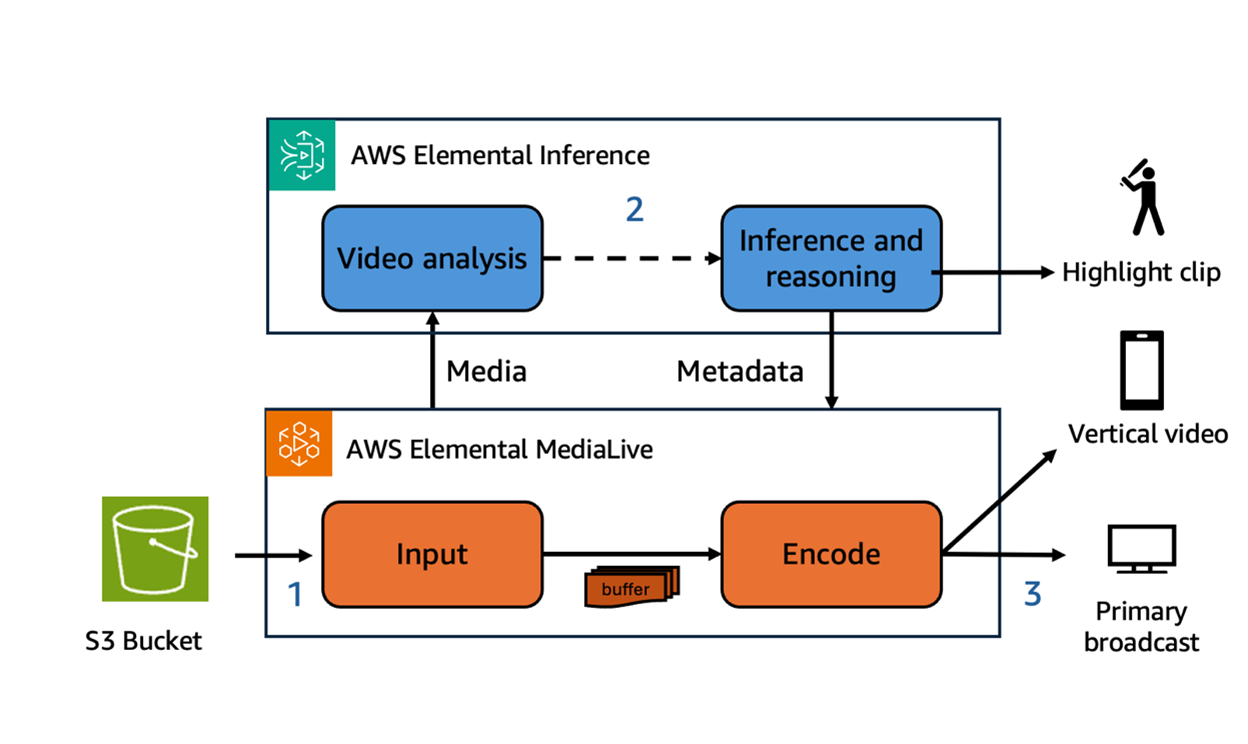
Today’s audiences consume media differently than ever before. While most broadcast content is still produced in horizontal (also called landscape) format for traditional viewing on TVs, mobile-first platforms like TikTok, Instagram Reels, and YouTube Shorts, which use a vertical format, have fundamentally changed how viewers engage with video. Converting 16:9 broadcast content into vertical formats optimized for these platforms typically requires hours of manual editing, causing broadcasters and content creators to miss trending moments and lose audiences to mobile-first competitors. AWS Elemental Inference is a fully managed AI service that automatically transforms live video broadcasts to vertical video, reaching audiences across every screen. Broadcasters and streaming media creators can use Elemental Inference to deliver content to social and mobile platforms without manual post-production work or AI expertise. In this post, I show you how to enable Elemental Inference on an AWS Elemental MediaLive channel and use the Smart Crop (vertical video) feature to automatically convert landscape broadcast content into vertical 9:16 format. Prerequisites Before you begin, make sure you have the following: An active AWS account AWS Identity and Access Management (IAM) permissions to create and manage MediaLive channels An existing MediaLiveAccessRole IAM role (or permissions to create one) Source video content stored in an Amazon Simple Storage Service (Amazon S3) bucket Basic familiarity with MediaLive concepts (channels, inputs, output groups) Solution overview This walkthrough demonstrates how to: Create a MediaLive channel with Elemental Inference enabled Configure a landscape output (1280×720) and a vertical output (720×1280) Enable smart cropping on the vertical output to automatically reframe content for mobile platforms The following diagram shows the high-level architecture: MediaLive receives a source video from an S3 bucket MediaLive sends the video to Elemental Inference for real-time analysis Elemental Inference returns metadata to MediaLive MediaLive produces both landscape and vertical outputs using the smart cropping metadata Figure 1: Solution architecture Use Elemental Inference to convert horizontal media to vertical With the prerequisites in place, you’re ready to use Elemental Inference with Media Live to convert horizontal media to vertical media. Create a MediaLive channel Go to the MediaLive console and choose Create channel. Figure 2: Create channel in MediaLive Name your channel and assign an IAM role: a. Enter a name for your channel in Channel name. b. Under IAM role, choose Use existing role. c. Under Use existing role, select MediaLiveAccessRole. Figure 3: Enter a name for your channel and select an IAM role Leave most settings as default. For this example, make the following changes: a. Channel class: Select SINGLE_PIPELINE. b. Maximum input bitrate for Input specifications: Select MAX_10_MBPS. Figure 4: Set channel class and Input specifications settings Attach an input for the channel. For this example, use footage of High School Hoops—which is provided by Sinclair and saved in an S3 bucket—as the input source: a. Input: Enter s3://kp-general-usage/source-files/high-school-hoops-from-sinclair.mp4 b. Attachment name: Enter high-school-hoops-from-sinclair Choose Confirm to attach the input. Figure 5: Attach input and enter an attachment name With the channel created and input source attached, you’re ready to enable Elemental Inference so you can use its features with the MediaLive channel. MediaLive sends video to Elemental Inference for: Real-time video analysis Video understanding Inference Enable Smart Crop: The metadata from Elemental Inference enhances the outputs of the MediaLive channel. In this example, you will enable the Smart Crop feature. Navigate to AWS Elemental Inference settings in the navigation pane. Use the State dropdown to select Enabled. Figure 6: Enable Elemental Inference features Create two output groups, each with a single output. Both output groups use an HLS output group that writes to Amazon S3. Both outputs have the following rate control settings: Rate Control Mode: QVBR Bitrate: 1,500,000 bits per second (1.5 Mbps) Max bitrate: 2 Mbps Min bitrate: 1 Mbps a. Output Group 1: Landscape i. Output group name: Enter High School Hoops [landscape] (HLS) ii. Output name: Enter landscape iii. Resolution: For this example, select 1280×720 (landscape, same aspect ratio as input) iv. Scaling behavior: Leave as the default (not Smart Crop) b. Output Group 2: Vertical (with Smart Crop) i. Output group name: Enter High School Hoops [vertical] (HLS) ii. Output name: Enter vertical iii. Resolution: For this example, select 720×1280 (vertical, 9:16 aspect ratio). iv. Scaling Behavior: Select SMART_CROP—this enables the Elemental Inference smart cropping feature for a specific output. When done, you can review the complete configuration in the left pane, including the output name, HLS settings, and both output groups. Figure 7: Output settings for the vertical output To configure the vertical output stream settings: In the Output groups section, select the vertical output. Under Stream settings, choose Add video. Set Video Description Name to video_vertical. Set Width to 720 and Height to 1280. Set Codec Settings to H264. Figure 8: Video stream settings for video_vertical To set the rate control and scaling behavior: Expand the Rate Control section and configure QVBR with the following settings: Bitrate: 1,500,000 bits per second (1.5 Mbps) Max bitrate: 2 Mbps Min bitrate: 1 Mbps Expand the Scaling Settings section in the video stream settings. Set Scaling Behavior to SMART_CROP. Figure 9: Scaling Settings with SMART_CROP selected Verify Smart cropping settings and create the channel: Before creating the channel, navigate back to the AWS Elemental Inference settings to verify that the Smart cropping feature is correctly enabled on the vertical output: Output group 1: Name: High School Hoops [landscape]. Smart cropping: Off. Output 1: landscape (_1): Off. Output group 2: Name: High School Hoops [vertical]. Smart cropping: On. Output 1: vertical (_1) – On. After verifying the settings, choose Create channel. Figure 10: Smart cropping enabled for vertical output Review the created channel and Elemental Inference feed: After the channel has been created, the Channel details page includes a new tab labeled AWS Elemental Inference. This tab displays: ID: The feed ID Name: my_test_channel-Feed Status: Active ARN: arn:aws:elemental-inference:us-west-2:123456789012:feed/
Data endpoints: The endpoint URL Figure 11: Channel details page showing AWS Elemental Inference tab The Amazon Resource Name (ARN) represents the Elemental Inference Feed—the Elemental Inference resource that MediaLive automatically creates. This feed: Receives video from MediaLive Generates metadata for each enabled feature (for example, Smart cropping) Returns that metadata to MediaLive to enhance the channel outputs Conclusion In this post, you learned how to enable AWS Elemental Inference on a MediaLive channel and use the Smart Crop feature to automatically convert landscape broadcast content into vertical 9:16 format. This eliminates the need for manual post-production editing and enables broadcasters to deliver content to mobile-first platforms in real time. To learn more see: AWS Elemental Inference User Guide AWS Elemental Inference features AWS Elemental MediaLive User Guide About the author Kali Ridley Kali is a Senior Technical Industry PMM for Media & Entertainment at AWS, where she leads product marketing for AWS Elemental Services. She’s passionate about building product narratives at the intersection of media, entertainment, and technology. Outside of work, Kali is a beach lover who enjoys reading novels, running, and spending time with her family. -
How FOX fuels innovation with AI on AWS
Media companies harnessing AI are revolutionizing operations, accelerating workflows, and unlocking new creative possibilities. One of the greatest recent examples of this is Fox Corporation. A...
General Source
Media companies harnessing AI are revolutionizing operations, accelerating workflows, and unlocking new creative possibilities. One of the greatest recent examples of this is Fox Corporation. A longtime proponent of innovation, the company has remained ahead of the technological curve by keeping an eye on what’s next and is now reaping the rewards of combining cloud scale and cutting-edge AI. Game-changing reinvention In 2019, Fox Corporation made the strategic decision to sell decades of legacy productions and focus on live news and live sports. Partnering with Amazon Web Services (AWS), FOX transformed how news, sports, and entertainment content gets created, produced and distributed. FOX consolidated into a unified cloud platform that now powers content operations across FOX Sports, FOX News Media, Tubi Media Group, FOX Entertainment, and FOX Television Stations—delivering three Super Bowls to record-breaking audiences. “We just didn’t move to the cloud. We basically rebuilt how content is created, produced, and delivered to millions of viewers,” said Mayur Srinivasan, Senior Vice President, Digital Video Platform Team, Fox Corporation. “We shifted from being a traditional broadcaster to becoming a cloud-native media powerhouse. AWS has been critical to our successes.” In 2025, it launched a new streaming service, FOX One, enabling live and on-demand access to FOX channels. Today, FOX One serves millions of concurrent users with near zero latency, which they’ve achieved through smart, straightforward technical decisions driven by audience expectations. The following screenshot shows the FOX One highlights experience. Figure 1: The FOX One highlights experience Continuing to build on its success, FOX has since implemented an AI-powered vertical video strategy, using AWS Elemental Inference, and named AWS its preferred generative AI provider. Looking ahead, the company is now optimizing other areas with AI, especially as coverage for the FIFA World Cup ramps up. Doubling down on personalization and user engagement As audiences increasingly fragment, it’s a huge challenge for media companies to reach viewers where they are. Additionally, changing expectations have upended the very nature of content discovery, shifting from search to proactive recommendations. With this in mind, FOX created a streamlined user experience for FOX One. The single platform offers live linear and video on demand (VOD) content across sports, news, and entertainment, making it easier for viewers to find and view content of interest. At the same time, this approach helps FOX dynamically serve personalized content to the right person at the right time, whether it’s a news clip, a full season series or episode, or a sports highlight. That same streamlined experience translates to mobile, where live scores, stats, and highlights sit alongside the action. Figure 2: The FOX One highlights and stats experience AI solutions are crucial for helping FOX understand its audience to achieve this personalization. Tools such as AWS Elemental Inference, which automatically reformats 16×9 video for vertical viewing, allow the company to implement multi-platform content strategies that engage fans across mobile devices within the FOX environment. An early adopter of the AI-powered service, FOX worked with AWS on the development of AWS Elemental Inference for almost 2 years. Fox Sports editors helped guide the service’s content understanding to more authentically capture the action instead of simply following the ball or player. Figure 3: The FOX One highlights experience on mobile Ricardo Perez-Selsky, Senior Director of Digital Production Operations at FOX Sports, explained, “For me and my team, AI is three pillars. Content creation starts from nothing, and I use generative AI to create the content. Content enhancement with Inference is where I’m taking a horizontal video and I’m reformatting it into 9×16 for TikTok, Instagram, or other vertical platforms. Then content understanding is knowing what fans are following so that we can make our strategy decisions around what they want first.” “At Fox, we’re all empowered to experiment with AI with a focus on driving speed, user engagement, and monetization. We embraced AI as a company and as a technology team, and we’re continuing to see advancements,” added Fox Corporation Senior Vice President of Media Services Whil Reliford. “One area that’s really working very well for us is using AI tools to help us enrich our content and surface key moments from our content libraries to make them available to our end users. We’re also getting into building agents and seeing how these agents can help us move faster.” Enhanced personalization also creates new monetization opportunities. Metadata tagging and contextual content surfacing serves appealing content to viewers, but also allows for targeted ad insertion, opening additional revenue streams. Recently, FOX One added support for server-side ad insertion, and the ability to generate contextual metadata will help the team identify other areas for enriching their ad experience. Several AWS services are key in these areas, including fully managed machine learning (ML) service Amazon Personalize and AWS Elemental MediaTailor for linear channel assembly and personalized ad insertion. FOX uses these to augment its workflow built on AWS Elemental MediaLive live encoding and AWS Elemental MediaPackage video origination and just-in-time packaging, among other AWS services and solutions. Accelerating creativity AI has been transformative for operational efficiency, and it’s also opening new storytelling avenues for FOX. As the Fox Sports team prepares for FIFA World Cup coverage, it’s equipping its creatives with AI agents to handle basic tasks, freeing them to focus on the content instead of the pipeline. It’s also enabling storytelling that wouldn’t have been possible even a year ago due to time and budget constraints. “Your imagination is really limitless,” said Perez-Selsky. “It’s also understanding what works, what doesn’t, and where to put up guardrails, but it’s been really exciting. Because of AI in the cloud, there are a lot more doors that are open for us.” New for the FIFA World Cup, the Fox Sports team is building an agentic workflow that inputs social media data and runs it through AI models on AWS to pinpoint areas for post-game analysis. Although some moments are obvious, the bespoke analytics platform predicts which aspects of each game warrant post-show discussion based on real-time fan activity. The AI modeling can infer what game aspects a person is discussing and connect the dots across social platforms, surfacing the insights to producers. AI also helps FOX with speed to market. “I can have 30 minutes of condensed programming posted on YouTube the second the final whistle blows. Before that was a manual process,” Perez-Selsky added. Recognizing the cloud potential The transformative power of the cloud is evident today, but many broadcast professionals can cite a key moment that kickstarted their cloud journey. For Srinivasan, that moment was in 2018, as FOX was preparing the infrastructure to air Super Bowl LIV in 2020. His team was focused on implementing a multi-CDN delivery strategy and building resiliency into the ecosystem, and AWS served both objectives. Around the same time, Reliford helped oversee the building of a state-of-the-art technology centerfollowing Fox Corporation’s spin-off from 21st Century Fox. Recognizing that the previous monolithic approach to streaming wasn’t going to cut it when bringing together two massive entities, Reliford and his team worked with AWS to design and launch a reimagined facility. Perez-Selsky turned to the cloud out of necessity early in the pandemic. His AWS account rep at the time dropped an AWS Elemental Link encoder on his doorstep that Perez-Selsky integrated into his makeshift control room. Using the small device that connects a live source to the cloud, he ran more than 700 hours of live broadcast television through his garage. When teams began resuming in-person operations, Perez-Selsky and his team built a proper digital studio, taking the learnings from the garage environment and scaling them appropriately for digital content. These unique experiences help lay the foundation for FOX’s digital transformation. Reliford reflected, “The momentum that we got from building that first environment is still paving the way for us today. As new challenges come up, or as new things need to be built or deployed, we move with that same sort of momentum and pace. It’s made us ready for what’s happening today, with some of the innovations with AI and things like that.” Expanding capabilities Since first partnering with AWS to migrate its video workflows to the cloud, FOX has continued collaborating with AWS to ensure it’s delivering the best possible experience to audiences. In addition to its ongoing AI-powered transformation, FOX is focused on bringing its rich content offerings to a broader global audience. Srinivasan concluded, “Now that we’ve built the platform to conditionally onboard new content, our next big challenge is scaling our ecosystem. We’re seeing so much demand for localization and language translation, and those are things we’ll partner closely with AWS on and figure out how to tailor our offerings in a way that can be easily consumed internationally.” Find out how to transform broadcast workflows with automated vertical video on Inference, and get in touch with an AWS for Media & Entertainment expert. Further reading Transform live video for mobile audiences with AWS Elemental Inference Drive hyper-personalized customer experiences with Amazon Personalize and generative AI AWS Elemental Inference – AI-powered vertical video in real time AWS Elemental Inference FAQs
-
Generate live subtitles with AWS Elemental Inference Smart Subtitles
Live subtitling has moved from a specialty workflow into a baseline requirement for nearly every live event. Accessibility mandates, international audience growth, and platform-specific subtitling...
General Source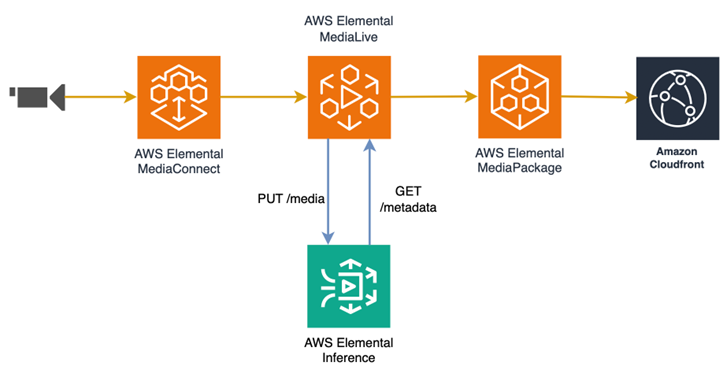
Live subtitling has moved from a specialty workflow into a baseline requirement for nearly every live event. Accessibility mandates, international audience growth, and platform-specific subtitling rules mean that live sports, news, conferences, government proceedings, and corporate broadcasts all need reliable, real-time subtitles on the wire. AWS Elemental Inference Smart Subtitles automatically generates subtitles for your live content. The feature integrates seamlessly with AWS Elemental MediaLive, so customers can add subtitles to any MediaLive channel—there’s no external service to operate. For customers whose primary need is to quickly turn on automatic subtitles for a live event, it provides the shortest possible path from audio to subtitle track. This post walks through what the feature does, how to enable it, and where it fits in a typical live streaming workflow. What Smart Subtitles provides At launch, the feature offers: Source-language speech-to-subtitle: the output is already subtitle-ready, with proper line breaks, aspect-ratio-aware wrapping, and speaker-change detection. This is distinct from raw transcription. Six source languages: English, Spanish, Portuguese, Italian, German, and French, including regional English variants (Australian, British, and American). Flexible subtitle output formats: The inference engine emits Timed Text Markup Language (TTML). For HTTP Live Streaming (HLS) outputs, MediaLive delivers subtitles as Web Video Text Tracks (WebVTT). For Common Media Application Format (CMAF) ingest to AWS Elemental MediaPackage, subtitles are delivered as TTML; MediaPackage can then emit any of its supported subtitle formats. Aspect-ratio-aware layout: Horizontal video can have more characters per line than vertical video. The server handles line length, so no player-side logic is required. Custom dictionaries: Use custom dictionaries for domain-specific vocabulary, sports team and player names, product names, brand names, place names. Profanity filtering for content sensitivities such as children’s programming. Speaker diarization: Diarization detects speaker changes and inserts a new line, so subtitles read naturally in multi-speaker content. The feature doesn’t insert speaker-change markers. The feature is fully managed: AWS operates the inference infrastructure, the underlying models, and the integration with MediaLive. Seamless integration with MediaLive MediaLive integrates seamlessly with Elemental Inference. Through the MediaLive console and API, you can create Smart Subtitles Caption Selectors. Smart Subtitles Caption Selectors pull autogenerated subtitles from Elemental Inference and can be integrated into your MediaLive configuration, just like any other caption selector. Same console: You can enable subtitles from the MediaLive channel edit. Same AWS account and AWS Identity and IAM boundary: Content stays within your AWS environment, and existing AWS Identity and Access Management (IAM) role, logging, and audit controls continue to apply end-to-end. Same operational surface: CloudWatch metrics, channel start/stop behavior, and the operational behavior of MediaLive all extend to the subtitle track. Elemental Inference billing: Usage is metered as part of AWS Elemental Inference pricing. If your live workflow already runs on MediaLive and MediaPackage, you can enable subtitles by changing the configuration on the existing channel. How the feature fits in a MediaLive pipeline Elemental Inference is a separate service that MediaLive communicates with to generate subtitles. MediaLive sends audio to Elemental Inference and receives subtitles back, then embeds the subtitle track into the channel’s output groups. Figure 1: Smart Subtitles process Enabling Smart Subtitles Setting up Smart Subtitles is a three-step configuration inside an existing MediaLive channel. 1. Enable Elemental Inference on the channel: Open the channel in the AWS Management Console for MediaLive, choose Edit, and choose Elemental Inference settings. For State, select Enabled, then choose Create new feed. 2. Configure the subtitling feed: Use the following settings for the subtitles feed: For Feature, select Subtitling. For Language code, select the language of your source audio. For Aspect ratio, select the appropriate option. For Custom dictionary -optional, you can upload a JSON dictionary with domain-specific terms. See Bootstrapping a custom dictionary with an LLM for details. For Profanity filter, select the option required for your content. Choose Create feed and wait for the feature to provision. 3. Add the feed into the MediaLive outputs: In the Elemental Inference settings, in the Smart Subtitles section: Choose Add a Smart Subtitles caption selector and configure the language code. Add a caption output to your output group, referencing the new caption selector. For HLS output, use WebVTT. For CMAF ingest output, choose TTML. Choose Update channel and Start the channel. Subtitles begin flowing as soon as the channel is running. That completes the setup. Bootstrapping a custom dictionary with an LLM Custom dictionaries are the biggest lever for improving subtitle accuracy on specialized content. Brand names, place names, player and coach names, product SKUs, medical terms, and domain jargon are the words a general-purpose Automatic Speech Recognition (ASR) model will most often get wrong and are the words your audience will notice most when they’re wrong. Building the list by hand is tedious. A large language model (LLM) can do most of the work for you. Provide the LLM with the context for your event and ask it to produce a dictionary formatted for Smart Subtitles. The feature accepts custom dictionaries as JSON with content entries and optional soundsLike pronunciation hints: { "entries": [ { "content": "gnocchi", "soundsLike": ["nyohki", "nokey"] }, { "content": "quinoa", "soundsLike": ["keen-wah"] }, { "content": "MediaLive" } ] } The following is an example prompt: "I'm preparing a custom dictionary for the AWS Elemental Inference Smart Subtitles feature for an event with Team A and Team B on January 26, 2026. Rosters: [URL-1], [URL-2]. Event recap: [URL-3]. Please return a JSON dictionary in the Smart Subtitles format — {"entries":[{"content": "...", "soundsLike":["..."]}]} — including all player names, coaches, and any event-specific terms, with soundsLike pronunciation hints for any names that aren't obvious from spelling." The LLM produces a first draft in seconds. Review it, add anything domain-specific that it missed, and upload the JSON to your subtitling feed’s custom dictionary. The same pattern works for press conferences, conference keynotes, sports broadcasts, medical panels, or any live event with known participants and subject matter. A few things that make the result better: Give the LLM the real sources: Provide sources such as rosters, program notes, and event pages instead of asking it to guess. Specify the target format: Set the target format at the start (the preceding Smart Subtitles JSON schema), so the output is ready to paste. Use soundsLike for difficult names: Phonetic hints help the ASR model pick up unusual pronunciations it wouldn’t learn from spelling alone. Review before going live: Treat the LLM output as a draft, not a final. Subtitle formats on the wire The Elemental Inference engine emits TTML. From there, the subtitle format on the output depends on the MediaLive output group. Output destination Subtitle format HLS output group WebVTT CMAF ingest → MediaPackage TTML MediaPackage ingests TTML and can emit any of its supported subtitle formats, giving you flexibility to match downstream delivery requirements from a single origin. Why Smart Subtitles Smart Subtitles is designed to make adding subtitles to live content as straightforward as possible: Ease of use: Enable subtitles on an existing MediaLive channel in minutes—no separate pipeline to build, no manifest manipulation, no additional account to manage. State-of-the-art accuracy: The underlying ASR models are purpose-built for live broadcast content, delivering high accuracy across supported languages. Resilient architecture: In the unlikely event that Elemental Inference experiences a disruption, the system fails gracefully. Subtitles might temporarily disappear, but video, audio, and all other tracks continue unaffected. Your stream stays live. Growing language and feature set: The supported language list is expanding, and additional capabilities are on the roadmap. Conclusion Elemental Inference Smart Subtitles brings automatic live subtitling into your MediaLive workflow as a directly integrated capability. By connecting MediaLive to Elemental Inference for subtitle generation, it gives you a straightforward path to subtitles on for live events—no external pipeline to operate, no manifest manipulation, no additional account to manage. To learn more about MediaLive, see AWS Elemental MediaLive. To learn more about Elemental Inference, see Elemental Inference.
-
World Cup Special: inside The Overlap's rights-free playbook
Apple paid $750 million for F1 live right, Sky 6.7B£ for the 2025-2029 Premier League. The Overlap never bid on live rights. Not because of a clever strategy, Scott Melvin is clear on this, but...
General Source
Apple paid $750 million for F1 live right, Sky 6.7B£ for the 2025-2029 Premier League. The Overlap never bid on live rights. Not because of a clever strategy, Scott Melvin is clear on this, but because the cost is prohibitive. You either go all in or you can’t play. So they built a business around what live rights don’t give you: the cold open where Ian Wright walks in and spends 15 minutes on Toy Story 3, the kind of football conversation that makes you feel like you stumbled into the right pub.5 years later, their bet paid off. 1.7 million subscribers, the Bundesliga came to them with a live rights deal and then Global took a majority stake in January. This week, and I bring Scott Melvin, Executive Director of The Overlap, on the pod to walk us through how that works in practice. What the Bundesliga actually handed over, what happened when they looked at the social numbers against the live and what Scott made of the gap. The numbers are not what you’d expect.He also gets into what Global’s capital made possible, why The Overlap acquired Mark Goldbridge’s channels rather than building new ones from scratch and why growing a YouTube channel to a million subscribers today is a different exercise than it was five years ago.The World Cup kicks off tonight. The Overlap is in Brooklyn without a single match right. I'll be watching both.👉🏻 APPLE PODCASTS | SPOTIFY | YOUTUBE | DEEZER with more platforms here.That’s it for today but before you go:🗳️ Poll timeWe’ve made predictions on this episode as to who will win the World Cup, it’s only fair that we ask you too 👇🏻
-
Why the TV ad ecosystem wasn’t built for small businesses and why that has to change
99% of EU businesses are small or medium. They generate more than half of GDP and 100+ million jobs and yet the TV ad ecosystem isn’t built to address them.The booking process assumes you have an...
General Source
99% of EU businesses are small or medium. They generate more than half of GDP and 100+ million jobs and yet the TV ad ecosystem isn’t built to address them.The booking process assumes you have an agency, the rate cards an annual commitment and last but not least the creative pipeline assumes you have a TV ad sitting on a hard drive somewhere. Every assumption baked into the European TV ad stack was designed for a customer profile that represents 1% of European businesses. Meanwhile €140 billion has flowed into European digital advertising in 2025 alone and sits in the hands of a handful of global players who have managed to attract SME budgets. This week’s keynote gives you the full picture about the state of SME advertising in Europe:The scale of the SME economy;The media stack SMEs use;The barriers that keep them off TV;The state of play, who is actually building for this segment right now, from TF1 AdManager in France, DPG Media in Belgium or RTL AdAlliance across Europe, to Universal Ads or Vibe.co across the Atlantic. Finally, I share my checklist on how broadcasters should address the SME segment right now.Grab the link to access the deck: Read more
-
How do you give Britain’s hidden army of young carers a break? | Is Mum OK? Documentary
Aiden is an unforgettable young caregiver in Walthamstow, east London, who has been looking after his mum for over half his life. Every few weeks, Aiden and other young carers get a rare night off...
General Source
Aiden is an unforgettable young caregiver in Walthamstow, east London, who has been looking after his mum for over half his life. Every few weeks, Aiden and other young carers get a rare night off thanks to tenacious council worker Satvinder, who fights to improve the recognition of young carers in her borough. This film joins them as they reclaim a few hours of their teenage lives back.Is Mum OK? is released during Carers Week in the UK, a campaign that celebrates unpaid carers across the country and calls for better recognition and support for them. There are more than one million young carers in the UK – with an average age of 12 – which is the equivalent of two kids in every school class. Continue reading...
-
France TV's YouTube ad playbook
🎤 The music event flywheel in actionAmazon Music had its biggest livestream night in France on Saturday. Aya Nakamura’s second of three sold-out Stade de France concerts became the most-watched...
General Source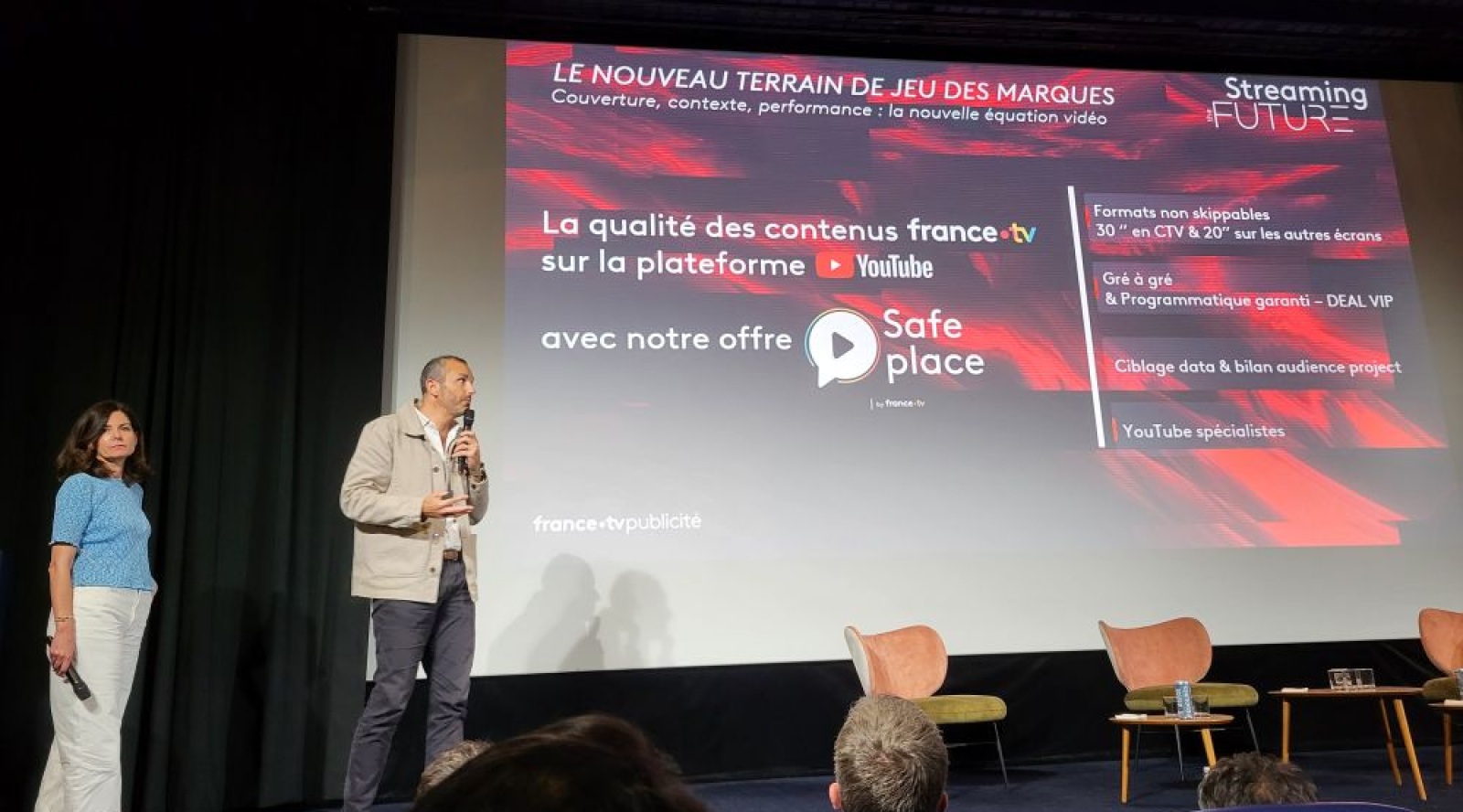
🎤 The music event flywheel in actionAmazon Music had its biggest livestream night in France on Saturday. Aya Nakamura’s second of three sold-out Stade de France concerts became the most-watched simultaneous live concert across Amazon Music, Prime Video and Twitch. Every event ships simultaneously across all platforms, runs worldwide, comes with curated playlists and ports exclusive merch onto Amazon.com in real time. This is the music event flywheel Spotify would love to run. Amazon seems to have a head start on multi-surface music event distribution, doesn’t it?📚 Netflix’s BookTok-shaped discovery testHave you noticed how Netflix’s UI now has genre hubs across its TV interface? Netflix launched Watch Your Favourite Books globally on June 2, a dedicated discovery hub organising the platform’s book adaptation library across nine reader personas (from “You Crave Amazing Characters” to “You’re Wild About Web Stories”). The hub joins August 2025’s Your Zodiac Watchlist as the second identity-driven destination Netflix has shipped on top of its 2025 homepage redesign.The premise is to test whether affinity or persona-driven hubs boost engagement on top of the algorithmic homepage. Nine personas is a lot though and these micro-hubs can now be found throughout the TV UI. I wonder if the redesigned homepage actually reduce or worsen browsing paralysis. Let’s look out for the potential engagement uptick when their H1 2026 report comes out, shall we?📲 Meta plays catch-up on episodic ReelsMeta is testing a “Series” feature for Reels on Instagram and Facebook with select creators. The feature lets creators bundle new and existing Reels into episodic collections with a dedicated hub on their profile, watch-in-order playback and resume-where-you-left-off mechanics. Monetisation is "being considered" with no specifics shared yet.TikTok launched a similar feature in March 2023, expanded it to 94 countries by mid-2023 and built it around a paywall model where creators set prices between $0.99 and $189.99 for collections of up to 80 videos at 20 minutes apiece. The “endless scroll then leave” model that defined Reels and TikTok enters a new phase. Series mechanics (resume, save, episode ordering, profile hubs) are TV grammar grafted onto vertical feeds. Meta cannot leave creator and IP-led structured short-form to TikTok and a new wave of standalone apps (myDrama, Reelshorts, RoseBerry) or can it?🎥 You merge two telcos, then make the bundle invisibleWhat if you never had to think about which streaming app to open? For episode 5 of Inside the Bundle: The Interviews, in partnership with Bango, we explore how one of Spain's largest telcos is tackling the biggest challenge in streaming today: making a fragmented world of apps, services and devices feel like one seamless experience for every type of customer. Ana Lopez, Head of TV Product & UX at MásOrange, discusses how the company born from the merger of Orange Spain and MasMovil is building a unified content platform across more than 10 brands, 200K+ catalogued assets and every device from set-top boxes to smart TVs. From WhatsApp-assisted onboarding for older customers to embedding AI at the very core of search, discovery and voice interaction, we unpack what it really takes to remove friction and keep customers inside your ecosystem for good.Watch the full episode here:Previous episodes: David Bouchier, Kenechi Amobi Belusevic, Vincent Stevens, Joan Cruells. Coming next: David Purdy. 🎙️ World Cup feverIn which group are you? The one who will watch everything but the World Cup (like my neighbourhood cinema): Or the one who’s already making prognostics about the World Cup winner? Either way, you will love our next guest on The Media Odyssey Podcast: Scott Melvin, Executive Director of The Overlap. You probably know it as Gary Neville's interview show. It is now a sports channel network with 5 million subscribers and 2.2 billion impressions in 2025, sitting inside Global after January's majority deal. The episode is out on June 11th for the World Cup kick off!👉🏻 APPLE PODCASTS | SPOTIFY | YOUTUBE | DEEZER with more platforms here. 🎮 Roblox turns on ads for kids Roblox is opening advertising to its under-13 audience, the cohort that is both its largest growth engine and its largest legal liability. Roblox indeed reported 144M daily active users in Q4 2025 with 45% age-verified. Among that verified group, 35% are under 13. So Roblox has roughly 22 million daily under-13 users it now has a clean monetisation pathway to, plus an unknown share of the unverified 55%. Roblox is also currently facing 130 child safety lawsuits, hence why they need to tread lightly and why it makes perfect sense to have SuperAwesome as its exclusive ad partner. SuperAwesome will do direct deals only, no programmatic, no rewarded video, contextual targeting, clear labels, GDPR and COPPA wrapped in. Hopefully, every platform with under-13 reach (YouTube Kids, TikTok, gaming broadly) is watching this rollout. If the SuperAwesome-led, contextual-only, direct-deals model holds up to scrutiny, expect it ported to other platforms within 18 months. If it does not, kids advertising goes back into the freezer for a few more years. 📺 France TV Publicité details its YouTube ad playbookThe commercial chapter of the France TV x YouTube partnership landed this week. France TV Publicité unveiled Safe Place on Tuesday at its “Streaming the Future” event in Paris. Safe Place packages non-skippable formats only: 20-second spots across all screens, 30 seconds on CTV, with 8 and 12-second slots including first-position buys. Completion rate is reported at 80%. Targeting runs by channel, content, editorial context, socio-demographics, geography, device and CTV-specific options. Inventory is sold direct or via programmatic guaranteed through DV360, with PG buys also counting towards advertisers’ broader Google volume commitments. First campaigns get an AudienceProject performance review at launch. Influencia describes the revenue mechanics: YouTube’s standard 45% take applies at a 7€ CPM benchmark (3,15€ guaranteed). Above that floor, France TV keeps 100% of the upside. Sell at 10€, the ad sales house pockets 6,85€.France.tv hit 45 million monthly unique users in May, its fifth consecutive month as France’s largest free streaming platform. The IFOP confidence figure shared at the event (87% of French people trust the france.tv environment) sits four times higher than the average for social platforms. Combine france.tv and YouTube campaigns and France TV Publicité reports 80%+ exclusive contacts and 50%+ incremental reach.Channel 4 led the way and four years in, it saw a 53% year-on-year viewership increase with 89% of watch time coming from long-form content according to Hannah Barlow on stage for the event. ITV’s Abul Noor outlined that brand trust, preference and consideration are lifting at least 20% when ads run inside ITV's YouTube content. Channel 4 and ITV wrote the YouTube playbook for the UK. France TV is writing the continental version. Grab my pictures of the event to get granular data on FTV’s YouTube pitch to advertisers. That’s it for today but before you go:🗳️ Poll time
-
The org chart is the strategy
“You have this thing in the US where you have to personify the companies. We’ve been talking about Zaslav. We’ve been talking about Ellison. I’m in European media, and I don’t know if I can name...
General Source“You have this thing in the US where you have to personify the companies. We’ve been talking about Zaslav. We’ve been talking about Ellison. I’m in European media, and I don’t know if I can name the CEO of Sky or RTL.”This week’s quote is my own for once. As Evan Shapiro and I welcomed Roben Farzad from NPR’s podcast Full Disclosure on the podcast, I couldn’t help but notice how in Europe, the operator is the organisation while in the US, the operator is the brand on the CEO.RTL closed its 12.3 million subscriber combination with Sky Deutschland and rolled out a Management Board built from both companies: Stephan Schmitter leads the combined business; Sky’s Elke Walthelm comes in as CHRO; Sky’s Michael Radelsberger takes Chief Consumer Officer; Julia Kloke arrives from Riverty as CFO. Don’t know any of these names? That’s the point.Compare notes with the other side of the Atlantic: Warner Bros Discovery and Paramount are racing the clock, the FCC and the calendar, with David Zaslav and David Ellison cast as the lead actors. RTL plus Sky Germany makes sense because the two businesses are genuinely complementary, one free, one pay, with limited audience overlap and a clear plan to integrate streaming, free-to-air and pay-TV under a single management team. Paramount plus Warner? Two studios with the assets to claim a top 3 spot and a real opportunity to build something that neither could build alone, if the org design follows the ambition.Let’s mark calendars. By June 2027, RTL will have a full year of Sky Deutschland on its books, will the €250 million synergy promise within 3 years be on track? Will Stephan Schmitter’s combined team be past third place in the DACH market and into Netflix and Amazon territory? By then, the Paramount and Warner combination, if it closes on the timeline Ellison wants, will have its own nine to twelve months of receipts to compare against a very different operating model, with the same underlying question. Did the org produce an incremental and stronger business or simply a combined entity?That’s the comparison worth running, not the deal announcements, the synergy slides or the CEO interviews. The actual operating results, the jobs kept or cut and the subscriber growth are what we’ll come back to in a year’s time. Until then, go listen or watch in full 👉🏻 APPLE PODCASTS | SPOTIFY | YOUTUBE | DEEZER with more platforms here. That’s it for today but before you go:🗳️ Poll time
-
How Bedrock Streaming optimizes its AWS costs
Introduction Optimizing costs represents a major challenge for video streaming companies. This challenge intensifies with constantly increasing traffic and growing solution complexity. With a...
General Source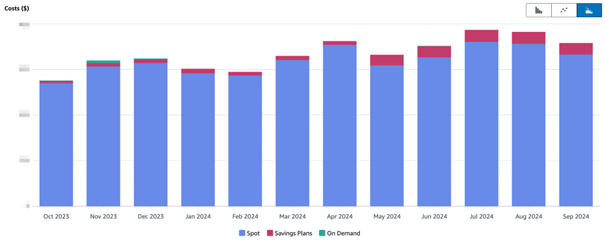
Introduction Optimizing costs represents a major challenge for video streaming companies. This challenge intensifies with constantly increasing traffic and growing solution complexity. With a systematic cloud financial operations (FinOps) strategy, organizations can turn each technical decision into an opportunity for cost optimization, achieving substantial savings. Bedrock Streaming perfectly illustrates this approach. The company hosts their solutions on Amazon Web Services (AWS) to serve major European broadcasters such as M6+, Videoland, and RTL+. With an AWS budget of several million dollars per year, each percentage point of optimization generates considerable savings. Managing costs is particularly challenging because their web traffic varies throughout the day, with peaks during sports events and popular TV shows. Since beginning their AWS migration in 2018, Bedrock Streaming has developed an approach that goes beyond traditional reservation strategies. The company applies a multi-axis FinOps strategy involving Kubernetes worker nodes that run 100% on Amazon Elastic Compute Cloud (Amazon EC2) Spot Instances, AWS Graviton Processors, the rationalization of AWS API calls, video streaming optimization, and constant attention to data storage. This FinOps approach transforms every technical decision into a cloud cost optimization lever. Compute and managed services optimization Bedrock Streaming optimizes its AWS compute costs using two main strategies. First, the company deploys instance reservations for managed services such as Amazon Relational Database Service (Amazon RDS), Amazon ElastiCache, and Amazon OpenSearch Service, and capacity reservations for Amazon DynamoDB. Savings Plans represent less than 5% of Amazon EC2 usage, also covering AWS Lambda and AWS Fargate services. The second strategy specifically targets Amazon EC2, where Spot Instances replace traditional reservations. This approach meets Bedrock Streaming’s autoscaling needs, where traffic fluctuates by a factor of 10 between morning low points and evening peaks. The production infrastructure, including Kubernetes worker nodes, runs on Spot Instances with automatic failover to on-demand instances during periods of limited spot capacity. AWS can reclaim Spot Instances at any time with 2 minutes of advance notice. Bedrock Streaming has implemented a termination handler, which is triggered when an instance signals it will be reclaimed. The handler immediately starts a new instance while stopping applications deployed on the old node. The team has reduced the startup time of new instances thanks to custom Amazon Machine Images (AMIs) that incorporate Kubernetes components and base Docker images required by their applications. They use more than 10 instance types in each of the three Availability Zones to maximize availability. This approach means Bedrock Streaming can achieve 100% Spot Instances for Kubernetes. The following chart illustrates how Bedrock Streaming’s Kubernetes infrastructure costs break down across Amazon EC2 purchasing options over a 12-month period, demonstrating the effectiveness of their Spot Instance strategy in keeping compute costs low: Figure 1: Stacked bar chart showing monthly Amazon EC2 costs for Kubernetes nodes from October 2023 to September 2024, split by Spot Instances (dominant), Savings Plans (master nodes), and On Demand (minimal) For managed services such as Amazon RDS, Amazon ElastiCache, or Amazon OpenSearch Service where elasticity doesn’t meet Bedrock Streaming’s needs, the teams begin by deploying their new projects with oversized instances, analyze their behavior under real load for a few days, then resize to the optimal size. The additional cost is minor, and this method quickly leads to optimal cost while avoiding the risks of undersizing. The team makes reservations later during semi-annual global reservations reviews. The following chart shows how this approach works in practice with an OpenSearch project: Costs peak during the initial days with oversized r5.2xlarge instances, then drop by approximately 80% after the team right-sizes to m5.large instances based on observed usage: Figure 2: Stacked bar chart showing daily OpenSearch costs in August, with oversized instances peaking at about $235 per day for the first few days, then dropping to about $50 per day after right-sizing The adoption of AWS Graviton Processors represents another effective optimization pillar. The teams began by migrating some Amazon Elastic MapReduce (Amazon EMR) jobs. The largest savings came during the migration of Amazon RDS, Amazon ElastiCache, and Amazon OpenSearch Service instances to AWS Graviton: They achieved a 15%–20% savings with a quick configuration change. The final step, which is underway as of this writing, involves migrating the few non-Spot Instance Kubernetes nodes (the master nodes). Storage and data services optimization Storage with Amazon Simple Storage Service (Amazon S3) forms the foundation of Bedrock Streaming’s infrastructure for hosting their video library. The company uses the advanced features of Amazon S3, including different storage classes, automatic transition policies, Intelligent Tiering for buckets with variable usage, and automated object lifecycle management. Efficient storage management extends beyond Amazon S3 at Bedrock Streaming. The cloud storage requires increased vigilance over resource accumulation, such as rigorous tracking of obsolete AMIs and unused snapshots. Bedrock Streaming’s experience with Amazon Elastic Container Registry (Amazon ECR) illustrates this issue. During their migration to AWS and Kubernetes, the company’s Amazon ECR costs increased significantly because of the accumulation of Docker images generated by daily deployments. Enabling the automatic purge feature for old images in Amazon ECR meant Bedrock Streaming could control these costs: Figure 3: Bar chart showing daily Amazon ECR storage costs from April to July, dropping from about $50 per day to about $3–$5 per day after enabling automatic purging of obsolete images in late May Amazon DynamoDB is one of the solutions Bedrock Streaming chose for their critical workloads. Amazon DynamoDB cost optimization relies on two main axes: query management and data storage. The data storage represents a major lever in cost control. The company identifies that storage for certain tables generates costs higher than those of queries. To address this issue, Bedrock Streaming uses the Amazon DynamoDB time to live (TTL) feature, which permits automatic expiration of obsolete data. This approach not only optimizes direct storage costs but also reduces costs associated with table backups. The following chart shows the impact of enabling Amazon DynamoDB TTL: After obsolete data is automatically expired, both storage and backup costs dropped significantly starting in early January: Figure 4: Stacked bar chart showing daily Amazon DynamoDB costs from December to January, with storage, throughput, and backup costs dropping sharply in early January after enabling TTL For Amazon DynamoDB tables with a large volume of rarely accessed data, the standard Infrequent Access storage class represents a relevant optimization option. This class becomes particularly advantageous when a table’s storage cost exceeds 50% of the cost related to read and write operations. Network cost optimization Network cost optimization is a major focus at Bedrock Streaming. The implementation of virtual private cloud (VPC) endpoints for Amazon S3 and Amazon DynamoDB eliminates transit costs using AWS Network Address Translation (NAT) Gateway. It generates significant savings on high-traffic services. The company also optimizes their inter-Availability Zone transfer costs through targeted architectural changes. The video-on-demand streaming solution illustrates this approach. The first version, which was deployed across three Availability Zones, involved video segment transfers between zones. The new architecture adopts a single-zone approach where each request is processed entirely within its entry Availability Zone, eliminating inter-Availability Zone data transfers. The following chart shows the impact of this architectural redesign. Inter-Availability Zone data transfer costs, which had been steadily growing, dropped to nearly zero after the solution switched to single-Availability Zone processing in mid-November: Figure 5: Stacked bar chart showing inter-Availability Zone transfer costs (InterZone-In and InterZone-Out) from October to January, dropping from peak levels to nearly zero after an architectural redesign in mid-November This new architecture maintains the same level of resilience as the previous one. The difference is its operating mode: Rather than handling requests distributed across three Availability Zones, the solution processes each request entirely within its entry zone. This approach eliminates inter-Availability Zone transfer costs while preserving high availability. Learn more about how Bedrock Streaming achieved this architectural transformation and scaled to 50 million users. Lesser-known aspects of cost optimization As their AWS deployment progressed in 2018–2019, Bedrock Streaming identified unexpected costs on certain projects. A significant case involved an API for downloading images stored on S3, where API costs exceeded storage costs. The following chart shows how adding a cache in front of S3 and optimizing API calls dramatically reduced costs. ListBucket and HeadObject operations, which were the main cost drivers, dropped by approximately 75% from 2015 onward: Figure 6: Stacked bar chart showing S3 costs for an image-serving project from 2009 to 2021, dropping about 75% after optimization and adding a cache Code analysis revealed that the API was unnecessarily checking the existence of each level in the file path hierarchy, an operation redundant in the S3 environment. The team replaced these checks with direct image access and implemented 404 error handling. As a result, the team achieved three key benefits: preserved functionality, reduced latency, and lower API costs. The use of Amazon Simple Queue Service (Amazon SQS) at Bedrock Streaming represents a significant case. The following chart illustrates how the company adopted a batch processing approach for messages rather than individual processing and reduced their deletion operation costs by 66%: Figure 7: Batch deletion of messages in Amazon SQS is less expensive than individual deletions The chosen implementation favors batches of three messages on average. Although Amazon SQS allows processing of up to 10 messages per batch, this configuration represents an optimal balance between cost reduction and maintaining latency performance. Logs and metrics management Bedrock Streaming favors a centralized approach for monitoring their metrics. Rather than directly using the Amazon CloudWatch console, the company uses a system for exporting metrics to a Prometheus stack. A dedicated Amazon CloudWatch exporter performs an export that periodically queries the Amazon CloudWatch GetMetricStatistics and GetMetricData APIs. Initially, the exporter was configured to collect a wide range of metrics as a precautionary measure. Bedrock Streaming optimizes the configuration by precisely aligning collected metrics with those used in Grafana. This rationalization reduces API call costs by two-and-a-half times. The following chart shows the result. By aligning Amazon CloudWatch metrics collection with what’s actually used in Grafana, Bedrock Streaming reduced API call costs by 2.5 times starting in early June: Figure 8: Stacked bar chart showing daily Amazon CloudWatch API costs from May to June, dropping from about $80–$90 per day to about $30 per day after optimizing metrics collection Log management represents another cost optimization axis at Bedrock Streaming. The company applies the dual strategy of rationalizing collected information and implementing an adapted retention policy. For logs requiring extended retention, particularly for compliance purposes, Amazon CloudWatch Logs Infrequent Access enables up to 50% reduction in ingestion and storage costs. Understanding how AWS services operate Cost optimization requires a deep understanding of the specificities of each AWS service, both at functional and financial levels. AWS Step Functions particularly illustrates this principle. Bedrock Streaming opts for express mode rather than the default standard mode. This choice significantly reduces the service’s financial impact in one of their workflow projects: Figure 9: When AWS Step Functions express mode is appropriate, the cost can be significantly lower than that of a standard function Amazon DynamoDB cost optimization at Bedrock Streaming relies on careful selection of the capacity mode for each table. Two main options are considered: On-demand mode – Suitable for tables with highly variable and unpredictable traffic Provisioned mode with autoscaling – More efficient for tables with predictable traffic patterns The choice between these two modes is made table by table based on the specific characteristics of each workload. Provisioned mode offers an additional advantage in the ability to make capacity reservations, facilitating additional cost reductions in the long term. This granular approach means Bedrock Streaming can optimize their Amazon DynamoDB costs by precisely aligning resources with the actual needs of each table. The following chart illustrates this in practice. After transitioning several Amazon DynamoDB tables from on-demand to provisioned mode in early June, costs dropped by roughly half while maintaining the same per-table cost distribution: Figure 10: Stacked bar chart showing daily DynamoDB costs by table from late May to mid-June, dropping about 50% after transitioning from on-demand to provisioned mode around June 3 (This cost analysis dates from before November 2024. Amazon DynamoDB on-demand pricing changes in November 2024 narrowed the cost gap described in the graph.) Bedrock Streaming follows a proven methodology for their new Amazon DynamoDB projects. The company systematically starts with on-demand mode to support application performance and stability. After an observation period of a few days and analysis of usage patterns, they evaluate tables for potential migration to provisioned mode when it presents an economic advantage. This approach is part of a broader strategy for optimized AWS services management relying on three essential pillars: Continuous monitoring of AWS documentation and updates Regular expense monitoring Rapid configuration adjustment capability A technical and cultural approach to cost optimization AWS cost optimization must be part of a global reflection on infrastructure return on investment (ROI). The goal is to achieve an optimal balance between costs and meeting operational needs. Bedrock Streaming illustrates this approach by limiting the use of Amazon EC2 T instance family (burstable performance) in production, favoring performance stability despite higher costs. The optimization approach must also consider the relationship between time invested and savings achieved. A rigorous cost-benefit analysis to facilitate optimization efforts generates significant added value for the company. Bedrock Streaming uses a cost tracking and optimization strategy based on three complementary tools: AWS Cost Explorer – Used for several years for detailed expense analysis AWS Cost Anomaly Detection – A machine learning system that quickly alerts to unexpected cost variations AWS Cost Optimization Hub – Provides a centralized view of optimization opportunities This multidimensional approach means Bedrock Streaming can maintain continuous control over their AWS expenses with consistent service performance and reliability. This screenshot shows an example of an AWS Cost Anomaly Detection notification, where a $217.18 unexpected increase in AWS Step Functions costs was automatically detected and flagged for investigation: Figure 11: Extract from an AWS Cost Anomaly Detection notification showing a detected cost spike of $217.18 in AWS Step Functions on July 5, 2024, in the eu-west-3 Region Although infrastructure teams manage tools such as reservations and Savings Plans, effective cost optimization requires broader involvement. All teams and business units need to recognize that managing hosting costs falls within their responsibilities and is not solely the infrastructure team’s domain. To facilitate this, we recommend that AWS costs from AWS cost and usage reports (CUR) be integrated into the organization’s business intelligence tools alongside other business metrics. Making financial data accessible can encourage engagement and informed decision-making across all levels of the organization. Optimization is part of a continuous improvement process that goes beyond bill reduction. Regular reviews can identify new optimization opportunities. As the FinOps Foundation emphasizes, considering future infrastructure costs from the beginning of project lifecycles is necessary for maximum optimization. Conclusion By combining 100% Amazon EC2 Spot Instances with Kubernetes worker nodes, using AWS Graviton Processors, and fine-tuning data services such as Amazon DynamoDB, Bedrock Streaming achieves substantial savings on a multimillion-dollar annual cloud budget. These techniques extend beyond traditional instance reservation approaches, including AWS API call rationalization, inter-Availability Zone transfer optimization, and intelligent use of storage classes. To achieve broader savings, we recommend integrating cost considerations starting from the feature and project design phase. Bedrock Streaming creates a FinOps culture where each team becomes an actor in cost optimization throughout their solution’s lifecycle. Infrastructure costs are no longer a constraint but a mechanism that can help guide strategic and technological choices. The optimization strategy in the video streaming sector is transferable to many industries. Regardless of the load profile, you can activate several optimization levers: strategic use of Amazon EC2 Spot Instances, AWS API call rationalization, adapting Amazon DynamoDB capacity modes according to usage, and optimal use of AWS service-specific features. The recommended methodology is to prioritize optimizations based on their potential financial impact, then proceed through successive iterations to refine results. To dive more deeply into these concepts, you can watch a talk delivered at AWS Summit Paris 2025 (English subtitles available) where Pascal Martin, the principal software engineer at Bedrock Streaming, detailed each optimization using concrete examples. You can also use AWS Cost Optimization Hub to identify your own savings opportunities, and explore AWS Cost Explorer to analyze your consumption patterns. Start your own optimization journey by activating AWS Cost Anomaly Detection today. As Bedrock Streaming demonstrates, every percentage point of optimization counts. Contact an AWS representative to learn how we can help accelerate your business. Further reading Faster anomaly resolution with enhanced root cause analysis in AWS Cost Anomaly Detection – Discover an enhanced root cause analysis feature that now identifies up to 10 root causes per anomaly, with best practices for investigating cost spikes. Cost Optimization Pillar – AWS Well-Architected Framework – This is the foundational framework for designing cost-optimized workloads on AWS. Evaluate your costs at the table level – AWS guide on using AWS Cost Explorer to analyze Amazon DynamoDB costs per table, including tagging strategies.
-
Why fandom is the new premium in advertising
Fans are the most under-priced asset in ad-funded media right now. If you're selling audiences to advertisers and not fans, you're leaving money on the table.Last week in Vienna, I gave a keynote...
General Source
Fans are the most under-priced asset in ad-funded media right now. If you're selling audiences to advertisers and not fans, you're leaving money on the table.Last week in Vienna, I gave a keynote during egta's CEO Summit making exactly that case to Europe's top ad sales executives.The data is pretty stark:→ Fans spend 27% more on subscriptions than non-fans. → They give 16% more time per day to entertainment. → 49% sustain engagement for life. → 79% of UK podcast listeners recall an ad from the past week → 4 in 5 will consider a brand promoted by their favourite host. And yet most ad sales houses are still organised around formats and channels, packaging reach instead of signal quality, host trust and community data.The keynote walks through what needs to change fast in our organisations, why fandom matters, what is happening right now (no we’re not standing still) and what is expected of us next. Here’s the link to access the keynote: Read more
-
Updated List of Streaming, OTT, and Brodcast Conferences and Events Globally
I’m often asked for a list of in-person conferences and events in the streaming media industry, so here’s an Excel sheet you can download listing nearly 50 events worldwide. For vendors wondering...
General Source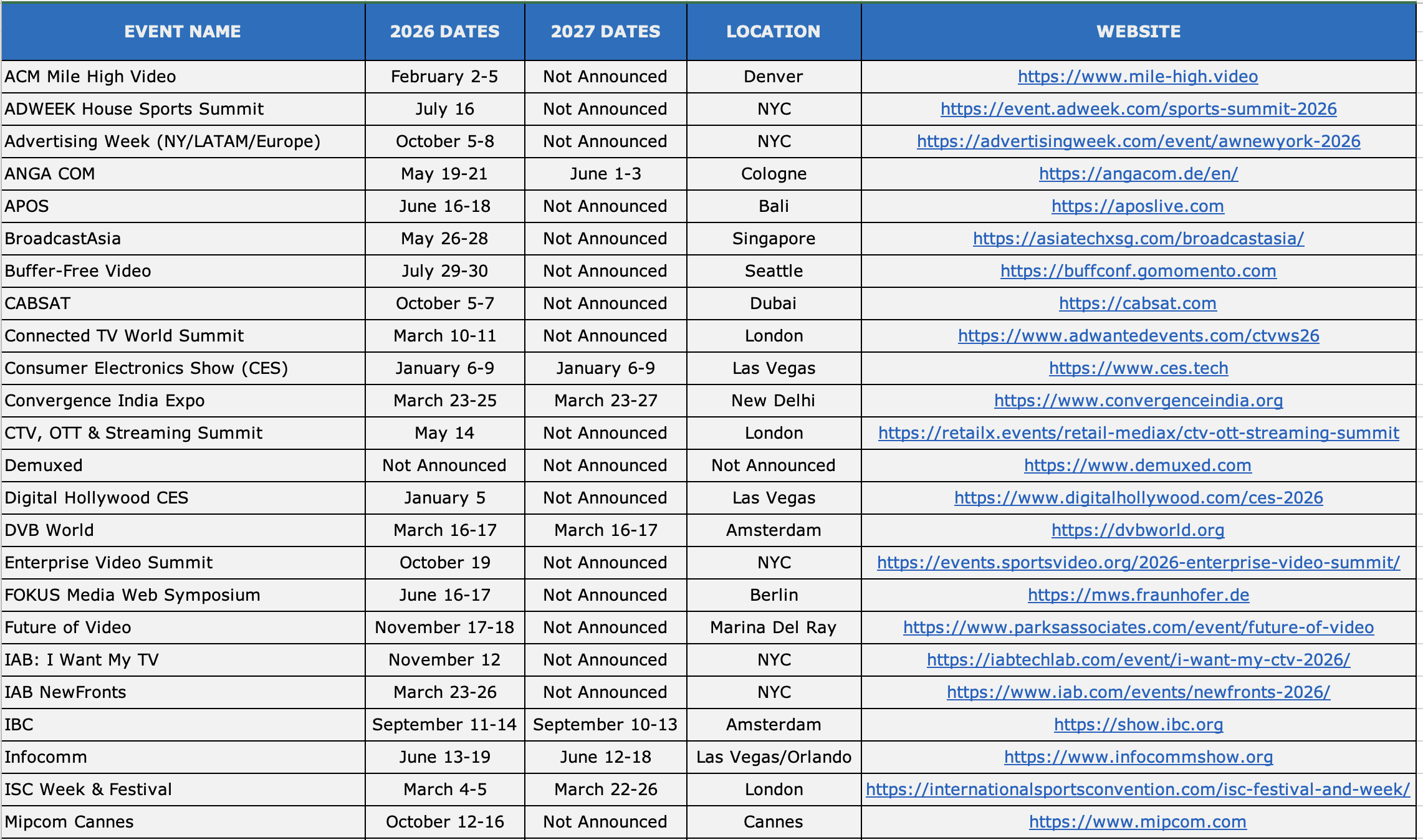
I’m often asked for a list of in-person conferences and events in the streaming media industry, so here’s an Excel sheet you can download listing nearly 50 events worldwide. For vendors wondering which events are the best fit, I’m happy to do a call with you and share my feedback on which events align with your objectives. Especially if you are new to a vendor’s marketing team, reach out to me. (dan@danrayburn.com) My list does not include any private events, vendor-produced events, meetups, or events that are only open to members. The list includes events primarily tied to the broadcast/TV and sports industries, as well as OTT services. It does not include events where video is used for retail/commerce, security, education, gaming, government and other use cases. I have excluded any event that focuses solely on video production, filmmaking, or the creator economy and does not discuss streaming technology and business models. Streaming is a technology. OTT is a business model. Broadcast is an industry. While many use the terms interchangeably, they are different, so other events do exist that are not on my list, depending on the video use case. If you think an event should be added to the list, please leave it in the comments section on this LinkedIn post, and I will consider it. I may not add it, but the Excel sheet is open and unlocked, so feel free to download and edit it as you wish. I will update the list a few times per year, and have included a date on the file so you always know when it was last edited.
-
How Bundesliga built Captain, an AI agent for fans, using Amazon Bedrock
On matchday 29 of Bundesliga’s 2025–2026 season, Bayern Munich walked into St. Pauli carrying 100 goals, just one short of a record that had stood for over half a century. The legendary Bayern...
General Source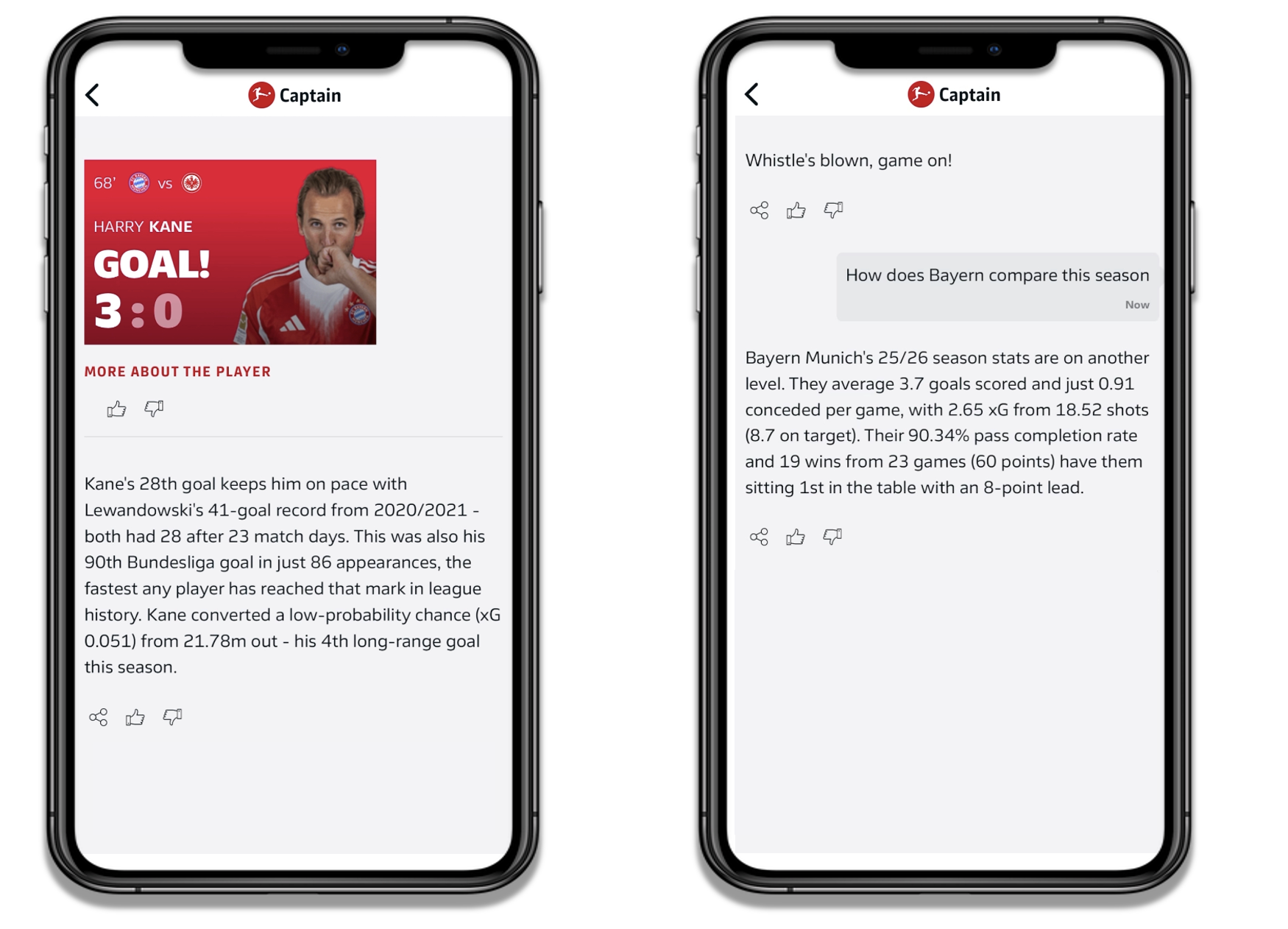
On matchday 29 of Bundesliga’s 2025–2026 season, Bayern Munich walked into St. Pauli carrying 100 goals, just one short of a record that had stood for over half a century. The legendary Bayern squad of 1971–1972, Gerd Müller, Franz Beckenbauer, and Uli Hoeneß, had set the bar at 101, a mark long considered untouchable. Then, in the 53rd minute, Leon Goretzka scored to make it 102, and the 54-year-old record was broken. But Bayern wasn’t done. By the final whistle, they had buried St. Pauli 5–0, pushing the season tally to 105 and turning a broken record into something extraordinary. That story alone is remarkable. But the numbers tell an even bigger story: Goretzka’s record-breaking goal was among the top 40% of fastest successful shots of the season, taken from only 9.5 meters (more than 31 feet) out. And the 2025–2026 Bayern squad didn’t just outscore the legends of 1971–1972, they also conceded 11 fewer goals. These are insights most fans would never find on their own. That’s why Bundesliga built Captain. Captain is an agentic AI companion built by Bundesliga Media and embedded inside the official Bundesliga app. It’s a single conversational interface for everything a football fan needs, from live stats and historical trivia to tactical analysis and video highlights. But Captain doesn’t wait to be asked. It continuously analyzes milestone moments as they unfold while AI agents detect and surface the most relevant insights for each individual fan in real time. It nudges fans with personalized storylines, and Captain even invites fans to play in-app quizzes based on live match action. With Captain, Bundesliga is delivering a new way to experience football through proactive, contextual storytelling and gamification at scale. The following two screenshots show the app interface. Figure 1: Captain’s proactive goal insight Figure 2: Stats agent in Captain’s chat assistant How the Bundesliga chat-based app works At the heart of Captain lies the chat-based service, which transforms natural language fan questions into data-driven answers in real time. When a fan asks a question like “Which teams score most in the final 15 minutes?”, the service employs a text-to-SQL workflow: a large language model (LLM) converts the question into a structured database query, Amazon Athena executes it against Bundesliga’s statistical data stored in Amazon S3 Tables, and a second LLM call turns the raw query results into a conversational, natural language response. The solution builds upon Sportec Solutions’ service offered to sports media professionals like live commentators and is now also made available to fans. Because fans’ questions vary widely in type and complexity, the chat-based assistant uses a dynamic workflow to optimize price performance. Rather than routing every question through the same pipeline, the service first classifies each question along two dimensions, query type and complexity, using Amazon Nova 2 Lite. Based on this classification, a model routing layer directs straightforward questions to Amazon Nova Pro for its cost and latency advantages, while medium and complex questions are handled by Claude Sonnet 4 by Anthropic in Amazon Bedrock for higher reasoning capability. Roughly 45% of fan questions qualify for the more economical Nova Pro path. A prompt builder then assembles a tailored prompt for the selected model, including football-specific instructions, relevant few-shot prompting examples, and only the database schema tables needed for the question’s type and complexity. This dynamic approach delivered a 35% reduction in chat assistant service costs while maintaining the same answer accuracy. Although the chat-based service answers questions fans ask, Captain’s research service surfaces insights fans didn’t know to ask for. The moment Goretzka’s goal hit the back of the net, an AI agent was already investigating—checking the Bayern scoring tally against historical records, comparing the team’s 2025–2026 form with the legendary 1971–1972 squad, and weighing the scorer’s own streak. Within seconds, fans received a personalized, data-backed story made possible by the LLM’s ability to reason over statistics and decades of historical context at once. The research service is built as an autonomous agentic loop using the Strands Agents SDK with Amazon Bedrock, designed to run on Amazon Bedrock AgentCore for production-scale execution. When a goal, penalty, or other key event occurs, the agent is triggered with a clear objective: find the most unique and noteworthy angle. Rather than following a fixed pipeline, it iteratively explores available data sources, surfacing player streaks, team milestones, all-time records, and cross-era comparisons until it uncovers a story worth telling. Each agent is given a task, a bounded toolbox of data sources, and a maximum time to spend on research before it must return an answer. As a key architectural decision, the chatbot service is made available to the research service agents. This lets the research service use the chat assistant’s query infrastructure and domain knowledge, including the deep historical context of Bundesliga data dating back to 1963. The same pattern extends beyond live events: after the chat assistant answers a fan’s question, a lighter research agent runs on top of that answer to suggest follow-up questions, related video clips, and deeper angles worth exploring. The conversation keeps fans engaged and offers them content they wouldn’t have thought to ask for. The same agentic approach powers other Captain features across the app, delivering content that feels handcrafted for every fan. “Every goal has dozens of stories hidden in the data—a streak, a milestone, a parallel to a match from decades ago. Captain’s research agent investigates them all and picks the most compelling one for each fan, in real time. That depth of storytelling at this scale is uniquely possible with agentic AI.” – Dirk Switalla, Senior Product Owner of Captain, Bundesliga Media GmbH The following diagram shows the architecture for Captain. Figure 3: Captain architecture overview How the Bundesliga chat-based AI app is implemented Agentic AI is only as powerful as the data it draws from. Captain’s AI agents need to autonomously query, reason over, and combine statistical, event, and video data in real time. That requires a data foundation built for open interoperability, industrial-scale reliability, and AI-ready data quality. Without these foundational aspects, agents can’t be trusted to generate the accurate, contextual insights fans expect during live matches. Bundesliga’s data foundation for Captain follows an open architecture approach, with Amazon S3 Tables at its core, as shown in the following figure. S3 Tables stores Bundesliga’s comprehensive statistical data (player performance, team metrics, match events, and Bundesliga Match Facts) in Apache Iceberg table format, providing the open data layer that Captain’s AI agents rely on. Amazon Athena serves as the serverless query engine, enabling the chat assistant service’s text-to-SQL workflow to execute dynamically generated queries against this data without infrastructure management. Figure 4: Data foundation for agentic AI For real-time data ingestion, Amazon Managed Streaming for Apache Kafka (Amazon MSK) handles the continuous stream of 200 million data points generated per match, delivering live event and positional tracking data with full wire-protocol compatibility to open source Kafka. This open standards–based pipeline enables data to flow seamlessly from the pitch to AI agents without proprietary connectors or complex extract, transform, and load (ETL). As data streams through Amazon MSK, an AWS Lambda function parses and extracts the relevant match signals and transforms raw positional and event data into structured records ready for storage. These records are then delivered by Amazon Data Firehose into S3 Tables in Apache Iceberg format, without requiring custom consumers or batch processing jobs. As data lands in S3 Tables, the table metadata is automatically registered in AWS Glue Data Catalog, which acts as the central schema registry for Captain’s data foundation. When Amazon Athena executes a query on behalf of an AI agent, it consults Data Catalog to discover table schemas, partition layouts, and Iceberg snapshots before reading the underlying data from S3 Tables. This tight integration between Lambda, Data Firehose, S3 Tables, Data Catalog, and Athena means that live match data flows from pitch-side sensors into a queryable, AI-ready format with minimal latency and zero manual schema management. Together, these services form the trusted data layer that gives Captain’s AI agents reliable, real-time access to the full breadth of Bundesliga’s data—enabling autonomous, accurate storytelling at the speed that live football demands. Creating a chat-based assistant with agentic AI Captain’s chat assistant lets fans ask natural language questions about Bundesliga—anything from “How many goals did Harry Kane score with a header at home this season?” or “How often did Olise assist Kane?” to “Show me highlights from the last Bayern match.” Behind the scenes, a coordinated team of AI agents works together to understand the question, find the right data, and deliver an accurate answer in real time. Rather than relying on a single AI model to do everything, the system uses a multi-agent architecture: specialized agents implemented with Strands SDK on Amazon Bedrock AgentCore that each handle one part of the workflow and hand off to the next, as shown in the following figure. This keeps each step fast, focused, and reliable. Figure 5: Multi-agent architecture of the chat assistant service Prepare the question before AI reasoning through context enrichment Before any AI agent reasons a user’s question, the system enriches it with conversation history, temporal awareness, and entity resolution. The most recent conversation entries are fetched from Amazon DynamoDB, enabling multi-turn follow-ups without the user restating context. The system also queries the sports data platform for the current matchday and any live matches because temporal context directly affects how questions are interpreted. A named entity recognition (NER) model on Amazon SageMaker extracts players, teams, competitions, and dates from the user’s question to resolve them to their unique entity IDs, which the agents use to run queries against the internal database. Router Agent understands user intent The first AI agent in the pipeline is the Router Agent. Its job is to understand the user’s intent and decide what to do next. It receives the user’s question, the conversation history, and the current time or match context. Then, the Router Agent makes three key decisions: Is this question safe? Amazon Bedrock Guardrails are applied for input filtering, blocking prompt injection attempts, inappropriate content, and off-topic requests. If the guardrail triggers, the user receives a polite rejection. Can this be answered directly? Straightforward greetings, chitchat, or questions answerable from conversation history don’t need a data lookup. The router replies mmediately. Which specialist should handle this? For data-driven questions, the router classifies the question into one of two flows: statistics (for data and numbers) or video (for match clips and highlights). Stats Agent answers data questions The Stats Agent answers data questions by first searching a vector database in Amazon S3 Vectors for proven question-to-SQL templates semantically like the user’s question. When a match is found, entity values are substituted into the template, and the query is executed against the database. When no template matches, a secondary AI agent generates SQL from scratch—slower and more expensive, but capable of handling novel questions. This fallback feeds directly into a self-improving loop: every successfully generated question-SQL pair is automatically generalized into a reusable template by a background AI process, embedded, and added to the vector index. The next time a similar question is asked, it matches the template directly. The more questions users ask, the faster and cheaper the system becomes, and novel questions gradually turn into instant template lookups. The following screenshots show the app agents answering user questions. Figure 6: Captain’s Video Agent Figure 7: Captain’s Stats Agent Video Agent delivers match footage For video-related questions, the Video Agent handles the request. It first needs to resolve which events or matches the user is asking about (using the same template search and data lookup capabilities as the Stats Agent), and then it retrieves the actual video content: Event videos – Clips of specific in-game events such as goals, shots, saves, assists, or bookings Match highlights – Full highlight reels for specific matches, available in English or German Video results are collected during processing and delivered alongside the text as a unified message, so the user sees both the written context and the video content together. Content safety The system applies safety measures at two points: Input filtering – Before the question reaches any AI model, Amazon Bedrock Guardrails screens for prompt injection attacks, sexual content, insults, violence, and hate speech. Blocked questions receive a polite refusal. Output grounding – After the AI generates a response, a second guardrail checks that the answer is factually grounded in the retrieved data and relevant to the question. This reduces the risk of hallucinated or off-topic answers. Conclusion Bundesliga’s agentic AI companion, Captain, is infusing live match experiences with personalized fan intelligence. Embedded in the official Bundesliga app and built on AWS data and AI services, including Amazon Bedrock, S3 Tables, and Athena, Captain uses a multi-agent architecture to answer fan questions in natural language and proactively surfaces and delivers insights to fans during matches in real time, completely transforming the way fans can experience the game. With AWS, Bundesliga’s modern data built an open, reliable, and AI-ready data foundation that made Captain possible. To learn more about the Bundesliga and AWS partnership, refer to Bundesliga on AWS. Further reading Strands Agents SDK: A technical deep dive into agent architectures and observability Introducing Amazon Nova 2 Lite, a fast, cost-effective reasoning model
-
Customize ad workflows with AWS Elemental MediaTailor Monetization Functions
Video publishers customize their ad-insertion workflows in many ways: fetching identity tokens to target audiences across sessions and devices, splitting traffic across ad servers for A/B tests,...
General Source
Video publishers customize their ad-insertion workflows in many ways: fetching identity tokens to target audiences across sessions and devices, splitting traffic across ad servers for A/B tests, and enforcing geography-specific advertising rules. These customizations typically require code that execute externally from AWS Elemental MediaTailor, whether in a dedicated proxy service, an edge function, or the client application. Each of these options adds development, operational, and observability overhead. MediaTailor has introduced MediaTailor Monetization Functions, a new capability that lets you run custom business logic at defined stages of the ad-insertion workflow directly within MediaTailor. You write lightweight expressions in JSONata, a JSON query and transformation language, and attach them to lifecycle hooks in your MediaTailor playback configuration. MediaTailor runs your logic inline, passes the results into the rest of the workflow, and emits Amazon CloudWatch metrics and logs for each execution. This post explains the framework and walks through an end-to-end example using LiveRamp identity enrichment. What you can do with Monetization Functions You can use MediaTailor Monetization Functions to customize the ad-insertion workflow without running separate infrastructure. You can fetch identity tokens, user entitlements, audience segments, or contextual metadata at session start and include them in every outgoing ad request. You can rewrite the ad decision server (ADS) URL per session to A/B test between providers, split inventory across partners, or route by device type or geography. Attach custom headers and parameters such as signing headers, experiment IDs, or compliance flags to ad requests. And you can apply conditional logic by chaining multiple steps together, where each step reads what the previous step produced. How Monetization Functions works A function is a small unit of logic defined in JSON. You author the logic as a declarative function definition, map it to a hook on your playback configuration, and MediaTailor executes it on the critical path. There is no separate service to deploy, scale, or monitor. Lifecycle hooks A function runs at a specific lifecycle hook point in the ad-insertion lifecycle. You attach hooks to functions on a playback configuration through a new FunctionMapping attribute on PutPlaybackConfiguration. One function can be reused across many playback configurations, and one playback configuration can map different functions to different hooks. At launch, MediaTailor supports two hooks, PRE_SESSION_INITIALIZATION and PRE_ADS_REQUEST. The following table outlines when these hooks run and their typical uses. Figure 1: Hook reference table The following flow diagram illustrates the workflow of these hooks during their typical uses. Figure 2: Hook model diagram Function types Three function types cover the common patterns: CUSTOM_OUTPUT – Pure data transformation using JSONata expressions. No external I/O. HTTP_REQUEST – Makes an outbound HTTP call, with URL, headers, and body all driven by JSONata expressions. The response is available to the rest of the function. SEQUENTIAL_EXECUTOR – Runs a list of functions in order. Each step can read what the previous step produced. Inputs and outputs A function reads from input fields and writes to output namespaces, both scoped to its lifecycle hook: At PRE_SESSION_INITIALIZATION – A function sees the session (session.*), player parameters passed at session start (player_params.*), and event metadata (event.*). It can write to player_params.*, and those values persist for the lifetime of the session. Every subsequent ad break inherits them. At PRE_ADS_REQUEST – A function sees everything from session initialization plus the current ad break’s context (avail.*, scte.*) and the outbound ad request (adsRequest.*, including url, method, headers, and body). It can also write to player_params.*, session.*, avail.*, or scte.*, but unlike at session initialization, these writes are one-time overrides. They apply to the current ad request only and don’t persist to the session. Two additional data paths show up at runtime. HTTP_REQUEST functions can reference their outbound call’s response (response.body, response.statusCode, response.text) when evaluating output expressions. And inside a SEQUENTIAL_EXECUTOR, steps pass intermediate data to each other through the temp.* namespace. Prerequisites To follow along with the walkthrough, you need to have the following prerequisites in place: An existing MediaTailor playback configuration. If you don’t have one, refer to Getting started with MediaTailor. An active LiveRamp Authenticated Traffic Solution (ATS) agreement and a placement ID for your domain. The client app should pass the viewer’s hashed email and any other required parameters as player parameters at session initialization. Walkthrough: Enrich ad requests with LiveRamp identity data using MediaTailor Monetization Functions LiveRamp’s ATS returns a persistent, encrypted identity envelope for a viewer. Advertisers use these envelopes to match viewers to audience segments across publishers and return higher-value, personalized ads. This walkthrough shows how to fetch an envelope at session start and include it in every ad request. You’ll complete the following three high-level steps create two functions and attach them to a playback configuration: Create the identity fetch HTTP_REQUEST function. Create a CUSTOM_OUTPUT function that appends the stored envelope to the outbound ADS URL at each ad break. Map both functions in the playback configuration. Create the identity fetch HTTP_REQUEST function Create an HTTP_REQUEST function that calls the LiveRamp ATS API with the viewer’s hashed email and stores the returned envelope as a player parameter: Open the MediaTailor console. In the left navigation pane, under Ad insertion, choose Functions. Choose Create function. Choose Use a recipe, choose LiveRamp ATS API, and continue to the function configuration page. Fill out the recipe parameters: { "FunctionId": "fetchLiveRampEnvelope", "FunctionType": "HTTP_REQUEST", "HttpRequestConfiguration": { "Runtime": "JSONATA", "MethodType": "GET", "Url": "{% 'https://api.rlcdn.com/api/identity/v2/envelope?pid=YOUR_PLACEMENT_ID&it=4&iv=' & $encodeUrlComponent(player_params.hashed_email) & '&ct=' & player_params.consent_type & '&cv=' & $encodeUrlComponent(player_params.consent_value) & '&atype=3' %}", "Headers": { "Origin": "https://YOUR_APPROVED_DOMAIN", "X-Forwarded-For": "{% session.client_ip %}", "Accept": "application/json" }, "RequestTimeoutMilliseconds": 2000, "Output": { "player_params.liveRampEnvelope": "{% response.statusCode = 200 ? response.body.envelopes[type=19].value : null %}" } }, "Description": "Fetch LiveRamp envelope at session start" } Create a CUSTOM_OUTPUT function that appends the stored envelope to the outbound ADS URL at each ad break Complete these steps: Repeat the steps from Create the identity fetch HTTP_REQUEST function previously in this post but choose Create from scratch and choose CUSTOM_OUTPUT for the function type. Fill in the function details: { "CustomOutputConfiguration": { "Output": { "adsRequest.url": "{% adsRequest.url & '&envelope=' & player_params.liveRampEnvelope %}" }, "Runtime": "JSONATA" }, "FunctionId": "enrichAdsWithEnvelope", "FunctionType": "CUSTOM_OUTPUT" } Map both functions in the playback configuration Complete these steps: In the left navigation pane, choose Configurations. Choose your playback configuration, then choose Edit. Expand the Functions configuration section. For Session initialization hook, choose fetchLiveRampEnvelope. For Ad request hook, choose enrichAdsWithEnvelope. The resulting function mapping is: { "FunctionMapping": { "PRE_SESSION_INITIALIZATION": "fetchLiveRampEnvelope", "PRE_ADS_REQUEST": "enrichAdsWithEnvelope" } } What happens at runtime When a viewer starts a playback session, the player sends a session initialization request to MediaTailor with the viewer’s hashed email: POST /v1/session/
/index.m3u8 { "adsParams": { "hashed_email": "b4c9a289323b21a01c3e940f150eb9b8c542587f1abfd8f0e1cc1ffc5e475514", "consent_type": "1", "consent_value": "CPxxxxxxxxxxxxxxxxxxxxxxxxxxxxxxxxxxxxxxxxxxxxxxxxx" } } MediaTailor fires the PRE_SESSION_INITIALIZATION hook and runs fetchLiveRampEnvelope. The function calls LiveRamp’s ATS API with the hashed email in the query string: GET https://api.rlcdn.com/api/identity/v2/envelope?pid=YOUR_PLACEMENT_ID&it=4&iv=b4c9a289323b21a01c3e940f150eb9b8c542587f1abfd8f0e1cc1ffc5e475514&ct=1&cv=CPxxxxxxxxxxxxxxxxxxxxxxxxxxxxxxxxxxxxxxxxxxxxxxxxx&atype=3 X-Forwarded-For: 192.0.2.1 Origin: https://your-approved-domain.com/ LiveRamp returns an identity envelope for the matched viewer. The function extracts the envelope value and stores it in player_params.liveRampEnvelope, where it persists for the lifetime of the session. At each ad break, MediaTailor fires the PRE_ADS_REQUEST hook and runs enrichAdsWithEnvelope. The function reads the stored envelope and appends it to the outbound ADS URL. ADS request before functions: https://ads.example.com/v1/vast?device=samsung&session=abc123 ADS request after functions, with &envelope=AjDN1B4ALj0x appended: https://ads.example.com/v1/vast?device=samsung&session=abc123&envelope=AjDN1B4ALj0x The ADS uses the envelope to match the viewer to audience segments and return personalized ads. If either function fails or exceeds its timeout, MediaTailor discards the output and proceeds with default behavior. The following screenshot shows this sequence. Figure 3: Sequence diagram Observability MediaTailor emits CloudWatch metrics at both the hook and function level: Invocations – Count of hook executions Errors – Count of hook errors Latency – Hook execution time (ms) Metrics carry functionId and hookType dimensions. You can create CloudWatch dashboards to monitor error rate and latency percentiles, and you can monitor alarms for elevated error rates or approaching the hook timeout. MediaTailor also writes structured log events to existing MediaTailor log groups: MediaTailor/ManifestService for session-init events MediaTailor/AdDecisionServerInteraction for ad-request events Log events include an eventId that correlates hook-level and function-level events for the same invocation. Using these, you can pinpoint a specific function execution across log events. Limits and execution MediaTailor enforces execution, data, and expression limits on every function invocation to keep function issues from disrupting playback. Execution limits: Each hook runs under a 2-second execution budget that covers all function steps, including outbound HTTP calls. You can tune per-call HTTP timeouts with RequestTimeoutMilliseconds, up to the remaining hook budget. A SEQUENTIAL_EXECUTOR can chain up to 10 steps, with a maximum nesting depth of 2. Data limits: HTTP responses are parsed as JSON up to 2,000 characters. Larger responses appear as null in response.body, so request only the fields you need. Session-scoped player parameters are capped at 200 characters total at session initialization. Expression limits: JSONata expressions run with CPU, memory, stack, and expression-length guardrails. You can use 37 built-in functions to transform strings, do math, encode URLs, and read JSON responses. If a function or hook exceeds a limit or fails, MediaTailor discards the output and proceeds with default behavior, so a function issue never interrupts playback. Pricing and availability MediaTailor Monetization Functions is available today in all AWS Regions where MediaTailor is available. You are billed $0.0001 per hook invocation. One invocation includes the execution of all functions mapped to the lifecycle hook. Conclusion MediaTailor Monetization Functions gives you a programmable, observable way to customize ad-insertion workflows without standing up separate infrastructure. By defining logic as JSONata functions and mapping them to lifecycle hooks, you keep your customizations close to the ad-insertion workflow, with the latency, scaling, and observability characteristics of MediaTailor itself. As new hooks are added, you can extend the same functions and authoring patterns to new stages of the workflow without re-platforming your code. For updates on new Monetization Functions capabilities, monitor the AWS Media Blog and the AWS What’s New page for MediaTailor announcements. Further reading AWS Elemental MediaTailor service overview and pricing Launch announcement for MediaTailor Monetization Functions Working with MediaTailor Monetization Functions Monetization Functions examples -
Three Paths to Compression for Machine Vision: VCM, FCM, and the V-Nova Wild Card
Video is increasingly captured primarily or exclusively for machine viewing, including applications like surveillance cameras, autonomous vehicles, industrial inspection, and drone footage....
General Source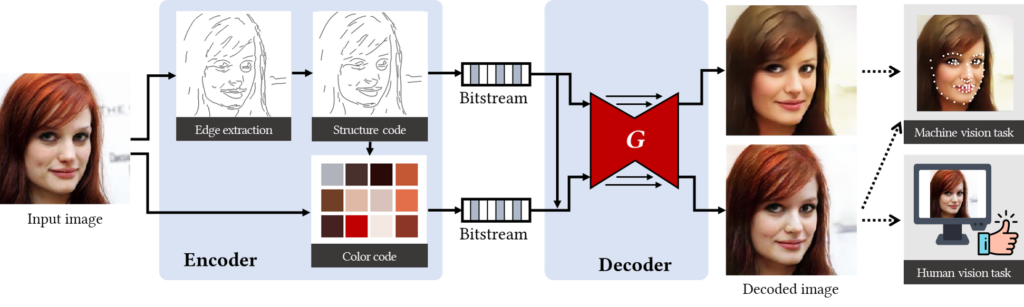
Video is increasingly captured primarily or exclusively for machine viewing, including applications like surveillance cameras, autonomous vehicles, industrial inspection, and drone footage. Traditional codecs like H.264 and HEVC were designed around human perception rather than machine vision tasks, which has opened the door to new compression approaches tailored to AI-driven workflows. Three emerging standards tackle this challenge from different angles: MPEG’s Video Coding for Machines (VCM), MPEG’s Feature Coding for Machines (FCM), and V-Nova’s LCEVC. Yes, LCEVC. Video Coding for Machines Video Coding for Machines, or VCM, is currently moving through the final ballot stages of the MPEG-AI roadmap as an upcoming international standard (ISO/IEC 23888-2). Operationally, it keeps video in the pixel domain but changes the optimization target. Operationally, it keeps video in the pixel domain but changes the optimization target. Instead of preserving what looks best to the eye, VCM attempts to preserve what helps computer vision models perform tasks such as detection, tracking, and classification. In practical terms, that can mean allocating more bits to objects or regions important to the model and fewer to background areas with minimal impact on task accuracy, using techniques like region-of-interest encoding. This is shown in Figure 1 (from here), which illustrates how VCM encodes image features optimized for machine tasks (edge extraction, structure coding, and color coding) while still producing a decodable bitstream. The same decoded output serves both a machine vision task (such as facial landmark detection) and conventional human viewing, demonstrating VCM’s dual-use architecture. However, a key caveat is that while the pixels remain available for human review or auditing, heavily optimized VCM streams will often appear distorted, blocky, or visually jarring to human eyes. Figure 1: Video Coding for Machines (VCM) architecture. The encoder optimizes for machine-relevant features (edge extraction, structure coding, color coding) while producing a standard bitstream. Click to view at full resolution. Feature Coding for Machines While VCM is nearing the end of its standardization pipeline as a Draft International Standard, Feature Coding for Machines, or FCM (ISO/IEC 23888-4), represents a newer, more radical track on the same MPEG-AI roadmap, currently sitting at the Working Draft stage.. Instead of transmitting compressed pixels, it transmits compressed features extracted by a neural network, so the receiving system gets machine-ready data rather than a viewable picture. That makes FCM a machine-only approach by design: highly efficient when no one needs to monitor the stream, but not suitable when operators, auditors, or consumers also require conventional video output. Figure 2: FCM runs neural network layers on the device, compresses intermediate features, transmits feature bitstream, and completes inference on the server. FCM eliminates pixel reconstruction and reduces bandwidth by up to 90%. Figure 2 contrasts the traditional video pipeline with the FCM approach. In the traditional workflow (a), the mobile device encodes raw video, transmits the compressed bitstream, and the server decodes it back to pixels before running the full CNN for object detection (identifying the car at 100% confidence). In the FCM workflow (b), the mobile device runs the first portion of the neural network (NN Part 1) on the raw video, extracting intermediate features that the FCM encoder compresses. The server receives this compressed feature bitstream, decodes it, and runs only the second portion of the neural network (NN Part 2) to complete the detection task. By transmitting neural network features instead of pixels, FCM eliminates the decode-to-pixels step entirely and achieves substantially lower bitrates. LCEVC – Base Layer for Machines; Enhancement Layer for Humans V-Nova’s LCEVC is fundamentally different. It uses a hierarchical structure with a lower-resolution base layer produced using a traditional codec such as H.264, HEVC, or AV1, and an enhancement layer that fills in the details. If played back on a device without an LCEVC decoder, only the base layer plays at the lower resolution. When an LCEVC player exists, the video plays at full resolution. This architecture allows AI systems to work from the lower-resolution base while humans can still reconstruct the full stream, enabling a single encoded asset to support both machine analysis and human viewing. Figure 3: LCEVC hierarchical encoding. The encoder produces a base layer (540p) and enhancement layer (residuals). Decoding only the base layer provides sufficient resolution for AI inference, while combining both layers reconstructs full 1080p quality for human viewing. Figure 3 illustrates LCEVC’s hierarchical encoding structure. The encoder splits the 1080p input into two components: a base layer at reduced resolution (540p) that contains a decodable version of the scene, and an enhancement layer that stores the residual information needed to reconstruct full quality. AI systems can decode only the base layer for inference tasks, avoiding the computational cost of full-resolution decode, while human viewers can decode both layers to reconstruct the original 1080p output. Note that working with the lower-resolution base layer for AI functions isn’t a disadvantage. Most AI vision models operate at significantly lower resolutions than the video content human viewers consume. Popular object detection models like YOLO typically process inputs at 640×640 pixels or smaller, while image classification networks such as ResNet commonly use 224×224 pixel inputs. Even advanced models rarely exceed 1024×1024 resolution due to the quadratic scaling of computational costs with image dimensions. LCEVC’s dual architecture distinguishes LCEVC from both MPEG tracks. VCM is still fundamentally about machine-optimized video, and FCM is about machine-only feature transport, while LCEVC is being pitched as a practical bridge between the two worlds. V-Nova’s public case is that many real deployments don’t want to choose between a stream for AI and a separate stream for people; they want one workflow that can serve both. LCEVC Performance Testing The company also backs that argument with public test claims. In a joint evaluation with Intel using UHD traffic surveillance footage, Intel Deep Learning Streamer, and MobileNet SSD, V-Nova says decoding only the LCEVC base layer reduced combined decode-and-analytics time on CPUs by 30 to 50 percent and increased integrated GPU inference throughput by about 3×, while holding detection accuracy essentially steady. Those are V-Nova’s numbers, but they at least give the argument something more concrete than a generic “AI-ready” claim. Those performance gains are modest compared to FCM. Rather than encoding pixels, FCM compresses the intermediate feature maps extracted by neural networks, transmitting only the task-relevant data needed for inference. In standardized testing, FCM achieved a 90% bitrate reduction versus H.264 and a 67% reduction versus VVC while maintaining equivalent object detection accuracy. That translates to roughly 10% of H.264’s bandwidth and 33% of VVC’s bandwidth for machine vision tasks. However, FCM’s architecture requires compatible AI models on both ends and produces streams that can’t be decoded for human viewing, the compressed features aren’t interpretable as images. LCEVC’s more conservative gains preserve compatibility with existing codecs and dual-use scenarios in which both humans and machines consume the same stream, but at the cost of substantially lower compression efficiency in pure machine-vision workflows. Summing Up For now, the cleanest way to think about the landscape is this: VCM keeps pixels but tunes them for machine tasks, FCM skips pixels and sends features, and LCEVC keeps video viewable while letting machines work from the lower-resolution layer. All three start from the same premise: that a growing share of video is no longer compressed primarily for human eyes. The open question is which compromise the market wants. If the workflow is machine-only, FCM has the clearest logic, delivering massive bandwidth savings that justify the infrastructure investment. If compatibility with existing video infrastructure matters most, VCM is the more natural path: it requires no AI processing at the origination point, works with standard video codec technology, and fits into current encoding workflows. If the real-world requirement is one encode for both AI and human viewing, V-Nova has planted itself squarely in that lane. The post Three Paths to Compression for Machine Vision: VCM, FCM, and the V-Nova Wild Card first appeared on Streaming Learning Center.
-
What Is Media over QUIC (MoQ) and Why It Matters for Real-Time Streaming
Live streaming has a fundamental tension that no existing protocol fully resolves. On one side sits WebRTC, which Ant Media describes as “ideal for real-time, interactive, low-latency...
General SourceLive streaming has a fundamental tension that no existing protocol fully resolves. On one side sits WebRTC, which Ant Media describes as “ideal for real-time, interactive, low-latency communication like video calls, conferences, and interactive live streams.” On the other side sit HLS and DASH, which remain HTTP-based, CDN-friendly, and operationally mature at large scale, but practical low-latency variants still usually land in the low-single-digit seconds rather than sub-second territory, as several NAB 2026 engineering reviews point out. For example, a pre-NAB 2026 review of low-latency streaming architectures pegs LL-HLS and LL-DASH in the 2–6-second range and contrasts them with sub-second MoQ demos. Any platform that wants low latency at scale typically ends up stitching these worlds together with custom infrastructure, protocol translations, and operational complexity. Media over QUIC, or MoQ, is the IETF’s attempt to build a single protocol to bridge the gap. The MoQ working group says it was formed to “develop a simple low-latency media delivery solution for ingest and distribution of media,” and the IETF blog describes MoQ as “a media delivery solution that has the potential to transform how we send and receive media during live streaming, real-time collaboration, gaming, and more.” By NAB 2026, that ambition had become visible across the show floor. Bitmovin and Cloudflare demoed live MoQ playback, Oracle and partners showed MoQT-based workflows, Broadpeak featured MoQ in joint live streaming demos, Ant Media highlighted MoQ comparisons in its booth, Faultline’s coverage documented nanocosmos’ MoQ CDN story, and the Streaming Summit hosted an “OpenMOQ and MoQ” session focused on next-generation streaming. QUIC: The Foundation Under MoQ MoQ depends on QUIC because QUIC fixes transport problems that are painful for media. TCP suffers from head-of-line blocking when multiple streams share a single connection, meaning the loss of a single packet can stall unrelated streams until the retransmission completes. APNIC explains that QUIC “relieves HOL blocking as it is stream-aware such that it knows which specific streams have been affected,” so only the affected stream waits while the others continue. Writing in Medium, Aditi Mishra further explains, QUIC “addresses HOL blocking at the transport layer by using UDP instead of TCP. QUIC allows multiple independent streams within a single connection, so packet loss in one stream doesn’t block others.” The image in Figure 1 explains the difference. Figure 1. With HTTP over TCP, messages for different requests block behind each other on a single connection, while QUIC over UDP lets streams deliver independently, so one slow packet does not stall the rest. Image from Edgecast. In addition to avoiding head‑of‑line blocking, QUIC also reduces connection setup time compared with TCP plus TLS. Because QUIC combines transport and encryption in a single handshake, it can start sending application data in fewer round-trips, which cuts tens to hundreds of milliseconds off the time‑to‑first‑frame, as illustrated by the timing diagrams for standard TCP+TLS versus QUIC. Figure 2: QUIC combines transport and encryption in a single handshake, cutting connection setup from hundreds of milliseconds with TCP+TLS to near zero for repeat connections and around 100 ms for new ones. Image from Edgecast. What MoQ Actually Is With that as background, MoQ is a publish/subscribe media transport protocol built on top of QUIC. APNIC describes it as “a generic live pub/sub framework designed for CDNs and mass fanout.” Cloudflare explains that MoQ’s core innovation is “treating media as subscribable tracks in a publish/subscribe system,” with three main roles: “Publishers: Announce track namespaces and send Objects. Subscribers: Request specific tracks by name. Relays: Connect publishers to subscribers by forwarding immutable Objects between them.” Broadpeak adds that “MoQ is built around a publish/subscribe model. A client subscribes to one or more media tracks, and the publisher makes the corresponding media objects available. Relay nodes in the network handle fan-out and caching.” Figure 3: In a standard MoQ architecture, a publisher announces and publishes media objects into a QUIC‑based relay cluster, which forwards and caches those objects so subscribers can retrieve them on demand. Image from Caton Technology. Figure 3 illustrates the standard MoQ delivery model: a publisher sends media objects (video, audio, data) into a MoQ relay fabric, where each relay forwards and caches those objects before passing them downstream to other relays or subscribers. Rather than every viewer maintaining a separate connection to the origin, subscribers attach to nearby relays that handle both fan‑out and short‑term storage, applying the publish/subscribe model the MoQ architecture is built on. The IETF charter states that “media will be mapped onto underlying QUIC mechanisms (QUIC streams and/or QUIC datagrams) and can be used over raw QUIC or WebTransport,” and that the working group will define the protocol so it can “leverage coordinating relays, caches, or replication points wherever applicable to improve the delivery performance.” The IETF blog also notes that MoQ’s publisher–subscriber protocol “supports multiple media formats, interoperability when indicating the media and media format being sent, rate adaption strategies… and cache-friendly mechanisms.” The wire protocol being standardized is formally called MoQT, for Media over QUIC Transport. In its NAB post, Oracle’s Video @ Edge team explains that “any system that speaks MoQT (Media over QUIC Transport), the IETF wire protocol, can publish or subscribe to any Track without prior bilateral negotiation,” which is exactly the interoperability story vendors are trying to build around the spec. Publishers, Subscribers, and Relays The architectural feature that most clearly separates MoQ from both WebRTC and classic HTTP streaming is the relay. In a MoQ deployment, publishers don’t send a separate stream to every viewer. Instead, publishers send media Objects over the network; relays receive and cache those Objects; and subscribers retrieve them from a nearby relay or a chain of relays. Figure 4: Cloudflare’s MoQ relay deployment model, with MoQ relays running in every edge data center to serve nearby publishers and subscribers. MoQ relays are typically operated by the same kinds of organizations that run today’s delivery infrastructure, including CDNs, cloud and platform providers, and network or service operators, depending on the deployment. Cloudflare’s explainer and Broadpeak’s article both emphasize that relays handle the fan-out and caching, not the origin server. The IETF blog explains that these relays “function as cache mechanisms, where copies of media are stored and then are distributed as needed.” APNIC gives a branch-office example: “With MoQ, a media relay installed at that local branch office would enable fan out, meaning the content from that call only travels one time. Copies are stored in the local relay and then are distributed within the branch office as many times as necessary.” That is essentially CDN logic applied to real-time media: one upstream copy, local distribution, and less waste across the backbone. APNIC also argues that “the allure of MoQ is that a single delivery network, protocol, and format can address multiple market segments concurrently,” which “affords lower network OPEX and better capacity management while maximizing the addressable market.” That is a large part of why MoQ attracts attention from CDN, player, and infrastructure vendors rather than just RTC specialists. How MoQ Compares to WebRTC and HLS/DASH WebRTC vs. MoQ WebRTC and MoQ overlap, but they don’t target the same core use case. Ant Media’s article on WebRTC vs MoQ says, “For use cases where responsiveness is existential — live auctions, telehealth consultations, remote drone monitoring, interactive sports betting — there is simply no better option available at production scale today. MoQ will shine in large-scale events like “Concerts, sports broadcasts, and political events where you need sub-second latency for a million simultaneous viewers.” nanocosmos writes that it “leverages both WebRTC and MoQ depending on the use case,” using WebRTC for browser-based ingest in web applications and MoQ as “the go-to choice for stable, large-scale delivery to a global audience.” In practice, that means WebRTC remains the best fit for true interactive sessions, while MoQ is being shaped as a better fit for one-to-many distribution where sub-second latency matters but full conversational interactivity is not the primary requirement. HLS/DASH vs. MoQ The comparison with HLS and DASH is different. Those protocols are deeply integrated into today’s CDN and player ecosystems, which is why they dominate at scale. But low-latency variants still usually operate in the 2–6 second range in real deployments, not the sub-second range that vendors now target with MoQ. Bitmovin and Cloudflare say that MoQ can enable “sub-second latency for millions of concurrent viewers over standard web infrastructure.” That “millions” language is a forward-looking architectural claim rather than a published benchmark, but it captures the design intention clearly. MoQ therefore sits between two worlds: it’s not trying to replace WebRTC for conversational applications, and it is not merely another flavor of HTTP chunked streaming. It is trying to create a third option: relay-based, sub-second, internet-scale media delivery over QUIC. Who Is Building on MoQ Today MoQ is no longer just a paper specification. The IETF blog reported that at IETF 118 “some degree of interoperability was achieved for the first time among the six early implementations,” which is a meaningful milestone for any emerging protocol. The MoQ transport draft remains active and continues to evolve through working-group discussion and interims, as reflected in the 2026 interim minutes. nanocosmos claims to be the “first vendor to bring Media over QUIC into production in 2025, with its official launch on the nanoStream platform during the IBC 2025.” Faultline reported after NAB 2026 that nanocosmos customers were already using its MoQ CDN in live environments “at small-scale in the low hundreds of thousands of concurrent users.” At NAB 2026, Bitmovin and Cloudflare demonstrated live MoQ playback, with a Bitmovin encoder publishing into Cloudflare’s network, which then acted as a MoQ relay fabric to deliver the stream to Bitmovin players around the globe. Figure 5: Bitmovin’s encoder publishes media objects into Cloudflare’s unified MoQ relay, which then fan-outs the stream to many Bitmovin Player clients over the Cloudflare network Oracle’s Video @ Edge team described its NAB 2026 demos as “a collection of demonstrations developed with partners that show how independent systems interoperate through a shared transport model,” all speaking MoQT. Figure 6. Oracle MoQ partner demonstrations at NAB 2026. Click to view the image at full resolution. Broadpeak’s NAB material positioned MoQ as part of a live streaming and monetization workflow, describing it as “the new protocol that offers enhanced live streaming performance with faster zap times, lower latency, and reduced re-buffering.” What Isn’t There Yet MoQ is still a draft, not a finished RFC. The IETF working group notes that it “will develop a simple low-latency media delivery solution,” which clearly signals that the work is still underway rather than complete. Interim meetings in 2026 discussed features such as REWIND to improve join behavior, and those ideas had not yet been incorporated into a final, stable standard by late April 2026, as seen in the interim minutes and the evolving MoQ transport draft. A useful way to think about MoQ in 2026 is as feature-complete enough to support demos and some targeted production deployments, but not yet boring, default infrastructure. The table below sketches what is effectively “there,” and what still needs time. Area What’s effectively there What’s not mature yet Standardization MoQT and related documents have stabilized sufficiently that multiple vendors can interoperate on late-stage drafts, and the overall architecture is well-defined in the IETF overview. There is still no final RFC, and details such as relay behavior and advanced features like REWIND are being refined in working-group discussions and interim meetings, so wire behavior can still change. Browser and player support WebTransport and HTTP/3 are now available in mainstream browsers, and vendors such as Bitmovin, nanocosmos, and Ant Media have shipped players or servers that can speak MoQ, as described in Bitmovin’s MoQ player article and nanocosmos’ explainer. There is no native MoQ stack in browsers; everything depends on JavaScript libraries and custom players, and interoperability across different vendor implementations is still in its early stages rather than routine. Implementations and deployments Several companies have working MoQ-based systems, including nanocosmos’ MoQ CDN, Bitmovin with Cloudflare’s relays, and Ant Media Server, which demonstrated live workflows at NAB 2026, as described in Faultline’s coverage and in Bitmovin’s and Cloudflare’s NAB post. These stacks target draft versions of the spec and are not yet aligned on a frozen profile, so coordinated upgrades will be needed as the standard evolves. Feature coverage is uneven across vendors. Ecosystem features Core media delivery works: sub-second live playback, pub/sub fan-out through relays, and basic content-agnostic object forwarding, as outlined in Qualabs’ overview. Broad, multi-vendor solutions for ad insertion, DRM, complex rights workflows, and standardized telemetry are still being prototyped; they do not yet match the maturity of comparable HLS/DASH/WebRTC ecosystems. Performance evidence Vendor demos and early lab work show MoQ achieving sub-second glass-to-glass latency, and academic studies are starting to benchmark MoQ-based adaptive streaming, including the thesis “Evaluating Media over QUIC (MoQ) for Low-Latency Adaptive Streaming”. The industry still lacks broad, published performance data at global scale across diverse networks, especially compared with the many years of real-world data behind HLS, DASH, and WebRTC, as noted in the pre-NAB review “Evaluating Low-Latency Streaming Architectures and Protocol Evolution at NAB 2026.” The upside is that MoQ’s design space extends beyond video streaming. The IETF blog notes that similar pub/sub delivery patterns could be valuable for IoT telemetry and event notification. That broader potential explains why some vendors are already running MoQ in production for specific workflows, while many others still treat it as near-term, but not yet fully settled. The Takeaway MoQ is a QUIC-based publish/subscribe transport with built-in relays and caching. Its backers position it as the protocol that can finally combine sub-second latency with broad fan-out and CDN-like scalability. In practical terms, that means MoQ will sit between WebRTC’s interactive strengths and HLS/DASH’s scale strengths, without inheriting the worst compromises of either. The promise is not fully proven yet. The spec is still moving, the ecosystem is still normalizing around draft behavior, and even supportive vendors acknowledge that MoQ is not yet ready for every production use case. But after NAB 2026, MoQ is best understood not as a lab curiosity but as an emerging industry standard with real momentum, real implementations, and enough public evidence to justify serious attention from anyone building low-latency streaming systems. The post What Is Media over QUIC (MoQ) and Why It Matters for Real-Time Streaming first appeared on Streaming Learning Center.
-
Half the Storage, Twice the Flexibility: Why a Tier-1 Operator Replaced Its Legacy Cloud DVR Platform with NEA Genesis
The video infrastructure market is in flux. Recent high-profile acquisitions and vendor consolidation have left many operators reassessing the platforms they depend on for cloud DVR, catch-up TV,...
General Source
The video infrastructure market is in flux. Recent high-profile acquisitions and vendor consolidation have left many operators reassessing the platforms they depend on for cloud DVR, catch-up TV, and VOD delivery. When the company behind your origin packaging solution is absorbed into a larger entity, with overlapping product lines and uncertain roadmaps, the risk isn’t theoretical. It’s operational. For operators who built their OTT services on legacy storage and processing platforms, the warning signs are hard to ignore. Product rationalisation following M&A activity means some platforms will be sunset. Feature development slows or stops entirely. In at least one case, the source code for a major platform has reportedly been lost during a support transfer, leaving the maintenance vendor unable to make any meaningful product evolution. They can patch around the edges, but the platform is frozen. This is exactly the situation a major European Tier-1 operator recently navigated. Facing a legacy cloud DVR platform with known architectural limitations and no credible roadmap for improvement, the operator partnered with Ateme and deployed NEA Genesis: a cloud-native origin packager built from the ground up for non-linear content delivery. The result: storage requirements dropped by more than half. What previously consumed over 100 petabytes now requires just 55. Where the storage overhead actually comes from The savings aren’t the result of a single optimisation. They stem from eliminating a fundamental architectural constraint in the legacy platform. The previous system imposed a hard limit on the number of recording assets that could be managed per cluster in its database. To stay under that ceiling, the platform was forced to record in oversized windows: a 15-minute programme recording might require a three or four-hour capture window. If just 3 to 6 percent of a channel’s content is recorded by subscribers at scattered times throughout the day, the platform ends up storing close to 24 hours of content for what amounts to one hour of actual recording assets. The overhead ratio is roughly 2:1. For every unit of content subscribers actually want, the platform stores two. NEA Genesis eliminates this constraint entirely. Content is ingested as granular DASH segments and stored in open, non-proprietary formats with no per-cluster asset limits. Just-In-Time packaging means content is only assembled into the specific format a device requests at the moment of playback. No oversized recording windows. No wasted storage on formats or durations that nobody requested. Beyond storage: the case for hybrid flexibility The storage saving alone justified the migration. But the operator’s architecture has continued to evolve in ways that validate a second, equally important design decision: the hybrid deployment model. The operator initially planned to keep just eight hours of content on-premises, with everything else in the public cloud. That number has since grown: first to 24 hours (to reduce cloud egress costs for catch-up content), then to three days (to cover weekends without relying on cloud availability), and now to a potential 30-day buffer. Each expansion was driven by real operational experience rather than upfront modelling. The reasons are practical. Cloud cost projections for video workloads carry 20 to 30 percent variance from reality, not the 5 percent many vendors suggest. Monitoring adds 10 percent. Security layers add another 10 percent. Usage-dependent factors like storage tiering transitions, traffic peaks, and CPU activity introduce yet more unpredictability. Accurate cost metrics require six to twelve months of full operational data, and by then the cloud provider may have changed its pricing anyway. NEA Genesis supports a three-tier architecture: live content served on-premises, a configurable buffer layer that can sit on-prem or in the cloud, and long-tail storage in object storage with lifecycle management. The split between tiers is adjustable without re-architecting the system. If egress costs rise, the operator extends the on-prem buffer. If cloud pricing becomes more favourable, they shift more content to object storage. The architecture adapts to commercial reality rather than locking the operator into a single deployment model chosen years earlier. A platform with no path forward vs. one designed for what comes next The legacy platform’s vendor has no on-premises replacement planned. Their only migration path is a fully cloud-based SaaS offering, which doesn’t suit operators who want to retain control over their deployment topology or who have learned from experience that pure-cloud isn’t always the most cost-effective option. For operators evaluating their options, the question isn’t about today’s storage bill alone. It’s about whether their platform can adapt as cloud economics shift, as operational requirements evolve, and as the vendor behind it continues to invest in the product. When the answer to that last question is no, the migration timeline stops being optional. Efficiency isn’t a cost metric. It’s a strategic advantage. Explore related insights NEA CDN & Video Delivery Cloud DVR Solutions About the Author Mark Haines CDN Product Manager & OTT Streaming Solutions Manager at Ateme Mark brings 18+ years of experience in OTT streaming & Content Delivery Networks. With a background spanning product management, solution architecture, and business development, he helps content owners, telcos & network operators navigate modern streaming infrastructure, from CDN strategy and live video delivery to cloud-native OTT platform design. At Ateme, Mark leads product direction for the NEA CDN portfolio and drives OTT & streaming solution strategy for major telcos and network operators worldwide, having previously spent 5 years as a Global Solution Architect. Prior to Ateme, he held solution architecture and business development roles at Velocix, part of Nokia/Alcatel-Lucent’s IP Video division. L’article Half the Storage, Twice the Flexibility: Why a Tier-1 Operator Replaced Its Legacy Cloud DVR Platform with NEA Genesis est apparu en premier sur Ateme.
-
Monetize your live streams using Amazon IVS server-side ad insertion
Live streaming platforms are growing fast, and with that growth comes the need to monetize content effectively. Whether you are building a creator-driven platform, a sports streaming service, or...
General Source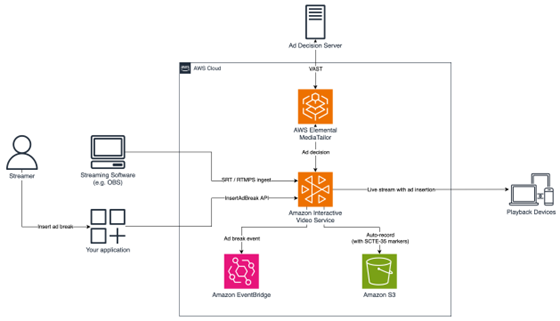
Live streaming platforms are growing fast, and with that growth comes the need to monetize content effectively. Whether you are building a creator-driven platform, a sports streaming service, or an interactive entertainment experience, video advertising is a critical revenue stream. However, implementing server-side ad insertion (SSAI) in live streams has traditionally required significant engineering effort and introduced complexity that can degrade the viewer experience. Amazon Interactive Video Service (Amazon IVS) Low-Latency Streaming now supports SSAI, integrating with AWS Elemental MediaTailor to stitch ads directly into your live video streams at the server, delivering a seamless viewing experience while giving you access to ad decisioning, audience targeting, and personalization capabilities. In this post, we show how you can monetize your live streams using Amazon IVS SSAI. The challenge of monetizing live streams With Amazon IVS, you can build low-latency interactive live streaming experiences with managed infrastructure. But turning those streams into ad revenue is harder than it looks. Client-side ad insertion introduces challenges including ad blockers, complex player transitions across platforms, and inaccurate delivery measurement. Building a server-side solution from scratch is equally demanding, requiring integration with ad decision servers (ADS), creative transcoding, stream stitching, and signaling. This is complex engineering work that doesn’t differentiate your product, taking resources away from what matters most to your viewers. Solution overview Amazon IVS SSAI removes this complexity by providing a managed, server-side ad insertion capability built into the Amazon IVS low-latency streaming pipeline. This solution offers the following benefits: Seamless ad stitching without client-side complexity – Ads are stitched directly into the video stream at the server before it reaches the viewer, maintaining the low-latency experience Amazon IVS is known for. There is no client-side ad SDK to integrate, no visible transitions between content and ads, and significantly reduced opportunity for ad blockers to interfere. Viewers experience ads as a natural part of the stream. Simple ad break control with operational visibility – Amazon IVS provides an API operation, InsertAdBreak, that lets you trigger ad breaks programmatically. You specify the channel and the duration, and Amazon IVS handles the rest. Each ad break publishes an Amazon EventBridge event with the expected insertion time, helping you drive UI updates, logging, or analytics pipelines in response. Ad decisioning and personalization – Through the integration with MediaTailor, Amazon IVS SSAI connects to your ADS to request and fill ads. MediaTailor passes per-viewer parameters to your ADS, allowing it to apply audience targeting, competitive exclusion, frequency capping, and other decisioning logic. You can define these parameters through the Amazon IVS playback authorization token, giving you control over the viewer context sent with each ad request. Programmatic inventory and measurement – Server-side ad insertion stitches ads on the server, but programmatic ad platforms such as Google Ad Manager require client-side signals for ad tracking, viewability verification, and programmatic access. Amazon IVS SSAI supports integration with the Datazoom SDK, which provides client-side ad beaconing, IAB Tech Lab’s Open Measurement SDK compliance, and the Google PAL SDK to meet these requirements. Datazoom also offers a data platform with real-time QoE observability, advertising monetization dashboards, and connectors to AWS services such as Amazon Simple Storage Service (Amazon S3) and Amazon Kinesis, available under separate commercial terms. Enabling Datazoom data collection is optional and not required to use Amazon IVS SSAI. The Datazoom SDK can also be used to track ad breaks for UI treatments (incoming ad, ad duration, VOD timeline decoration, and more). Scales with your platform – A single MediaTailor playback configuration and Amazon IVS ad configuration can serve multiple channels. When a live stream is recorded to Amazon S3, Amazon IVS includes SCTE-35 ad markers (industry-standard cue points for ad insertion) in the VOD playlist, so you can monetize on-demand content using the same ad infrastructure. Viewer controls – Using playback authorization tokens, you can opt specific viewers out of ads by adding the claim “aws:ads-opt-out“: true to the JWT, supporting use cases such as subscriber-only ad-free experiences. The following diagram illustrates the solution architecture. Figure 1: Amazon IVS SSAI architecture overview Getting started with Amazon IVS SSAI involves three configuration steps: creating a MediaTailor playback configuration, creating an Amazon IVS ad configuration, and associating the ad configuration with your channel. We walk you through these steps in the following sections. Prerequisites Before you begin, you need the following resources: An AWS account An Amazon IVS channel with the container format set to TS (see Getting Started with IVS Low-Latency Streaming) A Video Ad Serving Template (VAST) compliant ADS URL (or use the sample ADS provided when you create a MediaTailor playback configuration) Create MediaTailor playback configuration To create a MediaTailor playback configuration that connects your ADS to Amazon IVS, complete the following steps: 1. On the MediaTailor console, choose Create configuration. Figure 2: AWS Elemental MediaTailor console 2. Under Required settings, configure the following fields: a. For Name, enter a name for your configuration, for example my-ssai-config. b. For Content source, enter your Amazon IVS channel playback URL prefix, ending in live-video.net/. This prefix is shared across Amazon IVS channels in your account and AWS Region, which means a single MediaTailor playback configuration can serve multiple Amazon IVS channels. You can find your playback URL prefix on the Amazon IVS console on the channel details page. c. For Ad decision server, enter the URL of your VAST-compliant ADS. For testing, you can use the AWS Live Event Framework sample ADS: https://n8ljfs0h09.execute-api.us-west-2.amazonaws.com/v1/ads?duration=[session.avail_duration_secs]. The [session.avail_duration_secs] token is a MediaTailor dynamic variable. When an ad break is triggered, MediaTailor replaces it with the requested break duration in seconds before calling your ADS. This allows the ADS to return ads that fit the available break window. For the full list of available dynamic variables, see MediaTailor dynamic ad variables for ADS requests. Figure 3: Creating a MediaTailor playback configuration with required settings 3. Under Personalization details, for Ad insertion mode, choose Player select. This is required for Amazon IVS SSAI. Figure 4: Setting the ad insertion mode to Player select 4. Choose Create configuration. 5. After the configuration is created, note the playback configuration Amazon Resource Name (ARN), which you will need in the next step. Figure 5: MediaTailor playback configuration created successfully Create Amazon IVS ad configuration An ad configuration links your Amazon IVS resources to your MediaTailor playback configuration. A single ad configuration can be reused across multiple channels. Complete the following steps to create an Amazon IVS ad configuration: 1. On the Amazon IVS console, choose Ad configurations under Low-latency streaming in the navigation pane. 2. Choose Create ad configuration. Figure 6: Amazon IVS ad configurations page 3. For Ad configure name, optionally enter a name for your ad configuration, for example my-ad-config. 4. For Elemental MediaTailor playback configuration, choose your MediaTailor playback configuration. The dropdown menu lists MediaTailor playback configurations in your account. If you have not yet created one, choose Create MediaTailor playback configuration to open the MediaTailor console in a new tab. Figure 7: Selecting a MediaTailor playback configuration for the ad configuration The console displays a reminder of the three MediaTailor settings required for ad insertion to work: the ADS URL, the content source (your Amazon IVS playback URL prefix), and the insertion mode set to PLAYER_SELECT. 5. Choose Create ad configuration. Figure 8: Completed ad configuration form with MediaTailor requirements Associate ad configuration with your channel Complete the following steps to associate the ad configuration with your channel: 1. On the Amazon IVS console, open your channel. 2. Choose Edit. 3. Under Server-side ad insertion, turn on Enable server-side ad insertion. 4. For Ad configuration, choose your ad configuration. 5. Choose Save changes. Your channel is now configured for server-side ad insertion. Figure 9: Enabling server-side ad insertion on an Amazon IVS channel Insert ads into live streams Now that your channel is streaming, call the InsertAdBreak API to trigger an ad break: aws ivs insert-ad-break \ --channel-arn "arn:aws:ivs:us-west-2:123456789012:channel/ABcdef12ghIJ" \ --duration-seconds 30 When the ad break is successfully scheduled, Amazon IVS publishes an EventBridge event (Amazon IVS Ad Break State Change) containing a target_start_time timestamp indicating when ads will begin appearing in viewer playlists. If no ad can be filled, for example if your ADS doesn’t return an ad or the creative hasn’t yet been transcoded by MediaTailor, source content continues uninterrupted. One ad break can be active per channel at a time. Subsequent calls to InsertAdBreak while a break is in progress return a 409 ConflictException. Player SDK integration The Amazon IVS Player SDK surfaces events across supported platforms when an ad break is played, notifying your application when ads start, progress, and end. The following table summarizes the events, payloads, and triggers. Event Payload Trigger Ad break started AdBreak First segment of ad break Ad creative started AdCreative First segment of each creative Ad time update AdTimeUpdate Every second during ad playback Ad creative ended AdCreative Last segment of each creative Ad break ended AdBreak First content segment after break The following code is an example using the Web SDK to build a simple ad countdown overlay: player.addEventListener(PlayerEventType.AD_TIME_UPDATE, (payload) => { const text = `Ad ${payload.podIndex} of ${payload.podLength} · ${Math.round(payload.creativeDuration - payload.creativeElapsed)}s remaining`; updateAdOverlay(text); }); player.addEventListener(PlayerEventType.AD_BREAK_ENDED, () => { hideAdOverlay(); }); For platform-specific event names and payloads, see the Amazon IVS Player SDK documentation for Web, Android, and iOS. Viewer tracking and targeting You can pass per-viewer parameters to your ADS through the Amazon IVS playback authorization token. Add a claim with the following format: { "aws:ads-player-params": { "player_name": "web-player", "content_genre": "sports" } } These values are passed to MediaTailor and mapped to [player_params.player_name] and [player_params.content_genre] template variables in your ADS URL. For more detail, see MediaTailor passing parameters to ADS. Clean up When you are done with the solution, clean up any resources you created to avoid incurring ongoing charges. Conclusion In this post, we showed how you can monetize your live streams using Amazon IVS SSAI. To get started, see Server-Side Ad Insertion (SSAI). For questions or feedback, visit AWS re:Post or contact an AWS representative to learn how we can help. Further reading Getting Started with IVS Low-Latency Streaming AWS Elemental MediaTailor User Guide Datazoom SDK for MediaTailor IVS Player SDK Amazon EventBridge User Guide
-
Comparing H.264, HEVC, VP9, and AV1 in SBE: From BD-Rate to Contextual ROI
Most video engineers use a similar tool stack. MediaInfo for file data, Bitrate Viewer to view the bitrate of H.264-encoded files on Windows, Moscow State University VQMT on Windows for metrics,...
General SourceMost video engineers use a similar tool stack. MediaInfo for file data, Bitrate Viewer to view the bitrate of H.264-encoded files on Windows, Moscow State University VQMT on Windows for metrics, with a custom combination of data input scripts and Excel for RD curves and BD-Rate data. Most tools have critical gaps. Few let you compare videos during real-time playback, which is essential to verify whether quality scores actually reflect subjective quality. Few tools below four figures show frame and GOP-related data. None helps you analyze whether a new codec or higher-quality encoding configuration actually makes economic sense. Most quality-seeking encoding decisions involve increasing encoding cost and increasing storage requirements. AV1 might drop bitrates by 35%, but AV1 is expensive to encode, and the storage costs are additive. Moving from the medium to the very slow preset will allow you to deliver the same quality at a lower bitrate but might quadruple your encoding costs. This might make sense if each file is viewed 20,000 times, but probably not 500 views. Understanding these dynamics is critical to effective decision-making. All encoding decisions are, at their core, economic decisions, but there’s no easy way to get from VMAF data to ROI. If you’re using different tools for different functions, you’re often copying and pasting data from one tool to another, including tools working on different operating systems. The Streaming Learning Center’s Bitrate Explorer (SBE) was designed to simplify and accelerate the analyses that help you make better encoding-related decisions. File data, metrics, still-image and frame comparisons, BD-Rate and RD-curves, and an ROI analysis you can refine to incorporate your actual delivery patterns. SBE is available on Windows and Mac (Intel and ARM). To illustrate how SBE enables better decision making, I encoded a short 1080p60 football clip to codec-specific encoding ladders with H.264, HEVC, VP9, and AV1 at matched quality (~VMAF 93 at the top rung). In this article, I review SBE’s capabilities and workflow, taking you through the various tools tab by tab. You’ll learn what each tab shows, what it means, and where the cross-codec comparison isn’t as direct as it looks. File Intelligence MediaInfo is pervasive because basic file details underpin the analysis of any file. At its core, MediaInfo runs FFprobe on the file and reports data like resolution, codec, and bitrate. SBE does the same, but adds several features: A video thumbnail so you don’t have to play the file to figure out what it is With x264 and x265 encodes, it analyzes the data FFprobe delivers to identify the preset used to encode the file If you click the Hide Defaults check box on the right, SBE hides all default settings so you can see the ones that were actually customized. If you’ve hunted through the MediaInfo HTML view to identify how a particular encode differs, you’ll find this instantly useful. Figure 1. The File Intelligence view provides the same data as MediaInfo with several additional features. Click to view at full resolution. File Compare The File Compare function is next. Load multiple files into SBE, then click the Compare button; SBE displays the file data in columns. Click Show Deltas only, and the tool hides all common configurations, allowing you to instantly see how the files differ. Figure 2: File Compare with Show Deltas Only enabled, four files side by side. Figure 2 shows the top rung for all four codecs. File sizes at the top: H.264 9.0 MB, HEVC 7.1 MB, VP9 6.8 MB, AV1 4.1 MB. Same source, same target VMAF, AV1 is less than half the size of H.264. Below that data are the parameter deltas: preset, profile, GOP, B-frames (3/4/0/0), reference frames, and rate control. The B-frame counts look like the headline structural difference. The Frame Type section below explains why that comparison isn’t as direct as it looks. In the interest of full and fair disclosure, as with MediaInfo, SBE can only report the metadata the encoder included in the file. With x264 and x265, the information is comprehensive. With VP9 and AV1, much less so. With third-party encoders like AWS MediaConvert, there’s usually even less data. Here’s a video that shows the File Intelligence and Compare Tabs. How are the bits being spent? Bitrate Chart The next tab is the Bitrate Chart, a bit like Bitrate Viewer, but it can handle any codec FFprobe can analyze, including AV1, VP9, and VVC, as well as H.264 and HEVC. Scanning Figure 3, you see that the average bitrate is a summary statistic. The shape of the bitrate curve over time tells you how each codec’s rate control actually behaves on this content, including where it spikes, where it conserves, how it tracks the scene complexity, and where it fights it. As with Bitrate Viewer, you can also view the bitrate in GOP or frame view. Figure 3. The Bitrate Chart is like Bitrate Viewer, but it can analyze many more codecs. If you study the top toolbar above the bitrate chart, you’ll see the Frame Viewer button. This opens a player you can use to click to view still frames or video, which is useful when you want to gauge video quality at the bitrates shown in this tab. We’ll explore this below when studying the Metrics Tab. Are Your GOPs Aligned – Frame Type The Frame Type tab shows the I/P/B distribution from each codec’s bitstream over time, with average bitrate and VMAF overlaid on the same chart. This is useful for verifying GOP structure, confirming that scene-cut I-frames land where you expected, and checking that B-frame patterns match what you configured at the encoder. This feature is available in the free version of SBE; you’ll have to spend over $1,000 to get this feature in Telestream Switch or other similar tools. Figure 4 shows the four top rungs stacked in this frame view. You can see that all the videos have matching GOP intervals, which is always good to validate. You can also see that the top two videos, x264 and x265, include I, B, and P frames, while the bottom two, VP9 and AV1, don’t include B frames. That isn’t quite right, and it’s worth being precise about why. Figure 4. Frame Type for the four codec top rungs. H.264 and HEVC have an explicit B-frame frame type in their bitstream syntax. When the encoder uses bidirectional prediction, the bitstream marks the frame as B and FFprobe reports it. SBE shows it. VP9 doesn’t have a B-frame type in its bitstream. It uses alternate reference frames, which are hidden frames future frames can reference, and compound prediction modes inside frames the bitstream classifies as P. A VP9 encode using bidirectional prediction extensively still shows zero B-frames in any tool reading the bitstream classification. AV1 is the same shape. AV1 defines KEY_FRAME and INTER_FRAME, with no distinct B-frame type. SVT-AV1 defaults to multi-level hierarchical reference structures functionally similar to H.264 pyramid B-frame patterns, but the frames are labeled INTER_FRAME (P) at the bitstream level. So all four codecs use bidirectional temporal prediction on this content. Two of them surface it via the frame-type field; the other two do so via prediction-mode mechanisms that FFprobe doesn’t currently expose. The next SBE release adds hidden-frame detection (VP9 altrefs, AV1 frames with show_frame=0) and hierarchical reference level per frame, which will make the VP9 and AV1 columns directly comparable to H.264 and HEVC. For now, read I/P/B percentages directly across H.264 and HEVC, and treat them as single-codec only for VP9 and AV1. Measure VMAF, PSNR, and SSIM – Metrics The Metrics tab computes VMAF, PSNR, and SSIM against the source reference in a single pass, with per-frame curves for each metric. Results are verified to within 0.01% of MSU VQMT. You can switch between metrics with the radio buttons without re-running, export to Markdown for reports or CSV for further analysis, and jump directly into Frame Viewer to investigate any frame of interest. Figure 5 shows the per-frame VMAF curves for the four top rungs. Averages: H.264 93.0, HEVC 93.1, VP9 93.1, AV1 93.0, confirming the matched top-rung quality. Note the poor quality at the start of the x265 encode, which is very common with x265. If you’re testing 5-10 second clips, the ultra-low quality at the start significantly impacts your average score, though you wouldn’t be aware of it without a view like this. Figure 5. Per-frame VMAF for the four top rungs against the source reference. Note the shared dip near 0:19. All four codecs lose quality at the same moment, in roughly the same magnitude. That’s a sanity check that the dip is a hard moment in the source content, not a codec-specific failure. But a metric drop into the high 60s is exactly where averages stop helping. Is it perceptually significant, or noise, that the metric is over-reporting? This is where Frame Viewer excels. Click into the dip on any of the four files, and SBE opens the still frame in the Frame Viewer window (Figure 6), with the mini chart below tracking your position. From there, you can navigate frame by frame, switch between any of the loaded files with the dropdown in the upper right or a keyboard shortcut, hit play to view at normal speed (or 0.5×, 2×, 3×), and switch between encodes mid-playback. The mini chart can show bitrate, frame type, or any of the three metrics, synced to the current frame. Figure 6 shows Frame 1154 at 19.25s on the HEVC top rung at the bottom of the dip. Figure 6. The worst frame on the HEVC top rung. VMAF 68.0. The frame is in the middle of a video transition with motion blur on the dissolving graphic. VMAF doesn’t score graphics transitions well, so it reports low scores on frames that viewers wouldn’t notice. A/B playback against the source confirms it; you can swap between the reference, the HEVC encode, and the AV1 encode during playback, and the dip is invisible to the eye. This is the part of the workflow that hasn’t really existed before. MSU VQMT enables frame-level still comparison on Windows, but not on Mac, and no video playback on either. In fact, I’m not aware of any tool that enables real-time A/B video playback against a reference, with keyboard-shortcut switching between encodes mid-playback and a metric chart synced to the current frame. If you’ve ever tried to verify whether a VMAF score corresponded to a real perceptual issue and ended up screen-grabbing frames into Photoshop, you know why this matters. BD-Rate The BD-Rate tab is next. Bjøntegaard Delta Rate is the definitive measure of codec efficiency, computing how much bitrate one codec needs to deliver the same quality as another, averaged across the full rate-distortion curve. Building it in Excel with the standard plugin is a multi-hour project the first time, and an hour or two each subsequent time, which is why most practitioners skip it. SBE processing times depend on the number of files included, their duration, and the type of machine you’re running on. SBE processed the 19 20-second files shown in this analysis in under 5 minutes on a $2,000 HP Workstation, with results verified using the Excel plugin. To run BD-Rate comparisons, load your reference, drag in the encode ladders, and SBE groups files by codec from the metadata. For non-codec comparisons, like preset variants, single- vs multi-pass, CRF ladders, you can tag manually. Press Calculate to get the RD curves and the BD-Rate matrix. Figure 7 shows the result. Figure 7. RD curves and BD-Rate matrix for the four-codec comparison. The matrix reads row codec vs column codec. Negative values mean the row codec is more efficient, so it needs less bitrate to deliver the same quality across the ladder. Like the Excel plug-in, green is good, red is bad. Against H.264 as the baseline: AV1: -59.83% (AV1 can produce the same quality at roughly 60% less bitrate than H.264) VP9: -35.08% HEVC: -31.48% VP9 vs HEVC: -5.65% VP9 is marginally more efficient than HEVC on this content. That ordering can flip on other content, which is a feature of BD-Rate rather than a bug; worth running on multiple sources before drawing a general conclusion about either codec. OK, so you know the relative efficiency of the codecs. Does that mean AV1 is the best codec in all instances? What if it costs 8x more to encode? What if the file will only be viewed 1,000 times? What if your distribution pattern slants more towards mobile viewers than SmartTVs? What if your distribution cost is $0.08/GB or $0.005/GB? Knowing which codec is more efficient is miles away from understanding if and when it makes economic sense to deploy that codec. Ditto for encoding-related decisions like multiple-pass vs single-pass, the very slow preset vs. the medium preset, or eight reference frames vs one reference frame. All of these decisions trade off quality against encoding and distribution costs, and if you don’t incorporate these costs into the decision, it lacks critical context. This is what the Breakeven tab provides. Here’s a video showing how BD-Rate operates. Breakeven The Breakeven tab takes the BD-Rate result and adds the cost side: encoding cost premium, time to break-even, net dollars over the period, and (under an audience distribution) the increase or decrease in quality each codec actually delivers to the viewer. The relationship between BD-Rate and audience-weighted break-even is important for interpreting the numbers. BD-Rate measures the average bitrate savings across the entire shared ladder. It’s a number that doesn’t exist in the real world. You don’t distribute at all shared points; you distribute a fixed number of rungs that are played by viewers connecting at multiple different connection speeds. You’d get close to the BD-Rate savings if you distributed all rungs equally, but most services aren’t close to this. Some are top-heavy with higher concentrations of the top higher-quality rungs. Others are mobile-centric with distributions focused in the mid and lower rungs. If you attempt to use BD-Rate averages to predict real-world savings, you’ll find significant variance that increases the more your actual distribution patterns differ from the average. You’ll see this in the three examples below that measure savings: 1) using the BD-Rate data, 2) using a top-heavy distribution pattern, and 3) using a mobile distribution pattern. All three computations share the following inputs: CDN cost: $0.02/GB; baseline encoding cost: $5/hour; encoding cost multipliers (AV1: 4x, HEVC: 2x, VP9: 1.5x); projected viewing hours: 250,000. Figure 8 shows the default view, which are the BD-Rate average numbers with no audience distribution applied. You can tell this because the Apply audience distribution checkbox in the upper-left corner of the Breakeven tab is unchecked. Figure 8. Break-even with no audience distribution. The savings percentages match BD-Rate. Here are the results using the default BD-Rate values: Efficiency over H.264 (the BD-Rate result): AV1 -59.83%, VP9 -35.08%, HEVC -31.48%. Break-even hours: VP9 520, HEVC 1,140, AV1 2,025. Net savings over 250k viewing hours: AV1 $1,836, VP9 $1,199, HEVC $1,091. VMAF change: blank. BD-Rate computes the savings at the same quality by definition, so there’s no quality delta to report. This view shows the relationship between bandwidth savings and encoding cost premium. AV1 saves the most bandwidth per hour but requires the most viewing hours to recoup its 4x encoding cost. VP9’s 1.5x multiplier means it reaches profitability four times faster than AV1, even though it saves much less bandwidth per hour. Below a few thousand viewing hours, AV1’s encoding premium hasn’t been amortized, and the only codec actually making money is VP9. Figure 9 applies a top-heavy distribution, with 81.7% of viewing on the 3.8 Mbps top rung. That’s a premium-tier viewing profile. You see the Apply audience distribution checkbox is checked, and the average bitrate has changed to reflect the distribution pattern. Figure 9. Break-even with a top-heavy distribution. Here are the results using the top-heavy distribution pattern: Efficiency over H.264: AV1 -51.12%, VP9 -21.97%, HEVC -18.65%. Each codec is less efficient at this audience-weighted bitrate than its BD-Rate average across the full ladder. Break-even hours: VP9 368, HEVC 866, AV1 948. Net savings over 250k viewing hours: AV1 $3,942, VP9 $1,697, HEVC $1,438. Dollar numbers go up despite lower percentages because more absolute bandwidth is in motion at premium-tier viewing volume. VMAF change: AV1 +0.93, VP9 +0.57, HEVC +0.58. Small deltas. Premium content sits near the top of the quality curve where all four codecs converge, so the codec choice mostly buys bandwidth efficiency rather than quality lift. The view tells us that audience volume amplifies absolute dollar savings even when percentage savings shrink. AV1’s net dollars more than double the no-distribution case, and VP9’s break-even drops to 368 hours. At a premium service with significant viewing volume, AV1 produces the largest absolute return. At smaller premium audiences, VP9 may pay back faster and net more total dollars. Figure 10 shifts to a mobile-centric distribution, with viewing weighted toward the lower rungs of the ladder. Figure 10. Break-even with a mobile-centric distribution. The ranking shifts. Here are the results using the mobile distribution pattern: Efficiency over H.264: AV1 -23.16%, VP9 -4.96%, HEVC -3.99%. Each codec is much less efficient at this audience-weighted bitrate than its BD-Rate average. Break-even hours: VP9 3,188, AV1 4,099, HEVC 7,936. Net savings over 250k viewing hours: AV1 $899, VP9 $194, HEVC $152. VMAF change: AV1 +6.96, VP9 +3.96, HEVC +3.48. H.264’s audience-weighted VMAF is 84.01 at this distribution. AV1 brings it to 90.97, VP9 to 87.97, HEVC to 87.49. This view shows that, at constrained bitrates for mobile-centric content, codec efficiency appears more as a quality lift than as a bandwidth reduction. AV1’s bandwidth savings shrink to 23%, but it delivers nearly +7 VMAF over the H.264 baseline. The deployment question on this audience profile isn’t mostly about saving bandwidth. It’s about whether your viewers see 84 VMAF or 91 VMAF. The three codecs offer different deployment recommendations across three axes. Audience volume. Below VP9’s break-even point, no codec is making money. VP9 is the only one paying back fast enough to matter at a small scale, because its encoding cost premium is low enough that even thin bandwidth savings cover it. Audience distribution. Premium-tier viewing makes the choice mostly a matter of bandwidth efficiency, because the codecs converge near the top of the quality curve. In contrast, mobile-centric viewing makes it about quality delivered at constrained bitrates, because that’s where the codecs diverge. Optimization target. If you’re optimizing for absolute dollars at scale, AV1 produces the highest return across all three distributions. If you’re optimizing for fastest payback, VP9 reaches it first in every distribution. If you’re optimizing for QoE on mobile-centric content, AV1 again, because the +7 VMAF lift is large enough to justify the encoding premium at any reasonable audience size. HEVC gets squeezed on every distribution at this content profile: less bandwidth savings than VP9, less quality lift than VP9, longer break-even than VP9, and less net dollars than VP9. There’s an audience and a content type where HEVC is still the right answer, but it isn’t this one. This is the analysis the field has been doing by hand in custom spreadsheets, or skipping entirely. Having it in the same window as the BD-Rate that feeds it is what turns “which codec is more efficient” into “which codec is right for our deployment, our audience, and our quality target.” Here’s a video showing the Breakeven tab in operation. Wrapping up The findings from this comparison: AV1 produced a file less than half the size of H.264 at matched VMAF (4.1 MB vs 9.0 MB) The shared metric dip at 0:19 turned out to be a sponsor overlay transition — perceptually clean once you A/B against the source in Frame Viewer BD-Rate ranking: AV1 ~60% more efficient than H.264, HEVC ~31%, VP9 ~35%, with VP9 marginally outperforming HEVC on this content Codec ranking depends on audience distribution. HEVC nearly stops being worth the encoding cost on a mobile-centric audience BD-Rate provides only general guidance and little meaningful insight into the economic impact of your encoding decisions. To recommend a new codec, or even a simple change in encoding configuration, you need to understand the return on investment it provides, given your encoding ladder, your distribution pattern, and your encoding and distribution cost structure. Before that, you need to verify that the metrics underpinning the BD-Rate calculations are accurate, which means comparing still-image and real-time playback. SBE delivers a comprehensive, integrated toolset that lets you elevate your analysis and recommendations from generic BD-Rate to contextual ROI. It’s the only available tool that enables real-time playback comparisons and the only one that allows you to comprehend and present the economic impact of your encoding-related decisions. SLC Bitrate Explorer is free for a full 14-day trial. After the trial, File Intelligence, File Compare, Bitrate Chart, and still-frame Frame Viewer stay in the free tier. Metrics, BD-Rate, Frame Viewer video playback, and the Break-even Calculator are Pro at $109.99 once. SBE is available on Windows, Intel Mac, and Apple Silicon. The post Comparing H.264, HEVC, VP9, and AV1 in SBE: From BD-Rate to Contextual ROI first appeared on Streaming Learning Center.
-
Redefining OTT Efficiency: How Ateme and AMD Are Powering the Next Generation of Sustainable Streaming
As streaming platforms scale to deliver more channels, higher resolutions, and lower latency experiences, operators are being challenged to balance performance, efficiency, and sustainability like...
General Source
As streaming platforms scale to deliver more channels, higher resolutions, and lower latency experiences, operators are being challenged to balance performance, efficiency, and sustainability like never before. For service providers, the challenge is no longer simply scaling video delivery. It’s about doing so efficiently and economically while continuing to deliver the ultimate viewing experience. At Ateme, we believe the future of streaming depends on smarter infrastructure choices. Through our collaboration with AMD and the latest AMD EPYC processors, we are helping operators modernize OTT workflows with improved efficiency, lower Total Cost of Ownership (TCO), and premium Quality of Experience (QoE). Doing More with Less Infrastructure Traditional OTT deployments often rely on large server footprints, high power consumption, and complex operational environments. As video demand grows, these inefficiencies become increasingly costly. By combining Ateme’s TITAN encoding and packaging solutions with the processing power of AMD EPYC CPUs, operators can process more channels on fewer servers while still delivering premium video quality at scale. The result is a leaner and more efficient architecture that helps operators: Reduce energy consumption Lower cooling and space requirements Simplify operations and maintenance Optimize infrastructure investments Improve long-term scalability Modern software optimization combined with next-generation CPU performance allows OTT providers to scale capacity without linear increases in power and rack space. TITAN’s Smart Constant Quality technology further improves delivery efficiency by dynamically optimizing bitrate allocation to maintain consistent perceptual video quality while reducing bandwidth consumption. The platform also supports AV1, the next-generation codec rapidly emerging as the future of video streaming thanks to its superior compression efficiency and growing ecosystem support. By integrating AV1 into OTT workflows, service providers can significantly reduce bandwidth requirements while maintaining premium video quality. Ateme is also actively innovating around Media over QUIC (MoQ), including participation in the OpenMoQ forum. These next-generation delivery architectures are designed to enable lower latency live streaming, improved scalability, and more efficient video transport for future streaming services. Sustainability as a Core Design Principle Sustainability is becoming a strategic priority across the media and telecommunications industries. Running more channels on fewer servers directly reduces power consumption and data center footprint while lowering operational costs. Ateme’s collaboration with AMD reflects a shared commitment to helping operators build streaming platforms that are both technically advanced and environmentally responsible. Unlocking Higher Quality Experiences Infrastructure efficiency should never come at the expense of viewer experience. With TITAN’s advanced compression technologies and the high-performance capabilities of AMD EPYC processors, operators can continue to enhance video quality while maintaining operational efficiency. This creates headroom for: Higher resolutions and bitrate optimization More consistent streaming performance Faster deployment of new services Greater flexibility for future platform evolution As streaming competition intensifies, maintaining exceptional QoE while controlling costs becomes a critical differentiator. Building the Future of OTT Delivery The future of streaming will belong to platforms that can scale intelligently, operate sustainably, and continuously improve viewer experience. As the industry moves toward higher efficiency codecs, lower latency architectures, and more sustainable infrastructure models, the ability to deliver premium streaming experiences efficiently at scale will become one of the industry’s most important competitive advantages. Disclaimer: Actual performance, efficiency, and cost benefits may vary depending on workload, configuration, and deployment environment. Explore related insights OTT Streaming Solutions TITAN for Video Processing & Compression About the Author Jean-Louis Lods VP Media and SaaS at Ateme Jean-Louis offers over 25 years of media, entertainment, and broadcast industry knowledge. Focusing on the customer experience, he brings a consultative approach to solutions delivery, focusing on everything from business transformation through cloud strategy and SaaS to a manage-by-exception media supply chain principle plus contribution and primary distribution and monetization with DAI to VoD-to-Live. Prior to joining Ateme, Jean-Louis managed a major service provider in Amsterdam offering video-on-demand and linear playout services for international blue-chip media companies. L’article Redefining OTT Efficiency: How Ateme and AMD Are Powering the Next Generation of Sustainable Streaming est apparu en premier sur Ateme.
-
S4C on Freely: How a local broadcaster delivered a complex live TV workflow with AWS Elemental Media Services
S4C has been the home of Welsh-language television since 1982. In its recent “digital first” strategy, the public service broadcaster describes itself as being “more than a TV channel,” and its...
General Source
S4C has been the home of Welsh-language television since 1982. In its recent “digital first” strategy, the public service broadcaster describes itself as being “more than a TV channel,” and its mission is clear: to show the world through the Welsh language with content for audiences in Wales, the UK, and beyond on the platforms that they watch. Part of fulfilling that mission in the new era of TV over IP means reaching audiences on connected TVs—not only through traditional broadcast. When Freely launched as the UK’s modern free-to-air streaming platform for connected TVs, it offered S4C a direct path to millions of households. The challenge was that joining Freely meant meeting a specific set of technical standards, including DVB DASH (Dynamic Adaptive Streaming over HTTP) for adaptive streaming delivery, and it all had to be implemented reliably at scale. S4C has a lean engineering team. Building and operating a delivery stack that meets those requirements from scratch without additional resources would have been challenging. Working with Amazon Web Services (AWS), S4C built a production-ready pipeline using AWS Elemental Media Services—and got its channel live on Freely. What Freely demands from broadcasters Freely is built on open standards, which is good news for interoperability, but it means broadcasters must meet specific technical requirements to join the platform: DVB DASH manifest format for adaptive bitrate streaming EBU-TT-D subtitles for accessibility compliance if captions are produced by content provider Accessibility metadata embedded in the stream so players can surface audio description and subtitle options correctly if it’s produced by content provider In addition to Freely requirements, S4C needs to fulfill its own requirements, such as multi-language support, monetization, and audience measurement. So, beyond Freely’s platform requirements, S4C brought its own needs to the integration. Multi-language audio is central to S4C’s identity as a Welsh-language broadcaster. The Freely platform supports multi-language audio, and S4C took full advantage of this, delivering English, Welsh, and Welsh audio description (AD) tracks to viewers. English and Welsh subtitle tracks are also included. As a public service broadcaster, S4C needed to monetize its Freely channel through advertising and measure the audience accurately. S4C chose to add server-side ad insertion (SSAI) to the pipeline, using FreeWheel as its Ad Decision Server (ADS). FreeWheel is S4C’s existing ad management platform, and integrating it into the Freely delivery pipeline meant S4C could serve targeted advertising during commercial breaks without disrupting the viewing experience. S4C also required Kantar audience measurement markers to be embedded in ad creatives. End-to-end AWS media pipeline Live streaming involves ingesting video, audio and captions, transcoding it into multiple formats with adaptive bitrate (ABR) technology, packaging it for HTTP(S) delivery, hosting it for content delivery network (CDN) access, and distributing it globally through edge caching for optimal viewer experience. S4C built an end-to-end AWS media pipeline that follows this four-step workflow: Ingestion and encoding with AWS Elemental Live Packaging with AWS Elemental MediaPackage (MediaPackage) Ad insertion with AWS Elemental MediaTailor and FreeWheel Delivery with Amazon CloudFront Encoding with AWS Elemental Live S4C’s playout system outputs a linear TV channel in SDI format. That signal feeds into AWS Elemental Live, which handles live video encoding that runs on hardware on premises at S4C. S4C configured AWS Elemental Live to encode the signal to ABR Common Media Application Format (CMAF), meeting several requirements in a single pass. Video and audio segments alignment This creates a seamless, broadcast-quality transition between the show and the commercial. Perfect Instantaneous Decoder Refresh (IDR) frames alignment could be achieved with 3.84 seconds or its half (1.92 seconds), applicable for 25 video frames per second (fps) stream with Advanced Audio Coding (AAC) audio codec and low complexity (LC) profile at a sample rate of 48,000 Hertz (Hz). The segment in that case ends exactly when an audio frame ends and a video group of pictures (GOP) ends. This allows the ad to be replaced with frame-accurate precision. To achieve this for the S4C setup, the GOP size was set to 96 full video frames: 96 video frames × (1∕25 fps) = 3.84 seconds For audio, AAC LC codec is used at a sample rate of 48,000 Hz. This configuration allows the encoder to process 180 full audio samples in 3.84 seconds as standard frame size used in AAC LC compression is 1024: 48000 Hz∕1024 × 3.84 seconds = 180 audio samples For the CMAF segmentation segment length, the unit was set to 3 seconds. Because the GOP is 3.84 seconds, this will create output CMAF segments of 3.84 seconds. The following Elemental Live screenshots show these configuration details. Video: Audio: CMAF packaging: The resulting output values for this configuration will be a duration of 3.84 seconds for CMAF segments with 96 full video frames and 180 full audio frames in it. Multi-language audio English, Welsh, and Welsh AD tracks are preserved and passed to the encoding engine. To achieve this, three audio selectors were configured with the correct track number for each, which was taken from the playout system configuration. The following screenshot shows these configurations. Captions English and Welsh subtitle tracks are preserved and sent for further processing (Teletext to EBU-TT-D conversion). To achieve this, caption selectors should be correctly selected. The following screenshot shows these configurations. Accessibility metadata Elemental Live embeds the metadata that downstream players need to surface audio description and subtitle options to viewers. To achieve this, you need to select the correct accessibility tags in advanced settings for audio and caption output stream configuration. The following screenshots show this configuration. Preserving ad markers S4C’s playout inserts ad markers at the start and end of commercial breaks. AWS Elemental Live preserves this data and passes it downstream To achieve this, the ad avail trigger option should be correctly selected. For the S4C use case, this should be set to SCTE-104/35 TimeSignal with APOS. This is shown in the following screenshot. To preserve ad markers on output, the CMAF output group configuration should include SCTE without the segmentation option, as shown in the following screenshot. Packaging with MediaPackage The ABR CMAF signal from Elemental Live feeds into MediaPackage v2. This is where the stream is packaged into the format Freely requires, DVB DASH. MediaPackage v2 was chosen specifically because it supports the capabilities Freely mandates: DVB DASH manifest output – The standard Freely uses for adaptive streaming EBU-TT-D subtitle format – The European standard for broadcast subtitles Accessibility tagging in the manifest – Freely-enabled players can correctly identify and present audio description and subtitle tracks to viewers MediaPackage also preserves the ad markers from playout, passing them through to the next stage of the pipeline intact. The following screenshot shows the DASH manifest configuration of the MediaPackage v2 endpoint. For Segment duration, choose 3 seconds (choose 4 if HLS manifest is planned to be used for the same endpoint). For Profiles, choose DVB-DASH. For DASH period triggers, choose Avails. For Manifest compactness, choose Standard. For Subtitle TTML profile, choose EBU_TT_D_101. Set the Manifest window at 1,080 seconds, which is 18 minutes. The standard maximum Manifest window in MediaPackave v2 is 15 minutes, but that can be extended to 18 minutes (the length required by Freely) by using a soft limit increase through service quotas. These configurations are shown in the following screenshot. To protect origin (MediaPackage) from overload, CloudFront is used as a manifest cache layer between origin and MediaTailor. Ad insertion with MediaTailor and FreeWheel The DVB DASH manifest from MediaPackage is pulled by MediaTailor, which provides SSAI capabilities. S4C integrated MediaTailor directly with FreeWheel, which serves as S4C’s ad decision server (ADS). Here’s how the monetization workflow operates: S4C’s playout system inserts ad markers at the start and end of every commercial break. That data is preserved through Elemental Live and MediaPackage. When MediaTailor encounters an ad marker indicating an ad break, it sends an ad request to FreeWheel, passing session and context information to determine which personalized ads to serve for that viewer. FreeWheel responds with a Video Ad Serving Template (VAST) ad response containing the selected ad creatives. MediaTailor then performs manifest manipulation, dynamically replacing segments in the DBV DASH manifest to splice in the ad content during the designated ad break. When MediaTailor encounters an ad creative for the first time, it automatically downloads and transcodes it to match the stream’s encoding profile. The result is a personalized ad experience for each S4C viewer during commercial breaks, without interrupting the viewing experience. To deal with duration inconsistency between the original commercial break and the ads returned by the ad decision server, the slate ad was configured in MediaTailor by adding a URL where the slate media file is located. The following screenshot shows this configuration. Two key additional requirements made ad transcoding more complex than a standard SSAI setup: Multi-language support – Ad creatives need to be transcoded to match the multi-language audio configuration of the S4C stream. Kantar audience measurement markers – Kantar markers must be embedded in ad creatives for UK audience measurement. To meet both requirements, a custom transcode profile (CTP) was configured in MediaTailor. This can be done through AWS support at the time of this writing. As a result of the support action, the name of the CTP will be provided, which needs to be added to the MediaTailor configuration. The following screenshot shows this configuration. This profile applies the correct audio track handling (the captions track is excluded for ads because ads usually don’t include captions) and embeds Kantar markers during ad transcoding. This way, every ad served to S4C viewers meets both the stream’s technical requirements and the broadcaster’s measurement obligations. The CTP should include the following Kantar Watermarking settings: CredentialsSecretName, the Amazon Resource Name (ARN) of your secret ChannelName ContentReference KantarServerUrl KantarLicenseId Each audio configuration should have the following attributes: StreamName: welsh or english LanguageCodeControl: USE_CONFIGURED CustomLanguageCode: cy or en In addition, some other key settings are required to achieve video and audio alignment for ad segments. The following are the key video, audio, and packaging-related settings. Video related: GopSize: 96 FramerateNumerator: 25 FramerateDenominator: 1 GopSizeUnits: FRAMES NumberBFramesBetweenReferenceFrames: 2 Audio related: AudioDuration: MATCH_VIDEO_DURATION AudioNormalizationSettings: TargetLkfs: -23 Codec: AAC CodecProfile: LC SampleRate: 48000 Packaging related settings: SegmentLength: 3 MinFinalSegmentLength: 1 FragmentLength: 3 SegmentControl: SEGMENTED_FILES WriteSegmentTimelineInRepresentation: DISABLED DashManifestStyle: FULL Lastly, the MediaTailor configuration should have the internal configuration shown in the following examples. This can only be done through AWS support at the time of this writing. calculateSegmentLength = true enableAccessibilityTagMatching = true manifestRequestTimeOutMilliseconds = 3000 Delivery with Amazon CloudFront With the stream fully prepared—encoded, packaged to DVB DASH, and with SSAI applied—CloudFront delivers the live content to Freely viewers at scale. CloudFront provides the CDN layer that makes reliable, minimum possible latency delivery across the UK. Freely viewers receive the S4C stream through their connected TVs without needing a subscription, a set-top box, or additional hardware. When configuring Amazon CloudFront for a SSAI workflow, there are three origins that need to be created: original content origin (MediaPackage), MediaTailor origin that creates personalized manifests, and another MediaTailor origin that stores ads. The following screenshot shows these configurations. In addition, you need to remember the following: Personalized manifests generated by MediaTailor are not cached by CDNs. Live content video can be cached by CDNs. Ad video can be cached by CDNs. Detailed instructions on how to configure CloudFront with MediaTailor can be found at Integrating AWS Elemental MediaTailor with Amazon CloudFront in the AWS Elemental MediaTailor User Guide. The workflow from S4C’s playout system through to Freely viewers using Amazon CloudFront is as follows: S4C playout (on-premises) – Outputs SDI signal with ad markers. AWS Elemental Live – Encodes to ABR CMAF with multi-language audio, captions, accessibility metadata, and ad markers preserved. AWS Elemental MediaPackage v2 – Packages to DVB DASH with EBU-TT-D subtitles, accessibility tagging, and ad markers preserved. AWS Elemental MediaTailor – SSAI with FreeWheel, which uses CTP during ads transcoding to deal with multi-language and Kantar. Amazon CloudFront – CDN delivery. Freely viewer (connected TV icon) – End point. The following architecture diagram shows this signal flow. Results Since launching on Freely, S4C has extended its reach to a new generation of viewers watching on connected TVs, without requiring a subscription, satellite dish, TV antenna or set-top box. “Joining Freely meant meeting a complex set of modern streaming requirements, from DVB DASH delivery to multi-language audio, subtitles, accessibility metadata, and server-side ad insertion. AWS Elemental Media Services allowed us to bring all of those elements together in a streamlined workflow, making it possible for a small engineering team to deliver a fully compliant service and bring Welsh-language content to Freely viewers reliably and quickly,” said Nathan Tamblyn, S4C lead solutions architect. What this shows for other broadcasters S4C’s Freely integration demonstrates something important: in the new era of TV over IP, complex delivery requirements—including DVB DASH, EBU-TT-D, multi-language audio, SSAI with FreeWheel ad decisioning, custom ad transcoding, and Kantar measurement—are achievable for broadcasters who have the right architecture and the right support. S4C’s architecture, built on AWS Media Services, handled every requirement within a single, integrated workflow. S4C’s engineering team designed and operated the pipeline without needing to build custom infrastructure for packaging, ad insertion, or CDN delivery. AWS solutions architects supported the process by helping validate the architecture and specific components. For public service broadcasters and content owners considering connected TV distribution, S4C’s experience shows that the barrier isn’t organizational size—it’s having the right architecture in place. About S4C S4C is a public service broadcaster and the only Welsh language television channel in the world. S4C distributes a wide range of programs including drama, documentaries, news, music, entertainment, live sports, and children’s programs. Online content includes HANSH, a unique brand with content aimed mainly at 16-to-34-year-olds. S4C Clic—S4C’s player and on-demand service—provides exclusive content, catch up, archive material, and box sets. All S4C content is also available on demand through BBC iPlayer. Read more about S4C. About Freely Freely is the UK’s first free-to-air streaming platform for connected TVs, bringing together public service broadcasting and on-demand content—free for viewers with a compatible device and internet connection. Read more about Freely.
-
CEO of BBC Studios’ DTC Business Discusses How North America Became British TV’s Biggest Opportunity
At the NAB Streaming Summit on April 20, 2026, Robert Schildhouse, CEO of BBC Studios’ DTC business, discussed the strategic evolution of streaming and the specific success of BritBox....
General Source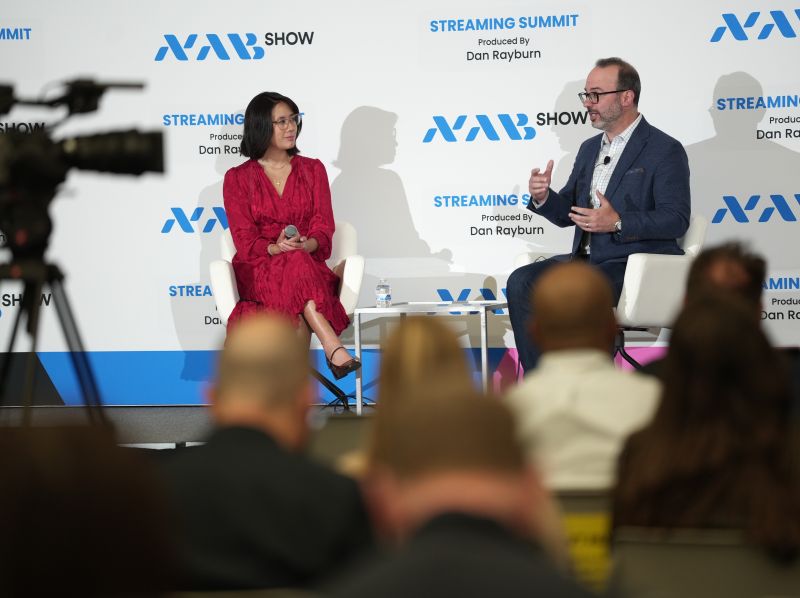
At the NAB Streaming Summit on April 20, 2026, Robert Schildhouse, CEO of BBC Studios’ DTC business, discussed the strategic evolution of streaming and the specific success of BritBox. Schildhouse, an industry veteran who helped launch Hulu in 2008, outlined how his division prioritizes a “durable and profitable” business model over the high-volume, “grow-at-all-costs” strategy popularized by Netflix. Unlike general entertainment platforms aiming for 200 million global households, BritBox focuses on a disciplined, niche approach, which some might call the “Anti-Netflix” model. Some of Robert’s key takeaways on the business included: Profitability Over Scale: BritBox prioritizes profit margins and lifetime customer value over sheer subscriber counts Distinctive Content Lanes: BritBox leans into specific British genres that resonate with American audiences, particularly mysteries, crime, and period dramas Retention vs. Hits: Instead of relying on a single quarterly “mega-hit” to drive sign-ups, the service focuses on its “deep cannon” of thousands of hours of programming to keep users engaged long-term Schildhouse highlighted the successful launch of BritBox Premier, a premium tier that offers 4K quality, early access to shows, mobile downloads, and documentaries from BBC Select. Though launched with little fanfare, it already represents over 10% of its own-and-operated subscribers. An interesting stat Robert gave out was that 50% of BritBox’s direct subscribers are on annual plans. These users are worth more than twice as much as monthly subscribers, given their significantly higher tenure and lower churn. BritBox’s audience leans older and more female, a segment Schildhouse describes as more loyal and less prone to “serial churn” than younger viewers. Marketing efforts are highly specific: while a general viewer might not see BritBox ads, target demographics are “overwhelmed” by them across TV and social media to keep the service top-of-mind. Robert also teased the May 6 release of The Other Bennet Sister (a Pride and Prejudice spin-off), which he views as a major “on-ramp” for reaching broader female audiences. Schildhouse strongly believes the industry’s future lies in aggregation and bundling, not fragmentation. BritBox is actively experimenting with bundles—having already partnered with Starz, MGM+, and Hallmark—to introduce the service to unique, adjacent audience profiles. My thanks to Robert for speaking at the NAB Show Streaming Summit and giving everyone an update on BritBox’s business and market strategy. My apologies that his fireside chat is not available on demand; we had a technical issue with the recording. The rest of the presentations from the show can be seen here.
-
Netflix Announces Its Ad Tier Now Has More Than 250 Million Monthly Active Users
At its UpFronts presentation, Netflix announced it has more than 250 million monthly active users (not subscribers) on its Standard With Ads plan, up from 190 million in November of 2025. During...
General Source
At its UpFronts presentation, Netflix announced it has more than 250 million monthly active users (not subscribers) on its Standard With Ads plan, up from 190 million in November of 2025. During Netflix’s Q1 earnings, the company said 60% of new Netflix customers now choose the ad plan, and a new stat from the UpFronts also showed that more than 80% of ad-supported viewers sign in to Netflix weekly. In its Q1 earnings report, Netflix noted its ad business is expected to double this year, reaching $3 billion in revenue. In a letter to shareholders, the company noted that building the ads business has been a priority and that Netflix now works with over 4,000 advertisers, up 70% year over year. The 250 million number is not the number of subscribers on its Standard With Ads plan. Netflix uses its own data, not a third-party, to calculate monthly active users as everyone in a household who watches more than one minute of ads on the service each month. Starting next year, Netflix will also launch the ad-supported plan in 15 more countries: Austria, Belgium, Colombia, Denmark, Indonesia, Ireland, the Netherlands, New Zealand, Norway, Peru, the Philippines, Poland, Sweden, Switzerland and Thailand.
-
BitMar Is A Scam, Don’t Sign up For It: All Content Can be Found for Free Online
A company called BitMar, which promises to “stream everything legally,” is scamming people out of $150 by linking to free YouTube content via Bing search and Pluto TV. The CEO reached out,...
General Source
A company called BitMar, which promises to “stream everything legally,” is scamming people out of $150 by linking to free YouTube content via Bing search and Pluto TV. The CEO reached out, offering me a “personal lifetime membership” and hoping I would “inform my audience” about the service. I’ll be happy to inform them. Stay away from BitMar! While the company doesn’t say it streams content from the major OTT platforms, it still uses their name in its marketing, saying: “BitMar provides easy access to more movies, and TV shows, than: Cable, Satellite, Netflix, Disney Plus, Max/HBO Max, Amazon Prime Video, Apple TV+, Peacock, and Hulu combined, and more songs, than: Pandora, Spotify, Amazon Prime Music, and Apple Music—combined.” As expected, all of its recent reviews on the Google App Store are 1-star. Google shouldn’t allow this type of app in the store; Apple doesn’t. The fine print on BitMar’s site makes for a good laugh. “Some content may be internationally restricted. Not all content is free and/or accessible. We have a no-refund policy.” If you are a consumer reading this post, do not pay for this service.
-
Getting Started with Wait and Save service-managed fleets on AWS Deadline Cloud
Visual effects and animation studios can accelerate creative iterations and explore more rendering options with AWS Deadline Cloud, a fully managed service that simplifies render management for...
General Source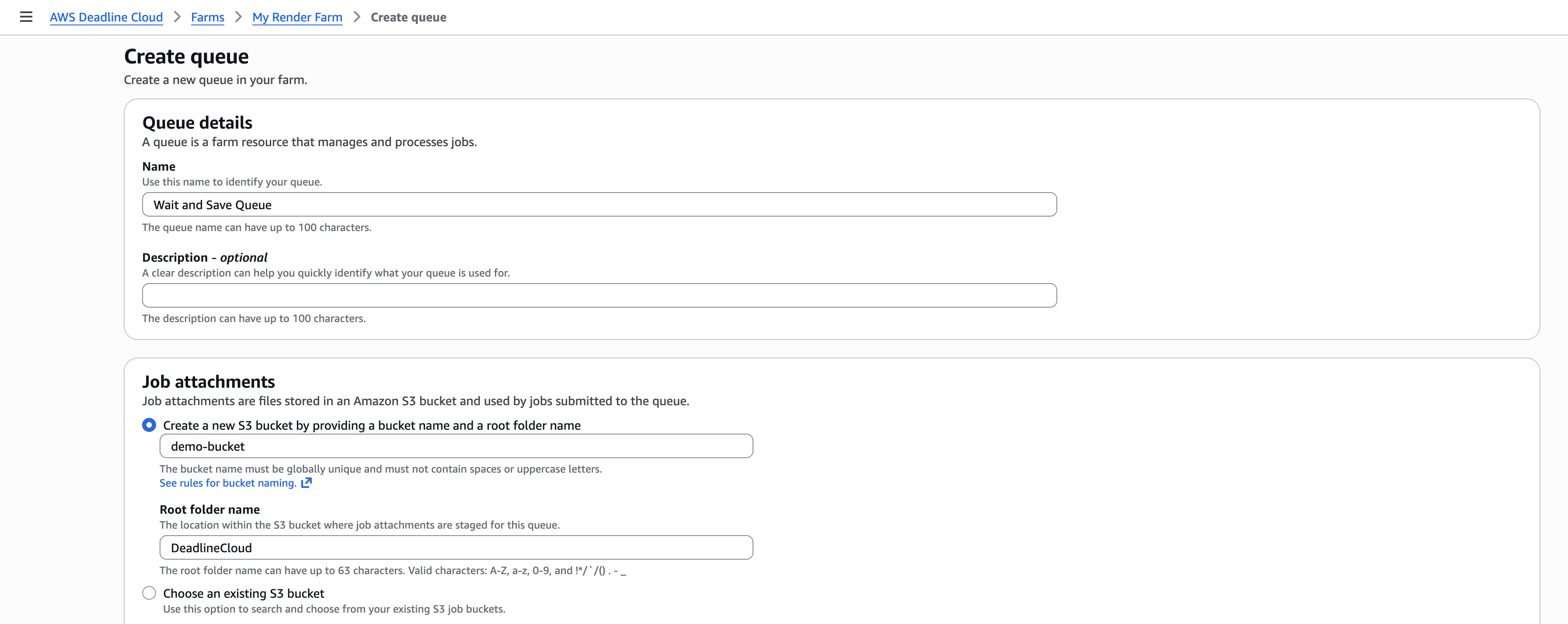
Visual effects and animation studios can accelerate creative iterations and explore more rendering options with AWS Deadline Cloud, a fully managed service that simplifies render management for teams creating computer-generated 2D and 3D graphics and visual effects. Deadline Cloud offers service-managed fleets, where AWS automatically provisions and manages compute resources to simplify infrastructure management. Wait and Save, now available for service-managed fleets on Deadline Cloud, offers discounts on CPU rendering compute rates in exchange for flexibility in job scheduling times. This post shows how to configure Wait and Save for service-managed fleets on Deadline Cloud to reduce CPU rendering costs. We will cover the following topics: Understanding service-managed fleet capacity fulfillment Setting up a dedicated Wait and Save queue and fleet for maximum cost savings Comparing costs across Wait and Save, Spot, and On-Demand fleets Monitoring job status, wait times, and cost tracking in Deadline Cloud Monitor Automating capacity management for a hybrid fleet setup with Wait and Save and Spot fleets for capacity and cost optimization Understanding service-managed fleet capacity fulfillment Deadline Cloud service-managed fleets can acquire Amazon Elastic Compute Cloud (Amazon EC2) instances through two primary methods: On-Demand Instances and Spot Instances. On-Demand Instances provide reliable compute capacity, making them ideal for workloads that require consistent, uninterrupted processing. With Spot Instances, you can take advantage of unused Amazon EC2 capacity at steep discounts compared to On-Demand prices—often up to 90% savings. This capacity becomes available when AWS has unused compute resources across its data centers. Workloads on Spot Instances might be interrupted to supply On-Demand requests. Wait and Save uses excess CPU Spot capacity by offering discounted compute rates in exchange for flexibility in when your rendering jobs start. By allowing Deadline Cloud to use periods of higher Spot capacity availability, you can achieve significant cost savings while maintaining the quality and throughput of your rendering workloads. For current pricing details, see AWS Deadline Cloud pricing. Smart scheduling with Wait and Save The following are key optimization factors to improve capacity and pricing: Time of day – Customer usage patterns typically align with the cyclic working hours of the day—namely greater capacity availability in evenings and early mornings. Submitting jobs during off-peak hours offers faster capacity availability. Regional strategy – Consider submitting jobs to an AWS Region where it’s currently outside of business hours. For example, if you’re working during the day in the US, a Region in a different time zone might have more capacity available at that time. When using different Regions, ensure compliance with your organization’s data governance and residency requirements. By submitting jobs during off-peak hours or selecting different Regions, you can increase your access to available Wait and Save capacity and benefit from its pricing. A straightforward way to use Wait and Save is with dedicated queues that map exclusively to Wait and Save fleets. In the following sections, we walk through the basic setup for Wait and Save fleets, demonstrate the cost savings, and show how you can integrate Wait and Save fleets with your existing EC2 Spot or On-Demand fleets. Prerequisites Before you begin, verify that Wait and Save aligns with your workload requirements and you have the necessary AWS resources configured. Wait and Save supports the following workloads: CPU-based rendering workloads only (GPU not supported) Projects with flexible scheduling requirements Workloads that can accommodate variable start times Key limitations to consider: Instance type selection – Wait and Save automatically selects from CPU instance types that match your capability requirements. You can’t specify exact instance types. Wait times – Jobs typically start within 24 hours. Actual wait times vary based on Region, time of day, and available capacity. Interruptions – Workers might be interrupted to fulfill On-Demand requests. Interrupted tasks restart from the beginning. Ensure you have the following required AWS resources in place: An AWS account to use Deadline Cloud The Deadline Cloud monitor set up in the Region of your choice, including: A Regional AWS IAM Identity Center for your user A monitor URL A farm to which you want to configure your Wait and Save fleet (or use the Quickstart guide to provision these resources if this is your first time using Deadline Cloud) A supported Digital Content Creation (DCC) application with the corresponding Deadline Cloud submitter installed Create dedicated queue Complete the following steps to create a dedicated queue: On the Deadline Cloud console, choose Farms in the navigation pane. Choose your farm from the farms list. On the Queues tab, choose Create queue. Configure the queue settings (see Deadline Cloud queues for additional options): For Queue name, enter a descriptive name (for example, Wait and Save Queue). For Job attachments, configure your Amazon Simple Storage Service (Amazon S3) bucket for job attachments. Choose Create queue. Figure 1: Create a queue specifically for Wait and Save fleets Create Wait and Save fleet Complete the following steps to create a Wait and Save fleet: On the Deadline Cloud console, choose Farms in the navigation pane. Choose your farm from the farms list. On the Fleets tab, choose Create fleet. Configure the fleet details: For Fleet name, enter a descriptive name (for example, Wait and Save Fleet). For Fleet type, select Service-managed. For Instance market type, select Wait and Save. Choose Next. Figure 2: Select service-managed fleet type and Wait and Save instance market type Define the hardware and software requirements for your fleet. You don’t need to select specific EC2 instance types—Wait and Save automatically pulls from a range of instance types that match your criteria. For Amount vCPU, enter the minimum and maximum vCPU count (for example, 4–16). For Amount memory (GiB), enter the minimum and maximum memory (for example, 32–64). Choose Next. Set Maximum worker count based on your workload needs. The default quota is 50 Wait and Save vCPUs per Region. Quotas help facilitate responsible resource usage and cost management. To support larger production workloads, request a quota increase for Wait and Save vCPUs per Region for Deadline Cloud. See the Service Quotas User Guide for instructions on requesting quota increases. Choose Next. For Associate queues, associate the Wait and Save fleet with the queue you created earlier. Choose Next. Figure 3: Associate the Wait and Save queue with the fleet Set up additional configurations and tags (optional), then choose Next. Review and choose Create fleet. Submit job to Wait and Save queue To demonstrate Wait and Save in action, we will submit a 200-frame turntable render. This example uses Autodesk Maya with the Deadline Cloud submitter, though the submission process works similarly with other supported DCCs. Save your Maya file. In Maya’s shelf, choose Deadline Cloud to open the submitter. In the Shared job settings section: For Farm Selection, choose the farm that contains your Wait and Save queue. For Queue Selection, select the Wait and Save queue you created. Choose Submit and follow the prompts to send your job to Deadline Cloud. Figure 4: Maya Deadline Cloud submitter configured with the dedicated Wait and Save queue Monitor job status and costs in Deadline Cloud Monitor Track the job in the Deadline Cloud Monitor to observe the following: Job status – Track when the job transitions from Ready to Running as Wait and Save capacity becomes available. You can configure Amazon EventBridge notifications for job start and completion to get updates on your job when you’re away from your desk. See Job Run Status Change event for more information. Wait time – Monitor the duration between job submission and when it starts running. Wait and Save times can vary based on time of day, Region, workload size, and fleet configuration. Typically, wait times are less than 24 hours. As shown in the following screenshot of the job’s Create time to Start time details in the job monitor, the job took approximately 7 hours to start running. Figure 5: Job monitor shows when the job was created, started, and ended Interruption handling – If interrupted, incomplete tasks will restart from the beginning; interrupted workers will be replenished from other available instance types, provided resources are available. For short tasks, this typically has minimal impact, but longer-running tasks might lose progress. Usage and cost tracking – Use the Deadline Cloud usage explorer to compare costs against Spot or On-Demand pricing and track runtime patterns. With a dedicated Wait and Save queue, the queue filter shows hourly usage patterns indicating when jobs are running, waiting, or being interrupted. Figure 6: This usage explorer view demonstrates dedicated queues created for each market type with identical job submissions. The hourly interval setting shows when the jobs ran. Dedicated Wait and Save setup cost savings Let’s examine the cost impact of the 200-frame Maya turntable render we submitted in our example. To demonstrate the true savings potential, we created dedicated queues for each market type fleet with identical worker capabilities and ran the same Maya job on Wait and Save, Spot, and On-Demand fleets. Running our 200-frame Maya turntable render on all three market types reveals significant compute cost differences, as shown in the following table. For this single job, Wait and Save yielded 92% savings vs. Deadline Cloud’s On-Demand and 78% savings vs. Deadline Cloud Spot. Service-Managed Fleet Market Type Compute Cost License Cost Total Rendering Cost for 200-Frame Maya Job On-Demand $2.09 $2.86 $4.95 Spot $0.76 $2.04 $2.80 Wait and Save $0.17 $2.18 $2.35 Figure 7: Total compute and licensing cost for our 200-frame Maya turntable render on each market type: On Demand (left), Spot (center), and Wait and Save (right). Figure 8: Total Cost breakdown for each market type from Deadline Cloud Monitor usage explorer. Automated hybrid fleet setup for capacity and cost optimization When you need higher capacity availability for your jobs, but want to capture cost savings when possible, you can associate Wait and Save alongside your current Spot and On-Demand fleets in the same queue. This automatically balances cost optimization with capacity availability, so your jobs run without delay. The following open source AWS CloudFormation template uses AWS Lambda and Amazon EventBridge Scheduler to automatically adjust Spot fleet capacity based on real-time Wait and Save worker availability. The Lambda function will monitor your desired fleet size at regular intervals, fulfilling your desired fleet size of workers from the Wait and Save fleets primarily, but covering deficits by adding instances from a secondary Spot Fleet. Because the Deadline Cloud worker termination policy is derived at the worker level, instances will only be terminated upon completion of tasks, so your fleets balance for their most cost-effective configuration, without any loss of rendering. To deploy automated capacity management, complete the following steps: Associate the Wait and Save fleet with your existing queue alongside On-Demand or Spot fleets. Configure your Wait and Save fleet’s maxWorkerCount to your desired total fleet size (for example, 20 workers across both fleets). Download the CloudFormation template and follow the deployment instructions in the README with the following parameters: TargetMaxWorkerCount: Total workers across both fleets (must match Wait and Save maxWorkerCount) FarmId: Your Deadline Cloud farm ID WaitAndSaveFleetId: Your Wait and Save fleet ID SpotFleetId: Your Spot fleet ID CapacityCheckRateMinutes: Interval between capacity checks (default: 2 minutes) The Lambda function will automatically scale your Spot fleet up or down to maintain your desired total capacity as Wait and Save workers come online or go offline. As with many AWS services, Lambda has a pay-as-you-go cost, starting at $0.20 per 1 million requests, making it a cost-effective solution to quickly establish code-based automation within you AWS environment. When you’re not actively rendering, you can disable the EventBridge schedule to stop the automated capacity management and Lambda invocation costs. You will not incur rendering costs because the minimum worker count is set to 0 in the fleet configurations, which means no workers will start without jobs. Clean up If you no longer need the resources created in this post, follow these steps: Open the CloudFormation console in your AWS account. Search for the stack you created while following this post. Choose Delete the stack and wait for the status to change to DELETE_COMPLETE. This will delete the Lambda function, EventBridge schedule, and IAM role from your account. To delete your Deadline Cloud resources (farm, fleets, queue, and more), refer to Clean up your farm resources in Deadline Cloud. Conclusion Wait and Save offers substantial cost savings for flexible CPU rendering workloads, as shown in our Maya example with 78% savings with dedicated Wait and Save setup compared to Spot pricing. Whether you use dedicated queues for maximum savings or hybrid fleet setups for flexible execution, Wait and Save can significantly reduce your rendering costs. These savings add up quickly across larger projects, helping studios render more content within their budgets. Contact an AWS Representative to learn how we can help accelerate your business. Further reading Now that you have set up Wait and Save fleets and seen the cost savings, continue learning about Deadline Cloud features to further optimize your rendering workflows: Learn about other fleet types and configurations to optimize your rendering pipeline. Explore Service-managed fleets for advanced configuration options. Review detailed pricing information and Regional rates for Wait and Save compared to other instance market types on the AWS Deadline Cloud pricing page. Learn more about setting up automated notifications for job status changes using EventBridge integration for job run status events to get alerts when your Wait and Save jobs start or complete. To learn more about tracking costs and analyzing usage patterns, see Track usage and costs with the Deadline Cloud usage explorer. Explore more open source samples for CloudFormation templates provided by Deadline Cloud.
-
From 40 Seconds Behind to Broadcast-Level: Getting Low Latency Right for Global Live Sports
A viewer’s neighbour cheers. Four seconds later, the goal lands on screen. That gap is tolerable. Thirty seconds later? The match is already being discussed on social media before your stream...
General Source
A viewer’s neighbour cheers. Four seconds later, the goal lands on screen. That gap is tolerable. Thirty seconds later? The match is already being discussed on social media before your stream catches up. For live sport on OTT, latency is the difference between a viewing experience and an information delay. The 2026 global football tournament will take place across the US, Canada, and Mexico: 104 matches over 39 days, the largest live sporting event ever staged. For every broadcaster and streaming service delivering coverage, this is the highest-stakes latency test OTT has faced. The margin for error is measured in seconds, and the audience will notice. Traditional OTT pipelines add delay at every stage The latency problem in OTT streaming is structural. Each stage of a traditional workflow contributes its own delay, and the total compounds quickly. Encoding typically adds 1-2 seconds. Packaging contributes 5-10 seconds. CDN propagation adds several hundred milliseconds. Player buffering, designed to smooth out network variability, accounts for the largest single chunk: 15-20 seconds. Add it all up and you reach 30-40 seconds of end-to-end delay. For a news broadcast or a drama series, 30 seconds behind live is invisible. For football, it breaks the product. Social media spoilers arrive before the goal. Betting markets move before the replay. A second-screen companion app showing live stats desynchronises from the video feed. The experience fragments. Fixing any single stage in isolation makes only a marginal difference. Cutting encoder latency from two seconds to one still leaves 28 seconds of delay elsewhere in the chain. The problem demands an end-to-end approach where every stage of the pipeline is optimised together. Encoder latency can drop to two seconds without sacrificing quality Ateme’s TITAN Live is a 7th-generation software encoding engine that supports H.264, HEVC, AV1, and VVC across HD, 4K/UHD, and HDR formats including Dolby Vision, HDR10+, and HLG. It offers five configurable latency modes, ranging from a standard broadcast setting down to an Ultra Low mode that contributes around two seconds of encoder delay. The critical design choice in TITAN Live is its CMAF (Common Media Application Format) output. Rather than producing traditional 2-10 second segments, TITAN generates chunks of a few hundred milliseconds each. These sub-second chunks are the foundation of the low-latency pipeline: smaller chunks mean the packager and player can begin processing sooner, and the cumulative delay drops at every downstream stage. TITAN’s ingest interface to the packager is HTTP-based, using CMAF Ingest, which makes it cloud-friendly by design. The encoder is pure software, hardware-agnostic, and runs on bare metal, virtualised, or cloud-native infrastructure. Operators who already have a preferred cloud environment or on-premises setup can deploy TITAN without rearchitecting their infrastructure. For major football event coverage specifically, the codec flexibility matters. An operator serving a mix of legacy set-top boxes (H.264), modern smart TVs (HEVC), and next-generation devices (AV1) can handle all three from a single encoding platform rather than running parallel pipelines. Packaging latency below a single GOP changes the delivery equation Ateme’s NEA Live is a Just-In-Time packager, and its approach to latency is fundamentally different from traditional packaging workflows. Where a conventional packager waits for complete segments before making them available, NEA Live reduces packaging latency to below the duration of a single GOP (Group of Pictures), down to a few video frames. NEA Live supports both major low-latency streaming protocols. For LL-DASH, it uses Chunked Transfer Encoding to deliver data as it becomes available. For LL-HLS, it implements Apple’s full specification: partial segments, byte-range addressing, delta playlists, and blocking playlist responses that allow the player to request the next segment before it exists, reducing round-trip wait times. This protocol coverage has been validated across every major player implementation: Apple’s native player, dash.js, ExoPlayer, Shaka Player, THEOPlayer, VisualOn, NexPlayer, and RxPlayer. Player compatibility is often the hidden bottleneck in low-latency deployments. A solution that works on one player but fails on another creates device-specific quality gaps that are difficult to diagnose in production. On a single node, NEA Live handles up to 200 channels at 2.5 Gbps ingress and 14 Gbps egress, with an 8-hour time-shift buffer and full DRM integration. For a global football tournament deployment where channel counts spike during group stages (multiple simultaneous matches), this density matters for both cost and operational simplicity. CMAF chunk sharing cuts core-to-edge CDN bandwidth by up to 50% One of TITAN Live and NEA Live’s most significant capabilities for large-scale live events is CMAF chunk sharing between HLS and DASH. Both protocol variants, LL-HLS and LL-DASH, point to the same underlying CMAF chunks rather than maintaining separate segment stores. The practical impact: core-to-edge CDN bandwidth reduction of up to 50%, with a corresponding improvement in cache efficiency. When millions of concurrent viewers are hitting the same live feed during a global football tournament knockout match, CDN costs and origin load are the primary scaling constraints. Halving the unique content that needs to traverse the CDN backbone is a meaningful operational and financial advantage. This is a protocol-level efficiency, not a compression trick. The content is identical; the packaging layer avoids duplicating it for each delivery format. Operators serving mixed device populations (some requesting HLS, others DASH) benefit the most, which describes virtually every large-scale OTT deployment. Low latency and dynamic ad insertion: closing the last gap A persistent challenge in low-latency OTT is ad monetisation. Server-side ad insertion typically adds delay that undermines the purpose of a low-latency pipeline, forcing operators to choose between fast delivery and revenue. Ateme is actively working to close this gap. NEA Live’s architecture already supports SCTE-35 splice point management, and the roadmap includes full Dynamic Ad Insertion (DAI) operating at speed within the low-latency workflow. The goal: operators will be able to monetise live sport through targeted ad replacement without adding latency to the viewer experience. For live sports event coverage and beyond, where ad revenue during live matches represents a significant portion of the total commercial return, this capability will be a meaningful differentiator. Operators currently have to choose between latency and monetisation. Eliminating that trade-off is one of the most commercially significant problems left to solve in low-latency OTT delivery. Production deployments validate the numbers Lab benchmarks are useful for setting expectations, but production results on real audiences are what matter. Several operators have deployed Ateme’s low-latency pipeline and published their results. Canal+ delivers HD and UHD sports streaming through its myCanal app with near-zero perceptible delay compared to broadcast. For a premium sports broadcaster, this is the standard their subscribers expect: OTT that matches the satellite experience. CYTA in Cyprus achieved sub-four-second latency across 20 premium OTT channels. The deployment was completed in under three months, including full integration with existing infrastructure. For operators concerned about deployment timelines ahead of the global football tournament, this is a relevant reference point: June 2026 is weeks away, not months. ClicTV in Spain reduced its end-to-end latency from 50 seconds to 10 seconds, a 5x improvement that moved the service from unwatchable-for-live-sport to competitive. Tivify used Ateme’s CMAF encoding to stream the Champions League final at broadcast-level latency for the first time on its platform. These are production services running on real audiences, not controlled demonstrations. The combined solution of TITAN Live encoding and NEA Live packaging delivers 3-5 seconds of end-to-end latency using standards-based LL-HLS and LL-DASH protocols. What these deployments also demonstrate is speed of execution. CYTA went from contract to live service in under three months. Ateme operated as a hands-on integration partner throughout, working alongside the operator’s engineering team to configure, test, and launch. That deployment model, where Ateme brings both the technology and the implementation expertise to get it running in production, is what makes a compressed timeline realistic rather than aspirational. Ateme has its solutions deployed in over 100 countries. That breadth of operational experience across different configurations, device populations, and regulatory environments means fewer surprises during integration. When an operator encounters an edge case in player behaviour or CDN caching, the likelihood is that Ateme’s engineering team has already seen and resolved it in a prior deployment. Low latency alone does not solve everything An honest assessment: latency is necessary but not sufficient for a competitive live sports event streaming experience. Viewers also expect reliability under peak concurrent load, consistent video quality during network congestion, and fast channel switching between simultaneous matches. Low-latency streaming can make some of these harder. Smaller chunk sizes and reduced buffering leave less room for the player to absorb network jitter. ABR (Adaptive Bitrate) algorithms need to be tuned differently for low-latency modes, because the buffer reservoir they rely on for quality decisions is shallower. Operators deploying low latency for the first time should expect to invest in player-side tuning and CDN configuration, not only in the encoding and packaging pipeline. The protocols themselves are also still maturing. LL-HLS and LL-DASH are standardised, but player implementations vary in their handling of edge cases: playlist request timing, partial segment reassembly, and failover behaviour under packet loss. Testing across the full device matrix is essential, and the validation work Ateme has done across eight major player implementations reduces but does not eliminate this risk. None of this diminishes the value of a 3-5 second end-to-end pipeline. It means operators should plan for integration and testing time alongside the technology deployment itself. The largest OTT live sport test ever staged 104 matches. 39 days. Three host countries across multiple time zones. Peak concurrent viewership numbers that will exceed anything OTT has handled for a single event. The operators who deliver broadcast-level latency on OTT will keep viewers on their platform through the full 90 minutes and beyond. Those running 30 seconds behind will lose them: to broadcast, to social media spoilers, or to a competing service that solved the problem. The technology exists today, is standards-based, and is running in production. CYTA’s deployment took less than three months from start to live service. With June weeks away rather than months, that timeline still works, but the window is narrowing. Ateme’s track record of rapid, solution-centric deployments across 100+ countries means operators who act now can be live before the opening whistle. Explore related insights NEA CDN & Video Delivery OTT Streaming Solutions Sports & Live Events Solutions About the Author Mark Haines CDN Product Manager & OTT Streaming Solutions Manager at Ateme Mark brings 18+ years of experience in OTT streaming & Content Delivery Networks. With a background spanning product management, solution architecture, and business development, he helps content owners, telcos & network operators navigate modern streaming infrastructure, from CDN strategy and live video delivery to cloud-native OTT platform design. At Ateme, Mark leads product direction for the NEA CDN portfolio and drives OTT & streaming solution strategy for major telcos and network operators worldwide, having previously spent 5 years as a Global Solution Architect. Prior to Ateme, he held solution architecture and business development roles at Velocix, part of Nokia/Alcatel-Lucent’s IP Video division. L’article From 40 Seconds Behind to Broadcast-Level: Getting Low Latency Right for Global Live Sports est apparu en premier sur Ateme.
-
Wall Street Doesn’t Understand the CDN Business, What AI Agentic Traffic Is, and How Bits are Delivered
Fastly’s stock was down 40% on Thursday, May 7th, one day after its Q1 earnings report, with Piper Sandler saying, “The disappointment was in the core delivery business that saw lower...
General Source
Fastly’s stock was down 40% on Thursday, May 7th, one day after its Q1 earnings report, with Piper Sandler saying, “The disappointment was in the core delivery business that saw lower quarter-over-quarter volumes than most were expecting, as pricing remained stable.” Who’s most, and why were they expecting something different? If you talk to customers, which Wall Street doesn’t, in particular, the large ones, none of them are seeing delivery volumes accelerating faster than projected. These large customers matter most to Fastly, as its top 10 customers accounted for 34% of revenue in Q1. Customers have optimized their encoding, overall bitrates have gone down, and 4K traffic accounts for 1-2% of all bits delivered across CDNs and isn’t growing. There is no catalyst in the market for Wall Street to expect volume increases quarter-to-quarter, outside of a CDN winning a new contract(s). Another Wall Street firm, KeyBanc Capital Markets, had been bullish on the potential for “agentic use of the internet and web applications to drive CDN traffic higher.” That statement demonstrates no understanding of delivery technology, the scale of traffic requests, and how content is delivered. Agentic traffic refers to traffic generated by autonomous AI agents. AI agents are not watching videos from streaming services or downloading large software files, which account for the largest majority of the bit volume for a CDN vendor. Anything an AI agent does, such as requesting information from a website, accounts for a very small volume of data per request. As of late 2024–2025, the average home page size is approximately 2.1 MB, according to HTTP Archive. A 30-minute video streamed at 6 Mbps averages 2.7 GB of data delivered. The video delivers 1,200 times as many bits as a webpage, or 2,400 times more for a 60-second video. Before earnings, year-to-date, Fastly’s stock was up 210%, and it rallied 19% ahead of earnings. Even with the stock down 40% as of 2:35pm ET, it’s still up 212% in the past year. While Fastly raised its full-year 2026 revenue guidance to $710-$720 million, the midpoint was below Wall Street’s $716 million estimate. That, plus Fastly’s Q2 revenue guidance of $170-176M, which would be mostly flat from Q1, would be a realistic explanation for the stock’s decline. Anyone on Wall Street expecting an acceleration in bit delivery within the CDN product bucket clearly doesn’t understand the market conditions, pricing, contract terms, commitments, or size of files delivered. And yet, so many public data points exist, many from the CDNs themselves, that Wall Street misses. Disclaimer: I have never bought, sold or traded shares in any public CDN vendor, nor do I own any shares in any private CDN vendor.
-
Emerging Markets for Video and Video Codecs
Executive Summary Most codec discussions orbit a familiar set of markets—consumer streaming, broadcast contribution, video conferencing—where the economics are well understood and the roadmaps...
Entertainment SourceExecutive Summary Most codec discussions orbit a familiar set of markets—consumer streaming, broadcast contribution, video conferencing—where the economics are well understood and the roadmaps relatively stable. But a growing share of the world’s video bits flow under constraints those markets don’t share: feeds that no human ever watches, downlinks measured in kilobits per second, latency budgets shorter than a frame, and certification cycles measured in years. The codec choices that make sense for Netflix don’t necessarily make sense for an autonomous vehicle, a LEO satellite, or a tactical drone link. This article surveys eight of those markets: video coded for machines rather than people, spatial and volumetric media, enterprise XR, remote healthcare and telesurgery, cloud gaming, defense ISR, LEO Earth observation, and AI-based neural video compression. Each has a different dominant codec today, a different near-term standardization story, and a different answer to where AI fits—whether as a consumer of video, an optimization target inside the codec, or both. Taken together, they sketch the corners of the codec landscape where the next wave of disruption is most likely to come from. Figure 1. Video Coding for Machines standards cover technologies used to compress video primarily consumed by machines. Image from this InterDigital article. 1. Video for Machines (VCM / FCM) Overview This is arguably the most structurally disruptive development in codec technology in the MPEG age. The fundamental premise shifts: instead of compressing video so a human viewer can reconstruct a perceptually faithful image, machine-oriented codecs discard everything irrelevant to the downstream AI task (object detection, tracking, classification) and transmit only task‑relevant features. MPEG has two parallel standardization efforts under the MPEG‑AI umbrella (ISO/IEC 23888): VCM (Video Coding for Machines): A traditional pixel‑domain codec, but optimized for machine analysis rather than human perception. The output remains a playable video stream, but coding decisions are guided by machine‑vision metrics such as mAP and MOTA instead of PSNR or VMAF (MPEG VCM overview). FCM (Feature Coding for Machines): Compresses intermediate neural‑network features rather than pixel data, enabling collaborative intelligence (split inference between camera and cloud). Recent work on the Feature Coding Test Model shows average bitrate reductions on the order of 85% compared to pixel‑domain baselines while preserving task accuracy across multiple vision workloads. At the 153rd MPEG meeting in early 2026, MPEG reported that Video Coding for Machines (ISO/IEC 23888‑2) had progressed to Draft International Standard (DIS) status, with Feature Coding for Machines following on a similar timeline toward DIS and Final Draft International Standard stages (ISO/IEC 23888‑2 project). In practice, this means that “video for machines” is transitioning from exploration to a stable, referenceable standard. Complementary research from Florida Atlantic University investigates new VVC profiles targeting Feature Coding for Machines, showing that lightweight VVC configurations can significantly accelerate feature compression while maintaining near‑baseline machine‑task accuracy. FAU has also demonstrated a standards-aligned real‑time FCM implementation, described in their FCM‑RT paper and in a detailed article on real‑time feature coding for machines. Here’s a YouTube video by the author that describes Feature Coding for Machines as impliemented by FAU. Sub‑markets Autonomous Vehicles: Autonomous‑vehicle development generates petabyte‑scale video datasets. In 2026, Beamr and dSPACE announced that a joint workflow for autonomous‑vehicle video achieved a 31% reduction in file size compared to a high‑quality baseline encode, and about 97% reduction versus uncompressed video, while maintaining mean Average Precision (mAP) within a narrow tolerance band (secondary report). For in‑vehicle teleoperation (remote driving), DriveU.auto reports that adding AV1 support on NVIDIA Jetson Orin delivers about 30% higher compression efficiency than HEVC at equal quality, which is critical for low‑latency operation over constrained cellular links. For in‑sensor and ADAS pipelines, JPEG XS (ISO/IEC 21122) is gaining traction as a visually lossless, ultra‑low‑latency option. The JPEG committee and subsequent technical papers report that JPEG XS is designed for end‑to‑end latencies well below a frame (often a few lines), with implementations achieving sub‑millisecond codec latency in automotive and professional video applications (intoPIX JPEG XS overview, coding techniques paper), making it suitable for camera‑to‑processor links where frame‑level delays are unacceptable. Smart Cities / Intelligent Transportation: In smart‑city deployments, large numbers of surveillance cameras feed analytics systems for traffic management, safety, and law enforcement, often with minimal human viewing. MPEG’s VCM documents explicitly highlight city‑wide camera networks and video analytics as primary target applications. While traditional video encoders remain a multi‑billion‑dollar market segment dominated by H.264 and HEVC, recent video encoder market reports note that surveillance and security are among the largest application categories and are expected to continue growing alongside AI‑driven analytics demand. Drones / UAVs: Drone swarms and persistent ISR (intelligence, surveillance, reconnaissance) platforms face severe bandwidth and power constraints on RF links. FCM is directly applicable here: both machine‑to‑machine coding surveys and feature‑coding research describe UAVs and drones as primary use cases for split inference, where only compressed features are transmitted from the drone to a ground‑based model. The defense tactical video data link market, which includes drone video feeds, is estimated at USD 4.81 billion in 2025 and projected to reach USD 7.23 billion by 2030 at a CAGR of 8.49%, providing a natural budget line for FCM/VCM‑style technologies once they mature. Industrial Machine Vision / IIoT: Factory automation, quality inspection, and robotic systems increasingly run vision inference at the edge. The industrial edge market, which includes edge servers, gateways, and compute platforms for these workloads, was valued in the low‑twenties billions in the mid‑2020s and is projected to roughly double by 2030, with CAGRs in the low‑ to mid‑teens depending on the definition. These systems need codecs that minimize latency and power consumption on constrained hardware, a role well‑suited to JPEG XS today and, over time, to VCM‑style machine‑centric coding as standards and silicon support become widely available. 2. Spatial / Immersive / Volumetric Video Figure 2. Market estimates for immersive video should be viewed in the context of Apple’s recent move. Overview The first wave of consumer spatial computing headsets (Apple Vision Pro, Meta Quest 3) demonstrated what spatial codecs can do, but the device market has already hit a correction. Reports indicate that Apple has effectively stopped work on future Vision Pro hardware after weak sales and high return rates, even as it continues to support the existing device in software, and Meta’s Reality Labs division has accumulated tens of billions of dollars in losses while Quest shipments declined in 2025. Despite this retrenchment, the underlying spatial media pipeline continues to evolve. Apple now records spatial video in MV‑HEVC on iPhone 15 Pro and plays it back on Apple Vision Pro, and Meta has added native support for this format on Quest headsets so it can play Apple’s spatial video without transcoding. On the enterprise side, XR for training, design, and remote assistance is still a growth area, with market studies for XR and industrial metaverse consistently projecting high‑double‑digit CAGRs into the early 2030s despite differing scopes. Codec Landscape MV‑HEVC (Multiview HEVC): Apple’s spatial video format, which is used natively in iPhone 15 Pro capture and Apple Vision Pro playback, is based on an MV‑HEVC representation. Apple’s documentation describes spatial video as “recorded in the MV‑HEVC format,” storing stereoscopic views in separate HEVC layers, and coverage of Meta’s roadmap confirms that Quest now natively supports Apple’s MV‑HEVC spatial video rather than requiring transcoding. V‑PCC / G‑PCC (MPEG‑I Point Cloud Compression): MPEG’s point cloud compression standards address volumetric and point cloud media. Unified overviews of V‑PCC and G‑PCC highlight that V‑PCC (Video‑based Point Cloud Compression) projects dense point clouds into atlases and compresses them with a conventional video codec, while G‑PCC (Geometry‑based Point Cloud Compression) targets sparse point clouds such as LiDAR scans. V‑PCC is explicitly video‑codec agnostic, so it can reuse existing HEVC decoders today and migrate to AV1 or VVC in the future, and is positioned for volumetric capture of real‑world scenes for VR/AR, telepresence, and digital twins. Radiance Fields (NeRF / 3D Gaussian Splatting): JPEG and MPEG have recognized that radiance field representations (including Neural Radiance Fields and 3D Gaussian Splatting) are emerging as a distinct class of visual media that requires dedicated compression and interoperability standards. A joint JPEG/MPEG workshop on radiance fields and related announcements notes that both committees see a need for standardized coding of radiance fields to enable interoperable applications and services. Independent coverage reiterates that these techniques have advanced rapidly but face challenges around data size and interoperability, creating a clear standardization opportunity. AI‑based point cloud coding is also within the scope of MPEG‑AI, which explicitly includes machine‑centric coding tools for non‑traditional visual data such as point clouds and volumetric captures alongside VCM and FCM. 3. Enterprise XR / Industrial Metaverse Figure 3. Industrial applications for VR, like digital twins, are projected to dramatically increase in value. The industrial metaverse, including digital twins, collaborative XR for manufacturing, and large‑scale industrial simulation, remains a significant adjacent market even as consumer XR cools. A ResearchAndMarkets summary reports that the global industrial metaverse market was valued at USD 34.44 billion in 2024 and is expected to reach USD 181.04 billion by 2030, implying a CAGR of roughly 32% from 2025 to 2030. A separate analysis from Precedence Research puts the market at USD 24.51 billion in 2024 and projects growth to USD 395.15 billion by 2034 at a CAGR just over 32%, underscoring both the aggressive growth expectations and the variability in definitions. Platforms such as NVIDIA Omniverse provide much of the enabling infrastructure for digital twins and real‑time 3D collaboration, allowing engineers to aggregate 3D data, simulate complex systems, and iterate on designs in a shared virtual space. As these platforms mature, they effectively set expectations for volumetric video and 3D streaming requirements in industrial environments, creating a pull‑through effect for codecs that can handle dense point clouds, radiance fields, and mixed 2D/3D media. In terms of codecs, today’s industrial metaverse stacks are likely to combine conventional streaming formats such as H.264, HEVC, and AV1 for 2D viewports and dashboards with specialized volumetric standards like V‑PCC and G‑PCC for point‑cloud and LiDAR‑style data. In addition, proprietary volumetric codecs like Arcturus’s Accelerated Volumetric Video (AVV) for character and human capture, plus emerging radiance‑field codecs and machine‑centric tools under MPEG‑AI, are positioned to capture a larger role as high‑fidelity digital twins and AI analytics become more tightly integrated. 4. Remote Healthcare / Telesurgery Overview Telemedicine covers synchronous video visits, asynchronous consults, remote monitoring, and increasingly, robot‑assisted interventions and telesurgery. Market studies define it variously as part of a broader telehealth and telemedicine market or as a standalone segment focused primarily on virtual clinical encounters, but all agree that video is a core modality rather than an add‑on. Market projections Across major analyst series, the global telemedicine market is already measured in the tens to low‑hundreds of billions of dollars and is projected to grow rapidly through the 2030s. For example, one forecast estimates that the telemedicine market was USD 141.19 billion in 2024 and will reach USD 380.33 billion by 2030 at a CAGR of 17.55%. Even narrower regional studies (for example, the U.S. telemedicine market alone) show multi‑billion‑dollar baselines and high‑teens to low‑20s growth, underscoring telemedicine’s role as one of the largest “video as core workload” markets in healthcare. Codec story From a codec perspective, most deployed telemedicine and telesurgery systems still rely on H.264/AVC as the primary standard for medical video compression, with controlled studies showing that full‑HD surgical sequences can be encoded at compression ratios on the order of 100:1 to 270:1 while maintaining surgeon‑acceptable quality. Experimental work and comparative evaluations demonstrate that HEVC can deliver higher efficiency than H.264 at similar perceptual scores, and recent image‑coding research suggests that VVC outperforms HEVC on raw medical imagery, but real‑time telesurgery workflows remain heavily biased toward H.264 because of decoder ubiquity and mature, low‑latency implementations. Clinical and engineering studies of telerobotic surgery report that acceptable performance has been achieved at bitrates as low as 8–20 Mbps with end‑to‑end delays under roughly 200–300 ms, confirming that latency and predictability are as critical as compression efficiency for robot‑assisted procedures. Vendors targeting remote healthcare contribution links emphasize ultra‑low‑latency 4K encoders over 5G, and there is growing interest in combining WebRTC‑style transports with sub‑frame‑latency codecs such as JPEG XS (ISO/IEC 21122) for surgical feeds, even though formal clinical standards around JPEG XS deployment in telesurgery are still emerging. 5. Cloud Gaming and Interactive Streaming Overview Cloud gaming moves game rendering into the data center and streams a compressed video feed back to users, turning games into a low‑latency interactive video application. Instead of pushing game binaries to consoles or PCs, providers run GPU instances in the cloud and deliver frames over the network, so latency budgets that were once local (controller → console → TV) now span edge nodes, core networks, and consumer devices. This makes codec choice and encoder implementation central to both user experience and unit economics. Market projections Analyst estimates for the cloud gaming market differ widely, but all agree on rapid growth from a relatively small base. One study from Grand View Research estimates that the cloud gaming market was USD 2.27 billion in 2024 and will reach USD 21.04 billion by 2030, implying a CAGR of 44.3% from 2025 to 2030. A separate analysis from Precedence Research puts the market at USD 3.30 billion in 2024 and projects growth to USD 120.60 billion by 2035 at a CAGR of 43.31%, while another from Stratview Research reports a path from USD 7.7 billion in 2025 to USD 19.7 billion by 2032 at 14.4% CAGR, underscoring both the growth potential and definitional variability. Codec story Figure 4. A useful introductory article for codecs in cloud gaming. From a codec perspective, cloud gaming sits at the intersection of strict latency constraints and high bitrate demand. Industry analyses emphasize that end‑to‑end latency needs to stay below roughly 100–150 ms for experiences to feel responsive, which forces encoders into low‑delay configurations and limits how much buffering can be used to smooth bitrate variations, as discussed by GameBench. In practice, many cloud‑gaming and game‑streaming services still depend heavily on H.264 because of its near‑universal hardware decode support. Public discussions around Xbox Cloud Gaming indicate that H.264 is currently used for most clients, with HEVC and AV1 treated as options for newer hardware rather than baseline requirements. Next‑generation codecs are starting to appear in real cloud‑gaming deployments. NVIDIA’s GeForce NOW has publicly announced that it uses AV1 on supported clients, promising improved quality and lower bitrate compared to its previous H.264 and VP9 encodes, especially when combined with its Reflex latency‑reduction features and Ada‑generation GPUs with AV1 hardware encode, as detailed in NVIDIA’s own AV1 architecture blog. Cloud‑gaming‑focused providers such as Boosteroid also describe AV1 as an emerging option for higher resolutions and bitrates when both server and client hardware support it, with H.264 remaining the default for older devices. Real‑world interactive video services provide additional evidence that AV1 can be practical under cloud‑gaming‑like constraints. Evolution Gaming, for example, has deployed AV1 for live casino streams to reduce bandwidth and improve quality across a large installed base of client devices, as described in their AV1 rollout case study. Taken together, these deployments suggest that AV1 is starting to make inroads into cloud gaming and adjacent interactive video workloads where hardware acceleration is available, while H.264 (and increasingly HEVC) remain essential for broad device coverage and predictable low‑latency performance. 6. Defense and Military ISR Figure 5. A workflow and integrated system components for defense and military applications. Description The defense and military market relies on secure, rugged, low‑latency video for intelligence, surveillance, and reconnaissance (ISR), command and control, and tactical situational awareness. Platforms range from manned and unmanned ground vehicles to naval vessels, aircraft, and dismounted soldiers, all of which depend on reliable video links in contested and bandwidth‑constrained environments. Dedicated tactical video streaming systems and tactical data links form the core transport layer for these video workflows, often operating over RF links where bandwidth and reliability are constant constraints. Projection The tactical video streaming systems market has been estimated at roughly USD 4.2 billion in the mid‑2020s, with robust growth expected as more ISR and situational‑awareness workflows migrate to IP video and high‑resolution sensors, according to a tactical video streaming systems market report. The defense tactical video data link segment is separately estimated at USD 4.81 billion in 2025 and forecast to reach USD 7.23 billion by 2030, reflecting an 8.49% compound annual growth rate driven by upgrades to digital, high‑bandwidth links and the proliferation of unmanned systems, per Mordor Intelligence’s analysis of defense tactical video data links. Codec Story HEVC (H.265) is the dominant codec in many current military encoding platforms, with vendors such as VITEC offering certified, rugged HEVC/H.264 encoders like the MGW Diamond TOUGH and MGW Pico+ TOUGH for naval, airborne, and ground ISR deployments, as described in VITEC’s situational awareness and ISR solution briefs. Soliton Systems and similar vendors also provide ultra‑low‑latency HEVC/H.264 streaming solutions targeted at military and public‑safety use cases, including encrypted, bonded‑link systems for live contribution from vehicles and field units, as outlined in Soliton’s overview of live streaming for military and defense applications. Legacy systems continue to rely heavily on H.264, particularly where backward compatibility with existing receivers and interoperability across coalition partners are more important than bandwidth efficiency, a pattern reflected in broader advanced video coding market reports that show AVC still holding a substantial share of professional and broadcast infrastructure. By contrast, adoption of AV1 in defense has been limited so far due to long platform certification cycles and the lack of widely fielded, certifiable AV1 encoder/decoder silicon in harsh‑environment systems, even as AV1 gains traction in consumer and cloud‑streaming workflows. Looking forward, feature‑ and video‑coding‑for‑machines (FCM/VCM) are natural fits for autonomous defense applications—such as drone swarms and unmanned ground vehicles—where video primarily feeds onboard or remote machine inference rather than human operators. The MPEG‑AI family of standards, which includes Video Coding for Machines and Feature Coding for Machines, explicitly targets machine‑centric coding for analytics and autonomous systems, suggesting a future path where defense ISR pipelines increasingly transmit compressed features or machine‑optimized video rather than purely human‑viewed streams. 7. Satellite and LEO Earth Observation Description The low Earth orbit (LEO) satellite market spans communications, Earth observation, and scientific payloads, with constellations of small satellites providing persistent coverage for remote sensing, connectivity, and surveillance. Earth observation imagery and analytics—covering applications such as agricultural monitoring, change detection, environmental monitoring, and maritime domain awareness—are a major driver within this broader LEO ecosystem, and video from LEO platforms must be compressed efficiently to fit within constrained RF downlink channels and limited contact times with ground stations. Market projections One recent forecast estimates that the global LEO satellite market was valued at approximately USD 7 billion in the mid‑2020s and is projected to grow to USD 15.85 billion by 2035, at an 8.36% compound annual growth rate, driven by communications constellations and Earth observation services. Codec story Codec deployment in satellite video pipelines has historically lagged commercial streaming and broadcast markets because of long hardware qualification cycles and the need for radiation‑tolerant, certifiable components. As a result, H.264 and HEVC dominate many current satellite video payloads and ground segments, since they are supported by space‑qualified encoder ASICs and FPGAs and are already integrated into existing modem and gateway equipment, a pattern that mirrors broader video‑encoder market analyses showing AVC/HEVC entrenched in professional contribution workflows. Fraunhofer’s NESC neural speech codec targets satellite and NTN voice and operates at around 1 kbit/s, with demonstrations over GEO links for direct‑to‑device and in‑vehicle services. Fraunhofer has also previewed NCVC, a neural video codec for video conferencing over narrow‑band LEO links, with a stated operating range of roughly 3–20 kbit/s at 25 fps for smartphone‑to‑satellite video. As operators move toward more flexible, software‑defined satellite platforms and reconfigurable payloads, there is a clearer path to deploying newer codecs on orbit via software update, potentially enabling AV1 or machine‑centric standards such as VCM and FCM in future constellations where link budgets, onboard processing, and ground infrastructure can support the additional complexity while benefiting from higher compression efficiency or feature‑centric workflows, as explored in emerging MPEG‑AI / VCM documentation. xml 8. AI / Neural Video Compression Figure 6. How NVCs differ from traditional codecs. Click to view at full resolution. Description AI‑based neural video compression is the wildcard category in this landscape—potentially disruptive to all traditional codecs, but on a longer timeline and with substantial deployment risk. Neural video codecs (NVCs) replace handcrafted coding tools with trained neural networks, learning end‑to‑end transforms for motion, prediction, and reconstruction rather than relying on block‑based DCTs, hand‑tuned in‑loop filters, and manually designed prediction modes. In contrast to VCM and FCM, which explicitly target machine‑centric analytics and may never produce a human‑viewable pixel stream, most neural codecs to date still aim at human‑viewed video: they try to deliver better subjective quality and lower bitrate than H.26x‑class standards for applications like streaming, conferencing, and interactive video. Projections Current state‑of‑the‑art work suggests that neural codecs are moving from pure research toward practical prototypes, but they still remain several years away from broad deployment. One recent NVC, introduced as DCVC‑RT and presented at CVPR 2025, reports real‑time encoding and decoding at roughly 125 and 113 frames per second, respectively, for 1080p video on an NVIDIA A100 GPU while saving about 21% bitrate on average compared to the H.266/VTM reference encoder. At the more experimental end, generative approaches such as GNVC‑VD, built on video diffusion models, demonstrate perceptually sharp, temporally coherent reconstructions at extreme bitrates below roughly 0.01–0.03 bits per pixel, outperforming both traditional and learned codecs on perceptual metrics in that regime. Formal standardization efforts are tracking this research but are on a much longer clock than the near‑term VCM/FCM work. The joint MPEG and ITU‑T JVET group has begun preparing the next‑generation “beyond VVC” standard, informally referred to as H.267, with workstreams that include both enhanced traditional coding tools and neural network‑based video coding. A public roadmap compiled in mid‑2025 indicates that H.267 is projected to be finalized sometime between 2028 and early 2029, with realistic large‑scale deployment not expected until well into the 2030s once silicon, software stacks, and content workflows catch up. In parallel, “bridge” efforts like Nokia’s Video Services over Efficient Infrastructure (VSEI) specification introduce neural‑network post‑filtering as an enhancement layer on top of existing H.26x codecs, providing a first standardized foothold for AI inside deployed compression systems without requiring a wholesale switch to end‑to‑end NVC. Codec story A small number of commercial NVC implementations are already being tested in real workflows. Deep Render, for example, has demonstrated an AI‑based video codec that runs inside familiar tools such as FFmpeg and VLC, with independent evaluation at the Streaming Learning Center reporting substantial subjective BD‑rate gains versus SVT‑AV1 at typical streaming bitrates. The combination of toolchain compatibility plus clear quality‑per‑bit advantages is a useful preview of what early commercial neural codecs could look like before full H.267‑class standards and silicon arrive. Most recently, Apple Machine Learning Research published a paper for CVPR 2026 on STARFlow-V, a normalizing flow-based video generator that achieves approximately 10x higher sampling efficiency than diffusion-based baselines while maintaining strict temporal consistency. By utilizing a “global-local” architecture and a video-aware Jacobi iteration scheme, STARFlow-V addresses the historical “uncanny valley” of AI video—flickering and warping—enabling high-fidelity, strictly causal video synthesis that is suitable for real-time streaming and interactive applications. Over the longer term, the same neural compression tools are likely to influence both sides of the broader taxonomy laid out earlier in this article. On the “human video” side, H.267‑class neural codecs aim to replace or extend H.26x for streaming, conferencing, and interactive media once standardization and hardware support make them viable at scale. On the “video for machines” side, many of the same architectures and training pipelines underpin VCM and FCM, but the optimization target is different: instead of human MOS or VMAF, the objective is downstream task performance. In that sense, neural video compression complements VCM/FCM rather than competing with it—VCM and FCM redesign the pipeline around machine inference, while neural codecs offer a path for higher‑efficiency, perceptually optimized video in cloud gaming, immersive media, and future low‑bandwidth interactive services. Summary Table Market Projections Dominant codecs Video for Machines (VCM/FCM) Sub-markets include defense tactical video data link at $4.81B (2025) → $7.23B (2030), 8.49% CAGR; industrial edge ~low-$20Bs (mid-2020s) doubling by 2030 at low-to-mid teens CAGR Standards still maturing (VCM at DIS, FCM following); JPEG XS for in-sensor / ADAS today; HEVC/AV1 in current AV pipelines Spatial / Immersive / Volumetric No standalone figure cited; consumer headset segment in correction (Vision Pro paused, Quest shipments down) MV-HEVC (Apple and Meta spatial video); V-PCC and G-PCC for point clouds; radiance-field coding in early JPEG/MPEG discussion Enterprise XR / Industrial Metaverse $34.44B (2024) → $181.04B (2030), ~32% CAGR (ResearchAndMarkets); $24.51B (2024) → $395.15B (2034), ~32% CAGR (Precedence) H.264, HEVC, AV1 for 2D viewports; V-PCC and G-PCC for volumetric; proprietary AVV (Arcturus) Remote Healthcare / Telesurgery $141.19B (2024) → $380.33B (2030), 17.55% CAGR H.264 dominant; HEVC growing; VVC promising on raw imagery; JPEG XS emerging for sub-frame-latency surgical feeds Cloud Gaming $2.27B (2024) → $21.04B (2030), 44.3% CAGR (Grand View); $3.30B (2024) → $120.60B (2035), 43.31% CAGR (Precedence); $7.7B (2025) → $19.7B (2032), 14.4% CAGR (Stratview) H.264 dominant for device compatibility; AV1 emerging on supported clients (GeForce NOW, Boosteroid); HEVC where hardware allows Defense and Military ISR Tactical video streaming systems ~$4.2B (mid-2020s); defense tactical video data link $4.81B (2025) → $7.23B (2030), 8.49% CAGR HEVC dominant in new systems (VITEC, Soliton); H.264 in legacy and coalition interop; AV1 adoption limited; VCM/FCM as future direction for autonomous platforms Satellite / LEO Earth Observation ~$7B (mid-2020s) → $15.85B (2035), 8.36% CAGR H.264 and HEVC dominant due to space-qualified silicon; Fraunhofer NESC and NCVC neural codecs emerging for narrow-band links; AV1 / VCM / FCM as future on software-defined payloads AI / Neural Video Compression No market projection cited; H.267 finalization projected 2028–2029, large-scale deployment well into the 2030s Research and early commercial: DCVC-RT, GNVC-VD, Deep Render; Nokia VSEI as standardized neural post-filter bridge on top of H.26x; H.267 long-term The post Emerging Markets for Video and Video Codecs first appeared on Streaming Learning Center.
-
WNBA Inside the Game, powered by AWS: AI Meets the Next Era of Women’s Basketball
Starting this season, fans will experience the game like never before with Gravity, a new AI-powered stat that quantifiably measures what the eye test never could. The Women’s National Basketball...
General Source
Starting this season, fans will experience the game like never before with Gravity, a new AI-powered stat that quantifiably measures what the eye test never could. The Women’s National Basketball Association’s (WNBA) milestone 30th season arrives at a moment of unprecedented momentum. In 2025, the league garnered over 3.2 billion views across WNBA social platforms, had over 75 million unique viewers across the United States, set a total attendance record with 3.4 million fans, and experienced record international engagement. The league now enters this season beginning a historic media rights deal, launching new global partnerships, and welcoming two new teams, the Portland Fire and Toronto Tempo, expanding the league to 15 franchises. Along with the new broadcast deals, corporate partners, and two new teams, a new kind of intelligence is coming to the W. Starting this season, WNBA Inside the Game powered by Amazon Web Services (AWS) is bringing its AI-powered basketball intelligence platform to the WNBA for the first time, giving fans, broadcasters, and teams a deeper, more precise understanding of how the game is played and won. As the Official Cloud and Cloud AI Partner of the NBA, WNBA, and affiliate leagues, AWS extended the basketball intelligence platform that has transformed how the NBA is understood and experienced to the WNBA. The centerpiece is Gravity, an analytic that finally quantifies one of basketball’s most elusive qualities. What is Gravity? Every basketball fan has seen it happen. A player catches the ball at the top of the key, and the entire defense shifts. A second defender cheats off their assignment. A third rotates to help. Somewhere on the weak side, a teammate is suddenly wide open, not because of a brilliant pass or a perfectly executed screen, but because of the sheer presence of a player. There’s a word for this which is Gravity. It’s the invisible force that certain players exert on a defense simply by being on the court. For decades, it lived in the realm of the eye test as only something analysts could observe but never quantify. Until now. Gravity is an AI-powered analytic that measures the level of defensive attention a player receives including how closely they’re guarded with or without the ball to quantify the space they create for teammates. Gravity captures a player’s ability to warp a defensive scheme, highlighting athletes who generate high-value spacing, draw mismatches, and make their teammates’ jobs easier often without taking a single shot. How it works: AI at 60 frames per second The WNBA’s optical tracking system uses 3D pose detection to track 20 points on each player’s body at 25 frames per second. Those detailed body-position coordinates fuel the machine learning model, allowing it to capture every movement and spatial relationship on the floor. At the core of Gravity is a comparison between two values: Defensive Pressure Score (DPS): The actual defensive pressure a player draws, calculated from 25 pairwise defender-to-offensive-player relationships, updated 25 times per second based on player speed, movement angles, proximity to the basket, and ball location. Expected Defensive Pressure Score (xDPS): A machine learning model that predicts where defenders are expected to be positioned based solely on the offensive spacing and ball location, essentially removing the defense from the equation and asking: given where the offense is, where would an average defense stand? The difference between actual and expected pressure is the Gravity differential measure of how much attention a player pulls from the defense beyond what the average player would receive in the same situation. The model learns how defenders typically behave in thousands of different offensive configurations by evaluating tracking data. When a defender steps off their assignment to shade toward a star player, the model captures that deviation in real time. The result is expressed as a normalized value on a -100 to 100 scale, with 0 reflecting the league average. A score above 80 off-ball means defenses are adjusting to you before you even touch the ball. Above 90? You’re bending the floor as a scorer the defense simply cannot take their eyes off. Why Gravity matters for the WNBA The WNBA has always been a league defined by basketball intelligence, precise spacing, unselfish ball movement, and players whose impact extends far beyond the box score. Gravity captures the moment the defense collapsed toward her considering that it was a critical moment in which she created the advantage, regardless of what happens next. Gravity gives fans and analysts a new lens to appreciate the complete player including the veteran point guard who commands a double team at half court, the post player whose seal in the paint forces help rotations and the sharpshooter whose mere presence on the wing stretches the floor for driving lanes. With Gravity, the influence becomes measurable. And the conversation about who truly shapes a game gets sharper. Built on a proven foundation Gravity isn’t arriving in a vacuum. It’s the product of a multi-year innovation partnership between AWS and the full NBA portfolio. During the 2025-26 NBA season, the Inside the Game platform introduced a suite of AI-powered stats that have already reshaped how fans and broadcasters experience and talk about the game. The platform processes billions of data points from the league’s player tracking system, running real-time inference on AWS infrastructure to deliver insights during live broadcasts, on the NBA App, NBA.com, and across social channels. The same engineering team that built these capabilities for the NBA is now bringing them to the WNBA. “We view this partnership as integral to the next phase of growth for the WNBA,” said WNBA Chief Growth Officer Colie Edison. “From unlocking deeper insights and advanced statistics to creating more immersive fan experiences and driving innovation, we are excited to welcome AWS as a partner and Changemaker and look forward to building the future of women’s basketball together.” What fans can expect this season At the start of the 2026 season, Gravity will be available to fans across WNBA digital channels and integrated into live broadcasts. Fans will be able to: Explore season-long leaderboards to discover which WNBA players exert the greatest gravitational pull on opposing defenses, and Watch enhanced broadcast graphics that visualize how defenses react to specific players, bringing the invisible chess match of basketball to life on screen. And this is just the beginning. The WNBA and AWS are exploring additional analytics that will continue to deepen how fans engage with the league throughout the season and beyond. Powering what’s next in women’s basketball This partnership is not about sponsorship visibility; it’s about visible impact. AWS is investing in what matters most to the WNBA community: growth, storytelling and access. By applying AI and cloud technology to the league’s most compelling challenges, AWS is helping the WNBA scale what’s coming next both on and off the court. The WNBA’s 30th season is a milestone. With Inside the Game powered by AWS, it’s also a new starting point for fans who want to understand the game at a deeper level, for broadcasters who want to tell richer stories, and for a league that has always been ahead of its time. The eye test just got smarter.
-
Meet the Minds Inventing the Future of Video: Jan Outters
In our blog series Meet the Minds Inventing the Future of Video, we’ve been going behind the scenes to find out more about some of Ateme’s brightest minds and what they’ve been working on. In this...
General Source
In our blog series Meet the Minds Inventing the Future of Video, we’ve been going behind the scenes to find out more about some of Ateme’s brightest minds and what they’ve been working on. In this new edition, we introduce Jan Outters, Director of Technology and Standards. He spoke with us about eXtended Reality (XR). What is Your Role at Ateme? As Director of Technology and Standards, I lead a two‑person team focused on emerging technologies and standardization. Our scope is broad: we conduct research, support business development, design and deliver demonstrations with partners, contribute to and lead collaborative innovation projects, and represent Ateme in industry associations, standards development organizations, and customer engagements. What Have You Been Working on at Ateme? My main areas of standardization are eXtended Reality (XR) and DVB‑I, with standardization forming the core of my work. I am deeply involved in DVB as both a Steering Board member and Chair of the Commercial Module, where commercial requirements for future technologies are defined. One of the key technologies currently rapidly evolving is DVB‑I, whose French proof‑of‑concept I co‑manage under the leadership of France Télévisions within the Forum Audiovisuel Numérique. I also lead some of Ateme’s efforts in eXtended Reality, which includes heading the French government–funded CIDRE project, contributing to the recently completed AR Lounge project, and conducting trials and discussions with partners and customers on immersive video solutions. What is eXtended Reality (XR)? XR stands for Extended Reality. It includes augmented reality (AR) and virtual reality (VR). Ateme has been investing significant efforts in XR as a new way to consume media, in particular in sports. Included in XR is of course immersive video, where Ateme TITAN encoders excel to completely exploit the capabilities of the latest headset like the Apple Vision Pro with a high fidelity audiovisual experience. What Industry Challenges Does it Address? It explores how sports organizations and media companies can bring fans closer to live events and create more engaging, immersive experiences. What Have You Achieved in This Field at Ateme? At the R&I department, we achieved the world’s first live end‑to‑end chain delivering an immersive, high‑fidelity experience using MV‑HEVC, as well as the first end‑to‑end chain dedicated to immersive high‑fidelity horseracing coverage. These milestones were accomplished in partnership with Focal Point VR Ltd. We are now advancing rapidly in this domain of immersive video as part of the French government–funded CIDRE project. In the area of XR based on 2D video, we delivered last year an ultra‑low‑latency workflow – around 2 seconds- enabling 2D multiview experiences and automated highlights detection and navigation. We also achieved our first commercial coverage of a major sports event powered by Ateme encoders for immersive video. What Does XR Change for Viewers? XR opens the door to entirely new ways of consuming and interacting with media, moving far beyond traditional formats. XR enables true telepresence, allowing audiences to experience major events as if they were physically there and bridging the gap between conventional TV viewing and on‑site attendance. XR is an enabler for future web 4.0. It also introduces new forms of interaction with content—such as choosing viewpoints, exploring angles, or arranging elements within a rich, customizable visual environment. Whether experienced at the venue or remotely, XR delivers an augmented audiovisual experience that enhances immersion and engagement. Explore related insights AI-Based Speech-to-Text & Speech-to-Speech Translation Open Caching CMAF Low Latency CMAF Ingest L’article Meet the Minds Inventing the Future of Video: Jan Outters est apparu en premier sur Ateme.
-
Meet the Minds Inventing the Future of Video: Robin Herin
In our blog series Meet the Minds Inventing the Future of Video, we’ve been going behind the scenes to find out more about some of Ateme’s brightest minds and what they’ve been working on. In this...
General Source
In our blog series Meet the Minds Inventing the Future of Video, we’ve been going behind the scenes to find out more about some of Ateme’s brightest minds and what they’ve been working on. In this new edition, we introduce Robin Herin, Director of Standardization. He spoke with us about AI-Based Speech-to-Text and Speech-to-Speech translation. What is Your Role at Ateme? I am a Director of Standardization within the CTO Office. What Have You Been Working on at Ateme? Content localization using AI-Based Speech-to-Text and Speech-to-Speech translation. What is Speech-to-Text and Speech-to-Speech translation? Essentially, it allows to add additional languages to a piece of content, both as a live or a file media asset. Let’s start with Speech-to-Text first. In order to add the desired languages, the first step is transcription : we use an ASR model (Automated Speech Recognition) to ingest the incoming audio and output text. Said text can be used immediately as basic subtitles (without translation) or it can be passed onto an LLM (Gemini for instance) for translation in additional languages. The additional text is then conditioned in the chosen subtitling format (DVB Sub or TTML for instance) and re-added into the original container for the media (MPEG2-TS over SRT, etc…). In the case of Speech-to-Speech, we reproduce the steps used for Speech-to-Text but add also another component which is dubbing. It uses another LLM that can ingest text and create audio based on that, either through a pre-existing digital voice or by creating a synthetic digital replica that matches the tone & emotions of the original speaker (what is commonly called as Voice Cloning). Similarly to the previous process, the output audio is then conditioned in the chosen audio format (AAC being the most frequent) and re-added into the original container for the media. What Industry Challenges Does it Address? Two aspects : accessibility & distribution Being able to add additional languages in subtitling for instance allows for the content to be more accessible, including for instance for people with impaired hearing. The European Accessibility Act was just ratified last year in Europe and incudes regulations around this topic, making sure that content can be enjoyed by everyone regardless of their situation. It is also an opportunity for rights owners to distribute existing content to additional countries or regions. This is particularly important in terms of preservation in places where the native language is not the same as the national language. For instance, Spain uses Spanish but also Galician, Basque or Catalan. In New Zealand, English is commonly spoken but Māori is still very much present. What Have You Achieved in This Field at Ateme? Not only we have achieved functionality using both Live & VOD assets, we were also able to work with some partners on the topic and achieve production quality during Live events. Specifically, our work with Syncwords and the integration between our TITAN Live & NEA Live OTT headend and their Syncwords live service leveraged our common CMAF Ingest implementation. What Does it Change for Viewers? Audience will benefit from an improved experience for everyone as well as a more fair experience to those who need accessibility features. Content is now more global than ever and viewers can enjoy the same shows across every almost every timezone and languages there is. Explore related insights Open Caching CMAF Low Latency CMAF Ingest Neural Video Compression L’article Meet the Minds Inventing the Future of Video: Robin Herin est apparu en premier sur Ateme.
-
AWS Partners driving AI adoption and bringing the future to life for media and entertainment customers worldwide
As part of AWS’s Three Big Questions podcast series, leaders from AWS partners Thoughtworks, TwelveLabs, and LucidLink shared insights on the trends driving media and entertainment growth and...
General Source
As part of AWS’s Three Big Questions podcast series, leaders from AWS partners Thoughtworks, TwelveLabs, and LucidLink shared insights on the trends driving media and entertainment growth and innovation. Audience evolution Vishnu Nair and Parvinder Singh Kalra of Thoughtworks pointed out that the media industry is experiencing a profound generational shift in consumption patterns with younger audiences migrating to mobile devices and shorter form content. This is increasing the need for effective content personalization and tailored experiences that precisely match a viewer’s interest with available content. This is especially pronounced in sports viewing and betting environments where creating “micro opportunities” to make frequent choices or engage at a deeper level with the live event helps convert passive viewers into actively engaged platform users. Soyoung Lee of TwelveLabs highlighted the evolution of audience engagement by using AI and semantic understanding to organize content as logical, connected stories and not just linear collections. This deeper understanding of content supports faster and more customized creation in diverse areas from sports and live events features and highlights to editing of long-form fiction features. Evolving content workflows As audience expectations are changing, so are the content workflows that produce what people are watching. Richard Yu of LucidLink highlighted the shift from highly linear workflows which stepped from production planning to content capture to post-production to distribution and delivery to now far more iterative processes. Content comes from many sources, is often processed in real-time, and is delivered immediately or remixed into new material as it is optimized for different platforms and experiences. Quality advancements in consumer grade technology has greatly expanded the rate and volume of content captured and created, which is driving corresponding changes to how content creators think about production. With new material increasingly easy to produce, access to the right portion is a growing challenge that requires new tools as Lee highlighted. These growing collections of audio, video, visual materials, and text content are often added by multiple contributors and editors, and the producers need access along with a host of automated tools that might also act on that content. The LucidLink software enables multiple software agents and remote individual users access to these large, diverse content collections stored in Amazon S3 as if the content were local to each user which greatly simplifies operations. Expand content reach Content owners have an opportunity to drive more value from both current and archived productions by better understanding what’s valuable in the petabytes of new content created daily instead of just storing it where it “goes to die,” as Yu noted. Instead, by leveraging cloud-native collaboration coupled with better semantic understanding of what has been captured, more of the created content can be used, reducing the need for duplicated or wasted material creation. Lee cited how TwelveLabs supports multiple news broadcasters in creating content that uniquely matches their audiences on specific platforms while maintaining the essential story throughout. What is needed to explain a news item for a television broadcast is distinct from what’s needed for telling the same story on social platforms, but the key elements must be included in each version. Now editors can use draft scripts and creative targets for each platform and pull the right footage automatically. As the Thoughtworks team noted, organizations seeking such solutions require a well-architected platform modernization strategy to support these workflows. In turn, Thoughtworks leverages a full ecosystem view considering not only specific technologies, but also capability models, company culture, and operating structures. The results include significant cost savings and accelerated deployments for customers. Insights Common themes emerged during the discussions of current trends and major industry disruptions: 1. Speed is essential at every stage and every step of content production through to delivery. Audiences have high expectations and if not engaged quickly, they will move on to alternatives. Personalization is essential for long-term engagement. Production is complicated by rising volumes of content captured coupled with shorter timelines and constrained budgets. Efficient workflows, supported by cloud-based automation and collaboration are essential components of successful production operations. Efficient platform architectures like the one from Thoughtworks, along with semantic tools from TwelveLabs supported by ready-access to content from capture to distribution as supported by LucidLink are all good examples of how to embrace the opportunities for successful media and entertainment operators. Three Big Questions with AWS View each of these interviews to dive deeper into the specific capabilities and unique perspectives: Vishnu Nair and Parvinder Singh Kalra of Thoughtworks Soyoung Lee of Twelvelabs Richard Yu of LucidLink AWS’s Three Big Questions video podcast series was live again during the NAB Show, April 19-22, 2026, from Las Vegas with more interviews with partners, customers, and experts from throughout AWS sharing their insights and success stories.
-
EngineLab AI: Production-ready AI for studios and creators on AWS
Studios face a critical dilemma: AI tools promise to accelerate production workflows, but adopting them means confronting real concerns about security, intellectual property (IP) protection, and...
Technology Source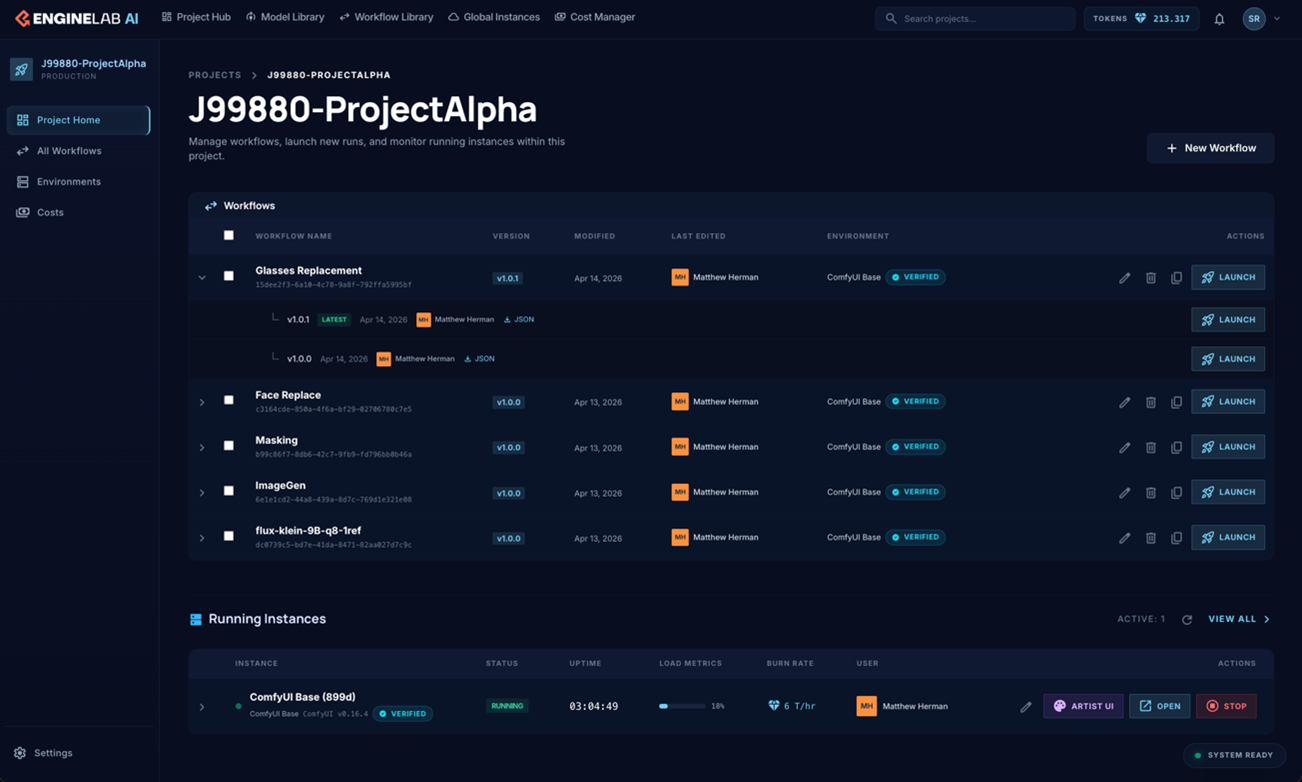
Studios face a critical dilemma: AI tools promise to accelerate production workflows, but adopting them means confronting real concerns about security, intellectual property (IP) protection, and production stability. This post introduces a solution designed to resolve that trade-off. You can use AI tools such as ComfyUI—an open source node-based interface for AI content generation— to graphically design and orchestrate complex AI-driven functionality by connecting models, processing tools, and creative operations into production-grade workflows. But as often happens with nascent technology that offers to accelerate production workflows or drive new efficiencies, it can introduce risks. Rapidly evolving AI landscapes create challenges around standardization, pipeline integration, and application stability. Security concerns are even more complex, because you need to understand the provenance of the models you use to navigate legal requirements and keep the intellectual property flowing through AI workflows private, as required by the strict security standards expected when working with IP. Without proper vetting and approval of models and related artifacts, unauthorized and potentially malicious tools and code can be introduced into working environments. Historically, creators have had to balance these benefits and risks at the cost of bringing AI into production. EngineLab, an AWS media and entertainment specialist partner, has launched a managed deployment platform called EngineLab AI. Built on AWS infrastructure, it packages AI apps like ComfyUI into a stable, secure, production-ready toolset. Purpose-built for the media and entertainment industry, it understands your workflows and puts powerful AI capabilities in the hands of every artist on your team—from the advanced authors of workflows to the general users wanting to benefit from defined processes. “Studios are telling us they want to use AI in production, but they can’t accept the instability and risk that comes with it today. We’re building the platform that removes that barrier, pipelining AI tools into studio workflows with the security and control the industry demands.” – Sam Reid, Co-Founder and CEO, EngineLab In this post, we show you how to solve these challenges with EngineLab AI: deploying directly into your AWS account for complete data sovereignty, tapping the global GPU resources provided by AWS for optimal availability and cost, and integrating security controls that protect your IP without sacrificing the creative flexibility your workflows demand. Enabling stable, scalable AI workflows Acquiring high-performance GPU hardware is getting harder and more expensive for studios. Component shortages, rising costs, and the overhead of maintaining on-premises infrastructure make it increasingly difficult to build and sustain the GPU capacity that AI workloads demand. Even when hardware can be acquired, studios face the challenge of keeping it stable and efficiently allocated across diverse projects and teams. ComfyUI’s web-based architecture offers a key advantage over traditional remote desktop solutions. Typical cloud-based workstations use Virtual Desktop Infrastructure sessions, to stream the desktop from its remote location to a local client—including user interface interactions from keyboard, mouse, and Wacom tablet inputs—but ComfyUI runs in a local web browser with the compute-intensive processing handled server-side. The user interface isn’t sensitive to latency constraints, which unlocks a key architectural advantage: compute resources can be provisioned remotely without latency sensitivity. EngineLab AI uses this flexibility to dynamically use the AWS Global Infrastructure, drawing upon AWS Regions (geographically isolated cluster of AWS data centers) with available Amazon Elastic Compute Cloud (Amazon EC2) capacity (an AWS scalable virtual server service that provides on-demand GPU instances for compute-intensive workloads). This allows EngineLab AI to access a global pool of GPU powered Amazon EC2 instance types, using a range of NVIDIA GPU architectures—including Blackwell, Ada Lovelace, Ampere, and others—with varying vCPU counts and memory configurations, expanding availability across Regions for greater resource access, reducing competition for fixed local hardware. By using Amazon EC2 instances, this solution reduces fixed costs for AI workflows, allowing studios to access GPU resources on-demand, as-and-when required. This also means studios can match compute to the current task. Not every artist needs the equivalent of a high-end graphics card under their desk when cloud infrastructure can dynamically allocate appropriate resources for each job. GPU resources can be partitioned across multiple users, further reducing costs without sacrificing performance, delivering stable access to GPU compute at scale, without the fixed costs and operational overhead of maintaining on premises hardware. EngineLab AI: A managed platform for studios and creators Building on the AWS global infrastructure, EngineLab has developed a managed platform designed from the ground up for media and entertainment, addressing the specific challenges studios face when bringing AI tools into production. The project management interface provides a centralized view of your workflows, as shown in Figure 1. From here, administrators can track which workflows are active, monitor resource utilization, and manage artist access. Figure 1: EngineLab AI’s project management interface showing how administrators track workflows, monitor resources, and manage artist access. Instant sessions with zero complexity Artists shouldn’t need to understand cloud infrastructure to use AI tools. With EngineLab AI, launching an AI app is as straightforward as selecting and launching the application. The solution handles everything underneath: provisioning the right compute, loading the right environment, and delivering a stable, ready-to-use session every time. No setup, no troubleshooting, no waiting. Studios organize work into projects, and artists launch the apps needed within them. The experience is consistent and reliable, which matters when working to a deadline, where a session must not fail to start or stop midway. Artist UI: Expert workflows for every artist Every studio has its ComfyUI experts (the technical power-users) who build sophisticated workflows using complex node graphs. But at scale, artists typically want to benefit from those workflows without becoming technical experts themselves. The Artist UI bridges that gap by exposing basic endpoints, such as an input, a prompt, and an output. Artists can then upload an image, describe what they want, and get results back; powered by the expert workflows running underneath without needing to navigate the node graph. This also solves an important consideration for studios: protection of IP. Those custom workflows represent real competitive advantage, and without a layer between the workflow and the user, there’s nothing stopping a freelancer from taking them to their next job. The Artist UI acts as a boundary, giving the whole studio access to the capability without exposing the underlying work. Data sovereignty: Security for you The solution deploys exclusively into the customer’s own AWS account and environment, providing comprehensive control and data sovereignty. Customer data isn’t used for training: what a studio creates stays theirs, with no ambiguity about how it might be used. In an environment where many platforms are purposefully vague about data handling, EngineLab AI is purposefully explicit. This approach also addresses the security risks inherent in running community-developed AI workflows, including controls designed to help protect against unauthorized and potentially malicious code injection. For studios working with major clients who have strict data requirements, this is essential for production environments. Model training: Secure environments, full control The platform includes training apps that allow studios to integrate their own content and train fine-tuned foundation models as well as Low-Rank Adaptations (LoRAs), which modify only specific parameters, making them faster and more cost-effective for style customization. This is performed within your platform environment so that training data never leaves your private account. After being trained, these custom models become directly available to ComfyUI workflows while the studio maintains full control over both the models and the data used to create them. This addresses an important need for studios that want the power of custom AI models without accepting the risk of their proprietary data being used to train models elsewhere or benefit competitors. Full control: Access management and provenance Administrators receive granular control over the platform through a least permissions model—granting users and resources only the access they need to perform their specific tasks—where experts and administrators can upload and approve models while other users retain restricted access. The system supports vendor-specific approvals, so that only approved models are used on specific projects—a crucial requirement for studios working with clients who have strict compliance requirements. Comprehensive audit trails track model usage per project for client reporting and compliance verification, while provenance tracking helps studios understand where models originate and exactly how they’re being used across the organization. The AI Model Library interface in Figure 2 provides a centralized view to categorize, approve and manage your models and LoRAs. Figure 2: A screenshot of EngineLab AI’s AI Model Library management pane. Pipeline integration: Compute across studio workflows EngineLab brings a team with deep pipeline expertise and extensive experience in high-end creative workflows to the platform. Recognizing that artist time is paramount, the team is actively working to integrate related GPU and CPU compute with ComfyUI directly into existing render farm workflows, using AWS Deadline Cloud—a fully-managed render farm service that automatically scales compute resources to match workflow demands. This integration allows the ComfyUI frontend to run on lightweight machines while heavy GPU tasks are offloaded to a render farm, decoupling the interface from the processing power. This natural progression uses EngineLab’s understanding of how tools need to integrate into production environments, handling the complexity so studios don’t have to. “We’ve been partnering with EngineLab as they develop the platform. Our team already has strong ComfyUI expertise in-house, but having a managed, secure environment that lets us scale that across the whole studio—with the control and governance we need for client work—is exactly what we’ve been looking for.” – Sean Costelloe, Managing Director, Selected Works Conclusion EngineLab AI transforms ComfyUI from experimental tool to production-grade platform, addressing the critical challenges studios face when adopting AI tools. By deploying directly into a studio’s AWS account, the solution provides comprehensive data sovereignty and security while using the global GPU resources provided by AWS for optimal availability and pricing. Studios gain production-grade AI capabilities without the risks and costs of traditional approaches: stable, secure access to AI generation with the control required for client work, integrated into familiar workflows. Learn more about the AWS infrastructure EngineLab AI is built on proven AWS services designed for compute-intensive creative workloads: Amazon EC2 – Scalable virtual servers with GPU instances for AI and rendering workloads AWS Deadline Cloud – Managed render scheduling service for scaling compute resources Next steps For more information about AWS and how to get started using cloud infrastructure for your creative workflows, contact your AWS account team or visit AWS for Media & Entertainment. Visit EngineLab AI to discover how your studio can leverage secure, scalable AI workflows on AWS.
-
MXL is the foundation. Here’s what it takes to build the house
The Hard Part Isn’t the Technology Picture a college basketball game. Two teams, a few thousand fans in the arena, and a regional sports network that has promised its subscribers a live broadcast....
General Source
The Hard Part Isn’t the Technology Picture a college basketball game. Two teams, a few thousand fans in the arena, and a regional sports network that has promised its subscribers a live broadcast. The production team has done this before — they know the sport, they know the workflow, they know what good television looks like. What they also know is that getting the show on air will take most of the day. Not because anything is broken. Not because the team isn’t skilled. But because connecting a live production in a software-defined environment — routing camera feeds from the arena to cloud processing, configuring the application parameters for each software function, verifying that the encoder at the venue is talking correctly to the switcher in the cloud — is a process that requires a specialist engineer working methodically through a checklist of settings that would fill a spreadsheet. By the time the opening tip-off arrives, that engineer has spent six to eight hours on configuration work that has nothing to do with producing good television. It’s just not as simple as SDI. This is the dominant reality of cloud live production today. And it is the problem the industry most urgently needs to solve. This isn’t one team’s bad day. Primary research conducted across more than ten live production organizations confirms it is the norm. For a 90-minute production running on cloud infrastructure, the compute cost — the actual cost of the servers doing the work — runs to approximately $15. The configuration and labor cost for setting up that same production runs to approximately $890. The infrastructure is nearly free. The expertise required to assemble it is not. That ratio — not the cost of compute, not the cost of software licenses, but the cost of configuration — is why cloud live production has been slower to take hold than the industry expected. The economics only work if you can reduce the setup burden dramatically. And that is exactly what a new generation of technologies, led by an open-source initiative called MXL, is beginning to make possible. What MXL Is — and Why It Matters For as long as broadcast television has existed, the industry has needed a common language for moving video between pieces of equipment. In the analog and early digital era, that language was SDI — a standard copper cable connection that any camera, router, or monitor could speak. SDI made the multi-vendor broadcast facility possible. You could buy a camera from one company, a router from another, and a monitor from a third, and they would all work together because they all spoke SDI. When the industry moved to IP networks, a new common language was needed. SMPTE ST 2110 provided it — defining how broadcast-quality video travels over standard IP infrastructure and enabling facilities to sca le their signal routing far beyond what SDI’s physical constraints allowed. ST 2110 was a genuine achievement, adopted by major broadcast networks and large production facilities worldwide. But ST 2110 was designed for a world of dedicated hardware and managed networks. As the industry now shifts to software — where video doesn’t travel over wires at all, but passes between applications running on the same server or cluster of servers — a new common language is needed again. That language is MXL, the Media Exchange Layer. The simplest way to understand what MXL does is through a comparison. The traditional way of passing video between software applications is like making a photocopier — every time one application needs to hand a video frame to another, it packages that frame, addresses it, sends it, and waits for the other side to receive and unpack it. Every step burns computing power. Every copy takes time. In a complex live production with dozens of software functions each processing hundreds of signal paths simultaneously, that overhead adds up fast. MXL’s approach is different. Instead of making copies, MXL gives every application a key to the room where the original video lives. A frame is written once into a shared area of the server’s memory. Any application that needs it — a switcher, a graphics engine, a monitor — simply walks in and reads it directly. No copies. No packaging. No wasted computing power. The frame doesn’t move; the applications come to it. This matters for two reasons. First, it is dramatically more efficient — software-defined production workflows running on MXL require significantly less computing infrastructure than those relying on traditional data exchange methods, which has a direct impact on infrastructure cost. Second, and perhaps more importantly, MXL is an open-source project governed by the Linux Foundation, with contributors including the EBU, CBC/Radio-Canada, the BBC, Grass Valley, Riedel, Lawo, AWS, NVIDIA, and others. Any vendor can implement it at no cost. Any broadcaster can use it without locking themselves into a single vendor’s ecosystem. In a market where vendor lock-in has been one of the biggest barriers to software adoption, that openness is not a minor detail — it is the point. MXL is one layer within a broader industry vision called the EBU Dynamic Media Facility (DMF) — a reference architecture that defines a complete model for software-defined production. For more on the DMF, see tech.ebu.ch/dmf. The Foundation Is Laid. What Still Needs to Be Built MXL is the right foundation. But let’s return to our production team at the basketball game — MXL alone does not get their show on air with less configuration work. It does not connect the encoder at the arena to the cloud. It does not help the engineer find and authenticate the camera feeds from the venue floor. It does not prove to the network’s legal team that the footage is genuine and hasn’t been manipulated. Those problems require solutions that sit alongside and above MXL — solutions the industry is actively developing but that are not yet fully in place. Understanding what they are, and how they connect to MXL, is the difference between seeing MXL as a complete answer and seeing it as the beginning of one. Getting signals in and out. MXL’s shared memory model works within a single server or a local cluster of servers. It does not, by itself, extend to the arena across town or the remote venue across the country. Productions that span physical locations — which is most live sports — need a way to bring those remote signals into the shared memory environment efficiently and reliably, across the variable and unpredictable conditions of real-world wide-area networks. This is the connectivity layer that MXL depends on but does not provide. It is worth pausing here to understand what happens when MXL meets the cloud — because the cloud changes the equation in ways that are not immediately obvious. In a traditional on-premises environment, MXL’s shared memory model operates within the physical boundaries of a server or a tightly coupled cluster. The network between applications is fast, predictable, and under the operator’s control. In the cloud, those assumptions break down. Video flows may traverse multiple virtual network layers — from the hypervisor’s virtual switch, through overlay networks that connect containers or virtual machines, across availability zones that are physically separate data centers, and potentially across regions separated by hundreds of miles. Each layer introduces latency, jitter, and the possibility of packet loss — none of which are tolerable in a live production workflow where a single dropped frame is visible to millions of viewers. What makes cloud infrastructure compelling despite these challenges is that the raw compute is extraordinarily affordable and elastic. Unlike dedicated hardware, cloud capacity can be provisioned in minutes and released the moment the production wraps. There is no capital expenditure, no truck roll, no hardware sitting idle between events. The challenge, then, is not whether the cloud is powerful enough or affordable enough for live production — it clearly is. The challenge is bridging the gap between MXL’s local shared memory model and the distributed, multi-hop reality of cloud networking, without sacrificing the simplicity and efficiency that make MXL valuable in the first place. Making sources easy to find and connect. Even with MXL in place, connecting to a remote camera or an encoder at a venue requires knowing where it is, how to reach it securely, and how to configure the connection correctly. Today that process is manual — and it is where most of that $890 in configuration labor goes. What the industry needs is a mechanism as simple as pairing a Bluetooth device: the encoder at the arena registers itself, the production team finds it in a list, and the connection is made. Emerging specifications like VSF TR-12 are working toward exactly that, and leading vendors are building practical implementations now. Proving that what you’re seeing is real. As AI-generated video becomes indistinguishable from genuine footage, the ability to cryptographically prove the authenticity of a live signal is becoming essential — particularly for news and sports organizations whose credibility depends on it. The C2PA initiative is developing standards for content provenance, currently focused on distribution formats. Extending that to live contribution and production — to MXL flows and other live video formats — is an important unsolved problem that the industry needs to address. These are not distant challenges. They are the specific gaps between MXL as a foundation and software-defined live production as a practical, economically viable reality. What a Complete Solution Looks Like Connect the pieces, and the picture comes into focus. A complete solution for software-defined live production has four components working together: A common media exchange layer — provided by MXL — that lets software components from any vendor share video efficiently and without lock-in. Global connectivity that extends the shared memory model beyond a single facility or cloud environment, bringing remote venues and distributed production into the same efficient workflow. Plug-and-play device discovery that makes connecting a production as simple as finding a source in a list and clicking connect — not manually configuring IP addresses and port mappings in a spreadsheet. Content authenticity built into the contribution and production chain, so that organizations can prove the provenance of their live footage from the moment it is captured. When these four layers work together, the engineer at the basketball game doesn’t spend six hours on setup. They spend thirty minutes. The economics of cloud live production change fundamentally — not because compute got cheaper, but because the configuration burden that dominated the cost equation has been addressed. And the production team that stayed on SDI because software was too hard now has a path forward that doesn’t require a specialist with deep knowledge of every vendor’s implementation. That is the goal. It is within reach. And the industry is moving toward it faster than many realize. TVU Networks and the Road Ahead TVU Networks has spent more than two decades building live video infrastructure for conditions where failure is not an option — breaking news situations, remote venues, locations where network conditions are unpredictable and the signal still has to arrive. That heritage shapes how TVU has approached the gaps described above. TVU MediaMesh® — TVU’s unified platform for live media connectivity, processing, and delivery — extends the same transmission technology that TVU built its reputation on across the entire live media chain, from field contribution through production to distribution, in a single orchestrated platform. On the connectivity challenge, MediaMesh addresses the LAN boundary directly through what TVU calls global shared memory. To extend the analogy used earlier: MXL gives every application a key to the room where the original media lives. TVU MediaMesh makes that room as big as the world. A camera at an arena, a graphics system in the cloud, and a production switcher at a remote facility can all participate in the same shared memory workflow — with the remote source appearing to the software process as simply as opening a shared file, regardless of where in the world it originates. MediaMesh is built to work with MXL, not to replace it — extending MXL’s model to the distributed environments that MXL alone cannot reach. On device discovery and connection toil, TVU’s global object model — a core component of MediaMesh global shared memory — assigns a unique identifier to every frame of every video source in the TVU ecosystem, making any source addressable from anywhere without manual configuration. TVU is also an active participant in the VSF TR-12 Client Device Discovery effort, an emerging open specification that brings plug-and-play device connectivity to production equipment at the edge of the workflow. On content authenticity, TVU has joined the C2PA initiative to contribute toward extending cryptographic content provenance to live video formats, including MXL flows. MXL-based integrations with partner vendors reflect TVU’s belief that the complete solution described above will be built by an ecosystem, not a single company. Conclusion The basketball game gets produced. The engineer goes home at a reasonable hour. The regional sports network delivers its broadcast without needing a specialist engineer on standby for every event. That outcome — which is entirely achievable with the technologies now being developed — is what the industry is working toward. What makes this moment different from previous waves of broadcast technology transition is the convergence of two powerful cost advantages that have never existed simultaneously before. The first is the affordability of cloud infrastructure. At approximately $15 of compute for a 90-minute production, the cost of processing power is no longer a barrier — it is a rounding error. Cloud infrastructure is elastic, globally available, and requires no capital expenditure. The hardware problem, for all practical purposes, has been solved. The second is the simplification of human labor. When MXL, plug-and-play discovery, and global connectivity work together, the configuration burden that currently dominates production costs — the $890 that dwarfs the $15 of compute — collapses. The specialist engineer who spent six hours on setup changes to a workflow that takes thirty minutes and can be executed by the production team itself. Together, these two advantages do not just make existing productions cheaper. They make entirely new productions possible. The Tier 3 and Tier 4 sporting events that were never economically viable to produce live — the college conference games, the regional tournaments, the niche sports with passionate but smaller audiences — suddenly have a path to live broadcast. The economics that once reserved live production for marquee events now extend to any event where there is an audience willing to watch. And the implications extend beyond sports. The same cost structure that unlocks lower-tier live sports also opens the door to live production in professional AV, corporate events, houses of worship, education, and use cases the industry can barely imagine today. Anywhere there is a need to produce, switch, and distribute live video — and the budget has historically made it impractical — this combination of affordable cloud compute and simplified production workflows changes the calculus. MXL is the foundation. It is the right foundation, built the right way, with the right coalition behind it. What gets built on top of it — the connectivity, the discovery, the authenticity — will determine how quickly software-defined live production moves from promise to reality. But there is a larger possibility here. MXL has the potential to become what SDI was for a previous generation: the universal standard that every piece of production equipment speaks, that every vendor implements, and that every production team can rely on. Not just for broadcast — but for every segment of the live media industry. The house is being built. The foundation is sound. And the neighborhood is bigger than anyone expected. For more information about TVU Networks and TVU MediaMesh, visit tvunetworks.com.
-
A Year Later: Examining Google Media CDN’s Evolution in Scale, Monitoring, and Architecture
A year ago, I wrote about Google’s Media CDN offering and its positioning in the market, which was primarily centered on leveraging Google’s network for large-scale video delivery. As with any...
General Source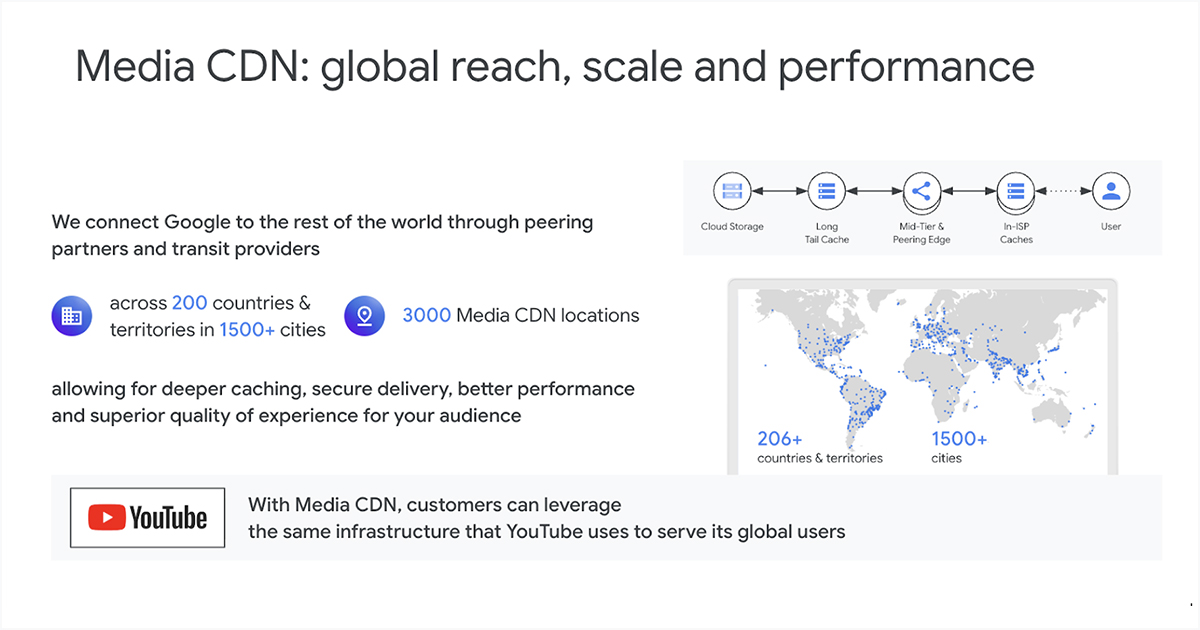
A year ago, I wrote about Google’s Media CDN offering and its positioning in the market, which was primarily centered on leveraging Google’s network for large-scale video delivery. As with any service, the initial value proposition is only part of the story. The more telling measure is its subsequent evolution in response to customer usage and industry demands. A year later, Google has made key enhancements to its Media CDN, focusing on adding capacity and operational tooling, as well as onboarding large media and entertainment customers. The fundamental challenge for CDNs remains handling massive, concurrent traffic spikes associated with live streaming. Events over the past year, such as the Super Bowl, FIFA World Cup, and IPL, have continued to set new streaming benchmarks. One notable change in Google’s Media CDN offering is that since early 2025, it has tripled its delivery capacity through a combination of Google’s Media CDN offering and YouTube capacity. Beyond raw capacity, several architectural and commercial updates have been introduced to address common customer pain points around origin performance and budget predictability. Google has added new caching and routing options, including Flexible Shielding, with shield regions in South Africa, the Middle East, and the U.S. The goal is to improve cache offload rates by keeping traffic within a region, thereby avoiding the latency and data-transit costs associated with the “hairpinning” effect of fetching content from a distant origin. This is an add-on feature that lets customers choose between optimizing for performance or offloading, in addition to the platform’s existing multi-region caching and shielding architecture, which is offered at no cost. Google says a series of updates is aimed at solving common origin integration issues. For instance, the platform now supports HEAD requests, has increased its maximum segment size from 10MiB to 25MiB (likely to better support high-bitrate 4K streams), and has added support for multi-part range requests. These changes suggest a focus on improving interoperability with a wider range of customer storage configurations. On the commercial side, Google has introduced monthly savings plans. This model provides a committed-use discount, giving customers a more predictable TCO, a departure from a pure pay-as-you-go cost structure. For live events, real-time performance visibility is critical. Google has introduced a Monitoring as a Service (MaaS) offering, positioned as a “broadcast operating center” equivalent. It is designed to provide a customer’s operations team with intensive, proactive support for events, with a consolidated view of an event’s health, from origin performance to end-user metrics. The tool’s intended impact is to enable proactive issue detection, allowing teams to identify potential problems before they affect a large number of viewers. For customers with large-scale events that have used it, the tool is intended to provide real-time data needed to manage a professional broadcast. Google’s initial market entry with its Media CDN offering was focused on its network foundation. The changes over the last year, however, indicate a shift toward addressing more specific, operational, and architectural challenges faced by large-scale broadcasters. The introduction of more flexible caching, origin compatibility fixes, and broadcast-grade monitoring tools suggests a maturing platform. The true measure will be how these enhancements perform under pressure across a broader range of customer workloads, but the direction of development is clear.
-
Distribute NDI content from AWS with AWS Elemental MediaConnect
The secure and reliable egress of live NDI® (Network Device Interface) video content from the Amazon Web Services (AWS) Cloud has previously been a challenge for our customers. With the addition...
General Source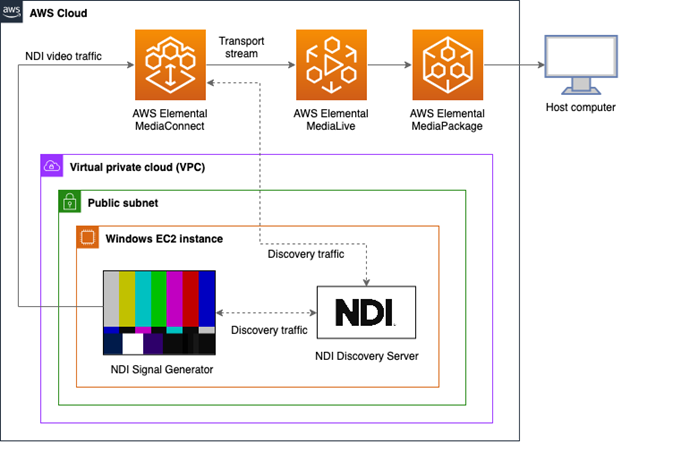
The secure and reliable egress of live NDI® (Network Device Interface) video content from the Amazon Web Services (AWS) Cloud has previously been a challenge for our customers. With the addition of NDI source support in AWS Elemental MediaConnect, you can now take live NDI video within an AWS Virtual Private Cloud (Amazon VPC) and seamlessly distribute it as a transport stream. NDI is a high-quality video connectivity technology that facilitates ultra-low latency video communication over internet protocol (IP). NDI is widely used in live production applications and supported by more than 500 hardware products and 400 software applications. Systems use NDI to encode, transmit, and receive multiple streams of video and audio in near real-time. The new AWS Elemental MediaConnect functionality that converts NDI sources to Secure Reliable Transport (SRT) or other compressed stream outputs provides an efficient way to bridge NDI with modern, transport stream-based distribution tools. Broadcasters and live production teams can use this capability to seamlessly integrate the flexibility of NDI-based production environments into their existing, standards-based distribution workflows. In this post, we show you how to build a demonstration of low-latency live NDI video conversion to a transport stream in the AWS Cloud with MediaConnect. You will: Create an Amazon Virtual Private Cloud (Amazon VPC). Create a MediaConnect flow with an NDI source in the Amazon VPC. Create an Amazon Elemental MediaLive channel to receive MediaConnect output. Create a MediaConnect output to MediaLive. Create an Amazon Elemental MediaPackage output group to receive from MediaLive. Create a Windows Amazon Elastic Compute Cloud (Amazon EC2) instance in the Amazon VPC, install NDI Tools, an NDI Discovery Server and NDI Signal Generator. Use the NDI Signal Generator to stream video and audio data over NDI in the Amazon VPC to MediaConnect. MediaConnect is a transport service that enables secure and reliable delivery of live video into, within, and out of the AWS Cloud. Using MediaConnect, you can send high-quality video to AWS for processing, storage, and distribution, with features including encryption, redundancy, and bandwidth-efficient protocols for reliable video transport. The following diagram (Figure 1) shows how you can use the NDI Signal Generator to stream content over NDI in an Amazon VPC in the AWS Cloud. A Windows EC2 instance in the Amazon VPC, running NDI Tools Discovery Server, delivers the NDI content to MediaConnect. MediaConnect converts the NDI content to a transport stream output to MediaLive. MediaLive transcodes and sends the stream to MediaPackage. You can then use the MediaPackage console to view the transcoded media through the MediaPackage origin endpoint. Figure 1: High-level architecture The workflow Within your private Amazon VPC, a public subnet hosts a Windows EC2 instance running the NDI Discovery Server and NDI Signal Generator. The NDI Signal Generator application acts as the NDI sender, outputting an NDI stream to a MediaConnect flow. A dedicated VPC interface handles MediaConnect NDI ingress traffic privately within the VPC. MediaConnect then converts the NDI feed to a transport stream for distribution through MediaLive and MediaPackage. The AWS resources to enable this workflow are set up using AWS CloudFormation templates. CloudFormation is an infrastructure as code (IaC) service. Templates let you model, provision, and manage AWS and third-party resources as code. For more information about using CloudFormation templates, see Working with CloudFormation templates. Prerequisites To set up the solution in this post, you must have the following: An AWS account that has permission to create a GPU instance, which isn’t enabled by default. A service quota of at least four vCPUs for running on-demand G and VT instances to support a four vCPU g4dn.xlarge EC2 instance. To check your quota, use the EC2 Service Quota console. This workflow is for demonstration purposes. For production workflows, apply additional security measures (such as permissions and CIDR blocks) for your specific environment. The solution With the prerequisites in place, you’re ready to set up and test the solution. Step 1. Create the AWS Cloud resources Deploy the AWS resources from a system that contains the AWS Command Line (AWS CLI) tools. Confirm the AWS account credentials and default AWS Region are set up. 1. Download the CloudFormation templates and scripts. 2. Create an Amazon Simple Storage Service (Amazon S3) bucket in your AWS account to store the CloudFormation template files. 3. To create the AWS Cloud resources, create a CloudFormation stack using the following command (be certain to replace the values in this bulleted list accordingly):
: The name of your S3 bucket. : The name of the folder to create within the S3 bucket. : The name of the stack to create. : The prefix for new AWS resource names. : The CIDR block for the IP range for remote desktop access to the EC2 instance. (Optional) : The AWS Identity and Access Management (IAM) profile to use instead of default AWS credentials. Default credentials require a region. Note, the .aws/credentials file must contain the profile and default Region. Linux command: ./create_stack.sh \ Windows PowerShell command: ./create_stack.ps1 \ 4. If the process completes successfully, the script outputs the following information: FlowArn is the Amazon Resource Name (ARN) of the MediaConnect flow. The name of the EC2 instance keypair’s PEM file written to your current folder. The file is used in the next section. Step 2. Install NVIDIA driver on the Windows EC2 instance The NDI Studio Monitor application requires a GPU instance and a specific set of NVIDIA drivers. The CloudFormation template creates the GPU instance and downloads the NVIDIA driver installer application to the desktop. The application requires manual intervention to install the driver. Use the following to install the driver: 1. Retrieve the Administrator password for the instance using the PEM file from Step 1. 2. Sign in to the instance. 3. Navigate to the desktop and open the NVIDIA folder. 4. Continue to open the subfolders until you locate the installation executable file. The following is an example of the name: XXX.XX_Cloud_Gaming_win10_win11_server2022_dch_64bit_international.exe 5. Open the file to launch it. 6. Follow the prompts to install. Step 3. Install NDI Tools and launch the NDI Discovery Server NDI distributes a set of tools that are free to download and use. 1. Download and install NDI Tools. 2. Launch the Discovery Server application from: C:\Program Files\NDI\NDI 6 Tools\Discovery Service\NDI Discovery Service.exe 3. The server runs using a shell to display the output. 4. (Optional) To automatically launch the Discovery Server on system restarts, create a program shortcut and move it to: C:\Users\Administrator\AppData\Roaming\Microsoft\Windows\Start Menu\Programs\Startup Step 4. Configure NDI Discovery Server Use NDI Tool’s Access Manager to configure the Discovery Server IP address, as shown in Figure 2, replacing XXX.XXX.XXX.XXX with the Private IP address of the Windows EC2 instance. Because the Discovery Server is on the instance, you can optionally specify the localhost instead of the IP address. Figure 2: Set Discovery Server IP address using NDI Access Manager Step 5. Install NDI Signal Generator on the Windows EC2 instance and create NDI source 1. Download and install an NDI Signal Generator application on the Windows instance. 2. Add an inbound rule to the Windows firewall to allow the NDI Signal Generator application to receive network traffic. You can add the rule using the Windows Defender Firewall with Advanced Security application, or by running the following command using an administrator command prompt: netsh advfirewall firewall add rule name="NDI_SignalGenerator" dir=in action=allow program="C:\Program Files (x86)\NDI Signal Generator\NDI Signal Generator.exe" enable=yes 3. Launch the application. 4. Start the NDI source. Note the NDI Channel Name. It will be used in the next step as the NDI source name. Step 6. Set the NDI source name and start the MediaConnect flow (console) 1. Open the AWS Elemental MediaConnect console. 2. Navigate to Flows and select the Flow flow. 3. Under the Sources tab, select the NDI source. 4. Choose Update and enter the name of the NDI source from the previous step. It should be something like EC2AMAZ-XXXXXXX (SIGNAL). 5. Choose Update source. 6. Choose Start to start the flow. 7. After the flow starts, the stream from the NDI Signal Generator application is visible in the flow’s thumbnail preview window. Step 7. Start the MediaLive channel (console) 1. Open the AWS Elemental MediaLive console. 2. Navigate to Channels and select the LiveChannel channel. 3. Choose Start. 4. After the channel starts, the stream from the MediaConnect is visible in the channel’s thumbnail preview window. Step 8. Use MediaPackage to preview the stream 1. Open the AWS Elemental MediaPackage console. 2. Navigate to Live V2, Channel groups and select the Group channel group. 3. On the Channels tab, select the Channel channel. 4. Under Origin endpoints, choose the radio button for the endpoint. 5. Under Manifests, choose the radio button for the manifest. 6. Under Manifests, select Preview. The stream from MediaPackage is visible in the console window. Clean up To prevent charges after evaluating this solution, stop the flow and delete all the AWS resources created for the solution by using the following command (replace the values in this bulleted list accordingly): : The name of the stack to delete. (Optional) : The IAM Profile to use instead of default AWS credentials. Default credentials require a region. Note, the .aws/credentials file must contain the profile and default region. Linux command: ./delete_stack.sh Windows PowerShell command: .\delete_stack.ps1 Verify that the AWS resources created for the solution no longer exist by checking the AWS console. This confirms no resources are accidentally left running, which could lead to additional charges. Conclusion In this post, you learned how to use AWS Elemental MediaConnect to convert an NDI source within an Amazon VPC into a transport stream and distribute it through MediaLive and MediaPackage. This facilitates communication between NDI enabled software and modern IP based live cloud production workflows. Contact an AWS representative to learn how AWS can help accelerate your business. Further reading AWS Elemental MediaConnect adds support for NDI inputs Guidance for Programmatic Deployment of NDI Discovery Servers for Broadcast Workflows on AWS Using NDI for video switching and routing in AWS AWS supports the second multi-partner live cloud production interoperability workshop NDI Docs & Guides -
Unlocking next generation audio production with MPEG-H on AWS
Most people today experience audio in fixed formats, where dialogue levels, commentary, and accessibility features are set in advance. But what if you could take full control over how you hear a...
Entertainment Source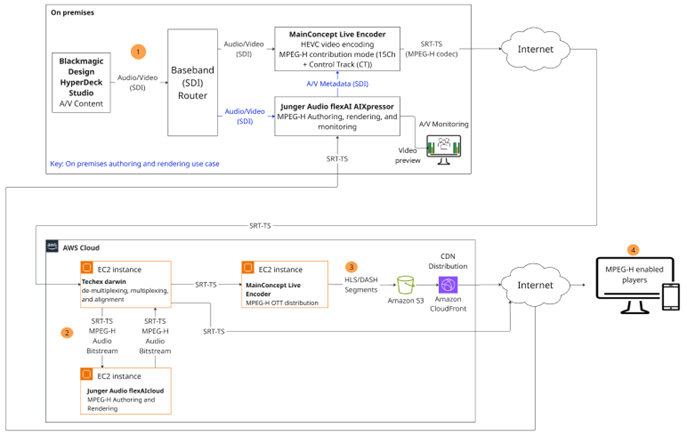
Most people today experience audio in fixed formats, where dialogue levels, commentary, and accessibility features are set in advance. But what if you could take full control over how you hear a show or sports game? Next Generation Audio (NGA) technologies like MPEG-H Audio make this possible, allowing viewers to adjust dialogue clarity, choose alternate commentary, or enable audio descriptions, seamlessly and interactively within a single stream. In this post, we examine how you can implement NGA workflows in the cloud using MPEG-H Audio to deliver immersive, interactive audio at scale. The standard MPEG-H production workflow using on-premises servers is widely used today. However, because more broadcasters are moving parts of their production workflows to the cloud, we need to rethink and adapt the current approach where source video and audio—including metadata—must be transferred and processed differently (for example in compressed formats instead of baseband or ST 2110). This effort was developed in collaboration with AWS Partners and technology leaders to build and enable a complete MPEG-H production workflow in the cloud resulting in the final delivery of Adaptive Bit Rate (ABR) content with NGA to the consumer. Jünger Audio provides flexAI for real-time audio processing, metadata authoring, and rendering. MainConcept deploys their Live Encoder software for both contribution and distribution encoding. Techex contributes darwin for stream processing and multiplexing. Fraunhofer IIS supplies the MPEG-H metadata creation, encoding, and decoding libraries that power the entire workflow. What is NGA? For decades, audio in broadcast and streaming has been delivered as fixed mixes—left and right in stereo, or predefined speaker layouts in surround sound. While this approach faithfully reproduced creative intent in traditional systems, it limited how audiences could interact with content. NGA transforms this paradigm. Broadcasters and streaming providers can differentiate their hybrid and cloud-based productions through object-based audio capabilities, while next-generation TV standards—ATSC 3.0 in the US and DTV+ in Brazil—mandate NGA codecs alongside efficient video compression (HEVC, VVC) to deliver superior quality at lower bandwidths, with European DVB and Japanese ARIB exploring similar paths. For large live sports events, broadcasters can launch cloud-based NGA production workflows on-demand and shut them down afterward, avoiding costly on-premises hardware investments. Through its extensive metadata framework, NGA enables each consumer device to generate reproduction signals optimized for the specific characteristics of the playback device and its listening environment. A multi-speaker audio-video (AV) receiver can render audio for 12 or more loudspeakers, while the same NGA bitstream can be rendered on a mobile device for binaural headphone playback—each with individually optimized dynamic range and spatial presentation. Object-based audio and metadata as enablers for NGA Object-based audio is the fundamental paradigm underlying NGA systems. Instead of delivering a fixed stereo or surround mix, object-based audio preserves individual sound elements—such as dialogue, commentary, music, and sound effects—as separate audio objects. Each object is accompanied by metadata that describes: What the audio element represents (for example, dialogue, ambience, music) Where it should be positioned within a three-dimensional sound field When it’s active over time How it should be rendered or presented on different playback systems What type and degree of user interactivity is permitted The loudness characteristics of each audio object This separation enables both personalization—such as selecting preferred languages or adjusting dialogue levels—and immersive audio, allowing sounds to be positioned dynamically around the listener in three-dimensional space. Understanding MPEG-H Audio MPEG-H Audio is an international audio standard developed by ISO/IEC MPEG, with key technologies contributed by Fraunhofer IIS. It’s specifically designed to enable NGA services for broadcast and streaming applications. Key capabilities of MPEG-H Audio include: Multi-format audio support: Supports channel-based audio (stereo and traditional surround), object-based audio, and Higher-Order Ambisonics (HOA) for advanced spatial audio reproduction—including any combination of these formats within a single stream Interactive audio capabilities: Enables user control over audio elements such as language selection, dialogue enhancement, alternative commentary tracks, and personalized mixes within boundaries defined by the content creator Immersive sound reproduction: Supports three-dimensional audio formats with height channels, including common immersive configurations such as 5.1+4H and 7.1+4H Adaptive rendering: Automatically optimizes audio playback for devices ranging from high-end home theater systems to soundbars, TVs, and mobile devices using binaural rendering Accessibility features: Natively supports dialogue enhancement, the addition of audio description, and other assisted listening features Partner collaboration: Building the cloud NGA workflow This cloud-based NGA production workflow brings together specialized expertise from multiple AWS Partners and technology organizations, each contributing critical capabilities: Jünger Audio brings deep expertise in audio processing with their flexAI platform, which performs the complex task of real-time metadata authoring and rendering. flexAI enables broadcasters to create and manage NGA audio and metadata streams in live production environments, supporting both S-ADM and MPEG-H Control Track workflows. MainConcept provides Live Encoder, a professional-grade encoding solution that manages broadcast-grade contribution (bringing SDI feeds into the cloud) and distribution encoding (generating AVC, HEVC, or VVC content in HLS, CMAF, and DASH outputs). Techex contributes darwin, a sophisticated stream processing platform that demultiplexes incoming feeds, routes audio to processing systems, and remultiplexes the processed streams while maintaining frame-accurate time alignment—critical for professional broadcast applications. Fraunhofer IIS, the research organization behind the MPEG-H Audio technology, provides the encoding, decoding, and player libraries that enable the entire NGA experience from production through playback. Together, these partners enable a complete cloud-based NGA production workflow that maintains broadcast quality while leveraging cloud scalability and flexibility. The role of metadata in NGA production Object-based audio is the fundamental paradigm underlying NGA systems. Instead of delivering a fixed stereo or surround mix, object-based audio preserves individual sound elements—such as dialogue, commentary, music, and sound effects—as separate audio objects. Each object is accompanied by metadata that describes what the audio element represents, where it should be positioned within a three-dimensional sound field, when it’s active over time, how it should be rendered on different playback systems, what type and degree of user interactivity is permitted, and the loudness characteristics of each audio object. In NGA productions, all user interactivity features are defined by producers through metadata. The process of creating and managing this metadata is referred to as authoring. During authoring, the content provider specifies which audio elements are available to the user, how they can be interacted with, and how they’re rendered during playback. MPEG-H production formats An MPEG-H Master contains all uncompressed audio elements and the complete set of production and authoring metadata that define an MPEG-H Audio scene. For live production workflows relying on SDI-based infrastructure, MPEG-H uses a Control Track method to deliver metadata. The Control Track is a PCM audio signal that carries all MPEG-H metadata and is fully aligned with the corresponding audio and video data. Because it’s carried and edited like any other audio signal, it’s robust against sample rate conversions or level changes, making it ideal for live production environments. Bringing NGA production to AWS As audio experiences evolve toward greater immersion and personalization, production workflows must also evolve. Traditional media production has relied on on-premises infrastructure—outside broadcasting (OB) vans, studios, and dedicated hardware—to manage uncompressed media, real-time metadata authoring, and distribution. As live production increasingly moves to the cloud, NGA workflows benefit from bringing tools to content rather than content to tools. The cloud’s scalability enables multiple audio studios globally to simultaneously deliver immersive mixes into a centralized publishing chain. This distributed model allows broadcasters to dynamically allocate resources during peak events and scale down afterward, paying only for what they use while maintaining broadcast-grade quality. Solution architecture Figure 1: Solution architecture and signal workflow 1. Audio capture: Individual audio sources—such as commentary, ambient sounds, and effects—are captured separately as discrete PCM audio signals. This separation enables interactivity and immersive rendering on the consumer side (devices such as TVs and handhelds). The MainConcept Live Encoder (in contribution mode) receives a video stream with 16 channels of embedded PCM audio over baseband (SDI). Having 16 channels enables the use of more objects to enrich the user experience downstream. Live Encoder—which has integrated the Fraunhofer’s MPEG-H encoding technology —outputs the stream as MPEG-H contribution bitstream plus video as Transport Stream (TS) over SRT. The SRT feed is then contributed to the AWS Cloud for processing. The Jünger Audio AIXpressor is used for monitoring of the return feed from the cloud. Optionally, authoring can take place on premises, providing additional flexibility for customers who are using local AIXpressor units. In this case, it receives the AV feed, de-embeds audio, and then authors and renders the feed for monitoring. It then sends the authored audio and metadata to the contribution encoder. 2. Metadata creation: Jünger Audio flexAI processes the audio elements and creates the metadata for defining: Channel-based beds: For example, 5.1+4H and 7.1+4H immersive mix Audio objects: For example, commentators in multiple languages Presets and presentations: Combinations of beds and objects tailored for different user selections Techex darwin (running on AWS) receives the SRT-TS (or NDI streams based on system requirements), which demultiplexes the incoming feed to its elementary audio and video streams. The audio bitstream is forwarded using SRT to the Jünger Audio flexAI cloud instance. In flexAI, the MPEG-H Audio bitstream is decoded to PCM audio to reconstruct the metadata and modulate it into a PCM audio track (the Control Track). Depending on the workflow, the incoming metadata can be edited or created from scratch. After the authoring and rendering is completed in flexAI, the audio and metadata are sent back to darwin as MPEG-H Audio bitstream over SRT. Darwin then multiplexes the processed audio, including the metadata, with the video stream while maintaining time alignment. Figure 2: Jünger Audio’s flexAI MPEG-H Rendering module Figure 3: Techex darwin screenshot for SRT routing, (de-)multiplexing and frame alignment 3. Distribution: The output from darwin is then sent using SRT-TS to the MainConcept Live Encoder operating in distribution mode. The Live Encoder receives the SRT-TS and encodes it into complete HLS, DASH, or CMAF streams including MPEG-H audio and AVC, HEVC or VVC video segments, and corresponding manifest that are then stored in Amazon Simple Storage Service (Amazon S3) completing the MPEG-H production workflow in a cloud environment. Amazon CloudFront is the CDN for OTT delivery with Amazon S3 as its origin. Figure 4: User Interface of MainConcept’s Live Encoder for AVC and MPEG-H Audio emission encoding 4. Rendering at the playback device: The decoder receives the MPEG-H Audio bitstream containing audio and matching metadata and decodes the bitstream into PCM Audio The renderer inside the decoder adapts the mix to the available playback setup (soundbar, headphones, or full surround system) using the metadata User interactivity is enabled, allowing selection of language, dialogue level, commentary tracks, and other personalized options using an on-screen display The MPEG-H libraries for encoding, decoding, and players are provided by Fraunhofer IIS. Fig. 5: MPEG-H Audio on-screen display on iOS mobile player for audio object selection and user personalization Conclusion In this post, we discussed the implementation of cloud-based NGA production workflows using MPEG-H Audio on AWS. By combining Jünger Audio’s audio processing expertise, MainConcept’s encoding capabilities, Techex’s stream processing platform, and Fraunhofer IIS’s MPEG-H technology, broadcasters can implement professional-grade NGA workflows in the cloud without compromising on quality or functionality. The cloud-based approach provides flexibility and efficiency enabling the scale to millions of concurrent viewers. Contact an AWS Representative to learn more about this workflow, or learn how we can help accelerate your business. Further reading: MPEG-H Audio technology Jünger Audio flexAI platform MainConcept Live Encoder Techex darwin platform
-
All Encoding Decisions Are Economic Decisions. It’s Time to Start Treating Them Accordingly
You think you know RD Curves. You think you know encoding ladders. I’m here to tell you, you don’t know diddly. The RD Curve above compares encoding ladders for VP9, HEVC, and H.264. It’s a short,...
General SourceYou think you know RD Curves. You think you know encoding ladders. I’m here to tell you, you don’t know diddly. The RD Curve above compares encoding ladders for VP9, HEVC, and H.264. It’s a short, idiosyncratic clip. Don’t focus on what you know about codec efficiencies. Focus on what you think the RD Curves tell you. Which codec is more efficient? Easy, right? Without question, VP9. But will the VP9 ladder save you bandwidth as configured or cost you more? What about quality? More or less than H.264? How will that change if your primary audience connects over high-bitrate connections and retrieves the top two or three rungs? What if it’s primarily a mobile audience retrieving middle-to bottom-tier content? More importantly, what does this all mean for how you should configure your encoding ladders for advanced codecs like VP9, AV1, and HEVC? You think you know encoding ladders, but you don’t know diddly. Take a seat, and have a listen. Getting Started Too much drama? Yeah, probably. Sorry. I just spent yet another day debugging a software program called the Streaming Learning Center Bitrate Explorer, or SBE. As you’ll see, building RD-Curves and BD-Rate functions is straightforward. Building algorithms to help understand them is a bear. Here’s what I mean. Figure 2 shows the BD-Rate stats that correspond with Figure 1. These make sense. For this short clip, VP9 proves most efficient, HEVC the least efficient, and H.264 in the middle. It’s a short test clip; it happens. But the numbers clearly match the BD-Rate curves. VP9 is in green at the top, H.264 in blue in the middle, and HEVC in red at the bottom. Figure 2. The BD-Rate stats for the files shown in the featured image above. By definition, BD-Rate stats are the average values for all the common data points in the clips. But we don’t ship averages, we don’t ship curves. We build encoding ladders to deliver clips that are points in the curve, those big circles you see in the RD-Curves. Figure 3 shows the economic impact of the BD-Rate values, accounting for encoding and distribution costs. We’re using the cost-per-minute model that shows H.264 at $0.04/minute for 1080p/30, with both VP9 and HEVC at double that. Our delivery cost is $0.02/GB. Because HEVC is 18.47% less efficient for this clip, same as the BD-Rate numbers, it never makes sense to encode with HEVC, the combined encoding and bandwidth costs will always be higher. VP9 costs twice as much to encode as H.264, but it’s 14.66% more efficient. The reduced distribution cost will exceed the increased encoding cost after 1,115 hours of video have been delivered; that’s the breakeven. If you deliver 1 million hours of video (bottom left), you save $2,150 overall. Interestingly, there’s no increase or decrease in quality (as measured by VMAF in this case) because BD-Rate computations measure the bitrate impact of delivering equivalent quality. Figure 3. The economic impact of encoding with HEVC and VP9 compared to H.264. All this is straightforward math, nothing dramatic enough to warrant the obnoxious intro. But let’s return to the point that we deliver encoding ladders, not RD-Curves. Let’s ask: what happens if we deliver to a primarily mobile audience? When I first considered this question, I looked at the RD Curves and said, VP9 will be much more efficient. So I clicked the Apply audience distribution check-box to apply the mobile-centric distribution pattern shown in Figure 4. And the numbers changed completely. Figure 4. Measuring the economic impact when delivering to a primarily mobile audience. You see this in Figure 5. VP9 delivery went from green to red. In this configuration, the average bitrate I was distributing was 0.752 Mbps, compared to 0.726 Mbps for H.264. Deploying VP9 to reach this audience costs more. How can this be? Figure 5. VP9 costs more to deliver to a mobile audience (though quality is much higher). Take a look at Figure 6, specifically the location of the file dots on the curve (H.264 is blue and VP9 is green). Look at the position of the green VP9 dots vs the blue H.264 dots in the lower half of the curve. They’re slightly to the right of the blue dots, meaning at every quality level a mobile viewer cares about, the VP9 file is 50-200 kbps higher than the H.264 file. The codec is more efficient in theory, but the ladder rungs aren’t placed where this audience lives. The result is that you ship more bytes per viewer connecting at these bitrates. Figure 6. We don’t deliver RD-Curves; we deliver file dots. As you can see at the bottom of Figure 5, all is not for naught; your mobile viewers will benefit from significantly improved quality. But that’s not particularly gratifying if you told your boss and the finance gal that VP9 would shave 40% off your bandwidth bill. What about at the other end of the spectrum, where you’re delivering to a high-bandwidth audience? Another surprise, as you see in Figure 7. VP9 performs poorly here while HEVC rises from the ashes, bandwidth-wise, at least, though it costs you a bit of quality. Figure 7. When delivering higher-quality rungs, HEVC emerges. How could this be? Figure 8 shows the top end of the encoding ladder and proves the numbers. Red HEVC stops at just over 3.1 Mbps, though with a VMAF score of 92.88, it’s unlikely any viewers would notice. VP9 extended all the way out to 4.4 Mbps at 94.43 VMAF, boosting quality a smidge over H.264, but destroying its efficiency for high-end distribution. It really should have stopped at the 2.6 Mbps rung. Figure 8. At the top end, VP9 spends too much bandwidth for too little quality. Who Created These Encoding Ladders and What Were They Thinking? That would be me, using a tool that attempts to duplicate Netflix’s convex hull approach. And here’s the thing: those ladders aren’t broken. The convex hull algorithm did exactly what the literature says it’s supposed to do: produce Pareto-optimal quality at each bitrate point. The problem isn’t the algorithm. It’s the objective. Convex hull optimizes for “best quality at every possible bitrate.” That’s the question codec researchers answer when they’re characterizing a codec. It’s not the question you answer when you’re shipping video to a real audience. The deployment question is different: “minimize cost, or maximize quality, for the bandwidth distribution my viewers actually have.” Convex hull doesn’t solve that problem. It can’t, because it doesn’t know your audience. The lesson is this. You’re starting with an H.264 ladder. If you want to save the most real-world bandwidth with your advanced codec, target the quality levels you’re currently delivering in the most efficient bitrate and resolution. In highly technical terms, make sure the new dots are to the left of the old dots, but equal or higher in quality. If you want to maximize quality improvement, encode at the same bitrates as your H.264 ladder in the highest-quality configuration. So the dots are in the same place, only higher. This sounds like you’re gaming the system, but if you don’t perform this analysis, you’re flying blind and hoping for the best. All encoding decisions are economic decisions. The ladders you deploy must deliver the promises you make. Now you know how. Building On Strong Shoulders By the way, this isn’t a new idea. Yuriy Reznik has been making the case for audience-aware ladder design since at least 2018, and this paper inspired all future musings on this topic, as you see here and here. What’s new is the ability to run the analysis on your own files in 30 seconds, instead of building it from scratch in MATLAB. SBE is my attempt to put that argument in front of any engineer with a laptop and a few encoded files, and to make audience-weighted analysis as easy to run as a BD-Rate matrix. If Yuriy’s papers have been on your reading list and you’ve been wishing you could try the analysis on your own data, that’s what SBE is for. Here’s a quick video showing another example of how to use this data. The post All Encoding Decisions Are Economic Decisions. It’s Time to Start Treating Them Accordingly first appeared on Streaming Learning Center.
-
How NFL Next Gen Stats Built the NFL IQ AI Assistant with Amazon Quick
NFL IQ’s conversational approach to football data replaces tool navigation with natural conversation across stats, models, and team insights so fans get instant answers. Every NFL offseason runs...
General Source
NFL IQ’s conversational approach to football data replaces tool navigation with natural conversation across stats, models, and team insights so fans get instant answers. Every NFL offseason runs on data. Player tracking from NFL Next Gen Stats, draft models, free agency movement, roster construction, and historical comparisons all feed into how teams evaluate decisions. Over time, that ecosystem has grown more sophisticated, layering predictive models and contextual metrics on top of raw data. For fans, however, that evolution has introduced a different kind of complexity. The challenge has not been a lack of insight—it has been how that insight is accessed. Even straightforward questions require navigating multiple surfaces, each designed around a specific function: mock drafts, depth charts, team needs, historical trends. The burden has consistently been on fans to move between them, interpret outputs, and assemble a coherent view. “The amount of information can be overwhelming at times, and it’s often published in many different places,” said Mike Band of NFL Next Gen Stats Research & Analytics. “One of the key goals was to bring it all together into one powerful dashboard.” NFL IQ, a living offseason intelligence platform, addresses that problem not by reducing the complexity of the underlying system, but by changing how people interact with it. Embedding AI directly into the analytics layer At the center of NFL IQ is a native AI assistant embedded directly within the experience. It is built alongside the same data and analytics infrastructure rather than layered on top of it. The system is powered by Amazon Quick, which acts as both the analytics layer and the foundation for integrating AI-driven interaction into the product. Dashboards, structured data, and conversational capabilities operate within the same environment. This allows the assistant to work from the same source of truth as the visual analytics layer. “We didn’t want to build a chatbot that sits off to the side,” said Band. “The goal was to embed the assistant into the same layer that powers the dashboards, so it operates on the same data models.” This architectural decision changes how the assistant behaves. It is not querying a loosely connected set of APIs or external sources; it is operating within the same system that powers the dashboards themselves. That proximity allows it to access structured datasets, contextual metadata, and curated content in a coordinated way. This translates into faster responses, more accurate answers, and a unified experience where the assistant becomes a native interface to the platform’s intelligence rather than a helpful add-on. “What’s powerful is that it’s not only accessing the data in the dashboard, but also connecting to dozens of broader information sources,” said Band. The result is a system that can move fluidly between different types of information—structured data, editorial context, and explanatory definitions—while maintaining consistency in how answers are generated. Building a retrieval system that can reason across sources One of the core technical challenges in building the NFL IQ assistant was not retrieval—it was orchestration. The system needs to determine which data sources are relevant to a given question, how those sources relate to one another, and how to synthesize them into a response that reflects both the data and the context around it. To achieve that, the team avoided a “connect everything at once” approach and instead built the system incrementally through Quick. “Rather than starting with everything, we added data sources incrementally so we could evaluate how well the model uses the data and ensures it consistently adds value,” said Keegan Abdoo, Senior Manager at Next Gen Stats. This approach allowed them to test how effectively the assistant could route queries across different inputs—structured datasets powering the dashboard, curated content from nfl.com, and the definitions that explain how metrics are constructed. Context emerged as a critical component of that system. “The definitions and explanations around the data are just as important,” Abdoo said. “That context helps the system understand which data to use, why it matters, and what should be surfaced.” By incorporating both data and its meaning, the assistant can produce responses that reflect reasoning rather than retrieval. “By combining multiple sources, we’re able to consistently provide insightful answers that help fans become smarter and anticipate second and third-order analysis,” said Band. “This effectively turns the system into a reasoning engine, where answers are constructed through the interaction of multiple inputs rather than pulled from a single source.” Modeling the draft as a dynamic system The draft provides a clear example of how that architecture operates in practice. At a surface level, predicting a team’s pick might appear to be a ranking problem. In reality, it’s a dynamic system shaped by multiple variables: available players, roster composition, positional value, historical decision patterns, and the sequence of picks leading up to a selection. “The simplest question is just, ‘Who will my team draft?’” said Abdoo. Answering that question requires the system to evaluate probabilities in context, not in isolation. Fans can ask, ‘If a player isn’t available at a certain pick, who becomes the next best fit?’ and it allows you to game out the draft as it changes. Each query effectively modifies the state of the system, requiring the assistant to recompute relevance based on updated constraints. That includes incorporating patterns that are not explicitly encoded as single metrics. “You can ask about GM tendencies, draft history, and the types of players a team has targeted—and how that applies to this year’s class,” said Band. “The assistant is not simply retrieving a prediction—it is constructing a response that reflects how those variables interact.” Translating complexity into accessible reasoning A key part of the system’s design is its ability to translate complex outputs into explanations that are accessible without oversimplifying the underlying logic. “You don’t have to be an expert or even know where to find the information,” said Band. “You can just ask a question and get your answer back.” Under the hood, Quick handles the complexity of routing queries, evaluating relevant inputs, and generating a response. The output, however, is structured in a way that aligns with how users think about the problem. “If it’s a simple question, you’ll get an answer quickly. If it requires deeper reasoning, it will take more time—but the goal is to handle both and deliver answers in a way fans can understand,” said Abdoo. That balance—between technical depth and accessibility—is central to the experience. It allows the system to support a wide range of use cases, from quick queries to more complex scenario analysis, without requiring the user to adjust how they interact with it. Replacing navigation with a reasoning interface NFL IQ represents a shift in how complex analytics systems are experienced. Instead of requiring users to navigate tools and interpret outputs, the system operates as an interface for reasoning—taking a question as input and applying data, models, and context to produce an answer. By embedding that capability directly within the analytics layer through Quick, the NFL has effectively collapsed multiple workflows into a single interaction model. The result is not a simplification of the data, but a reconfiguration of how it is accessed—moving from navigation to interaction, and from isolated outputs to connected explanations. In that sense, NFL IQ is less about adding a new feature and more about redefining the interface to the NFL offseason itself.
-
AWS brings AI-powered scale to storytellers at NAB 2026
NAB Show brings together the global media and entertainment community to explore new ideas and discover emerging tools, setting new trends for how stories are created, distributed, and monetized....
General Source
NAB Show brings together the global media and entertainment community to explore new ideas and discover emerging tools, setting new trends for how stories are created, distributed, and monetized. At this year’s NAB, being held April 18-22, 2026, at the Las Vegas Convention Center, Amazon Web Services (AWS) has prepared a can’t miss lineup of live demonstrations, speaking sessions, and interactive experiences that showcase the latest capabilities in cloud and AI technologies, with a focus on the power of agentic AI for media organizations and creators. Schedule a meeting with AWS and visit our 2026 NAB Show event page or Attendee Guide for a full rundown of where to find AWS. Check out key highlights below. Experience AI-accelerated innovation Stop by our West Hall booth (#W1701) for a firsthand look at real-world examples of how agentic AI technology on AWS is transforming media and entertainment. Booth visitors can explore how AWS is enabling automation for more complex tasks and workflows, helping organizations move faster, scale operations more easily, and increase revenue streams. With agentic AI on AWS, customers can accelerate the creative process, understand and monetize video archives, distribute personalized content across multiple platforms, and more, all without manual coordination. Among the many services and solutions featured in the booth, AWS Elemental Inference will showcase how AWS has solved a critical challenge for broadcasters and streamers: reaching mobile audiences in real time. The new fully managed service applies AI in parallel with live video encoding, enabling broadcasters and streamers to automate 16:9 vertical video creation in 6-10 seconds. Gen-Z viewers consume 88% of streaming content on smartphones and 92% engage with mobile video platforms, and this shift to mobile-first, AI-powered distribution allows content owners to more easily reach those audiences. With AWS Elemental Inference, broadcasters and streamers can take a “process once, optimize everywhere” approach as they build next-generation entertainment experiences. The service integrates seamlessly with existing AWS Elemental MediaLive and MediaConvert workflows, and customers including Fox Sports Digital and NBCUniversal are already benefiting from its real-time creation capabilities. Take the Cloud Court Challenge in the West Hall Lobby. Created together with Maple Leaf Sports & Entertainment (MLSE), the Cloud Court Challenge lets attendees put their basketball skills to the test. The activation showcases how the cloud and AI can influence athletic performance and fan engagement. Participants will receive real-time performance insights through detailed data analysis and computer vision and take home their own player card and social video. Discover the innovations media companies are already making with the cloud through 20+ AWS Theater sessions featuring Prime Video, AMC, Sinclair, Fan Duel, the National Basketball Association (NBA), Graham Media, and a AI Studio Startup Spotlight on Wednesday in the AWS Theater (#W1333). For hands-on technical workshops, experience the new Builder Lab located on the back of the AWS Theater. Check out the Amazon Entertainment Loft on level 2 of the West Hall (W235LMR) to uncover the many ways that emerging AWS technology powers Amazon Luna, Prime Video, and Fire TV under-the-hood. Drop by to network, play the latest games, and talk with Amazon subject matter experts. On Sunday from 4:00–5:00 PM, join AWS for Women in Media: Walk the Floor. The guided experience brings together women in media and technology for an inspiring afternoon of innovation, connection, and celebration. Beginning at the AWS booth, the tour will take attendees through a curated selection of AWS Partner booths, concluding at the Amazon Entertainment Loft with a champagne toast to innovative women. Register here to secure your spot — and raise a glass to the future of media. Hear from AI and cloud pioneers AWS will contribute to several speaking engagements during the week, including a Main Stage session on Monday focused on the Fox Corporation’s cloud transformation journey. AWS will also speak on three sessions on Tuesday during the Sports Summit, which will explore how production, distribution, investment, and policy are reshaping live sports experiences and driving new revenue. For the first time, the Sports Summit is open to all attendees with a Show Floor Pass. Sunday, April 19 1:00PM–1:45PM – AI and Content’s Next Generation Session | W213-W214 AI has enabled unprecedented production efficiency, empowering everyone from individual content creators to enterprise-level producers. Undaunted AI adopters share how it can shorten production cycles, turbocharge marketing and enhance creativity without compromising content integrity or endangering audience trust. Join Samira Panah Bakhtiar, AWS General Manager, Media & Entertainment, Games, and Sports, and industry experts from Genna, Gray Media, Sky, and A+E Factual Studios for a forward-looking discussion moderated by Ordo Digital Founder Jon Accarrino. Monday, April 20 12:45PM–1:45PM – Streaming the Future: Fox’s Cloud Transformation Journey with AWS | N141 Main Stage In 2019, Fox Corporation made the bold decision to move from legacy productions and focus on live news and sports. Partnering with AWS, they transformed content creation and distribution through their Media Cloud Live platform, which today powers FOX Sports, FOX News Media, Tubi, FOX Entertainment, FOX Television Stations, and FOX One. AWS Industry Leader, Broadcasting & Streaming Chris Ziemer teams up with FOX Corporation SVP, Digital Video Platform Team Mayur Srinivasan; FOX Sports Senior Director, Digital Production Operations Ricardo Perez-Selsky; and FOX Corporation SVP, Media Services Whil Reliford to share how FOX is leveraging AI to revolutionize operations, accelerating workflows and unlocking new creative possibilities. 2:45PM–3:45PM – The Intelligence Layer: How AI Technology is Shaping the Future of Content Distribution and Experience | W209-W210 AI is no longer a horizon technology — it’s on the lot, in the edit suite, inside the pitch room, and embedded in the recommendation engine. But amid the hype, a more grounded, urgent question has emerged: how are the most forward-thinking companies actually using AI today, and what does that mean for the people who create, distribute, and experience content? Explore the real workflows being transformed right now: from human-led AI-assisted development and production to intelligent post-production pipelines. Richard Adam Jones, Innovative Dreams Director of Production Technology and Innovation, and TwelveLabs Co-Founder Soyoung Lee share how they’re expanding the possibilities of storytelling at scale in a discussion moderated by AWS Global Business Development, AI Solutions for Studios and Creators Yana Peacock. Tuesday, April 21 2:00PM–2:45PM – The Fan Experience Reimagined | W3643 Sports Theater Marketing Brew Senior Reporter of Sports Marketing Alyssa Meyers and AWS Head of Integrated Marketing Shelby Williams examine how personalization, new content formats, and hybrid physical-digital experiences are keeping the modern fan connected to sports year-round in an increasingly competitive entertainment landscape. 3:00PM–3:30PM – AI in Sports: From Data to Dynamic Fan Experiences | W3643 Sports Theater Join NVIDIA and AWS for a forward-looking discussion with SumerSports and CAMB.AI on how AI is reshaping the sports landscape. From real-time translation and audio innovation to advanced analytics and scalable infrastructure, this panel explores how AI is enhancing performance insights, streamlining production, and unlocking new, personalized fan experiences. 3:45PM–4:15PM –How the PGA TOUR Teed Up Automated Broadcast Production| W3643 Sports Theater Learn how the PGA TOUR was able to automate live broadcast production utilizing events driven by the Shotlink Scoring Platform and agentic AI. Discover how real-time shot data and player performance metrics trigger intelligent production decisions, enabling the TOUR to scale coverage across multiple courses simultaneously while maintaining broadcast quality. AWS Head of Business Development, Americas for Media & Entertainment, Games, and Sports Jason Dvorkin and PGA TOUR Vice President of Broadcast Technology Michael Raiondo discuss technical architecture that’s transforming how golf is produced and delivered to millions of fans worldwide. Stay up to date Follow AWS for Media & Entertainment on LinkedIn for the latest information, learn more about AWS Media Services, or get in touch with an AWS for Media & Entertainment representative. We’re excited to showcase how AWS is empowering media customers to move beyond the boundaries of traditional workflows at the 2026 NAB Show. From the stadium to the newsroom, AWS provides the foundation to turn ideas into realities. We hope to see you there! Further reading Building intelligent media supply chain automation using Amazon Bedrock AgentCore Transform live video for mobile audiences with AWS Elemental Inference How AWS Built a Live AI-Powered Vertical Video Capability for Fox Sports with AWS Elemental Inference
-
SLC Bitrate Explorer: Encode Verification for Professionals
I spent 30 years assessing and interpreting codec quality. Here’s the tool I built to do it. The Toolchain You’re Stuck With You know the stack. MediaInfo for file information. Bitrate Viewer for...
General SourceI spent 30 years assessing and interpreting codec quality. Here’s the tool I built to do it. The Toolchain You’re Stuck With You know the stack. MediaInfo for file information. Bitrate Viewer for data rate profiles. MSU VQMT for metrics and frame viewing. Excel for BD-Rate and RD curves. Another spreadsheet to estimate the financial implications of your encoding decisions. And nothing built to assess real-time playback quality or to package your findings into something you can put in front of management. Some of these tools run on Windows but not Mac. Some the reverse. None of them talk to each other, which adds hours of file shuffling, format converting, and re-typing every time you do an analysis. None of them produces the report you actually need to defend your decision to colleagues, leadership, or other departments. Encoding quality is the cornerstone of streaming Quality of Experience. It’s time you had a tool built around the way you actually do this work. About SLC Bitrate Explorer SLC Bitrate Explorer gives encoding engineers and QA teams a complete picture of their video files in one place. Load any file encoded with H.264, HEVC, VP9, or AV1 and instantly see codec parameters, bitrate behavior, frame structure, and quality metrics. Available for Windows and Mac. Trial: Full access is free for 14 days. After that, a free tier includes File Intelligence, File Compare, Bitrate Chart, and Frame Viewer (still image only, no video playback). Pro is $109.99. Feature List: File Intelligence Tab Click any figure to see the frame grab at full resolution. MediaInfo has been the standard for decades. Free, ubiquitous, accurate. But the output is dense text formatted for technicians, you can’t compare files side by side without copy-pasting into a spreadsheet, and there’s no path from inspection to a shareable report. SLC Bitrate Explorer’s File Intelligence tab pulls every parameter ffprobe can read: codec, profile, level, resolution, frame rate, color space, bit depth, GOP structure, and audio tracks. For x264 and x265 files encoded with FFmpeg, it goes further, identifying exactly what the encoder did and showing only the parameters that differ from defaults. Checking deliverables before they ship, onboarding files from a new vendor, or auditing an old archive becomes a five-minute job instead of an hour. And the output goes into a report you can hand off without having to rewrite. File Compare Tab Click any figure to see the frame grab at full resolution. Comparing two encodes of the same source today means opening MediaInfo twice, eyeballing differences, and dropping into ffprobe when something doesn’t add up. There’s no purpose-built tool that says “here’s what changed between these two files.” File Compare puts files side by side in a single view. Check Show Deltas Only and every parameter that matches disappears, leaving only what actually changed. Drag in up to eight files. Export the comparison to CSV. This is the QA tool that catches the wrong profile from a vendor, the dropped HDR metadata, the ladder rung that diverged from the rest. The diff is the answer, and the diff is automatic. Here’s a video that explores this feature. Bitrate Chart Click any figure to see the frame grab at full resolution. Bitrate Viewer is the classic. Loved by a generation of encoding engineers. Abandoned, H.264-only, Windows-only. No HEVC, no AV1, no VP9. Useful for legacy work and useless for anything you encode today. The Bitrate Chart tab does what Bitrate Viewer did, for any codec ffprobe can parse. Per-frame, per-second, and per-GOP views. Multi-file overlay with distinct colors. Average bitrate reference lines. Cursor crosshair showing timecode and instantaneous bitrate. Filled area chart, not outline. Load as many files as you need and check or uncheck to control what’s displayed. For anyone who learned encoding analysis with Bitrate Viewer, this is the modern replacement that keeps the workflow you know and adds the codecs you actually deploy. Frame Type Tab Click any figure to see the frame grab at full resolution. Inspecting GOP structure today means parsing ffprobe JSON or scrolling through MSU VQMT’s frame view. Both work. Neither was built for at-a-glance pattern recognition across an entire timeline. The Frame Type tab visualizes I, P, and B frames with distinct colors per frame mapped against time, with average bitrate and VMAF overlaid on the same chart. Verify your GOP structure is correct, confirm scene cut I-frames land where expected, and see how bitrate and quality track together frame by frame. Load multiple files for synchronized scrolling across charts. This is where you catch the encoder doing something unexpected. Open GOPs where you specified closed. Fixed GOP where you wanted scene-adaptive. B-frame patterns that explain the size profile. The diagnosis you used to dig for is on screen. Metrics Tab Click any figure to see the frame grab at full resolution. VMAF means ffmpeg with libvmaf, the right model, the right scaling, the right log format, and another script to parse JSON output. PSNR and SSIM are easier but still command-line. None of it produces a chart without additional work. The Metrics tab loads a reference file, accepts your encodes, and runs VMAF, PSNR, and SSIM simultaneously across all files in a single pass. Results display as per-frame curves with average reference lines. Switch between metrics instantly without re-running. Export to human-readable Markdown for reporting or CSV for further analysis. Save stills or a comparison movie at any frame. Results verified to within 0.01% of MSU VQMT. Quality measurement should be a five-minute task, not a half-day project. Now it is. BD-Rate Tab Click any figure to see the frame grab at full resolution. Bjøntegaard Delta Rate is the definitive measure of codec efficiency: how much bitrate one codec needs to deliver the same quality as another across a full encode ladder. Building it manually in Excel is tedious enough that most practitioners skip it. The BD-Rate tab automates the entire workflow. Load your reference, drag in your encode ladder, and the tool groups files by codec automatically. For non-codec comparisons like single-pass vs multi-pass or preset variations, tagging support handles labeling without manual entry. Press Calculate and get Rate Distortion curves and a BD-Rate matrix in minutes. Save the project so you don’t re-run metrics next time. Export to Excel or Markdown for reporting. Results verified against the standard Excel plugin implementation. BD-Rate stops being a half-day project and becomes the default way you compare any encoding decision. The bar drops to where it should have been from the start. Here’s a video exploring the BD-Rate function. The question after a codec evaluation isn’t “which is more efficient?” It’s “what does this save us?” Most teams answer with a custom spreadsheet, a back-of-the-envelope estimate, or silence. The Breakeven Calculator models the financial implications of codec adoption against your audience distribution and content volume. Enter your CDN cost per GB, your encoding cost per minute, and your projected viewing hours. Breakeven calculates how many viewing hours it takes for the bandwidth savings to pay back the extra encoding cost, and what the net savings look like at your scale. CDF-based bandwidth allocation reflects real ABR player behavior, not a flat-distribution fantasy. When you walk into the meeting, you’re not the engineer asking for budget to evaluate AV1. You’re the engineer who has already calculated what AV1 saves on this content portfolio at this audience distribution, and what it costs to get there. That changes the conversation. Frame Viewer Click any figure to see the frame grab at full resolution. No metric tells the complete story. Frame-level visual comparison means MSU VQMT, which is Windows only. Real-time A/B video playback against a reference is a tool that doesn’t exist anywhere. Frame Viewer lets you see your encodes directly. Navigate to any frame, zoom in on detail areas, and switch between files instantly using keyboard shortcuts or the dropdown. Hit play and switch between encodes during live playback. The mini chart below shows bitrate, frame type, or quality metrics in sync with the current position, so you always know what you’re looking at and why it looks that way. Set in- and out-points to loop a specific section while switching between files. Same workflow on Mac and Windows. Viewing frame and video playback quality is the daily-driver feature for codec evaluation work. Metrics are useful, but observed video quality is the gold standard. Here’s a YouTube video that showcases metric calculation, still-frame analysis, and video quality analysis. Versions Available – Download/Installation Instructions Bitrate Explorer Getting Started (All Versions) Download 1 file(s) 2.71 KB Download Windows x64 – Download SLC Bitrate Explorer - Windows Download 1 file(s) 130.24 MB Download MacOS Intel – Download SLC Explorer - Intel (x264) Mac Download 1 file(s) 131.09 MB Download MacOS Apple Silicon – Download SLC Explorer - ARM (Apple CPU) Mac - Download 1 file(s) 129.54 MB Download System Requirements All platforms: – ffprobe + ffmpeg must be on PATH (not bundled) – ~130 MB disk space for the app itself Windows x64 (win-x64) – Windows 10 or later, 64-bit – .NET runtime bundled (self-contained) macOS Intel (osx-x64) – macOS 10.15 (Catalina) or later, Intel – .NET runtime bundled (self-contained) – VLC 3.x must be installed macOS Apple Silicon (osx-arm64) – macOS 11 (Big Sur) or later, Apple Silicon (M1/M2/M3/M4) – .NET runtime bundled (self-contained) – VLC 3.x must be installed The post SLC Bitrate Explorer: Encode Verification for Professionals first appeared on Streaming Learning Center.
-
New Codec Data: 40% of Respondents Plan to Deploy AV1 in 2026, H.264/AVC Has 84% Adoption
New data from NETINT’s state of video encoding survey shows H.264/AVC sits at 84% production deployment, making the standard effectively universal and plateaued. HEVC is at 65% in production with...
General Source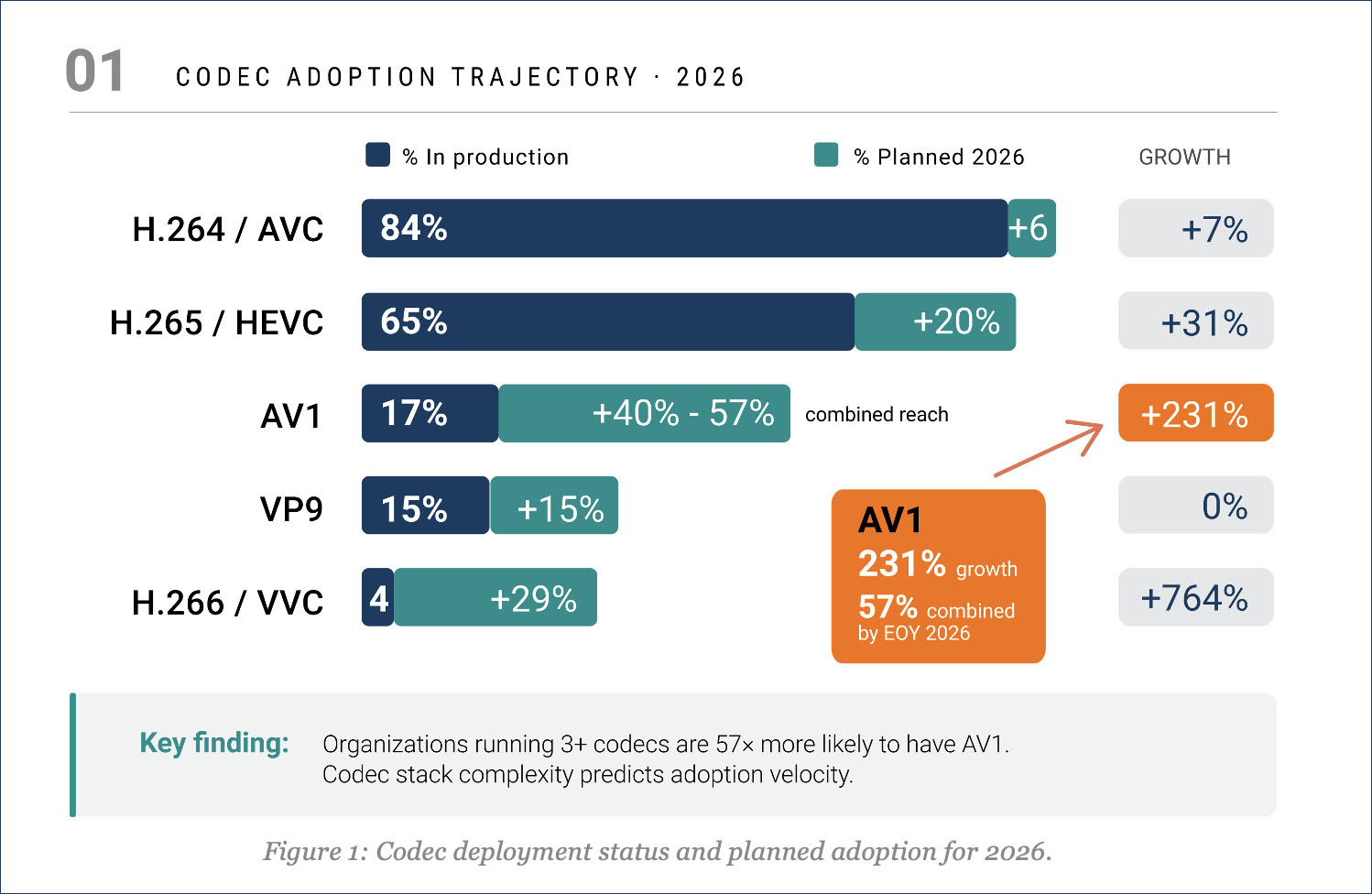
New data from NETINT’s state of video encoding survey shows H.264/AVC sits at 84% production deployment, making the standard effectively universal and plateaued. HEVC is at 65% in production with another 20% planning deployment, putting it on a path toward H.264-level ubiquity. But the breakout number belongs to AV1. At 17% current production deployment, AV1 might not look like much on its own. But 40% of respondents plan to deploy AV1 in 2026, giving it a combined reach of 57% by year-end. That is not early-adopter experimentation. That is mainstream planning. The barriers to AV1 adoption are worth noting because they are not primarily about the codec itself. Hardware decode support leads at 54%, followed by toolchain limitations at 43% and encoding compute costs at 37%. The licensing story is essentially a non-issue for AV1, with less than 1% cited it as a barrier. This stands in sharp contrast to VVC, where 44% flagged licensing and royalties as a concern. That licensing gap alone may determine which next-gen codec is deployed first. One additional data point I found interesting: organizations running three or more codecs in production today are 57 times more likely to have AV1 in their stack compared to single-codec operators. Current codec stack complexity is the strongest predictor of future adoption velocity. That pattern makes intuitive sense. Teams with multi-codec experience already have the tooling, testing workflows, and operational maturity to add another format without starting from scratch. VP9 offers a cautionary data point here. The data shows it sits at 15% production deployment with respondents, with only 15% planning further adoption, and 70% reporting no plans at all. VVC generates interest in evaluation, with 29% planning to adopt it, yet the successor to HEVC remains at just 4% in production deployment. It’s clear that VVC is facing both licensing headwinds and toolchain immaturity, unlike AV1. The report describes a clear codec progression ladder: organizations tend to climb from H.264 through HEVC and VP9 to AV1, meaning the current stack is a better predictor of next-gen adoption than company size or industry vertical. GPUs Dominate, But the Hardware Picture Is More Complicated Than It Appears GPUs hold 72% of the hardware acceleration market share, driven primarily by NVIDIA’s NVENC ecosystem. That number is not surprising. What is more revealing is what is happening underneath it. Among organizations using hardware acceleration, 41% deploy multiple hardware types simultaneously—GPU plus VPU, GPU plus on-premises appliance, or broader combinations. This is not a one-size-fits-all market. Organizations are matching different hardware to different workload profiles, and the data suggests this trend is accelerating rather than consolidating. GPU-specific pain points explain the hardware diversification. Power consumption leads at 39%, followed by codec/feature gaps at 37% and insufficient stream density at 35%. For live and high-density workloads, these are meaningful operational constraints. The report notes that VPU evaluation intent stands at 49%, nearly matching the 51% who plan to evaluate GPUs. Live and broadcast operators are 2.2 times more likely to adopt VPUs, driven by density economics and latency requirements that GPUs can struggle to meet at scale. The primary encoding method split also tells a story of transition. Software/CPU-based encoding remains the single largest encoding architecture at 37%, while hardware-accelerated (30%) and hybrid approaches (32%) collectively account for 62% of the market. The era of pure software encoding is winding down for anyone operating at a meaningful scale. AI in Encoding Has Crossed the Mainstream Threshold 60% of respondents currently deploy AI/ML in at least one encoding workflow, and 70% plan to expand those capabilities in 2026. That is no longer experimental. The more interesting story is where AI is heading versus where it started. Current deployments concentrate on what I would call adjacent applications: transcription and captioning at 46%, scene classification at 37%, and super-resolution at 26%. These sit next to the encoding pipeline but do not fundamentally change how encoding decisions are made. The highest-growth applications tell a different story. Content-aware ladder generation shows the highest planned growth at 77%, followed by QoE prediction at 50%. These are core encoding intelligence functions—they sit inside the pipeline and directly influence bitrate allocation, resolution selection, and quality optimization. This migration from auxiliary to core defines the AI trend in encoding for 2026. It also explains why AI expansion correlates with operational scale rather than company size. Organizations processing high VOD volumes are 2.3 times more likely to plan AI expansion regardless of employee count. GPU users are 2.4 times more likely, since GPU infrastructure provides the compute foundation for AI workloads. The implication for hardware vendors is clear: offering AI-ready compute alongside encoding capability could become a baseline expectation. The Quality Measurement Gap Nobody Is Talking About VMAF has crossed the 50% adoption threshold at 52%, establishing itself as the de facto objective quality metric for the encoding industry. PSNR remains at 32%, mostly due to legacy pipeline inertia rather than active preference. But here is the number I found interesting: 30% of respondents operate without any formal QA metrics. These organizations are making encoding decisions such as codec selection, bitrate allocation, and hardware investment without systematic quality measurement. The report finds they are 2.7 times more likely to report frequent quality issues and 1.9 times more likely to cite viewer complaints as a business problem. That gap correlates strongly with team size: organizations with one to two-person video teams are 3.1 times more likely to lack formal QA than those with 10+ person teams. This connects to a broader theme in the data. Content Adaptive Encoding (CAE) has nearly identical adoption across live (25%) and VOD (28%) workflows, which the report identifies as the clearest indicator of encoding sophistication, regardless of use case. Organizations using CAE for live workflows are 2.4 times more likely to also use AI/ML in their encoding pipeline. CAE adoption appears to serve as a gateway to broader encoding intelligence. For the 30% without formal QA, they are not just behind on measurement; they are likely missing the optimization wave reshaping streaming economics. The Biggest Roadmap Blockers Are Not Technical One of the more revealing sections of the report examines what is actually preventing organizations from executing their 2026 encoding roadmaps. The top constraints are capital and budget limitations (39%) and limited team capacity (38%). Device and technology support comes in at 30%, cost-per-channel pressure at 30%, and integration/API gaps at just 10%. In other words, 77% of respondents cite at least one organizational barrier, compared to just 19% citing a purely technical one. This shows the bottleneck is not the technology. It is the budget to buy it and the team capacity to implement it. This matters because the data elsewhere in the report shows that 49% of all respondents have video engineering teams of 1 to 5 people. Even among companies with 5,000+ employees, small video teams are not uncommon. When the report says lean teams are the norm across all company size brackets, it has real implications for how vendors should think about integration complexity, time to value, and operational overhead. Edge Encoding: High Interest, Low Conviction 42% of respondents expressed interest in deploying encoding at the edge, while 30% remain uncertain. This represents the largest undecided cohort on any topic in the survey. Only 29% said they are not interested at all. Among those interested, the top use cases are localized ladder generation (56%) and dynamic ad insertion (48%). Edge interest follows a U-shaped curve by company size. Small companies (46%) and large enterprises (43%) show the highest interest, while mid-market firms lag at 26–28%. Interest also correlates with operational scale: 50% of organizations running 250+ live channels are interested, compared with 35% at smaller scales. The data suggests edge economics become more compelling as encoding volume increases, regardless of overall company size. But the 30% uncertainty band represents the biggest market education opportunity in the survey. These organizations see the potential but lack the information or confidence to commit. Live event operators show the strongest interest in edge, at 44%, driven by latency requirements for real-time delivery. This aligns with what I have been hearing from operators at industry events—edge latency is becoming a competitive differentiator for sports and live entertainment. The report suggests that vendors who can reduce ambiguity through reference architectures, concrete use cases, and trial programs will convert undecided prospects faster than those who lead with product specs. Who Responded and Why It Matters Before drawing too many conclusions from any survey, it is worth understanding who completed it. Live events and sports broadcasting represent the single largest vertical at 35%, followed by subscription VOD at 18%, AVOD/FAST at 7%, and enterprise communications at 6%. Combined streaming verticals: live sports, SVOD, AVOD, and UGC represent 65% of the sample. EMEA leads geographically at 44%, followed by North America at 40%. The report is transparent about its limitations. Survey distribution through industry channels and NETINT’s network may overweight organizations already evaluating hardware encoding solutions. APAC (19%) and LATAM (16%) are underrepresented relative to their share of global streaming growth. These are fair caveats and worth keeping in mind when interpreting the data. The combination of executive-level respondents with real budget authority and hands-on engineers with operational experience makes this one of the more credible encoding industry surveys I have reviewed. The fact that nearly half the respondents are VP-level or above means the stated priorities and investment plans are not aspirational wish lists from mid-level managers—they reflect where actual dollars are going. The report runs more than 50 pages and covers codec adoption, hardware acceleration, AI/ML integration, quality measurement, cost structures, and organizational archetypes. The full report is available from NETINT here. It includes detailed archetype analysis of four distinct organizational segments, build-versus-buy economics, executive priority rankings, and projections. For a vendor-sponsored survey, NETINT deserves credit for producing something with analytical depth.
-
Akamai Details Rising Supply Chain Costs and Upcoming Price Adjustments
Due to rising costs for servers, RAM, SSDs, and energy, Akamai has notified customers and partners of upcoming interim surcharges and pricing adjustments for contract renewals. Akamai shared...
General Source
Due to rising costs for servers, RAM, SSDs, and energy, Akamai has notified customers and partners of upcoming interim surcharges and pricing adjustments for contract renewals. Akamai shared candid data with me on the massive economic pressures they are seeing across their supply chain and the specific market drivers behind the updated pricing. While CDN pricing has declined steadily for years, the current hardware and energy markets are forcing a shift. Akamai provided a detailed explanation of why they are implementing adjustments to account for what they describe as significant market-driven forces. They noted that over the years, Akamai has worked hard to maintain economic stability for its customers and partners amid rising global infrastructure costs. However, they are now introducing what they call a modest adjustment in response to the economic pressures reshaping the industry. According to the data Akamai provided, the cost of server components has spiked significantly since October 2025. Specifically, their market costs for RAM have more than doubled, and SSD pricing has seen significant increases. Due to ongoing supply shortages, Akamai noted that server costs increased between 75% and 200% compared to the first half of 2025. These hardware costs are not stabilizing. In fact, they are continuing to climb on an almost monthly basis. This aligns with recent industry analysis, with some analyst firms noting that end-user prices for memory and storage could rise by 150% to 300% or more in 2026 and 2027, compared to 2025 levels. Hardware is not the only factor, with Akamai noting that energy costs increased by more than 200% in many regions. Personnel costs are also rising significantly, as the market for highly talented engineering and services talent remains highly competitive. Given the growth in server costs over the past few months and a forecast for double-digit increases to continue into 2026, the company explained that it can no longer absorb these costs while maintaining the same performance and security standards. To address this, Akamai is implementing two specific changes: Interim Surcharge: Effective April 1, 2026, a 3% surcharge will be passed through to customers and partners. Renewal Adjustments: Akamai will incorporate a price adjustment of up to 10% on contract renewals to reflect the current cost environment. In response to my questions about what they have done internally to offset these costs, Akamai was clear that they are working to mitigate the impact through a variety of internal optimizations. This included org structure adjustments and migrating their own internal workloads to Akamai Cloud to significantly reduce third-party cloud spend. Ultimately, Akamai views this decision as an operational necessity to maintain the security and performance levels its customers require. The company noted that these changes are required to fund the ongoing costs of infrastructure, maintenance, and innovation associated with managing increasingly sophisticated cloud and edge services. While nobody likes cost pressures, this is clearly a systemic issue across the infrastructure market, not isolated to Akamai. We are seeing similar moves from other players. Hetzner recently announced price increases of up to 50% for its services, and OHVcloud has implemented similar measures. This reflects broader market realities, where every provider is facing the same spike in server and power costs, and the current cost environment is likely to continue into 2027. I will continue to track how other CDNs and cloud providers respond to these same supply chain pressures.
-
The Technology Behind Comcast’s 30 Mbps Upscaled 4K Super Bowl Stream
In conjunction with Super Bowl LX, Comcast’s Xfinity announced the launch of what they call “RealTime4K”, a new ultra-low-latency technology with a 30 Mbps bitrate supporting Dolby Vision HDR and...
General Source
In conjunction with Super Bowl LX, Comcast’s Xfinity announced the launch of what they call “RealTime4K”, a new ultra-low-latency technology with a 30 Mbps bitrate supporting Dolby Vision HDR and Dolby Atmos, compatible with an Xfinity X1 XG1v4 or Xi6 TV Box, or an XiOne streaming TV Box for Xfinity Flex. Comcast is positioning RealTime4K as a 4K delivery architecture designed specifically for premium live sports and optimized for both speed and visual fidelity. Unlike traditional 4K streams that rely heavily on compression, the technology is engineered to reduce latency while maintaining high-bitrate video and immersive audio formats. While the brand name to consumers uses the term 4K, it’s important to note that it is not native 4K and that Comcast’s source feed is 1080p HDR. Comcast’s RealTime4K uses DASH and HLS to stream to set-top boxes, and via the Xfinity Stream app, compatible customer-owned streaming devices (Xumo Stream Box, Apple TV, Fire TV, Roku, Samsung and LG TVs) can also get the 30 Mbps stream but without the ultra-low-latency functionality. Comcast set-top boxes further use low-latency DASH (LL-DASH) to remove delays introduced by segment packaging and client-side buffers. For the encoding pipeline, Comcast uses HEVC and Dolby Vision Profile 8.1, with a bitrate ladder that caps at 30 Mbps and supports full 4K resolution on both the first and second rungs. And since last year’s Super Bowl, Comcast has integrated the latest Dolby Vision improvements into its encoding pipeline. For audio encoding, Comcast RealTime4K always includes Dolby Atmos, natively produced when available from the content provider and, otherwise, upmixed by Comcast. Comcast encodes Atmos at 768 Kbps and delivers it as DD+JOC. For Super Bowl LX, Comcast partnered with NBCUniversal and used a JPEG-XS source feed. Typical 4K live events are compressed to 50-70 Mbps using HEVC before being sent to distributors. Using JPEG-XS at over 300 Mbps allowed Comcast to avoid a generation of HEVC encoding, significantly improving picture quality and reducing latency by about 5 seconds in the video production pipeline. The core of Comcast’s RealTime 4K video pipeline is a DASH live ingest, powered distribution transcoder, and CMAF linear origin. The transcoder accepts JPEG-XS as input (or HEVC mezzanine when JPEG-XS isn’t available) and generates all needed renditions while minimizing overall delay. The transcoder publishes each chunk of media, as it is encoded, to the CMAF linear origin. The origin provides access to DASH manifests and segments to both the just-in-time packager (JITP) for live playback and Comcast’s Cloud DVR system. Comcast has partnered with MediaKind for transcoding while building its own CMAF linear origin and JITP. For Super Bowl LX, Comcast used its on-premises CDN to deliver the RealTime4K feed, but also uses the same LL-DASH video architecture to power partner systems using public CDNs such as Akamai and CloudFront. Beyond the architectural claims, Comcast also put RealTime4K into a live, high-stakes environment during a full day of Olympics and Super Bowl coverage, plus streaming coverage on Peacock, making Sunday, February 8, the most-trafficked day ever for video streaming on Comcast’s network. According to internal testing Comcast conducted during the event, the RealTime4K feed on Xfinity delivered latency that was between 9 and 49 seconds ahead of vMVPD streaming services, even as the network experienced its most-trafficked day for video streaming to date, driven by a mix of IP video streams (including the RealTime4K feed) and streaming on Peacock and other platforms. During my testing of the Super Bowl LX stream, I was unable to test Comcast’s RealTime4K latency myself, as I am not in Comcast’s footprint; otherwise, I would have included them in my Super Bowl LX latency chart. As of today, Comcast RealTime4K technology is free for all customers, with the primary limitation being the hardware requirements for the ultra-low-latency verison of the stream. For customers who do not currently have compatible hardware, the company is offering device swaps to 4K-enabled Xfinity equipment at no additional cost. Customers can also visit a nearby Xfinity store to exchange their existing X1 TV box for a 4K-capable one. Comcast is positioning RealTime4K as the preferred delivery model for live 4K events going forward, not just for showcase events like the Super Bowl, and is already in talks with other programming partners to bring this technology to their live 4K events this year. The company has also emphasized its ongoing commitment to continuous network improvement, focusing on further optimizing delivery, throughput, and video pipelines to push the limits of video quality, latency, and immersive live-viewing performance. If you have had an opportunity to check out the RealTime4K tech at your home, please feel free to share your experience in the comments. I’ll be hands-on with the technology and offering soon, and will provide updates to this post once I see it in person.
-
CDN Netskrt Discloses Network Capacity, Revenue, and How it Adds Capacity Profitably
Netskrt Systems has carved out a meaningful foothold in the global streaming video market, particularly tier-one live events such as NFL football games, supporting both TNF on Prime Video and the...
General Source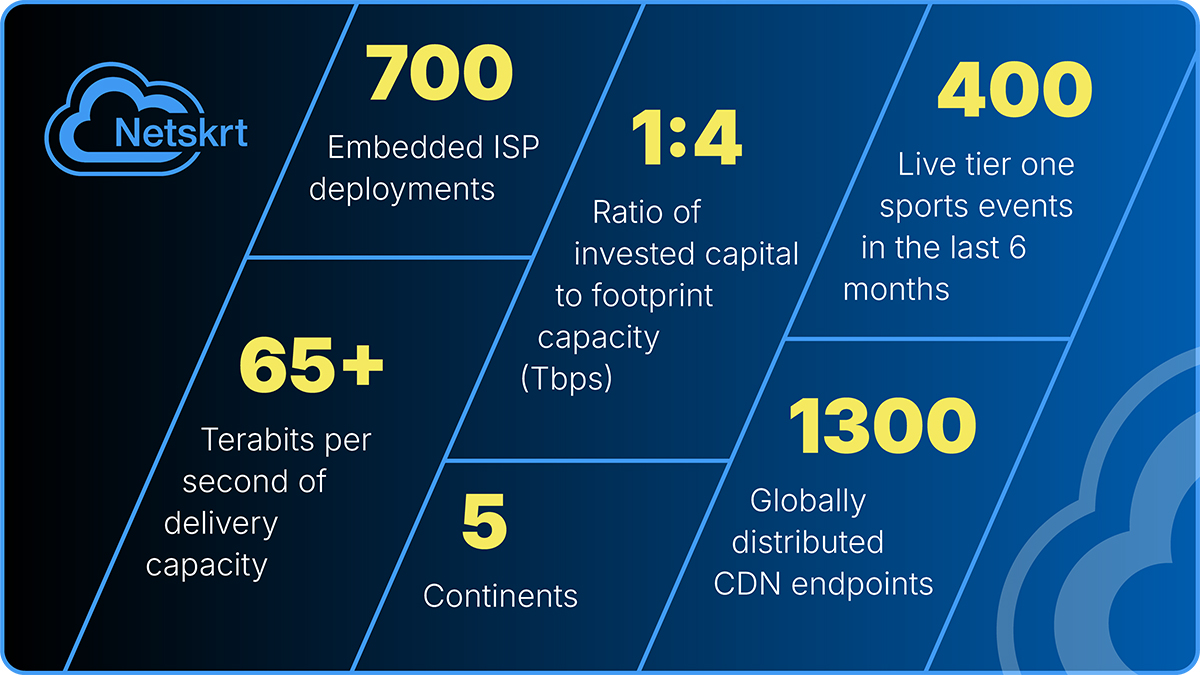
Netskrt Systems has carved out a meaningful foothold in the global streaming video market, particularly tier-one live events such as NFL football games, supporting both TNF on Prime Video and the recent Super Bowl on Peacock. It has done this in a manner unlike most of its competitors, focusing on broad, deep deployment of pure software POP instances that reduce its underlying costs. The cost factor is the key, since historically we have seen CDN vendors grow capacity at the risk of burning a lot of cash. The net result, the company tells me, is the ability to operate profitably under the demanding price umbrellas imposed by global streaming platforms. And this does show up in its numbers. Netskrt has built far more capacity and generated more revenue with less invested capital than its CDN peers, at its current size. With about $30 million in invested capital, Netskrt expects to exceed a 1:1 capital-to-revenue ratio in 2026 and a 1:4 capital-to-capacity ratio. Conventional CDNs typically operate closer to a higher multiple, but few disclose the ratios publicly. Netskrt informs me that its current “steady state” capacity is about 65 Tbps, but notes that because software instances can be spun up when and where required, whether on bare metal, virtual machines, or containers, the effective capacity that can be instantiated in 24 to 48 hours is substantially greater. In fact, when it wants to, Netskrt said it can even spin up capacity in cloud-based spot instances in minutes. This approach, which the company likens to a software-defined CDN, gives Netskrt considerable flexibility while also taking a sledgehammer to capital costs. Further, it’s a stratified infrastructure. Where Netskrt sees persistent, long-lasting demand for capacity, it can deploy iron to meet that demand in a manner that leans more toward CapEx than OpEx. Where it sees the reverse—in particular, the bleeding edge of spiky demand curves associated with live sports that are inherently seasonal, it can lean in the opposite direction. Executing this is more than just a business strategy; Netskrt says it requires CDN technology capable of positioning and repositioning content, as well as live-streaming POPs, in response to a complex array of real-time conditions. Roughly half of Netskrt’s capacity is embedded in last-mile ISP networks, with the balance allocated to its mid- and global tiers. From a geographic perspective, Netskrt now reaches across North America, South America, Europe and regions in APAC. Netskrt’s current growth trajectory, which has picked up significantly over the last year, will see it reach 150 Tbps by the end of 2026. Their partnerships with large network and bare metal suppliers like Lumen enable them to ramp up to these levels quite quickly. The company recently conducted a survey with professionals from 55 global ISPs to better understand how major events impact network performance. You can check out the results from that study here.
-
Mansfield's Reed scores fabulous free-kick to upset Burnley
Watch Mansfield Town's Louis Reed produce "set-piece sorcery," scoring a sensational free kick to stun Premier League side Burnley and reach the FA Cup fifth round.
General Source
-
These New ‘Super Mario Galaxy Movie’ Posters Go Galactic
Get some new, cosmic looks at the heroes and villains of 'The Super Mario Galaxy Movie.'
General Source
-
Church must learn from abuse victims, says new Catholic Archbishop
Archbishop Richard Moth was speaking to a 2,000-strong congregation during his installation at Westminster Cathedral.
General Source
-
Aston Villa v Newcastle: FA Cup fourth round – live
Updates from 5.45pm (GMT) game at Villa ParkFollow us over on Bluesky | And get in touch: email BarryThose teams: Unai Emery makes seven changes to the team that started against Brighton in...
General Source
Updates from 5.45pm (GMT) game at Villa ParkFollow us over on Bluesky | And get in touch: email BarryThose teams: Unai Emery makes seven changes to the team that started against Brighton in midweek. Marco Bizot, Pau Torres, Victor Lindelof, Lucas Digne, Ross Barkley, Leon Bailey and Tammy Abraham all start.Newcastle make six changes to the side that started against Tottenham, as Eddie Howe brings in Aaron Ramsdale, Lewis Hall, Sandro Tonali, Jacob Murphy, Nick Woltemade and William Osula. Continue reading...
-
Stoat removes all LLM-generated code following user criticism
General Source
-
Baloucoune spares Ireland’s Six Nations blushes as they recover to see off Italy
Ireland 20-13 ItalyAzzurri led at half-time for first time in DublinAfter what felt like 40 days and 40 nights of darkness and rain, the sun came out in Dublin. Cold, yes, and a grey day by...
General Source
Ireland 20-13 ItalyAzzurri led at half-time for first time in DublinAfter what felt like 40 days and 40 nights of darkness and rain, the sun came out in Dublin. Cold, yes, and a grey day by kick-off but bright enough to throw light on an Ireland side scrambling for their footing, and a bullish Italy one looking to break new ground.Never having won a Six Nations game in Dublin might be the sort of statistic to weigh you down. The Azzurri carried it like a backpack with only a couple of bits and bobs. For the first 40 minutes of physical, narky and very watchable Test rugby, they looked like they have never looked before at this venue in this competition: a well-rounded side with self-assurance to go with passion. By the end of 80 minutes the picture had changed only to reflect a shortage of finesse to finish, as they pounded away in the Ireland 22 before James Lowe lifted the siege. Continue reading...
-
Democratic senators launch inquiry into EPA’s repeal of key air pollution enforcement measure
Senators said repeal was ‘particularly troubling’ and was counter to EPA’s mandate to protect human healthMore than three dozen Democratic senators have begun an independent inquiry into the US...
General Source
Senators said repeal was ‘particularly troubling’ and was counter to EPA’s mandate to protect human healthMore than three dozen Democratic senators have begun an independent inquiry into the US Environmental Protection Agency (EPA) following a huge change in how the agency measures the health benefits of reducing air pollution that is widely seen as a major setback to US efforts to combat the climate crisis.In a regulatory impact analysis, the EPA said it would stop assigning a monetary value to the health benefits associated with regulations on fine particulate matter and ozone. The agency argued that the estimates contain too much uncertainty. Continue reading...
-
India doubles down on state-backed venture capital, approving $1.1B fund
India’s $1.1B fund-of-funds will invest through private VCs to support deep-tech and manufacturing startups.
Business Source
-
Scotland v England: Six Nations rugby union – live
Updates from 4.40pm (GMT) game at MurrayfieldGet in touch: mail Daniel with your thoughtsEverything points to an English victory. Form, logic, reason, the laws of nature.But none of that counts in...
General Source
Updates from 4.40pm (GMT) game at MurrayfieldGet in touch: mail Daniel with your thoughtsEverything points to an English victory. Form, logic, reason, the laws of nature.But none of that counts in this, does it? This is Scotland. This is Murrayfield. This is the land of bagpipes and tartan and haggis and all the other cliches that swirl around the discourse whenever the aul enemy have the temerity to roll up north and expect a triumph. Continue reading...
-
US military used Anthropic’s AI model Claude in Venezuela raid, report says
Wall Street Journal says Claude used in operation via Anthropic’s partnership with Palantir TechnologiesClaude, the AI model developed by Anthropic, was used by the US military during its...
General Source
Wall Street Journal says Claude used in operation via Anthropic’s partnership with Palantir TechnologiesClaude, the AI model developed by Anthropic, was used by the US military during its operation to kidnap Nicolás Maduro from Venezuela, the Wall Street Journal revealed on Saturday, a high-profile example of how the US defence department is using artificial intelligence in its operations.The US raid on Venezuela involved bombing across the capital, Caracas, and the killing of 83 people, according to Venezuela’s defence ministry. Anthropic’s terms of use prohibit the use of Claude for violent ends, for the development of weapons or for conducting surveillance. Continue reading...
-
Ireland survive scare from superb Italy in Dublin
Ireland survive a major scare from Italy to claim their first win in this year's Six Nations and deny the Azzurri a first championship victory in Dublin.
General Source
-
A Review of M Disc Archival Capability. With long term testing results
General Source
-
Winter Olympics 2026 LIVE: Team GB aim for record-breaking medal haul
Great Britain's Bruce Mouat and Grant Hardie (left) during the Men's Curling match against Czechia…. Pic: PA
General Source Winter Olympics 2026 LIVE: Team GB aim for record-breaking medal haul" onerror="this.src='static/images/placeholder.svg'">
-
Record 1,000 UK taxpayers under 30 earned more than £1m last year
HMRC figures show 11% rise in young million-pound earners, with influencers and tech pay cited as keyTheir generation is often derided for being work-shy, self-centred and overly sensitive. But...
General Source
HMRC figures show 11% rise in young million-pound earners, with influencers and tech pay cited as keyTheir generation is often derided for being work-shy, self-centred and overly sensitive. But when it comes to making money, people under 30 are proving they are something else entirely: successful.A record 1,000 taxpayers under 30 earned more than £1m last year, an 11% increase on the year before, HMRC records show. Continue reading...
-
The science behind the frog poison that allegedly killed Navalny
An ameerega bilinguis, more commonly known as an Ecuador poison frog
General Source
-
Platforms bend over backward to help DHS censor ICE critics, advocates say
General Source
-
Sixteen-year-old charged with murder after fatal stabbing of 18-year-old
The Metropolitan Police said they were called to Victoria Road, Feltham. Pic: Google Maps
General Source
-
Switzerland to Vote on Capping Population at 10M
General Source
-
Vim 9.2 Released
General Source
-
My smart sleep mask broadcasts users' brainwaves to an open MQTT broker
General Source
-
Hi-Yah! ‘The Muppet Show’ Was a Smash Hit
Disney's given everyone more Muppets with 'The Muppet Show,' and people love it. But is there more on the horizon?
General Source
-
Brazil’s Pinheiro Braathen wins gold – and South America’s first Winter Olympics medal
Norwegian-born skier storms to historic slalom gold‘Your difference is your superpower,’ says 25-year-old As the snow fell in Bormio, and the fog settled in, Lucas Pinheiro Braathen made history...
General Source
Norwegian-born skier storms to historic slalom gold‘Your difference is your superpower,’ says 25-year-old As the snow fell in Bormio, and the fog settled in, Lucas Pinheiro Braathen made history by becoming the first South American to win a Winter Olympic medal. Then, as the realisation that he had won gold for Brazil in the men’s giant slalom, he collapsed to the floor and allowed the tears to flow.“I just hope that Brazilians look at this and truly understand that your difference is your superpower,” he said, still sobbing away. “It may show up in your skin or in the way you dress. But I hope this inspires every kid out there who feels a bit different to trust who you are.” Continue reading...
-
US launches airstrikes on dozens of Islamic State targets in Syria
Militant group’s infrastructure and weapons storage facilities were hit, as Washington praised Damascus for fresh coalition roleThe US military conducted 10 strikes on more than 30 Islamic State...
General Source
Militant group’s infrastructure and weapons storage facilities were hit, as Washington praised Damascus for fresh coalition roleThe US military conducted 10 strikes on more than 30 Islamic State targets in Syria between 3 and 12 February as part of a campaign against the extremist group in Iraq and Syria.US Central Command (Centcom) said in a statement on Saturday that the US had struck IS infrastructure and weapons storage targets. Continue reading...
-
Summerville strike earns 10-man West Ham extra-time FA Cup win at Burton
For West Ham’s second string, barring a shock defeat this could barely have been a more uncomfortable afternoon. With the captain Jarrod Bowen among a clutch of regulars given a breather, it was...
General Source
For West Ham’s second string, barring a shock defeat this could barely have been a more uncomfortable afternoon. With the captain Jarrod Bowen among a clutch of regulars given a breather, it was Crysencio Summerville, a late substitute Nuno Espírito Santo would have rather kept fresh, who spared embarrassment at Burton Albion and helped them into the FA Cup fifth round. Four years ago at Kidderminster, in this competition, it was Declan Rice who entered to save their skin and it was a similar story here, Summerville’s extra-time strike preventing penalties.West Ham squeezed through, Freddie Potts’s red card 11 minutes into extra time for crunching into the Burton substitute Julian Larsson ensuring a nervy finale, in which another sub Kain Adom skittled a stoppage-time shot against the side netting. For Gary Bowyer, Burton’s colourful head coach who was wearing boxing gloves when he greeted his squad in the dressing room, a nod to a theme adopted through this Cup run, they almost landed a knockout blow. Continue reading...
-
Rescue cat renowned as chief mouser at UK’s Foreign Office dies in Bermuda
Social media account for Palmerston, who retired in 2020, announces death of ‘Diplocat extraordinaire’Palmerston, a rescue cat who became the chief mouser of the Foreign Office, has died in...
General Source
Social media account for Palmerston, who retired in 2020, announces death of ‘Diplocat extraordinaire’Palmerston, a rescue cat who became the chief mouser of the Foreign Office, has died in Bermuda.The cat, adopted from Battersea Dogs & Cats Home, retired in 2020 after four years of service in Whitehall. Continue reading...
-
Homeland Security has sent out subpoenas to identify ICE critics
General Source
-
What is colorectal cancer and is it preventable?
Cases among younger people are rising – such as with actor James Van Der Beek, who died on 11 February at age 48Actor James Van Der Beek died on 11 February, aged 48; he had been diagnosed in 2023...
General Source
Cases among younger people are rising – such as with actor James Van Der Beek, who died on 11 February at age 48Actor James Van Der Beek died on 11 February, aged 48; he had been diagnosed in 2023 with colorectal cancer.According to the World Health Organization, colorectal cancer is the third most common cancer and the second leading cause of cancer-related deaths worldwide. While rates are declining overall, cases among younger people are rising. Continue reading...
-
Labubus to burkinis: V&A unveils updated 21st-century design galleries
Museum’s revitalised galleries bring together 250 objects to show how design shapes modern lifeWhat do the first ever baby monitor, Nigeria’s 2018 World Cup kit, an 80s boombox, the smashed parts...
General Source
Museum’s revitalised galleries bring together 250 objects to show how design shapes modern lifeWhat do the first ever baby monitor, Nigeria’s 2018 World Cup kit, an 80s boombox, the smashed parts of Edward Snowden’s computer, a “Please offer me a seat” badge and a Labubu have in common? They are all included in the V&A’s Design 1990-Now galleries, which reopen to the public this week.The galleries, which run across two rooms on the upper floors of the museum, also house a collection of antique books. The displays cover six different themes including housing and living, crisis and conflict, and consumption and identity, rather than in a strict chronological order. Continue reading...
-
‘Nothing says love like chemicals’: Valentine’s roses often covered in pesticides, testing finds
Bouquets imported to Europe found to be heavily contaminated, often with chemicals banned in EU and UKStay away from roses this Valentine’s Day, environmental campaigners have warned after testing...
General Source
Bouquets imported to Europe found to be heavily contaminated, often with chemicals banned in EU and UKStay away from roses this Valentine’s Day, environmental campaigners have warned after testing revealed them to be heavily contaminated with pesticides.Laboratory testing on bouquets in the Netherlands, Europe’s flower import hub, found roses had the highest residues of neurological and reproductive toxins compared with other flowers. Continue reading...
-
Epstein's Ugly World of Science
General Source
-
7zip.com Is Serving Malware
General Source
-
Senior Reform UK figures attend launch of How to Launder Money book
Co-author George Cottrell is close aide to party leader Nigel Farage and served several months in US prisonAs a choice for a book title, How to Launder Money certainly caught the eye. But then...
General Source
Co-author George Cottrell is close aide to party leader Nigel Farage and served several months in US prisonAs a choice for a book title, How to Launder Money certainly caught the eye. But then again, its co-author George Cottrell claims to know what he’s talking about.A close aide to Nigel Farage, Cottrell served several months in a US prison after being convicted there in 2017 for wire fraud – a chapter in his life he referred to at his book launch party on Thursday night. Continue reading...
-
Canada warned after curling ‘F-bomb’ sparks emergency spot checks at Winter Olympics
Cheating allegations and curse words fly in matchWorld Curling says officials will watch for rule violationsCanada’s men’s curling team have escaped punishment in the Winter Olympics despite...
General Source
Cheating allegations and curse words fly in matchWorld Curling says officials will watch for rule violationsCanada’s men’s curling team have escaped punishment in the Winter Olympics despite appearing to have broken the rules in a bad-tempered victory over Sweden. However, World Curling has warned the Canadians about their abusive language during their 8-6 win on Friday, and introduced emergency spot checks.The game was halted after Sweden claimed their rivals were touching the stone following release – which is not allowed under the rules – and asked officials to keep an eye out for further incidents. With Canada 7-6 ahead after the penultimate end, Sweden’s Oskar Eriksson then told Marc Kennedy he was double-touching the stone, which led to the Canadian responding with an expletive. Continue reading...
-
Golf game built last night with Claude Code, Svelte and ThreeJS
General Source
-
Authorities investigating Nancy Guthrie disappearance seal off road
Pima County sheriff and FBI investigate Nancy Guthrie's disappearance. Pic: AP
General Source
-
Russia killed Alexei Navalny with frog toxin, UK and four European allies say
Intelligence agencies say deadly toxin in skin of Ecuador dart frogs found in Navalny’s body and highly likely resulted in his deathMunich Security Conference – live updatesAlexei Navalny, the...
General Source
Intelligence agencies say deadly toxin in skin of Ecuador dart frogs found in Navalny’s body and highly likely resulted in his deathMunich Security Conference – live updatesAlexei Navalny, the Russian opposition leader, was killed by dart frog poison administered by the Russian state two years ago, a multi-intelligence agency inquiry has found, according to a statement released by five countries, the UK, France, Germany, Sweden and the Netherlands.The US was not one of the intelligence agencies making the claim. Continue reading...
-
To infinity and beyond! Visitors can dive into Pixar worlds in immersive London show
Shrink to toy-size or dive into an ocean in exhibition where studio brings Toy Story, Finding Nemo and Up to lifeIf you have ever wanted to rummage through the books in Andy’s bedroom from Toy...
General Source
Shrink to toy-size or dive into an ocean in exhibition where studio brings Toy Story, Finding Nemo and Up to lifeIf you have ever wanted to rummage through the books in Andy’s bedroom from Toy Story or inspect the vintage trinkets lining the shelves of Carl Fredricksen’s home in Up, you’re in luck.Scenes from some of Pixar’s most beloved films have been meticulously recreated in Wembley, north London, as part of the newly opened immersive Mundo Pixar Experience. Continue reading...
-
‘More bling’: Matt Weston targets second Winter Olympics gold after skeleton glory
British sledder has high hopes for new mixed team event‘We’re going to be one of the strongest sets of teams’Matt Weston celebrated becoming the first British athlete to win a gold medal at these...
General Source
British sledder has high hopes for new mixed team event‘We’re going to be one of the strongest sets of teams’Matt Weston celebrated becoming the first British athlete to win a gold medal at these Olympics by having three slices of margherita pizza and then going straight to bed. “Some people might find it surprising,” Weston said on Saturday morning, “but I’ve got to keep my head together for the team race on Sunday.”The mixed team skeleton is a new event at these Olympics, and it means Weston has a shot at becoming the first British athlete to win two medals at the same Winter Olympics. Continue reading...
-
I Went On a Dinner Date With an AI Chatbot. Here’s How It Went.
How's your Valentine's Day going?
General Source
-
Police seal off road near Arizona home of Today show host Samantha Guthrie’s missing mother
Sheriff’s, FBI and forensics vehicles passed through roadblocks 2 miles from missing 84-year-old woman’s homeLaw enforcement investigating the disappearance of Today show host Savannah Guthrie’s...
General Source
Sheriff’s, FBI and forensics vehicles passed through roadblocks 2 miles from missing 84-year-old woman’s homeLaw enforcement investigating the disappearance of Today show host Savannah Guthrie’s mother, Nancy, sealed off a road near her home in Arizona late Friday night.A parade of sheriff’s and FBI vehicles, including forensics vehicles, passed through the roadblock that was set up about 2 miles (3.2km) from the house. Continue reading...
-
Show HN: Sameshi – a ~1200 Elo chess engine that fits within 2KB
General Source
-
Skier makes history for Brazil by winning gold in giant slalom
Lucas Pinheiro Braathen makes history for Brazil by clinching his nation's first Winter Olympic medal with gold in the giant slalom.
General Source
-
Manchester City v Salford, Burnley v Mansfield and more: FA Cup and EFL – live
Updates from FA Cup fourth round matches and moreFollow us on Bluesky | And get in touch: email XaymacaBurton Albion 0-0 West Ham (12:15pm)Burnley v Mansfield TownManchester City v Salford...
General Source
Updates from FA Cup fourth round matches and moreFollow us on Bluesky | And get in touch: email XaymacaBurton Albion 0-0 West Ham (12:15pm)Burnley v Mansfield TownManchester City v Salford CityNorwich City v West Bromwich AlbionSouthampton v Leicester CityAston Villa v Newcastle United (5:45pm)Liverpool v Brighton & Hove Albion (8pm)Hello and welcome to another Saturday clockwatch. Today we have seven FA Cup fourth round games to enjoy, including Manchester City v Salford City and Burnley v Mansfield Town at 3pm. Continue reading...
-
Ireland v Italy: Six Nations rugby union – live
Updates from 2.10pm kickoff (GMT) in DublinFollow us over on Bluesky | And get in touch: mail DanielJust seen a stat from Russ Petty concerning the expereince of the two teams.In terms of caps,...
General Source
-
Ooh.directory: a place to find good blogs that interest you
General Source
-
One giant boys' club? Why Westminster still feels like a man's world
The decision to appoint Peter Mandelson has prompted soul searching about women’s role in government, writes Laura Kuenssberg.
General Source
-
Russia killed opposition leader Alexei Navalny using dart frog toxin, UK says
There is no innocent explanation for the toxin, called epibatidine, being found in samples taken from Navalny's body, the Foreign Office said.
General Trending (2 sources)
-
How many registers does an x86-64 CPU have? (2020)
General Source
-
'She's running with the ski under her arm' - Sweden survive crash chaos to win silver
Sweden claim an incredible silver medal as Frida Karlsson completes a heroic comeback after Ebba Andersson crashed and lost one of her skis in the women's cross-country ski final.
General Source
-
Casey Wasserman to sell talent agency after Epstein fallout, reports say
The prominent agent and LA Olympics chief has come under scrutiny over past ties with Jeffrey Epstein and Ghislaine Maxwell.
General Source
-
Tom Banton powers England to emphatic T20 World Cup win over Scotland
Group C: England, 155-5, bt Scotland 152 all out, by 5 wktsBanton hits seven boundaries in unbeaten 63In the city where a few handfuls of rupees were melted down to make the original Calcutta Cup,...
General Source
Group C: England, 155-5, bt Scotland 152 all out, by 5 wktsBanton hits seven boundaries in unbeaten 63In the city where a few handfuls of rupees were melted down to make the original Calcutta Cup, it was Scotland who lost their shape when the heat started to rise and the pressure to build. England won by five wickets and though it was, in the end, emphatic it was not exactly a rediscovery of peak form, even if Tom Banton appeared to have located his with a 41-ball 63 that powered his team to victory.Scotland built half an excellent innings, but it careered downhill at Winterolympian pace in its third quarter. They faced two helpings of spin, each four overs long, and each brought carnage of a different kind: a barrage of runs in the first, a riot of wickets in the second. From there they recovered somewhat, but on a fine batting wicket England never seriously flirted with defeat, even if they did briefly threaten to self-destruct. Continue reading...
-
Police set up national group to deal with UK-related Epstein allegations
Senior policing source says ‘tsunami’ of claims expected after US release of papers relating to disgraced financierBritish police have set up a new national group to deal with allegations that...
General Source
Senior policing source says ‘tsunami’ of claims expected after US release of papers relating to disgraced financierBritish police have set up a new national group to deal with allegations that Jeffrey Epstein’s trafficking of women had ties to Britain, as well as claims against his associates, such as Andrew Mountbatten-Windsor.At least three British police forces are dealing with allegations triggered by the revelations about Epstein and his associates in documents released in the US, with more claims of wrongdoing expected by police officials. Continue reading...
-
England edge to victory to leave Scotland on brink
England wobble again but get their T20 World Cup campaign back on track with a five-wicket win over Scotland, leaving the Scots on the brink of an early exit.
General Source
-
‘Reminded me of a cheese, onion and mayo sandwich’: the best (and worst) supermarket quiche, tasted and rated
Which quiche egg-celled and which crumbled in the face of our rigorous taste test?• The best supermarket extra-virgin olive oilI learned to make quiche from one of the best chefs I know, Gill...
General Source
Which quiche egg-celled and which crumbled in the face of our rigorous taste test?• The best supermarket extra-virgin olive oilI learned to make quiche from one of the best chefs I know, Gill Meller, my old head chef at River Cottage HQ, about 20 years ago. His quiche is rich and creamy, with beautifully crumbly pastry, and my benchmark for these store-bought versions.I tasted all of the quiches cooked according to the manufacturer’s instructions. Overall, the quality was lower than I’d hoped for, with many relying on ultra-processed ingredients, such as palm oil, emulsifiers and, often, caged-hen eggs. Free-range products didn’t always communicate this clearly on the packet, so it’s worth checking the ingredients list. Also, some described their pastry as “buttery” when they don’t contain any butter, and are instead made with vegetable shortening (palm and rapeseed oil). Encouragingly, however, a few gems emerged, with wonderfully simple ingredients, light and fluffy free-range custards, crisp all-butter pastry and generously filled. Continue reading...
-
‘I cut out one little house at a time’: the trucker who spent decades building a tiny replica of NYC
Queens-born Joe Macken’s hyperrealistic model, made with wood, cardboard and glue, is now on view at the Museum of the City of New YorkIn 2003, Joe Macken built a miniature model of a bridge out...
General Source
Queens-born Joe Macken’s hyperrealistic model, made with wood, cardboard and glue, is now on view at the Museum of the City of New YorkIn 2003, Joe Macken built a miniature model of a bridge out of popsicle sticks. He wanted it to look like a “hybrid” of the Brooklyn, Manhattan, and Williamsburg bridges. Soon after, Macken, who grew up in Middle Village, Queens, moved his family to a small town upstate, more than 160 miles from the city. Macken loaded his bridge on the moving truck. It did not make the trip.“It got destroyed, and I was kind of bummed,” said Macken, who is now 63. “So I figured, let me build something better.” Continue reading...
-
‘Stabbed in the Face soundtracked an incredibly joyous time’: the weirdest songs we find romantic
Declarations of undying affection, comparisons to a summer’s day? Who needs ‘em! Our writers recall the offbeat songs that capture their heartsBy Easter 2004, I’d been in a relationship with my...
General Source
Declarations of undying affection, comparisons to a summer’s day? Who needs ‘em! Our writers recall the offbeat songs that capture their heartsBy Easter 2004, I’d been in a relationship with my partner, Maria, for four months and I was just realising how deeply in love I was. We had become inseparable. A magazine sent me to the ATP festival at Pontins in Camber Sands to interview “the Beastie Boys of noise”, Wolf Eyes. The interview fell to pieces when the band, in a state of great psychic refreshment, all wearing Manowar T-shirts, refused to stop watching a Manowar DVD and signalled they would only answer questions if they related to Manowar. Continue reading...
-
Elon Musk Has Changed His Mission Statement
Across his companies and his public statements, Musk is making a hard reset.
General Source
-
Jesy Nelson breaks down in tears after hitting 100k signatures for health campaign
Jesy Nelson broke down in tears after her campaign for more health checks on babies reached 100,000 signatures - meaning it must be debated by MPs.
General Source
-
The Best Time to Leave xAI Is Before Joining. The Next Best Time is Right Now
Would you believe working for Elon Musk sucks?
General Source
-
‘It is an honour’: Tottenham confirm Igor Tudor as interim head coach until end of season
Former Juventus head coach replaces Thomas FrankCroatian’s priority to ‘improve our results quickly’Igor Tudor has been announced as Tottenham’s interim head coach on a deal until the end of the...
General Source
Former Juventus head coach replaces Thomas FrankCroatian’s priority to ‘improve our results quickly’Igor Tudor has been announced as Tottenham’s interim head coach on a deal until the end of the season.Spurs dismissed Thomas Frank on Wednesday after a dismal display in a 2-1 defeat at home to Newcastle a day earlier left the club in 16th position and only five points above the Premier League relegation zone. Continue reading...
-
Scottish craft beer brand Brewdog put up for sale
Consultants Alix Partners have been brought in to oversee the sales process which could lead to the businesses being broken up.
General Source
-
Ban on Palestine Action ‘massively backfired’, says group’s co-founder
Huda Ammori calls for proscription to be lifted after high court finds it to be very serious interference with protest rightsThe co-founder of Palestine Action has said the ban on the group...
General Source
Huda Ammori calls for proscription to be lifted after high court finds it to be very serious interference with protest rightsThe co-founder of Palestine Action has said the ban on the group “massively backfired” and called for its proscription to be suspended after the high court found it to be unlawful.Three senior judges ruled on Friday that the ban was disproportionate and constituted very serious interference with the rights to protest and free speech. Continue reading...
-
Venezuelan deportee welcomes chance of US return but fears repeat of ordeal
Luis Muñoz Pinto, 27, who was sent to notoriously brutal prison in El Salvador would like to clear his name after US judge’s rulingA US federal judge’s order that some of the Venezuelan men sent...
General Source
Luis Muñoz Pinto, 27, who was sent to notoriously brutal prison in El Salvador would like to clear his name after US judge’s rulingA US federal judge’s order that some of the Venezuelan men sent by the Trump administration to a notorious prison in El Salvador must be allowed to return to the United States to fight their cases has been greeted with hope and a sense of vindication – but also fear – by one of the deportees. US district judge James Boasberg ruled on Thursday in Washington DC that the Trump administration should facilitate the return of deportees who are currently in countries outside Venezuela, saying they must be given the opportunity to seek the due process they were denied after being illegally expelled from the US last March.Boasberg added that the US government should cover the travel costs of those who wish to come to the US to argue their immigration cases. Continue reading...
-
Plantation weddings and pre-civil war fashion: the film that critiques the historical fantasy of Natchez
A documentary about Mississippi examines competing forces: the nostalgic celebration of the old south and the refusal to sanitize the brutal history of enslavement“Natchez swallowed a master...
General Source
A documentary about Mississippi examines competing forces: the nostalgic celebration of the old south and the refusal to sanitize the brutal history of enslavement“Natchez swallowed a master narrative about the old south.”In Suzannah Herbert’s documentary Natchez, the opening remark from National Park Service ranger Barney Schoby functions as both diagnosis and thesis. The film that follows does not evade the Mississippi town’s contradictions. Instead, it actively adjudicates them, staging white people’s curated nostalgia against Black people’s historical knowledge, lived experience and institutional fact. Continue reading...
-
From young men looking for no-strings sex to the 92-year-old who lied about his age: older women on the truth about dating in later life
Five women on both sides of the Atlantic reveal what it’s like trying to find a partner in your 60s, 70s, 80s and 90sStella Ralfini, 78-year-old beauty writer, London (pictured above) Continue reading...
General Source
-
‘Love, honor, cherish, accommodate’: 16 hard-earned relationship tips
While there is no one recipe for a successful relationship, we can learn from each other to build one that lastsWhat is the key to a good relationship?For some couples, it’s important to share...
General Source
While there is no one recipe for a successful relationship, we can learn from each other to build one that lastsWhat is the key to a good relationship?For some couples, it’s important to share hobbies. Others say having individual interests is imperative. I’ve read that couples who sleep in separate beds are the happiest and I’ve also read that sleeping in separate beds is the death knell of romance. When I got engaged, I asked my parents – who have been married for 40 years – what advice they had for me, and my mother offered: “Contribute as much as you can to your retirement accounts.” OK! Continue reading...
-
Danish state could face legal action over deal that gives US powers on its soil
Claims that agreement is unconstitutional could pose problems in talks with Washington over GreenlandDenmark could face legal action over an agreement that gives the US sweeping powers on Danish...
General Source
Claims that agreement is unconstitutional could pose problems in talks with Washington over GreenlandDenmark could face legal action over an agreement that gives the US sweeping powers on Danish soil, over claims it is “unconstitutional” and could pose problems in talks with Washington over Greenland.The agreement, which was signed under the Biden administration in 2023 and was passed by the Danish parliament last year, gives the US “unhindered access” to its airbases and powers over its civilians. Continue reading...
-
Rubio speech signals US-Europe relations are bruised but still friendly
The US Secretary of State sounds a conciliatory tone as he addresses European leaders in Munich.
General Source
-
Burton Albion v West Ham United: FA Cup fourth round – live
Updates from 12.15pm kickoff (GMT)Follow us over on Bluesky | And get in touch: email BarryThose teams: Gary Bowyer makes one change to the team that started against Port Vale last time out. Jack...
General Source
Updates from 12.15pm kickoff (GMT)Follow us over on Bluesky | And get in touch: email BarryThose teams: Gary Bowyer makes one change to the team that started against Port Vale last time out. Jack Armer replaces Alex Hartridge in defence.Nuno makes 10 changes to the side that snatched a draw from the jaws of victory against Manchester United and has given Jarrod Bowen a rare day off. The England winger is not in West Ham’s matchday squad. Konstantinos Mavropanos is the only survivor from Tuesday’s match, while January signing Keiber Lamadrid makes his debut. Mohamadou Kante and Adama Traore make their first starts for the club. Continue reading...
-
Gisèle Pelicot wants to look ex-husband ‘straight in the eye’ as she needs answers
Pelicot says she wants truth from Dominique Pelicot over potential abuse of daughter and case of estate agent who was raped and murdered in 1991Gisèle Pelicot has said she needs to visit prison to...
General Source
Pelicot says she wants truth from Dominique Pelicot over potential abuse of daughter and case of estate agent who was raped and murdered in 1991Gisèle Pelicot has said she needs to visit prison to look her abusive ex-husband “straight in the eye” after his conviction for drugging her and inviting dozens of men to rape her in a case that shocked France and the rest of the world.Pelicot, 73, said she needed “answers” from Dominique Pelicot over the potential abuse of their daughter and the case of an estate agent who was raped and murdered in 1991, which he is under investigation for. Continue reading...
-
Swansea man jailed for life after killing his older brother
Darren Steel has been charged with the murder of Martin Steel (pictured ) in Swansea
General Source
-
Ex-Reform MP Rupert Lowe launches new party
Restore Britain is set up by former Reform UK member, Rupert Lowe.
General Source
-
‘The bear feels comfortable and uncomfortable. It’s a bittersweet moment’: Iñigo Jerez Quintana’s best phone picture
Capturing things that mix the strange with the beautiful helped the Spanish graphic designer recover from a blue periodIñigo Jerez Quintana uses the French term objet trouvé to describe this...
General Source
Capturing things that mix the strange with the beautiful helped the Spanish graphic designer recover from a blue periodIñigo Jerez Quintana uses the French term objet trouvé to describe this abandoned bear. Quintana, a Spanish graphic designer, was walking from his studio to a work meeting in Poblenou, a district of Barcelona, when he spotted it.“I take photos based on visual impulses; anything that catches my eye,” he says. “The colour match of the bear’s fur and wall paint anchors a childish stereotype in a place where it doesn’t really belong.” Continue reading...
-
Trump’s repeal of landmark Obama-era climate rule: four key takeaways
Environmental groups say ‘cynical and devastating’ reversal of endangerment finding has grave implicationsThe Trump administration has dismantled the basis for all US climate regulations, in its...
General Source
Environmental groups say ‘cynical and devastating’ reversal of endangerment finding has grave implicationsThe Trump administration has dismantled the basis for all US climate regulations, in its most confrontational anti-environment move yet.The 2009 endangerment finding determined that greenhouse gases threaten public health and welfare and should therefore be controlled by the Environmental Protection Agency (EPA). By revoking it on Thursday, officials eliminated the legal foundation enabling the government to control planet-heating pollution. Continue reading...
-
US man who fled jail and pleaded to Trump and Kim Kardashian gets 60-year term
Antoine Massey was convicted on charges of rape and kidnapping before New Orleans jailbreakA man who joined nine others in fleeing a New Orleans jail – then publicly pleaded for help from Donald...
General Source
Antoine Massey was convicted on charges of rape and kidnapping before New Orleans jailbreakA man who joined nine others in fleeing a New Orleans jail – then publicly pleaded for help from Donald Trump; a rapper whom the president pardoned and reality TV star Kim Kardashian while on the run – recently got a 60-year prison sentence for kidnapping and raping his ex-girlfriend.Antoine Massey, 32, received his punishment on Thursday at a suburban New Orleans state courthouse, months after his jailbreak-related capture and subsequent conviction at trial of prior charges.Guardian reporting partner WWL Louisiana contributed Continue reading...
-
‘It’s been life-changing’: young Britons on why they left the UK to work abroad
Skilled workers facing a tough jobs market and high rents at home reveal how they have built new lives elsewhere, from Vancouver to DubaiUK migration could be negative this year – how will that...
General Source
Skilled workers facing a tough jobs market and high rents at home reveal how they have built new lives elsewhere, from Vancouver to DubaiUK migration could be negative this year – how will that hit the economy?As young people bear the brunt of a downturn in the jobs market, figures show a significant number are leaving the UK.Although statisticians caution against comparing annual figures after a recent change in methodology and stress younger people are traditionally more drawn to emigration, a net 111,000 people aged 16 to 34 emigrated from the UK in the year to March 2025, according to the Office for National Statistics. Continue reading...
-
UK migration could be negative this year – how will that hit the economy?
Universities, builders and health trusts are feeling the squeeze, as thinktank says effect of zero net migration could be similar to Brexit‘It’s been life-changing’: young Britons on why they left...
General Source
Universities, builders and health trusts are feeling the squeeze, as thinktank says effect of zero net migration could be similar to Brexit‘It’s been life-changing’: young Britons on why they left the UKWhen Greenwich and Kent universities said this month they would merge to save money, the heart of their financial difficulties could be found in the UK government’s crackdown on immigration.Tough restrictions on foreign students have sent the number of university applications from abroad plummeting, cutting lucrative tuition fees and leaving all universities facing the same squeeze. Continue reading...
-
Peter Attia appears to be staying at CBS News despite Epstein communications
Staffers believe network has decided to retain Attia, who issued apology after inappropriate Epstein emails, as on-air analystTwo weeks after a trove of files revealed extensive – and...
General Source
Staffers believe network has decided to retain Attia, who issued apology after inappropriate Epstein emails, as on-air analystTwo weeks after a trove of files revealed extensive – and inappropriate – communications between Jeffrey Epstein and a recently named CBS News contributor, the longevity expert Peter Attia, the network appears to have settled on keeping him.“Everyone internally unofficially concluded he was staying as of about a week ago,” one CBS News staffer told the Guardian. Continue reading...
-
Madeline Horwath on Valentine’s day for city dwellers – cartoon
General Source
-
A missing woman, bloodstains and a masked intruder: tantalising clues but few leads in hunt for Nancy Guthrie
The disappearance in Arizona of the Today show host Savannah Guthrie’s mother has captivated the nationNancy Guthrie disappeared from her Tucson, Arizona, home two weeks ago, setting off a potent...
General Source
The disappearance in Arizona of the Today show host Savannah Guthrie’s mother has captivated the nationNancy Guthrie disappeared from her Tucson, Arizona, home two weeks ago, setting off a potent chain reaction of federal and local criminal investigation, amateur sleuthing and public obsession that – so far – has resulted in neither the 84-year-old grandmother being located or anyone named as a suspect or, indeed, arrested.It is a case that is both enthralling and baffling the American public, casting doubts on the ability of investigators to get to the bottom of the mystery that each day generates a fresh 24-hour news cycle – but seemingly little in the way of solid fresh leads likely to solve the case. Continue reading...
-
Olympic gold means 'absolutely everything' to Team GB's Matt Weston
When Matt Weston came 15th in the skeleton at the 2022 Winter Olympics in Beijing, he asked himself whether he should continue competing at the sport.
General Source
-
4chan for Clankers
General Source
-
GB women shock curling world champions Canada
Great Britain's women curlers kickstart their campaign with a superb first victory of the 2026 Winter Olympics, beating medal contenders Canada 7-6.
General Source
-
Why are Team GB so good at skeleton?
No ice track, and yet the most successful nation in Olympic skeleton history - how Great Britain became a skeleton giant.
General Source
-
Britain will deploy warships to the Arctic
British Prime Minister Keir Starmer speaking during the Munich Security Conference on Saturday. Pic: Reuters
General Source
-
Guimaraes set to be out for two months with injury
Newcastle United captain Bruno Guimaraes is expected to be out for a couple of months after sustaining a hamstring injury.
General Source
-
William and Catherine all smiles in Valentine's Day photograph
The previously unseen photo was shared with the caption "Happy Valentine's Day" along with a heart emoji.
General Source
-
Rubio tells Europe US wants renewed alliance – but on Trump’s terms
Secretary of state calls the US ‘a child of Europe’ and urges continent to back a new world orderMunich security conference live: Europe must be ready to fight Russia as ‘warning signs are there’,...
General Source
Secretary of state calls the US ‘a child of Europe’ and urges continent to back a new world orderMunich security conference live: Europe must be ready to fight Russia as ‘warning signs are there’, says StarmerThe US secretary of state, Marco Rubio, has described America as “a child of Europe” and made an emotional but highly conditional offer of a new partnership, insisting the two continents belong together.In a much-anticipated speech at the annual Munich Security Conference, he said the US was intent on building a new world order, adding “while we are prepared, if necessary, to do this alone, it is our preference and it is our hope to do this together with you, our friends here in Europe”. The US and Europe, he said “belong together”. Continue reading...
-
Fall of the Quad God: Ilia Malinin finds he is all too human under the Olympic spotlight
The brilliant American was expected to glide to a gold medal on Friday. It was tough to watch such a gifted athlete discover the ruthlessness of his sportBy the time Ilia Malinin reached the...
General Source
The brilliant American was expected to glide to a gold medal on Friday. It was tough to watch such a gifted athlete discover the ruthlessness of his sportBy the time Ilia Malinin reached the closing stretch of his Olympic free skate, the outcome was no longer really the story. The story was the expression on his face – not panic, not shock, but the dawning realization that a destiny he had controlled for nearly three years had slipped beyond his reach in the blinding span of four and a half catastrophic minutes.For the rising generation of men’s skaters, the 21-year-old Malinin has existed less as a rival than as a moving technical horizon. The Quad God. The skater who built programs around jumps others still treated as theory, who pushed the sport into something closer to applied physics. Much like Simone Biles, who took in Friday’s contest from the arena’s VIP seats, his only competition was himself. Continue reading...
-
Matthew Kelly: ‘Something extinct I’d bring back to life? Wokeness – a good thing that’s been hijacked’
The actor on a massive scam, the guilty pleasure of Judge Judy and why he’s never done a day’s work in his lifeBorn in Lancashire, Matthew Kelly, 75, studied drama at Manchester Polytechnic and...
General Source
The actor on a massive scam, the guilty pleasure of Judge Judy and why he’s never done a day’s work in his lifeBorn in Lancashire, Matthew Kelly, 75, studied drama at Manchester Polytechnic and acted at the Liverpool Everyman. He moved into TV, presenting Game for a Laugh in the 80s, You Bet! in the 90s and Stars in their Eyes from 1993 to 2004. Having returned to the stage, he received an Olivier award in 2004 for his role in Of Mice and Men in London’s West End. He stars in Waiting for Godot at Glasgow’s Citizens theatre from 20 February to 14 March, then takes the play to Liverpool and Bolton. He has two children and lives in London.What is your greatest fear? Not being able to work. Continue reading...
-
‘It still rankles’: the French town living in the shadow of being an ayatollah’s refuge
Annual remembrance in Neauphle-le-Château revives memories of short exile that reshaped Iran, but which locals would rather forgetEvery February, members of the Iranian diaspora descend on an...
General Source
Annual remembrance in Neauphle-le-Château revives memories of short exile that reshaped Iran, but which locals would rather forgetEvery February, members of the Iranian diaspora descend on an abandoned plot of land in an unremarkable street in the French town of Neauphle-le-Château, a 90-minute drive west of Paris.On the nominated Sunday, a marquee is hastily thrown up and framed photographs of the late Ayatollah Ruhollah Khomeini hung on the canvas. Green baize is laid on the muddy garden path between posts painted with equal bands of green, white and red, the colours of the Islamic republic’s flag. Continue reading...
-
Nose for trouble: Italian town seeks ‘odour evaluators’ to sniff out bad smells
Mayor of Brendola in Vicenza says he has received complaints from residents who live near industrial zonesAn Italian town is seeking a crew of sniffers to identify bad smells in its quest to...
General Source
Mayor of Brendola in Vicenza says he has received complaints from residents who live near industrial zonesAn Italian town is seeking a crew of sniffers to identify bad smells in its quest to improve air quality.Bruno Beltrame, the mayor of Brendola, a small town in the northern province of Vicenza, said he began the recruitment campaign for six “odour evaluators” after complaints about “unpleasant smells” from people living in neighbourhoods close to industrial zones. Continue reading...
-
Learn this from Bezos and the Washington Post: with hypercapitalists in charge, your news is not safe | Jane Martinson
His shameful stewardship of a once great title highlights how much we lose when private interest eclipses the public goodNot long after being made Time magazine’s Person of the Year in 1999, Jeff...
Business Source
His shameful stewardship of a once great title highlights how much we lose when private interest eclipses the public goodNot long after being made Time magazine’s Person of the Year in 1999, Jeff Bezos told me: “They were not choosing me as much as they were choosing the internet, and me as a symbol.” A quarter of an increasingly dark century later, the Amazon founder is now a symbol of something else: how the ultra-rich can kill the news.Job cuts in an industry that has struggled financially since the internet came into existence and killed its business model is hardly new, but last week’s brutal cull of hundreds of journalists at the Bezos-owned Washington Post marks a new low. The redundancies that were announced to staff on a video call, the axing of half its foreign bureau (including the war reporter in Ukraine) – not since P&O Ferries have layoffs been handled so badly. Former Post stalwart Paul Farhi described a decision that affected nearly half of the 790-strong workforce as “the biggest one-day wipeout of journalists in a generation”. Continue reading...
-
'It all kicked off' Canada and Sweden curlers argue over 'double-tapping'
Sweden's Oskar Eriksson and Canada's Marc Kennedy exchange tense words after the Swedes accused the Canadian's of double-tapping their stones during their men's curling match at the 2026 Winter Olympics.
General Source
-
England v Scotland: T20 World Cup cricket updates – live
Group C game at Eden Gardens, 9.30am (GMT) startFollow us over on Bluesky | And get in touch: email TimJos Buttler is playing his 150th T20 international, the fifth man and first Englishman to do...
General Source
Group C game at Eden Gardens, 9.30am (GMT) startFollow us over on Bluesky | And get in touch: email TimJos Buttler is playing his 150th T20 international, the fifth man and first Englishman to do so. He was presented with a commemorative cap by Eoin Morgan. The two of them both captained England to a World Cup. If Harry Brook is to join them, England need a big win today.In this tournament Scotland have already played at Eden Gardens, Kolkata (twice). England haven’t, but they do have Phil Salt, who called this place home when he played for Kolkata Knight Riders in 2024 – and won the IPL. Our man at the World Cup, Simon Burnton, has been talking to Salt, who has more to say about authenticity than you might expect. Continue reading...
-
Ars Technica makes up quotes from Matplotlib maintainer; pulls story
General Source
-
Winter Olympics 2026: Alpine and freestyle skiing, curling, ice hockey and more – live
Medal table | Live scores and schedule | Results | BriefingFollow us over on Bluesky | Get in touch: mail TanyaMen’s Giant Slalom: real Ski Sunday stuff this - precipitous slopes, zig-zagging...
General Source
Medal table | Live scores and schedule | Results | BriefingFollow us over on Bluesky | Get in touch: mail TanyaMen’s Giant Slalom: real Ski Sunday stuff this - precipitous slopes, zig-zagging turns. Brazil’s Lucas Pinheiro Braathen is the fastest of the seven skiers to set off so far this morning. The competitors get two runs and the skier with the fastest total time is the winner.The medals table: Continue reading...
-
UK basks in sunshine ahead of snow and ice weather warnings
After days of cloud and rain, the weekend starts sunny and cold with further snow and ice warnings as Simon King expalains
General Source
-
YouTube as Storage
General Source
-
Navalny died after being 'poisoned with dart frog toxin'
Alexei Navalny was buried in the suburbs of Moscow in March 2024
General Source
-
‘Full of emotional wisdom’: Guardian writers on the best movie romances you might not have seen
For Valentine’s Day, writers picked their favourite lesser-known film love stories – from a dom-sub chamberpiece to a magical teen comedy‘It launched a million fantasies’: the greatest ever TV...
General Source
For Valentine’s Day, writers picked their favourite lesser-known film love stories – from a dom-sub chamberpiece to a magical teen comedy‘It launched a million fantasies’: the greatest ever TV romancesIt’s the first rule of romcoms that opposites attract, and you can’t imagine two more different lovers than Poinsettia (Lynn Redgrave), a spark plug of a dame convinced that she is in a relationship with the 19th-century composer Giacomo Puccini, and Fish (James Earl Jones), a gentle giant who spends his spare time wrestling a demon that only he can see. That makes for some of the film’s funniest moments, like when Poinsettia ruins a Madama Butterfly opera performance by loudly singing along to the aria. Charles Burnett’s touching film is about how Fish and Poinsettia find refuge with each other that lets them emerge from the fantasies protecting them from the real world’s cruelty, and they find a kind of late-in-life puppy love over dinner dates, cozy sleepovers and card games at their Barbary Lane-like boarding house. When I saw the restoration last 14 February, the theater was filled with couples who, like my boyfriend and I, seemed cozied up just a little closer than usual. Owen MyersThe Annihilation of Fish is available on the Criterion Channel in the US Continue reading...
-
Tucker's 94 keeps Ireland's World Cup hopes alive
Stand-in captain Lorcan Tucker hits an unbeaten 94 to lead Ireland to a 96-run win over Oman at the T20 World Cup.
General Source
-
‘Carnage of concern and upset’: Women’s Institute groups close after transgender ban
Members warn NFWI decision has opened up toxic culture that deters younger women from joiningAt least 12 Women’s Institute (WI) groups are closing or considering closure after the organisation...
General Source
Members warn NFWI decision has opened up toxic culture that deters younger women from joiningAt least 12 Women’s Institute (WI) groups are closing or considering closure after the organisation barred transgender women from membership.Members say more groups are likely to close, and that the federation’s decision has opened up a toxic, traditionalist culture that will deter younger women from joining. Continue reading...
-
‘There’s only one bed’, ‘fake dating’ and ‘opposites attract’: how tropes took over romance
They’re all over blurbs and social media, but do these bite-size labels lead to formulaic fiction? Plus the classics reimagined for a modern readerOpposites attract. He falls first. Coffee shop....
General Source
They’re all over blurbs and social media, but do these bite-size labels lead to formulaic fiction? Plus the classics reimagined for a modern readerOpposites attract. He falls first. Coffee shop. Forced proximity. Sports romance. University sports romance. Ivy League university sports romance! Best friend’s brother. Brother’s best friend. Slow burn. Age gap. Amnesia. Wounded hero. Single father. Single mother. Language barrier. The bodyguard. Fake dating. Marriage of convenience.If this list means nothing to you, you’re not a romance reader. Tropes, as these bullet-point ideas have come to be known, have taken over romance. Those who write, market and read romantic fiction use them to pinpoint exactly what to expect before the first page is turned. On Instagram, Amazon and bookshop posters you’ll find covers annotated with arrows and faux-handwritten labels reading “slow-burn” or “home-town boy/new girl in town”. Turn over any romance title and they’ll be there listed in the blurb. Continue reading...
-
BrewDog owners call time on craft beer pioneer
General Source
-
Ros Atkins on... Mandelson and the vetting system
Revelations over Peter Mandelson’s links to convicted sex offender Jeffrey Epstein have raised questions about how he became ambassador. Our Analysis Editor Ros Atkins reports.
General Source
-
'I told him where to stick it' - Canada and Sweden in curling row
When the men's rinks of Canada and Sweden met at the Winter Olympics in Cortina on Friday, tempers became frayed.
General Source
-
Munich security conference live: Rubio criticises mass migration, west’s post-war ‘delusion’, US and Europe’s mistakes
US secretary of state warns against idea that ‘every citizen is a citizen of the world’Rubio insists that the US “do not seek to separate, but to revitalise an old friendship.”He says “we do not...
General Source
US secretary of state warns against idea that ‘every citizen is a citizen of the world’Rubio insists that the US “do not seek to separate, but to revitalise an old friendship.”He says “we do not want allies to rationalise the broken status quo rather than reckon with what is necessary to fix it.”“We do not want our allies to be weak, because that makes us weaker. We want allies who can defend themselves, so that no adversary will ever be tempted to test our collective strength. This is why we do not want our allies to be shackled by guilt and shame. Continue reading...
-
FA Cup news and buildup, EFL and more football – matchday live
Buildup to the weekend’s football actionThings to look out for | Follow us | Mail us hereChampionship fixtures (all 3pm GMT)QPR v Blackburn RoversSheffield Wednesday v MillwallDerby County v...
General Source
-
Zig – io_uring and Grand Central Dispatch std.Io implementations landed
General Source
-
Show HN: Prompt to Planet, generate procedural 3D planets from text
General Source
-
Valentine's lamps, Easter rugs: 'seasonal decor' has become a year-long tat-fest | Amelia Tait
This year-round churn profits shops and content creators, but not the rest of us. Nobody needs ‘autumn oven gloves’ It’s Valentine’s Day, which means you should have spent the last few weeks...
General Source
This year-round churn profits shops and content creators, but not the rest of us. Nobody needs ‘autumn oven gloves’ It’s Valentine’s Day, which means you should have spent the last few weeks swapping all of the lamps in your house. If not, you still have a few hours: box up your beige lampshades (or better yet, throw them in the bin) and replace them with ones of red and pink hues. Then – if you want to feel mentally well – you must also change your lightbulbs, because “warm white lighting” is the best way to ensure your crimson decor doesn’t look “too harsh”.This is according to online lighting company Pooky, which is selling 43 “lust-worthy lamps” (and shades) for Valentine’s Day. A press release the brand sent on behalf of the brand in late January proudly declared that Google searches for “seasonal decor” have increased 70% year-on-year globally, while queries about “Valentine’s decor” have soared 2,584% since the start of 2026. “The beauty of seasonal lighting,” said Pooky’s chief creative officer, “is that it’s easy to rotate. Store one or two Valentine lampshades, a set of rose-tinted bulbs and a handful of candles in a labelled box, and you can transform your home every February in minutes.” Continue reading...
-
Leicester and Liverpool locked in tense race to avoid WSL relegation playoff
League expansion offers top-flight teams a greater chance of staying up but jeopardy remains in contest to steer clear of finishing bottomThe state of play at the top of Women’s Super League, with...
Sports Source
League expansion offers top-flight teams a greater chance of staying up but jeopardy remains in contest to steer clear of finishing bottomThe state of play at the top of Women’s Super League, with Manchester City 11 points clear of second-placed Manchester United, means jeopardy has to be found elsewhere.There is excitement to be had in the likely scenario of a different name on the WSL trophy for the first time in seven years, but at this point we are watching a procession rather than a battle, despite Arsenal’s impressive 1-0 win over City last weekend. Continue reading...
-
Sweeping romance: the married couples of Cortina’s Winter Olympic curling rink
Partners on and off the ice talk about the tensions and joys of competing alongside the ones they love at the Winter OlympicsEvery Olympics has its love stories. Usually, they’re all about the...
General Source
Partners on and off the ice talk about the tensions and joys of competing alongside the ones they love at the Winter OlympicsEvery Olympics has its love stories. Usually, they’re all about the quantities of free prophylactics being handed out in the athletes’ village (this year’s edition has an image of the Olympic mascots, the friendly stoats Milo and Tina, on the box). But you have to look a little harder to find the great romances of these Games, which have been on the ice rink in Cortina, where, for the large part of the past week, a trio of married couples were competing against each other in the mixed doubles curling. It is essentially a competitive lovers’ stress test held in front of a live audience.It’s a peculiarity of the Winter Olympics that there are so many partners partnering with each other in different events. There were two in the ice dancing: the US pair of Madison Chock and Evan Bates won silver and the Italians Marco Fabbri and Charlène Guignard came fourth. Which is all very well. But if you want to see a relationship you can actually relate to, curling was the sport to watch. It’s as if they made an Olympic event out of sharing the front of the car with your partner on a road trip with a map and no satnav. Continue reading...
-
‘Anti-racing’: Verstappen hits out at F1 rule changes as opinion divides drivers
Dutchman joins Lewis Hamilton in criticism of new carsChampion Lando Norris says changes are a ‘lot of fun’Driver disquiet over the new Formula One regulations marked the second pre-season test...
General Source
Dutchman joins Lewis Hamilton in criticism of new carsChampion Lando Norris says changes are a ‘lot of fun’Driver disquiet over the new Formula One regulations marked the second pre-season test which concluded in Bahrain this week, with world champions Lewis Hamilton and Max Verstappen delivering damning verdicts on driving the new cars, while in competitive terms leading contenders Mercedes and Red Bull were entertainingly vehement in each declaring the other as favourite.Times in testing must be taken with a liberal amount of salt, more so this year as so much time is being put into understanding the new cars and how best to drive them, without yet really pushing toward real performance limits. Nonetheless, across the three days in Bahrain it was Mercedes who finished on top with Kimi Antonelli and George Russell setting the quickest times, from the two Ferraris of Hamilton and Charles Leclerc, Oscar Piastri and Lando Norris in fifth and sixth for McLaren and Verstappen in seventh for Red Bull. Continue reading...
-
Winter Olympics briefing: Josie Baff burnishes Australia’s golden aura
To a backdrop of inflatable kangaroos, 23-year-old ensured a two-gold haul for her country for first time in 16 yearsThe kangaroos were bouncing and the sun beamed down. If she squinted a little...
General Source
To a backdrop of inflatable kangaroos, 23-year-old ensured a two-gold haul for her country for first time in 16 yearsThe kangaroos were bouncing and the sun beamed down. If she squinted a little (a lot) then Josie Baff may have just thought she was in her birthplace of Cooma, New South Wales, when she struck gold at Milano Cortina.Never mind that the sun was reflecting off the pearly white snow in Livigno and the kangaroos were inflatable, held aloft by fans. The 23-year-old looked right at home as she stormed to victory in the women’s snowboard cross, claiming her first Olympic medal and marking the first time since Vancouver 2010 that Australia had celebrated two gold medals at a single Winter Games. Continue reading...
-
Tottenham job has become a public meat grinder and the fans’ pain is more content | Barney Ronay
Ritualistic Spurs manager sacking is a marker in the year, but the failing lies with executives responsible for some really vague recruitmentDon’t talk about Spurs. Don’t talk about Spurs. Don’t...
General Source
Ritualistic Spurs manager sacking is a marker in the year, but the failing lies with executives responsible for some really vague recruitmentDon’t talk about Spurs. Don’t talk about Spurs. Don’t keep returning to Spurs, bloodshot and shivering. Don’t end up twitching on a Manhattan street corner, nodding at Jean-Michel Basquiat as he drifts past, waiting for your Spurs man to appear out of a fire escape, uncork his Spurs pouch, and say what do you need, while you chatter about just wanting to return to the club DNA, whatever that is, nobody knows, but it’s Spurs, and Spurs is your wife and it’s your life and, you know, sources close to sources say a swoop for German wunder-coach Helmut von Wangerburg may actually be at an advanced …So, Spurs then. It’s true that the media are addicted to this club. But it is also an understandable response to an entity that has become a content machine, perfectly structured to meet the requirements of any moreishly successful streaming drama. Continue reading...
-
‘The time of monsters’: everyone is quoting Gramsci – but what did he actually say?
Line handily sums up people’s bewilderment at state of world, but it isn’t quite what the Marxist thinker wroteAt a time when geopolitical certainties of old are crumbling away, it has become the...
General Source
Line handily sums up people’s bewilderment at state of world, but it isn’t quite what the Marxist thinker wroteAt a time when geopolitical certainties of old are crumbling away, it has become the go-to quote to make sense of the current moment in all its seeming senselessness. “The old world is dying, and the new world struggles to be born: now is the time of monsters” is a line attributed to the former Italian Communist party leader Antonio Gramsci.Over the last two months alone, it has been quoted – and often mangled – by a rightwing Belgian prime minister, a leftwing British political leader, an Irish central banker and in the title of the most recent BBC Reith lecture, given by the author Rutger Bregman. Continue reading...
-
'A lot of love and a bit of luck': 100 couples on the secret to a happy relationship
What exactly does it take to stay in love, and what's the secret to a long and happy relationship?
General Source
-
Los Angeles 2028 Olympics chief to sell talent agency after Maxwell backlash
General Source
-
Why do puffins have striped beaks and how does Velcro stick? The kids’ quiz
Five multiple-choice questions – set by children – to test your knowledge, and a chance to submit your own junior brainteasers for future quizzesSubmit a questionMolly Oldfield hosts Everything...
General Source
Five multiple-choice questions – set by children – to test your knowledge, and a chance to submit your own junior brainteasers for future quizzesSubmit a questionMolly Oldfield hosts Everything Under the Sun, a podcast answering children’s questions. Do check out her books, Everything Under the Sun and Everything Under the Sun: Quiz Book, as well as her new title, Everything Under the Sun: All Around the World. Continue reading...
-
The Guide #330: From Oasis to Bowie, your stories of seeing pre-stardom acts
In this week’s newsletter: Everyone has to start somewhere … and in front of someone. Thankfully, these soon-to-be-huge artists left the mime act and dodgy covers (mostly) in the pastFrom the...
General Source
In this week’s newsletter: Everyone has to start somewhere … and in front of someone. Thankfully, these soon-to-be-huge artists left the mime act and dodgy covers (mostly) in the pastFrom the Beatles slogging through mammoth sets for jeering sailors in Hamburg basement bars, to Ed Sheeran playing just about every open mic night in the south of England, even the biggest acts had to start small. So when we asked Guide readers to share their memories of seeing now-massive bands and artists before they were famous, it was inevitable we’d get some great tales. So much so, in fact, that we’ve decided to devote the main chunk of this week’s Guide to your pre-fame gig recollections. We’ve also asked Guardian music writers – seasoned veterans of seeking out the next big thing – to share a few of their memories. Read on for tales of Kurt Cobain in Yorkshire, Playboi Carti’s set in an east London snooker club and an ill-advised David Bowie mime performance …*** Continue reading...
-
My cultural awakening: ‘Thirteen influenced my hedonistic youth, until a psychotic episode ended it’
My teenage self was shy and miserable, before a coming-of-age film unleashed an adolescence of drink, sex and drugs. It was a years-long party that eventually came crashing downAt 13, what felt...
General Source
My teenage self was shy and miserable, before a coming-of-age film unleashed an adolescence of drink, sex and drugs. It was a years-long party that eventually came crashing downAt 13, what felt like almost overnight, I turned from a happy, musical-theatre-loving child into a sad, lonely teenager. Things I had cared about only yesterday were suddenly irrelevant, as I realised that nothing and no one mattered, least of all me. It’s an angst that adults often find difficult to remember or understand; as the famous line from The Virgin Suicides goes: “Obviously, Doctor, you’ve never been a 13-year-old girl.”Going to an all-girls Catholic school, I didn’t even really know that sex, drugs and alcohol existed, or that they had currency, until I watched Thirteen for the first time at 14, after seeing a still on Pinterest. The reckless rebellion the two best friends portrayed was seductive to me, and within weeks of watching the film, I’d met some girls from the co-ed school opposite who were having sex, going to parties and taking drugs. Soon, I was doing it all too. Continue reading...
-
Pension annuity sales hit record as average pot exceeds £80,000
Rachel Reeves’s inheritance tax changes encourage more people to invest in previously unloved product The government’s “inheritance tax raid” on pensions has helped drive sales of retirement...
General Source
Rachel Reeves’s inheritance tax changes encourage more people to invest in previously unloved product The government’s “inheritance tax raid” on pensions has helped drive sales of retirement annuities to new highs.Industry data this week revealed they enjoyed a “record-breaking” 2025, with sales growing by 4% to £7.4bn and the average amount invested in an annuity surpassing £80,000 for the first time. Continue reading...
-
10 of the most romantic hotels, pubs, cabins and cottages for a cosy UK getaway
It’s an ideal time of year for snuggling up on a countryside break. We pick accommodation from shepherds’ huts in Somerset to a chateau in WalesSix vintage-style “luxury huts” spaced out around a...
General Source
It’s an ideal time of year for snuggling up on a countryside break. We pick accommodation from shepherds’ huts in Somerset to a chateau in WalesSix vintage-style “luxury huts” spaced out around a lake make up The Shepherds Hut Retreat in south Somerset. They have modern kitchens and bathrooms, private areas with hot tubs, and fancy features such as telescopes, gin bars, pizza ovens, fire pits and hammocks. There is also a woodland sauna on site. The newest hut, 1898, is the grandest, and is inspired by the Pig hotels. It is a mile’s walk to the Lord Poulett Arms, a thatched 17th-century pub in the village of Hinton St George, and half an hour’s drive to the beaches of the Jurassic Coast in east Devon and Dorset. From £169, coolstays.com Continue reading...
-
Peta calls for pork-free menus as Peppa Pig show rolls into Grimsby
Auditorium to remove bacon and sausages from cafe during stage run after request from campaign groupCampaigners are calling on theatre bosses to stop serving bacon, sausages and ham in their cafes...
General Source
Auditorium to remove bacon and sausages from cafe during stage run after request from campaign groupCampaigners are calling on theatre bosses to stop serving bacon, sausages and ham in their cafes – at least while Peppa Pig and her family are performing in the same building.Grimsby Auditorium in Lincolnshire said this week it would remove pork from the menu when Peppa Pig’s Big Family Show opens next month, after a request from People for the Ethical Treatment of Animals (Peta UK). The campaign group is sending the venue vegan ham as an alternative. Continue reading...
-
Andrew aide advised Epstein to omit conviction on China visa form, files suggest
Epstein files release shows David Stern advised against mentioning ‘being denied previously or criminal charges’An aide to Andrew Mountbatten-Windsor advised Jeffrey Epstein to illegally hide his...
General Source
Epstein files release shows David Stern advised against mentioning ‘being denied previously or criminal charges’An aide to Andrew Mountbatten-Windsor advised Jeffrey Epstein to illegally hide his child sexual abuse conviction to obtain a visa to China, according to the latest Epstein files release.David Stern, who was a close associate of both Epstein and the then prince, was asked for his help after the disgraced financier’s initial application for a visa was rejected. Continue reading...
-
What term did Liz Hurley coin for non-celebrities? The Saturday quiz
From Boy, Baby, Reason and Diary to stubbin and rumpy, test your knowledge with the Saturday quiz 1 The world’s largest ocean current circles which continent?2 Who was both the 8th US president...
General Source
From Boy, Baby, Reason and Diary to stubbin and rumpy, test your knowledge with the Saturday quiz 1 The world’s largest ocean current circles which continent?2 Who was both the 8th US president and the 8th vice-president?3 Where did Britain’s first nudist beach open in 1980?4 What term did Liz Hurley coin for non-celebrities? 5 Stubbin and rumpy are local names for what felines?6 Who was introduced on The Porter Wagoner Show in September 1967?7 Which country’s postal service stopped delivering letters in December 2025?8 What was the only spin-off series from Friends?What links: 9 Royal Ascot; Open golf; Laver Cup; Olympic heptathlon; Cricket World Cup final (in descending order)?10 Fleet; Holloway; Marshalsea; Millbank; Newgate?11 Hirundine bird; Idris Elba DCI; male monarch; Mama Used to Say singer?12 Boy; Baby; Reason; Diary?13 1981 and 2005; 1973 and 1992; 1986; 1999?14 Gulf of Mexico; Denali; US Department of Defense?15 Septimius Severus; Constantius Chlorus; Dick Turpin; Joseph Rowntree? Continue reading...
-
‘My husband burned down our house – then the bank threatened repossession’
A family struggled to rebuild their lives after an abusive marriage ended in tragedy and financial ruinFamily life ended for Francesca Onody on a late summer evening in 2022 when her abusive...
General Source
A family struggled to rebuild their lives after an abusive marriage ended in tragedy and financial ruinFamily life ended for Francesca Onody on a late summer evening in 2022 when her abusive husband doused their cottage with petrol as police arrived to arrest him. She and her children escaped seconds before the building exploded. Her husband Malcolm Baker died in the blaze.That night, Onody lost her husband, her home, her pets and her possessions. Continue reading...
-
Cogram (YC W22) – Hiring former technical founders
General Source
-
England's brave new era runs up against Murrayfield ghosts
England come in with all the momentum. Scotland arrive chastened. But the recent history of Test rugby's oldest fixture will take some escaping.
General Source
-
Nothing opens its first retail store in India
The two-story location will sell products from Nothing and the more affordable, mass-market brand CMF.
General Source
-
TV tonight: take it off! Take it off! It’s The Masked Singer final
Moth, Toastie and Conkers battle it with their microphones. Plus, the story of Sarah Ferguson’s former dresser who was found guilty of murder. Here’s what to watch this evening 7pm, ITV1 Continue...
General Source
-
A 'very special' FA Cup win and why managing Ronaldo is 'easy'
Portugal manager Roberto Martinez sits down with Kelly Somers to talk about his life in football.
General Source
-
Six great reads: a writer’s last words, inside Epstein’s world and on the Zack Polanski trail
Need something brilliant to read this weekend? Here are six of our favourite pieces from the last seven days Continue reading...
General Source
-
Tim Dowling: I could look out the window all day – so why bother having curtains?
As a dedicated observer of things happening right outside my house, I can testify that that big puddle has been there for three monthsI’ve never needed to be convinced of the cognitive benefits of...
General Source
As a dedicated observer of things happening right outside my house, I can testify that that big puddle has been there for three monthsI’ve never needed to be convinced of the cognitive benefits of looking out the window. I would do it all day if I thought people couldn’t see me.I’m currently staring out of our front window, arms folded, at the large puddle running along the road’s edge outside our house. Continue reading...
-
Rain, rain, go away: the peculiar British stoicism of ‘celebrating’ awful weather
Bizarre idioms for downpours are just one facet of how the UK uses dark humour and ritual to brave the wetMay it fall as a blessing, not as a curse. So goes the ancient prayer inviting us to...
General Source
Bizarre idioms for downpours are just one facet of how the UK uses dark humour and ritual to brave the wetMay it fall as a blessing, not as a curse. So goes the ancient prayer inviting us to embrace days of rain.It is a prayer that would not be welcomed by anyone on the floodplains the UK persists in filling with houses. It would be met with outright hostility by any farmers who are now unable to do any of the things they need to do in February because their land has had literally 40 days and nights of rain. Continue reading...
-
‘Seasons have become confused’: the people struggling in UK’s relentless rain
A thatcher, gardener and others on keeping their business afloat in the bad weather – and their fears for the futureWith 76 flood warnings still in force across the UK and further downpours...
General Source
A thatcher, gardener and others on keeping their business afloat in the bad weather – and their fears for the futureWith 76 flood warnings still in force across the UK and further downpours forecast this week and next, parts of the country have endured rain almost without pause since the start of the year.The prolonged wet weather is disrupting livelihoods as well as daily life, particularly in rural areas, where flooded roads, waterlogged ground and repeated storms are making it harder to keep businesses afloat, protect crops and maintain steady work. Continue reading...
-
‘Police need to investigate’: will Andrew be questioned over his relationship with Epstein?
As calls for the former prince to cooperate with police become deafening, this may be the reckoning Andrew cannot outrunGordon Brown is a man who gets into the detail.In office, and since then, he...
General Source
As calls for the former prince to cooperate with police become deafening, this may be the reckoning Andrew cannot outrunGordon Brown is a man who gets into the detail.In office, and since then, he has applied his forensic mind to the matters that concern him. Lately, he has been focused on the Epstein files. Continue reading...
-
Will pancake day be a success? It’s a bit of toss up: the Becky Barnicoat cartoon
General Source
-
Meera Sodha’s recipe for pav bhaji | Meera Sodha recipes
A thrifty and flavourful mashed potato dish beloved of most Indians – careful with that pav bhaji masala though!Pav bhaji, or Indian spiced mash, is a home cook’s friend. It’s not fussy, and it...
General Source
A thrifty and flavourful mashed potato dish beloved of most Indians – careful with that pav bhaji masala though!Pav bhaji, or Indian spiced mash, is a home cook’s friend. It’s not fussy, and it will take most leftover vegetables and transform them into something delicious. Add a squeeze of lemon, chopped onion and fresh herbs, and mop up with a butter-fried roll, just as the people of Mumbai do. The odd potato? No problem. A bit of cauliflower? Sure. Some peas from the freezer? Ideal! What you do need, however, is a secret weapon in the form of pav bhaji masala, a little box of spice perfectly blended to add the appropriate magic (and available in most places where you’d find a hungry Indian). Continue reading...
-
‘A whole lost culture’: the Irishman reviving the forgotten sport of stone lifting
For centuries in Ireland lifting huge boulders was a way to test strength and bond communities, says Instagram sensation Indiana StonesDavid Keohan surveyed the County Waterford beach and spotted...
General Source
For centuries in Ireland lifting huge boulders was a way to test strength and bond communities, says Instagram sensation Indiana StonesDavid Keohan surveyed the County Waterford beach and spotted a familiar mound half-buried in sand: an oval-shaped limestone boulder. It weighed about 115kg.He wedged it loose with a crowbar, wiped it dry with a cloth, dusted his hands with chalk and paused to gaze at the Irish Sea, as if summoning strength from the waves pounding ashore. Continue reading...
-
Blind date: ‘My friends would adore her. She is a cupcake in a world of muffins’
Sabah, 38, a publicity director, meets David, 36, a PHD candidate What were you hoping for? In an ideal world, my last first date. Failing that, an entertaining voice note for my pals. Continue reading...
General Source
-
Given the toxicity of social media, a moral question now faces all of us: is it still ethical to use it? | Frances Ryan
With so many platforms rife with racism, misogyny and far-right rhetoric, there must be a point where decent people walk awayIn a week during which Keir Starmer has been under pressure to resign,...
General Source
With so many platforms rife with racism, misogyny and far-right rhetoric, there must be a point where decent people walk awayIn a week during which Keir Starmer has been under pressure to resign, cabinet ministers took to X to show their support. “We’ve all been made to tweet,” one Labour figure told a political journalist. The irony is hard to escape: as the prime minister is embroiled in the scandal of Peter Mandelson’s relationship with Jeffrey Epstein, and now his former aide’s links to a sex offender, MPs are defending him on a platform that has in the past month allowed users to create sexualised images of women and girls.This says something about the unprecedented way in which X has been tied to modern politics since it was still known as Twitter, as well as how widespread the culture of indifference is to the violation of female bodies, both online and off. But it also points to a growing dilemma facing not just politicians, but all of us: is it possible to post ethically on social media any more? And when is it time to log off?Frances Ryan is a Guardian columnist Continue reading...
-
Race to find source of carcinogenic Pfas in Cumbria and Lancashire waters
Exclusive: High levels of banned ‘forever chemical’ have been detected in rivers and groundwater at 25 sitesA string of toxic pollution hotspots has been uncovered across Cumbria and Lancashire,...
General Source
Exclusive: High levels of banned ‘forever chemical’ have been detected in rivers and groundwater at 25 sitesA string of toxic pollution hotspots has been uncovered across Cumbria and Lancashire, with high levels of the banned cancer-causing “forever chemical” Pfos detected in rivers and groundwater at 25 sites.The contamination, spread across a large area, was uncovered by Watershed Investigations and the Guardian after a freedom of information request revealed high concentrations of Pfos in Environment Agency samples taken in January 2025. Continue reading...
-
How a Soviet-era heating system exposes Ukraine to Russian attack – a visual guide
Communal central heating means Moscow can plunge entire neighbourhoods into cold with a single strikeMany Ukrainians are without heating in sub-zero temperatures as a result of relentless Russian...
General Source
Communal central heating means Moscow can plunge entire neighbourhoods into cold with a single strikeMany Ukrainians are without heating in sub-zero temperatures as a result of relentless Russian strikes on energy infrastructure, while the country suffers through its coldest winter of the war so far.Ukraine is especially vulnerable to such attacks, as Moscow can exploit a widespread Soviet-era heat system in which multiple apartment blocks rely on communal central heating. Continue reading...
-
‘Regrets? Number one: smoking. Number two: taking it up the wrong hole’: Tracey Emin on reputation, radical honesty – and Reform
She scandalised the art world in the 1990s with her unmade bed, partied hard in the 2000s – then a brush with death turned the artist’s life upside down. Now she’s as frank as everThere is a long...
General Source
She scandalised the art world in the 1990s with her unmade bed, partied hard in the 2000s – then a brush with death turned the artist’s life upside down. Now she’s as frank as everThere is a long buildup before I get to see Tracey Emin – her two cats, Teacup and Pancake, preceding her like a pair of slinky sentries as she walks into the white-painted basement kitchen of her huge Georgian house in Margate. The lengthy overture is because – though I’ve been invited for noon – Emin is a magnificently late riser. Her average working day, her studio manager Harry tells me, runs from about 6pm to 3am. And so, while the artist is gradually sorting herself out, Harry takes me on a tour through her home town in the January drizzle, the sea a sulky grey blur beyond the sands.At last, Harry is ringing the doorbell, and Emin’s lovely housekeeper, Sam, is sitting me down in the kitchen, then finally here she is, dressed in loose dark trousers and top, with those faithful cats. Emin is recognisably the same as she’s ever been – the artist who scandalised and entranced the nation in the 1990s with her tent embroidered with the names of everyone she’d ever slept with; with her unmade bed and its rumpled sheets and detritus. She still has that sardonic lip, those arched brows, those flashing eyes. But these days she is surprisingly calm, slow moving, her greying hair swept back into a loose bun. This is the Emin who has worked hard, survived a great deal and, somewhat unpredictably, ended up a national treasure. Continue reading...
-
From Wuthering Heights to Mario Tennis Fever: your complete entertainment guide to the week ahead
Emerald Fennell’s film brings the raunch to Brontë’s romance, while Nintendo’s beloved plumber stars in a colourful, family-friendly sports gameWuthering HeightsOut now Out on the wily, windy...
General Source
Emerald Fennell’s film brings the raunch to Brontë’s romance, while Nintendo’s beloved plumber stars in a colourful, family-friendly sports gameWuthering HeightsOut now Out on the wily, windy moors, writer-director Emerald Fennell has constructed a new interpretation of the Emily Brontë classic. Margot Robbie is Cathy while Jacob Elordi takes on Heathcliff, and as you might expect from the film-maker behind Saltburn, the passionate pair are set to leave no height unwuthered. Continue reading...
-
Crime 101 to Small Prophets: the week in rave reviews
A stylish high-stakes armed robbery thriller with Chris Hemsworth and Mark Ruffalo, and a gentle supernatural comedy from Mackenzie Crook. Here’s the pick of the week’s culture, taken from the...
General Source
-
Queen's letter of support left Pelicot 'overwhelmed'
The Queen's note said Gisèle Pelicot's courage had "created a powerful legacy that will change the narrative around shame, forever".
General Source